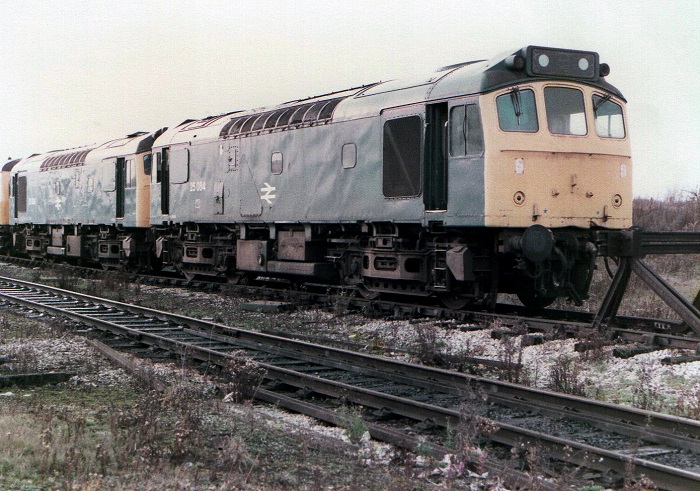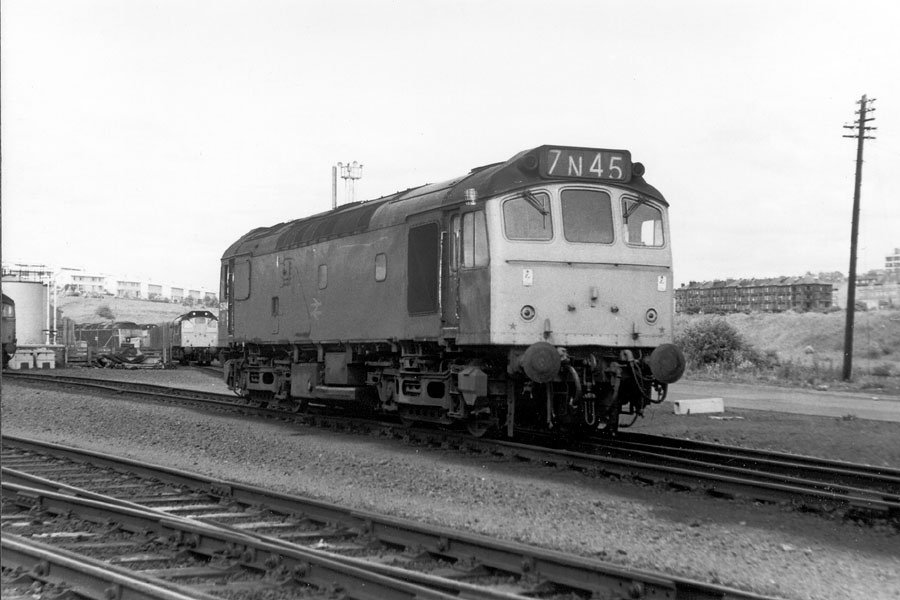
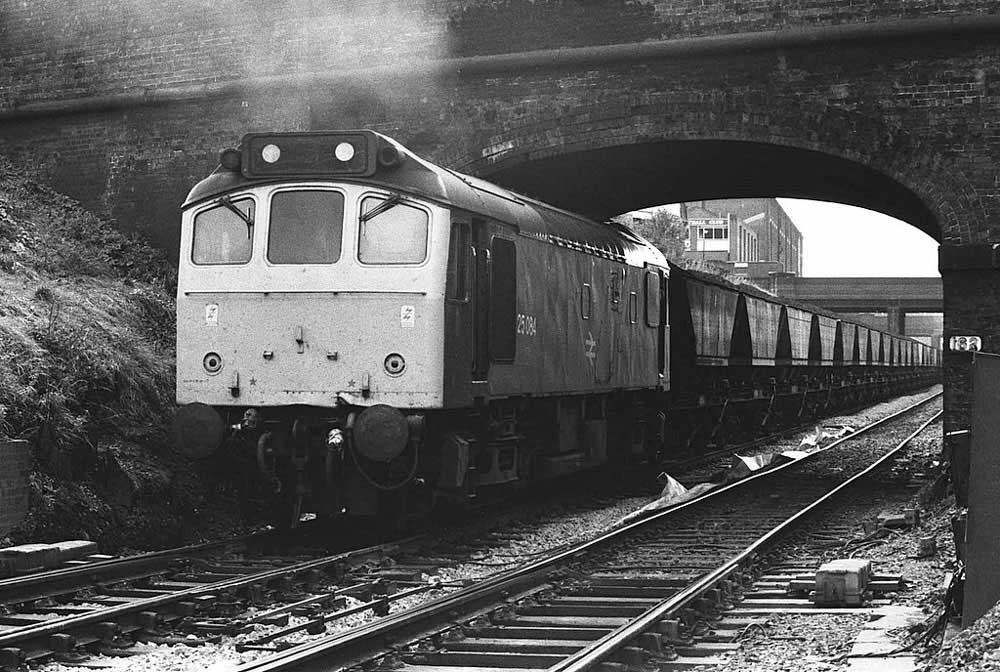
D5233-D5237, 5233-5237, 25083-25087

An ex-works factory portrait of D5233, just prior to entering traffic.

1963
D5233 - D5237 were constructed at Derby during the last quarter of 1963, all being released to traffic during December to Toton (16A). This batch of locomotives were the first to be delivered featuring the re-styled body work and two tone green livery similar to that carried by the Brush Type 4's (class 47's). The redesign principally affected two areas; the cab and the location of the air intakes. The gangway doors fitted to the earlier examples were rarely used, their presence certainly added to the complaints of noise and draughts in the cabs. The removal of the air filters to the cantrail was the result of a comparison carried out at Inverness between a batch of Derby built Type 2's and a batch of BRCW Type 2's, the tests targetting the air quality within the engine room.

The tests revealed the location of the grilles on the Derby designed build allowed for much more debris to reach the filters (especially the lower ones), clogging them quicker, leading to decreased air quality within the engine compartment, and so potentially affecting performance and engine wear. With over two hundred Class 25's still on the order books the redesign of these areas would result in a cost savings in the long run, in addition to a better working environment within the cabs, and providing less cluttered look to the locomotive's exterior.

One unique feature of these five machines was their being equipped with steam heating equipment, all the following Class 25's would be without boilers.

D5233 was sent out on its test run to Corby on December 6th 1963, D5234 & D5235 had already made their test run two days earlier. D5236 & D5238 went to Corby on December 10th, whilst D5237 went with D5239 on December 12th. Another test train went to Corby on this date in charge of D1697, some of the Loughborough built Class 47's were being accepted by Derby, whilst on December 16th Claytons D8565 & D8566 made the run.

1964
All of the group were reallocated during 1964, initially to other depots within the Nottingham Division (Derby 16C & Nottingham 16D). Three (5233, 5234 & 5236) were then sent on to Saltley (2E) during April. At this time much of the freight on the Derby - Birmingham line was still steam hauled, these transfers would allow for further driver training on the new diesels over this route and also the Birmingham - Leicester line. Whilst at Saltley these Type 2's were well travelled, on May 2nd D5236 was being used by Carlisle to handle an afternoon local round trip to Langholm & on May 16th D5234 hauled the 08.06 Newcastle - Birmingham.

1965
The only transfer for this group was during April when D5237 was reallocated to the Midland Lines (ML).

The 09.03 Leeds - Llandudno featured D5181 on June 19th & D5235 on June 26th.

1966
During April D5233, D5234 & D5236 returned from Saltley, now being allocated to the Midland Lines (ML).

1967
On March 24th the 20.05 Luton - Bathgate car carrier, normally a Type 4 diagram found D7508 & D5233 working the trip throughout, returning south the next day on the 06.40 Millerhill - Carlisle freight.

During the summer months Derby Works received D5234, D5236-5237 for a variety of repairs.

1968
It was back to the Midland Lines (ML) for D5233 during May.

1969
5234 - 5236 were transferred to the Nottingham Division during May.

5237 was noted at Derby Works for a general repair during June.

The 07.35 Nottingham - Llandudno and 13.52 return featured pairs of Type 2’s, noted during June were 5298 & 5299 (7th), 7537 & 7533 (14th), 5236 & 5246 (21st).

1970
5237 was noted at Kings Cross on February 16th having arrived assisting 1578 on a service from Grimsby, where the Class 25 provided assistance from is not recorded.

May 25th found a Derby - Blackpool excursion in the hands of 5235 & 7651.

1971
Crewe commenced receiving Class 25's for heavy repairs during January, with 5234 and 7669 being new arrivals. Class 25's overhauled at Crewe were usually easily recognised by the position of the number, similar to that of Glasgow it was situated behind the cab door on the bodyside, though usually placed higher up than one shopped by Glasgow.

On June 16th 5233 & 5226 made a rare appearance working the 17.57 St Pancras - Nottingham.

5236 & 5237 were both in Derby Works during September.

1972
5231 & 5237 were noted on January 15th passing through Northampton with an unidentified special. On April 30th 5237 & 7596 were noted on a special from the LMR to Newcastle.

5237 moved to the Manchester Division (D09) during June.

5236 & 5250 worked south from Birmingham on July 22nd with the 08.35 Birmingham - Portsmouth Harbour, presumably as far as Reading.

On September 1st 5236 handled a York – Manchester passenger service.

December 18th found 5234 on front line duty hauling the 1N31 Poole - Newcastle, noted 25 minutes late at Darlington.

1973
On January 13th 5186 & 5237 and 5641 & 5234 were noted working Leicester - Finsbury Park (for Highbury) F A cup tie specials.

5235 & 5535 were noted on the 08.00 Walsall - Yarmouth (as far as Norwich) on June 2nd.

Towards the end of the summer season four of the locomotives were transfered to the Scottish Region - 5235/5236 in August to Eastfield and 5233/5234 to Haymarket in September. All of these moves turned out to be short stays, 5233-5235 moved to Tinsley in October and 5236 to Kingmoor in November.

A step back in time occurred early in October when a motive power shortage in Scotland saw a number of the Edinburgh - Aberdeen services reverting to pairs of Type 2’s. So noted on October 8th was 5116 & 5236 on the 10.30 to Aberdeen.

1974
The only transfer in 1974 was that of 5236 to Longsight in March. Although these Type 2's were oddities in terms of their bodystyling & being boiler equipped, this technical difference did not affect the issuing of TOPS numbers for them, they were numbered in order with the remainder of the Class.

On November 5th the 06.43 Peterborough – Kings Cross arrived behind 31108 & 25085.

1975
During 1975 all were reallocated; Bescot received 25083 in March whilst Cardiff took 25084 & 25085.

On March 29th a Bletchley - Lowestoft excursion arrived at Norwich behind 25065 & 25083.

25084 & 25085 were in Derby Works for repair between April & June.

The new summer season began on Saturday May 24th with the Walsall - Yarmouth in the hands of 25083 & 25102. Three days later this pair were noted arriving at Skegness with a service from ? Two weeks later 25083 & 25253 visited Yarmouth twice over the weekend of June 7/8th arriving on Saturday with the regular service from Walsall, the next day bringing in a special from Burton on Trent.

During the summer 25083 - 25087 were all transfered to Eastfield, 25083/86/87 in July & 25084/85 in August.

On December 6th Type 2’s were in charge of a number of football & rugby specials in the Edinburgh area including 25087 & 25235

25084 at Eastfield, date unknown. It did not visit Glasgow Works until December 1979 and was only transferred to Eastfield in the summer of 1975, so with a still working headcode indicator this must be shortly after its arrive on the Scottish Region.
Photograph courtesy E A Woods

1976
On March 23rd 27015 & 25083 worked the 06.55 Mallaig - Glasgow.

April 5th found 25085 working the 09.10 Edinburgh - Inverness via Ladybank & Hilton Jct. On April 14th 25083 & 24113 were hauling the Carstairs - Perth newspaper train, at Dunblane they were required to assist a failed 47550 on the 20.50 Euston - Inverness, how far the Type 2's worked is not recorded.

During June 25083 was allocated to the Highland capital of Inverness, this apparently didn't stop its wanderings as it was noted at Stranraer on June 26th..

An unusual duty for 25062 on July 9th was to inspect the line between Inverness and Carr Bridge for effects from a major forest fire in the Daviot Moor area. Having reached Carr Bridge it was used to pilot 40072 on a northbound passenger service, at Tomatin the pilot rejoined 25086 on a southbound working. Damage to the railway property was minimal, mostly burnt grass and shrubbery.

25238 & 25085 were noted at Oxford on August 5th on the long distance Leith - Yeovil pipe train, presumably the Class 25's came off at Oxford. Two days later 25085 was noted at Leicester.

On a visit south of the border (possibly on one of the pipe trains) 25079 & 25083 were borrowed by Derby on September 18th to work the 11.58 (1Z52) football special to Norwich!

1977
On January 14th 25084 came to the rescue of 86251 working the 1M37 12.35 Edinburgh - Manchester. The Class 86 stalled near mp70, the Class 25 pushing the train into Abington loop, where fitters were able to revive the electric enough for it to continue south.

On April 8th (Good Friday) the 1S51 07.18 York - Aberdeen began its journey behind 40059, being replaced at Edinburgh by 25044 & 25084.

Glasgow Works outshopped 25087 during April - on May 16th it was noted on the 08.01 Oban - Glasgow Queen Street.

The paint fairly glistens as 25087 awaits release back into traffic from Glasgow Works, seen here on April 2nd 1977. BR's blue and yellow at its finest!
Photograph courtesy Ron Halestrap

25087 hauled the 17.10 Edinburgh - West Calder on July 18th.

The 17.20 Edinburgh - Dundee was worked by 25085 on September 12th.

Passengers on November 18th's 9.40 Edinburgh/10.05 Glasgow - Inverness had a variety of power north of Perth. The heavy train started out with 40166 & 25087, at Dalwhinnie 26045 replaced the Class 25, on reaching Carr Bridge 40166 failed leaving the Class 26 to continue on alone, arriving in Inverness almost four hours late!

December 29th found 25084 coming to the rescue of a Class 47 on the 08.45 Aberdeen - Kings Cross after its partial failure at Stonehaven. The Type 2 was removed at Dundee as it was vacuum braked only, limiting speed to 50 mph. The next day it was the turn of 25087 to assist a passenger service when 47454 expired on the 09.30 Glasgow - Euston via Dumfries.

1978
Three of the group were transferred to Haymarket; 25086 & 25087 during February and 25083 in December.

On March 31st 25086 replaced a failed 27009 at Dundee whilst working the 19.35 Glasgow Queen Street - Aberdeen, unfortunately the Class 25 proved to be as equally unreliable by expiring at Arbroath, the train terminated with passengers transferring to an ex-Kings Cross service.

On May 6th 25247 was noted in charge of the 17.10 Edinburgh - Newcastle, a working which seemed capable of being hauled by anything Haymarket could turn out, including dmu’s. This was also the day of the Scottish Cup Final between Glasgow Rangers & Aberdeen at Hampden Park, with five specials scheduled. The 09.30am left behind 25072 & 25087, the 10.00 had 25227 & 25033 whilst the other three featured 40167, 40063 & 40159.

The 8M36 Tyne Yard - Carlisle freight was hauled by 25085 on October 25th.

25083 stands at Millerhill on December 29th 1978.
Photograph courtesy A Forster
25085 stands at Millerhill on October 14th 1978.
Photograph courtesy A Forster

1979
25083 on the approaches to Millerhill on February 6th 1979.
Photograph courtesy A Forster
25083 catches the early morning sun at Haymarket on March 11th 1979.
Photograph courtesy A Forster

Railtour duty befell 25002 & 25083 on June 23rd, handling the Edinburgh - Perth leg of an SRPS excursion to Kyle of Lochalsh.

The 08.15 Inverness - Glasgow Queen Street was worked throughout on July 21st by 25065 & 25086.

25085 was noted in Glasgow Works on August 19th.

25085 was noted on the 15.57 Dundee - Glasgow Queen Street on September 21st.

On October 22, the 2L31 08.44 Glasgow - Dundee service in the hands of an ailing 25083 hauling five coaches had an eventful journey as far as Invergowrie. On boarding the locomotive at Eastfield the crew found the boiler inoperative and no sign of the locomotive's repair book. A new book was obtained and the boiler made operational prior to backing down to Queen Street. An on time departure was followed by two losses of power on the stiff climb to Cowlairs, closing the throttle and then reopening it seemed to cure the problem. All remained OK until Hilton Junction when power was lost again, the train coming to a stand. An earth fault was eventually found to be the cause of the problem, power being regained after resetting and isolating the earth fault switch. At Perth a fitter confirmed the locomotive would be fit for the short run to Dundee.

After the stop at Invergowrie the locomotive had difficulty in moving away from the platform. The crew stopped and examined the locomotive, discovering that the brakes appeared to be binding on the leading bogie. In the hope of making the short distance to Dundee the driver restarted the train, but was forced to stop a few hundred yards later when smoke was seen coming from the bogie. The locomotive was declared a failure and shut down. The driver climbed back into the cab whilst his assistant walked back down the train to inform the guard.

The driver's assistant had reached the fourth coach from 25083 when the following 1A25 09.35 Glasgow - Aberdeen headed by 47208 ran into the rear of the stopped train. The impact threw coaches Sc14044 & Sc4440 into the Tay estuary, derailing the other three coaches behind 25083 (Sc4739, Sc4002, Sc4245). Regretably the crew on 47208 and two passengers in the Dundee train were killed, a third would die later from injuries sustained. The Class 47 and the leading coach sustained heavy damage. 25083 was driven under its own power to Dundee MPD for examination. This revealed that two internal copper conductors on one of the traction motors had burned through, causing loss of power to one bogie and leading to the remaining two motors suffering severe wheelslip and overheating when power was applied whilst trying to restart from Invergowrie. The sequences of events that led to the failure of the copper conductors and the earlier earth fault problems could not be determined.

The Department of Transport report on this collision states: "the direct cause of the accident was the passing of the Longforgan Down Section signal at danger by the 09.35 Glasgow - Aberdeen express. The evidence suggests that at the material time the semaphore arm of this upper quadrant signal was raised above the horizontal by at least six degrees but by not more than ten degrees: in such a position it should have been taken to be an imperfectly exhibited signal and thus treated as at Danger, but for some reason the train driver passed the signal and continued into the occupied section".

October 22, 1979 and the picturesque line along the Tay west of Dundee is the scene of a serious tragedy after a rear end collision, prompted by the failure of 25083 on a local service. With the crew in the following Aberdeen service killed in the collision the official inquiry lacked two of the most important witnesses to confirm the sequence of events. Here 25083 awaits completion of the investigation prior to being removed. Photo courtesy Spanphoto.
Two weeks after the above view 25083 has reached the erecting shop at Glasgow Works for an intermediate and collision repairs, November 11th 1979.
Photograph courtesy A Forster.
By December 1st 25083 is off its bogies and is begining to receive attention to its cab bodywork as well as many other unseen parts.
Photograph courtesy A Forster.

On November 30th 25087 worked the 17.07 Edinburgh - Newcastle.

The winter of 1979/1980 found Glasgow Works giving intermediate repairs to 25083 - 25086. This included 25083 after its involvement in the rear-end collision detailed above - it was received for an intermediate & collision repairs, not being released until January 1980.

1980
January appeared to be a rough month for 25087, it was recorded at Haymarket for various repairs - battery repair (9th), traction motor repair (11th), it was noted across town at Millerhill on 13th & 14th - the latter for battery recharging, then being noted on Haymarket for generator flashover repair (21st). By 26th it was observed at Inverness.

With its paint glistening and only days out of Glasgow Works 25083 stands in the snow at Eastfield depot on February 2nd 1980.
Photograph courtesy A Forster.
A closeup cabside view of 25085 reveals a plethora of numbers, data panels and worksplate, seen at Millerhill January 2nd 1980.
Photograph courtesy A Forster.
25087 at Millerhill on May 22nd 1980.
Photograph courtesy A Forster.

The 17.24 Edinburgh – Dundee from February 11th used hauled stock, so noted were 25086 (15th) and 25240 (19th).

25085 was in charge of the 1A53 17.12 Glasgow - Ayr on April 25th.

On July 10th 25010 & 25085 worked the Perth - Kensington motorail as far as Mossend. The next day 25085 came to the rescue of an ailing 47210 working the 17.40 Edinburgh – Inverness. The Class 25 was sent from Perth to push the failure from Stanley Junction to Murthly, here detaching the failure before heading out alone to Dalwhinnie where 47040 was added to the train for the run to Inverness.

July 7th 1980 finds 25083 working a short freight at Mossend. Obvious signs of a visit to Glasgow Works are the numbers positioned behind the cab doors on the main body work, and of course the larger size numbers, at this time only applied by Glasgow.

Transfers in 1980 took these locomotives away from the Scottish Region, most had spent at least four years north of the border - 25084 went to Kingmoor in October, whilst Springs Branch received 25085 in October and 25083 & 25086 in December.

On September 22nd 25087 was placed to store due to wear & tear, the following week (29th) it was withdrawn at Millerhill, the first of this group to be taken out of service.

A Shrewsbury - Edinburgh excursion on November 1st was worked in both directions by 25050 & 25086 on the non-electrified Carstairs - Edinburgh leg.

25083 at Cockshute, October 10th, 1981.
Photograph courtesy Paul Bettany.

1981
25085 was transferred to Toton during January.

February 4th's 16.38 Birmingham - Norwich was hauled by 25083. Engineering work at the south end of the WCML led to diesel substitutions, on March 1st 25085 covered one brief working between Stonebridge Park and Euston whilst the 20.45 Barrow - Euston was worked forward from Bletchley by 25084 on 3rd and 25085 on 8th.

Between February 9th & 11th 25087 was towed from Millerhill to Swindon Works with 25010, 25011 & 25023. Part of the journey was undertaken using 25010 to haul the consist. 25087 was broken up by the end of March.

The 10.00 & 19.28 Crewe - Cardiff were worked by 25086 on February 17th.

Dead engine moves featured a number of Class 25’s - on April 1st. 25195 hauled 40110/116 from Springs Branch to Gloucester, picking up 40032 in the Manchester area. 25086 brought 25172, 40017/137/161 from Carlisle to the Birmingham area, both trains eventually destined for Swindon Works.

The 'Easter Tommy' railtour on April 21st was hauled from Liverpool to Guide Bridge by 25057 & 25083.

April 25th found 81017 on fire at Canley Halt working a 07.56 Coventry – York special. 25084 arrived from Coventry to propel the train to Birmingham International where 86237 took over.

Some lucky 'BedPan' commuters had the delights of 25058 & 25085 on the 07.40 Bedford - St Pancras service on May 5th. Between May 16th & May 27th 25083 & 25062 covered over one thousand miles of passenger haulage operating a number of services out of the East Midlands (Derby, Burton & Alfreton) to Norwich (for Yarmouth) and Skegness. And on the last weekend of May (30th/31st) 25086 & 25075 worked a roundtrip each day over the Cambrian route to Aberystwyth, interestingly on the 'English' side the start/end was different each time, the 30th's day started at Shrewsbury, coming back to Wolverhampton, the 31st started at Birmingham and came back to Nuneaton.

25085 was transferred from Toton to Kingmoor in May.

The 16.02 Crewe - Cardiff was worked by 25085 on June 26th, the next day it worked the 17.10 to Crewe.

With Springs Branch now the home to 25083 this view at Warrington Arpley on July 26 1981 would be nothing out of the ordinairy.
Photograph courtesy Tony Sayer
25085 at Perth on August 22nd 1981 with a short train. This may be the 10.14 Perth - Motherwell, which later failed at Gleneagles and required the assistance of 20121.
Photograph courtesy Gary Thornton

Parcels workings continued to bring Class 25's to the Bristol area, the 15.04 from Manchester had 25157 on July 14th, whilst the 12.10 Penzance – Glasgow left behind 25062 on August 10th and 25085 the following day. On August 22nd 25085 was diagrammed for the 10.14 Perth - Motherwell, it only got as far as Gleneagles before requiring the assistance of 20121.

A short trip for 25085 was working the 14.05 Blackpool - Crewe as far as Preston on September 5th.

The failure of 45009 at Derby on October 15th whilst working a Newcastle - Bristol service led to 25085 taking over as far as Birmingham - this may have been 25085's last passenger working.

For the six days commencing October 19th 25083 worked at least the 12.40 Glasgow Central - Carlisle each day.

In the third week of December 25083 had two small unusual workings, on 16th taking over a St Pancras - Derby working at Leicester and the next day rescuing 55021 at Wakefield Westgate whilst working a Bradford - Kings Cross service, assisting as far as Doncaster.

New Year's Eve saw the end of regular Deltic working on the ECML. The 1L44 16.03 Kings Cross - York was in charge of an ailing 55017, when the train arrived at Peterborough many of its passengers looked longingly over at the 15.18 Norwich - Birmingham, its westerly journey in the capable hands of 25083. For a short while across platforms 4/5 at Peterborough the echoes of Napier's finest kept time with Sulzer's finest musical box.

1982
During January 25083's passenger workings had a distinct Western Region flavour to them. On 3rd it was noted with 45065 arriving at Bristol Temple Meads with a relief from the north, on 5th it worked the 15.00 Bristol Temple Meads - Western Super Mare, on 8th it covered the 08.00 Kidderminster - Birmingham New Street, by the 10th it had travelled far enough north to work the 19.14 Leeds - Birmingham throughout. Finally on January 24th 25083 worked the 17.38 Bristol - Taunton.

The 18.15 Birmingham - Norwich on February 17th was diagrammed for 25084, by Washwood Heath the Class 25 was losing power, 31216 was added here for the run to Leicester. The last day of February produced some considerable mileage for 25086 when it worked a Derby - Newcastle football special out & back.

25085 was retired during March, possibly whilst at Derby Works with an engine defect.

Cleethorpes was host to two unusual machines on April 8th. Firstly 50030 filled in for a failure on the 06.20 service to Kings Cross whilst the 08.26 to Doncaster was hauled by 25086, normally a Class 40 working.

On the North Wales mainline April 24th found Type 2’s in abundance on Manchester – Bangor passenger workings. 25093 worked the 7.42 Manchester – Bangor and 11.03 return, the 9.42 (and 13.38 return); the 17.42 Manchester – Bangor utilised 25067, whilst 25120 powered the 15.42 Manchester – Bangor, on the 19.25 return working 25086 took over at Llandudno Jct. The same day (24th) a St Pancras – Bewdley special worked forward from Birmingham behind 25050 & 25199, whilst 25058 & 25084 took over a Norwich – Weston Super Mare excursion also from New Street. By May 2nd 25084, now attached to 25221 worked out and back from Wolverhampton to Aberystwyth, with a charter that had originated at Euston.
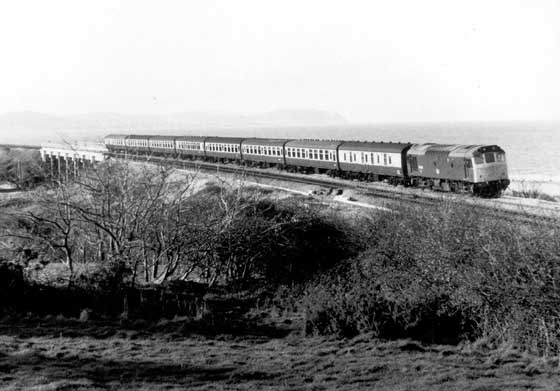
25086 moved to Kingmoor in May.

Some varied passenger mileage was racked up by 25086 during June. It worked a Leeds - Carlisle service on 10th, a late afternoon Manchester - Blackpool service beyond Preston, coming back with a Manchester Victoria service throughout (15th). On 26th it was joined by 25213 to work a round trip Shrewsbury - Aberystwyth, the return trip being worked to Wolverhampton.

25084 took over the 02.10 Manchester Piccadilly - Cleethorpes at Sheffield on June 17th, returning with the 08.26 to Doncaster. Four days later it traversed the Settle - Carlisle route with the 16.05 Leeds - Carlisle. It was then recorded north of the border during the latter part of July working Glasgow - Carlisle services on 19th & 23rd.

The summer brought several trips over the Cambrian lines for 25083, firstly on June 12th with 25027 on the 07.40 Euston - Aberystwyth forward from Wolverhampton, coming back with the 14.00 to Shrewsbury. Before the next Cambrian trip 25083 worked June 19th's 16.17 Birmingham - Norwich as far as Peterborough. Back to the Cambrian with 25184 on August 21st's 07.38 Shrewsbury - Aberystwyth and 10.07 return to Euston as far as Wolverhampton. Lastly on September 5th a charter from Euston to Aberystwyth was taken forward from Nuneaton by 25083 & 25182, they also handled the return working. Six days later 25083 was north of the border on the 08.40 Carlisle - Glasgow passenger.

25086 came to the rescue at Nuneaton of an ailing Norwich - Birmingham service on August 6th. A similiar event occurred on 16th, but in the other direction assisting 31108 between Nuneaton and Leicester, where 25326 was waiting to take over.

25084 was also working the GSW route in September handling a round trip each day on 9th, 15th & 17th. By October 1st it had migrated to the 16.05 Leeds - Carlisle. The next day 25086 was in charge of the 10.20 Manchester Victoria – Newcastle service.

Surrounded by the wreckage of its sisters 25085 stands in the scrapping area at Derby Works on September 4th 1982. The locomotive would linger here until May 1983 and would become the last complete locomotive to be scrapped at Derby by BREL staff.
Photograph courtesy Paul Bettany

The last transfer for 25083 took place in October with a move to Crewe. Shortly afterwards on October 16th it worked a roundtrip Bewdley - York charter with 25219. A newspaper printing strike in the London area during November led to 25083 having a bit of an adventure on November 27th. The strike had not affected the Manchester area printers allowing them to print additonal papers for distribution throughout the country. 25083 was summonsed to cover a Manchester - Bournemouth newspaper extra - surprisingly the Class 25 ended up working throughout to Bournemouth, presumably routed via Reading & Basingstoke. At Bournemouth 25083 went off to Branksome to refuel (see picture below) in order that it might return to Manchester with the empty vans.

Photograph courtesy Phil the Yid c/o Mark Jamieson
An early morning shot of 25083 on November 27th 1982 at Branksome - see notes above.

25086 transferred to Bescot in November.

It was a round trip over the Settle & Carlisle for 25083 on November 22nd working the 08.57 Leeds - Carlisle and 15.37 return. The next day 25084 handled these turns. Four days later it was time for a thrash along the North Wales coast with 25084 working the 07.45 Manchester Victoria - Bangor.

1983
The Annesley Annabis railtour on April 2nd utilised 25048 & 25084 between Bescot and Annesley colliery.
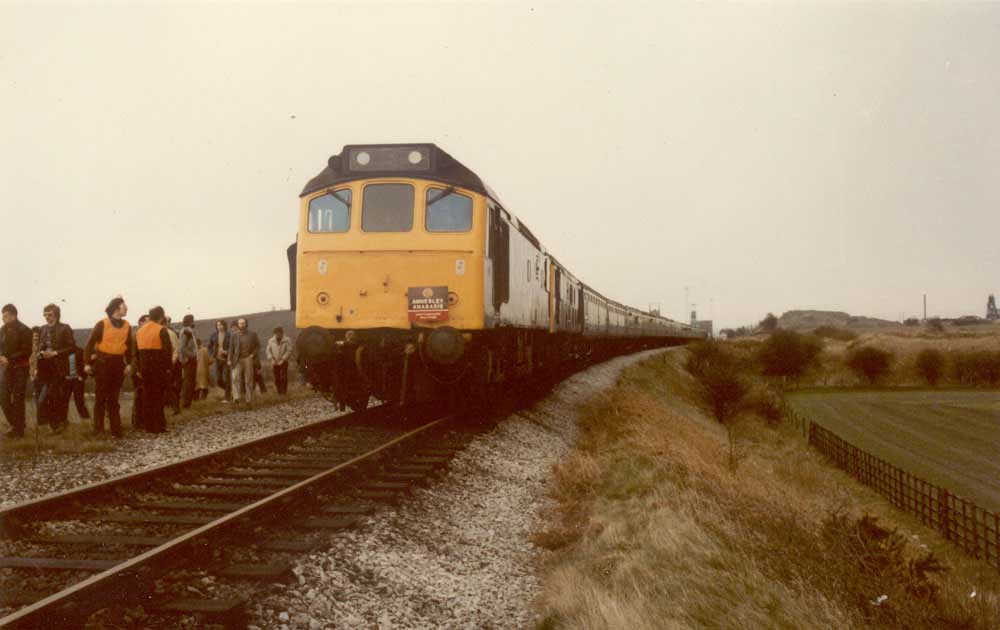
Somewhere in deepest, darkest Nottinghamshire, well Bulwell actually, 25084 & 25048 with the above mentioned railtour pause for the obligatory photographic stop, April 2nd 1983.
Photographer unknown

The first day of February saw 25086 assising 31413 on a Birmingham - Norwich service between Croft Sidings & March.

25086 was transferred to Crewe in March.

The first quarter's passenger workings for 25083 were a mixed bag. A failed Class 31 on a Birmingham - Norwich service on February 5th saw 25083 assist between Leicester & Peterborough. St Patrick's Day found 25083 working the 05.35 Cardiff - Crewe. April 2nd found 25083 & 25057 in charge of a Manchester Piccadilly - Aberystwyth day excursion. The 12th found 25083 working the 19.14 Blackpool - Manchester Victoria throughout. A Euston - Bewdley charter on April 23rd utilised 25027 & 25083 from Coventry to Bewdley and then back to Birmingham New Street.

April was the last month for the scrapping of locos at Derby Works by BREL staff, 25085 was the last complete locomotive to be cut, a start was made on 25261 but a dispute halted cutting on this locomotive.

On May 2nd 25083 & 25086 were in charge of a Manchester Piccadilly - Aberystwyth day excursion. Three days later 25086 worked the 17.35 Leeds - Sheffield, four days later (9th) 25084 handled the 16.02 Leeds - Carlisle. 25086 (with 25220) was off again on May 14th bringing back a Euston - Amwlch charter between Rock Ferry & Wolverhampton.

Its May 2nd 1983 and 25083 & 25086 have arrived at Aberystwyth with a day excursion from Manchester.
Photograph courtesy J Davenport

During July yet another trip to Aberystwyth, this time from Derby featured 25083 & 25199. The Cambrian lines west of Shrewsbury were familiar territory to 25083, being a regular performer on the scheduled summer diesel hauled passenger workings, so noted on August 6th & 13th. It was on one such working, the 17.15 Aberystwyth - Shrewsbury on August 6th, with 25032 when the multiple unit working capability failed, requiring both locomotives to be manned. Valiant efforts to get the m.u. to work proved ineffective.

25084 had been active in Scotland during July, being noted on passenger workings between Carlisle & Glasgow on 15th, 18th, 19th & 22nd, completing almost seven hundred miles of passenger mileage.

On August 16th 25086 was noted on the ECML at Newark hauling 46011 northwards, later returning south with 47295 & 47430. On the last day of August the 23.59 Sheffield - St Pancras was worked to Derby by 25086.

September 18th found Severn Tunnel Jct depot using two Class 25’s on local workings, 25199 on the morning local to Hereford and 25084 to Gloucester. Two days later 25084 was busy between Blackpool & Manchester Victoria working three services. These may have been the last passenger services hauled by 25084.

25086 worked the 17.15 Manchester - Blackpool and 19.14 return on October 3rd.

The last passenger working in 1983 for 25083 was October 10th's return working of a Blackpool - Birmingham excursion, between Preston & Blackpool.

25086 was withdrawn during October endings its days stored at Newton Heath.

25084 was withdrawn during December.

25083 heads north through Bescot during August 1983.
Photograph courtesy John Payne

1984
25083 would be withdrawn during 1984, however before that event it covered a wide variety of lines on its final passenger workings, both scheduled services and charter work. On January 17th 25083 worked the 07.16 Manchester Victoria - York, normally the province of a Type 4.

Photograph courtesy Nick Ross
Its April 14th 1984 and 25042 & 25083 rest on the stops at Marylebone after bringing in F&W's Capital City Transfer (see note below).

April was a very busy time for 25083's passenger haulage. It started off by filling in for the diagrammed Class 31 on April 5th, 25083 worked the 16.35 Leeds - Sheffield. A week later on April 11th 25083 covered the 10.03 Crewe - Cardiff throughout. A railtour from the West Country on April 14th (F&W's 'Capital City Transfer') was taken over by 25083 & 25042 at Coventry, running south through Rugby, Bletchley flyover, Claydon LNE Jct, Aylesbury, Amersham and into Marylebone. On April 21st a Manchester Piccadilly - Aberystwyth was taken over by 25083 & 25245 at Wolverhampton for the run to the coast and back. The next day the same pair were used on a Coventry - Scarborough excursion as far as Birmingham New Street, replaced here by 56053. However all was not lost as the pair were quickly used to take over a Leamington - Blackpool North excursion, it being a Sunday engineering works dictated the use of diesels rather than electrics on the WCML. They worked the return journey throughout giving the passengers some spirited running on the WCML. And finally on April 23rd 25083 & 25245 handled an excursion between Shrewsbury (ex Derby) and Llanelli, via the Central Wales line, 47140 took over for the final miles into Tenby. After refuelling at Landore the Class 25's rejoined the train at Llanelli returning home via Cardiff and Birmingham, 37297 assisting up Lickey since the Type 2's were not pulling too well. Over this three day weekend this pair of Type 2's clocked up almost 800 miles of passenger haulage!

On a dull overcast day in February 1984, with a hint of snow on the ground, 25083 rests at Longsight. By the summer 25083's working life with BR would be over, stored in relative obscurity at Crewe Electric Depot 25083 would outlive all its non-preserved sisters by at least a decade.
Photographer courtesy Phillip Moore
On April 21st 1984 25083 & 25245 took forward a Manchester - Aberystwyth day excursion from Wolverhampton. They are seen here running round the train at its destination.
Photograph courtesy Ian Mawson
25086 stands withdrawn at Newton Heath on August 12th 1984.
Photograph courtesy Phillip Moore

July 9th saw the withdrawal of 25083 with a main generator fault, a day that also saw York Minster severely damaged by fire after being hit by lightning, one presumes these two incidents were unrelated. During August 25083 was noted dumped at Crewe Electric depot, a location that would prove to be important for the continued existance of this machine. It would outlive all its non - preserved sisters, finally reaching preservation with the Caledonian Railway group at Brechin, late in 2000 having spent over sixteen years withdrawn!

1985
On February 19th 25084/86, 25270 were moved from Newton Heath to Swindon Works for scrapping.

1986
During June 25086 was broken up at Swindon Works, 25084 suffered the same fate here in July.

Undated Views

25086 on a short freight at Aylesbury, date unknown.
Photograph courtesy Mark Cook.

25083 into preservation
May 2001

Having spent sixteen years withdrawn, most of that time at Crewe Electric Depot, and having somehow avoided the final trip to the scrapman, it was probably to be expected that 25083 would eventually reach preservation. Late in 2000 25083 did reach preservation, with the Caledonian Railway Group at Brechin. In this May 2001 view 25083 stands at Brechin, revealing a little of the work it will need to bring it back to working order.
Photograph courtesy Phillip Moore.

September 2002
The three views below, all from the camera of Mike Cooper reveal the fine progress made on 25083 since 2000.

Fifteen months have gone by since the view of 25083 standing at Brechin in May 2000. Great progress has been made on reversing the ravages of many years of open air storage and vandalism.
Photographer courtesy Mike Cooper

Many thanks to Mark Bennett for his notes on the later activities of 25083 & to Alan Baylis' "Class 25's Action '84" book.

Page added September 20th 2001
Page updated December 22nd 2007

Return to Picture menu
Return to Home Page