
The twenty one year eight month career of D7629/25279 included allocations to Eastern Region & London Midland Region depots with almost twenty years spent continuously allocated to a great variety of LMR depots.
Built: Beyer Peacock Gorton Ltd, Works No.8039.
Dual brake equipped (1969).
Final exhaust roof panel: raised, square.
Time between last Classified repair and withdrawal: 90 months.
Preserved.
Allocations
D7629 was new to Tinsley on September 7th 1965. Further transfers were:
April 1966 to Wath (41C).
August 1967 to London Midland (Midland) Lines.
September 1967 to Birmingham Division (D02).
September 1967 to London Midland (Midland) Lines.
June 1968 to Longsight (9A).
June 1968 to Manchester Division (D09).
November 1968 to Preston Division (D10).
January 1969 to Birmingham Division (D02).
January 1971 to London Division (D01).
October 1972 to Birmingham Division (D02).
February 1973 to Liverpool Division (D08).
May 1973 to Springs Branch.
May 1976 to Cricklewood.
November 1978 to Toton.
May 1981 to Springs Branch.
October 1982 to Crewe.
March 13th 1987 to unserviceable store.
Withdrawn March 18th 1987.
Renumbered January 30th 1974.
After withdrawal 25279 was stored at Crewe depot and Basford Hall before moving to Leicester Humberstone Road on July 10th 1987 and into Vic Berry's yard on July 28th 1987. On March 19th 1988 it was moved by road to the Llangollen Railway and into preservation.
Works Visits
Works visits (records incomplete).
Noted Derby Works June, August 1969 (General repair & dual brakes fitted).
Noted Derby Works November 1973 - January 1974 (collision repairs, green to blue livery).
Noted Derby Works August - September 1979 (general repair).
Highlights
1965
D7629 arrived at its first depot, Tinsley (41A) during September, one of a batch of thirty five machines built by Beyer Peacock (Works # 8039) with many destined for the Eastern Region, for use on inter-regional freights in the Yorkshire area, diagrammed on those turns where the LMR drivers did not require traction knowledge of Class 31s.
On September 18th D7629 worked the 06.30 Brent - Feltham and the return working, later that evening it worked the West End sidings - Leeds fitted freight.
1966
On February 20th stabled at Tinsley were 73 diesels including D5207, D7598, D7599, D7624 - D7626, D7628 - D7630, D7632, D7641 & D7643.
On the afternoon of May 28th noted passing Chesterfield mid-afternoon were:
D7629 & D7641 with an up freight
D7606 with an upfreight
48466 with an up freight.
On the morning of July 6th D7629 & D7641 were southbound at Doncaster with a freight.
On August 13th D7629 worked the 1M65 09.28 Sheffield - Llandudno Town and the return 1E21 14.28 Llandudno Town - Sheffield.
1967
On July 15th D7629 worked the 1M65 09.35 Sheffield - Llandudno Town and the return 1E21 14.28 Llandudno Town - Sheffield.
On August 5th D7629 worked the 1M65 09.35 Sheffield - Llandudno Town and the return 1E21 14.28 Llandudno Town - Sheffield.
1969
On the afternoon of January 18th 5209, 5282, 7594 & 7629 were noted at Preston.
As quickly as 7629 headed north, it soon returned south, in January to the Birmingham Division (D02), though it was called to Derby to receive a general repair between June and August. At this repair the locomotive received dual brakes. On August 1st 7629 was noted at the Derby Works Test House, two-tone green livery, small yellow ends 'D' prefixes, most likely it was outshopped without a full repaint?
On August 9th 7629 worked the 09.40 Scarborough - Manchester Victoria (throughout?).
On December 19th a new Rootes container service between Linwood & Gosford Green commenced. Diesel haulage took place between Nuneaton & Gosford Green with 7619, the Class 25 also handling any shunting needed at Gosford Green.
1970
On the morning of January 26th 7626 & 7629 were noted at Nuneaton.
1971
A move further south took place in January to the London Division (D01). In the first week of December a brief visit was made to Derby Works to replace the fuel tank drain cocks.
On the morning of October 15th 7629 was at Willesden with a freight.
1972
On the evening of December 13th 7629 & 7563 were noted light engines at York.
1973
On January 2nd the 17.40 Euston - Shrewsbury with 1683 failed at Shifnal, 7629 pushed the train to Shrewsbury.
In the last week of March several days were spent at Derby Works for attention to the bogies.
On July 24th 7633 was noted at Birkenhead Mollington Street, two-tone green livery, full yellow ends, with'D' prefixes.
On August 4th the 12.08 Birmingham New Street - Glasgow Central was worked forward from Preston?(or Carlisle) to Glasgow Central by 7629 & 7669.
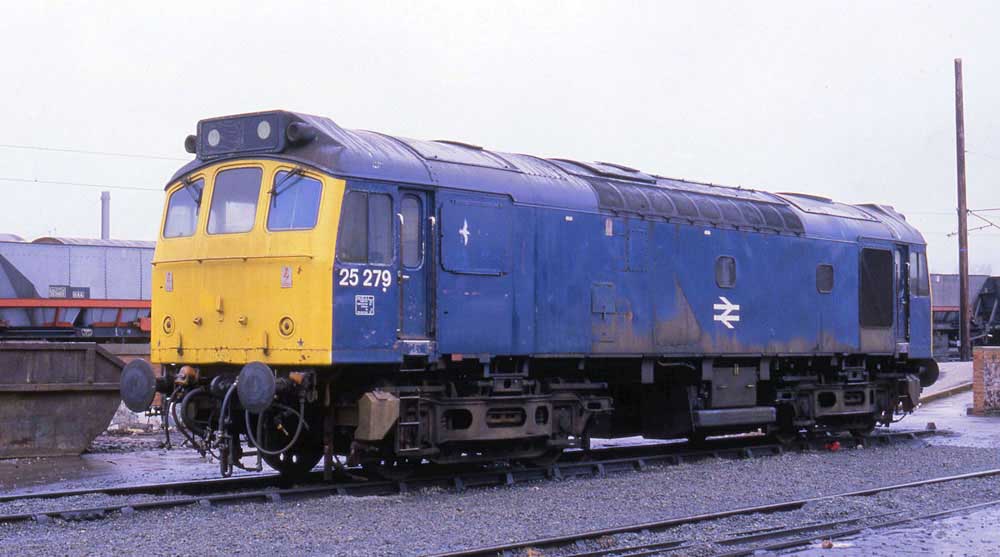
Late in November 25279 returned to Derby Works, for the repair of collision damage, not being released until late in January 1974. At the time of this repair the locomotive was still carrying 'D' prefixes.
1974
On June 6th 25279 worked the 4J30 10.26 Heysham - Manchester Victoria parcels.
1975
On the morning of May 30th 25303 & 25279 were noted at Leeds with stone empties (6M39).
On September 3rd 25296 & 25279 worked the 4F53 Stewartby - Garston brickliner.
On September 18th 25283 & 25279 worked the 6E40 Ryleston - Hull Tilcon.
1976
On March 4th 25279 was noted at Baguley station.
On August 19th the 13.30 St. Pancras - Leicester failed at Bedford with 45123, 25279 dragged everything to Leicester.
On September 4th 25279 & 25131 worked the 1E86 08.52 Leicester - Skegness and the return 1M02 12.35 Skegness - Leicester.
1977
On the afternoon of October 20th 25279 was stabled at York.
1978
A brief visit was made after the New Year to Derby Works for a bogie exchange, recieving the bogies previously under 25143.
On Wednesday May 3rd 25279 worked the 09.55 Willesden to Norwood and the return 12.10 Norwood to Willesden. On Wednesday May 17th 25279 worked (presumed) the 09.55 Willesden - Norwood and the return 12.10 Norwood to Willesden.
On Friday July 7th 25279 worked the 09.55 Willesden to Norwood and returned with the 12.10 Norwood to Willesden.
On July 28th 25251 & 25279 were northbound at Wellingborough with what appears to be the Stewartby - Garston brick train.
On Tuesday November 21st 25279 worked the 04.45 Norwood to Willesden. On Wednesday November 22nd 25279 worked the 09.55 Willesden to Norwood, returning with the 12.00 Norwood to Willesden.
The 18.10 Glasgow - Liverpool was worked forward from Preston by 25279 on December 3rd.
1979
On the morning of March 9th 25279 was noted shunting north of York station.
On the morning of March 21st noted at Derby were 25195, 25243, 25279 & 25289.
On March 24th 25279 was light engine at Derby.
On the afternoon of June 5th 25279 was stabled in Sheffield station.
On June 6th 25279 worked the Derby - Willesden empty coaching stock train.
On June 10th 25279 was stabled at Saltley.
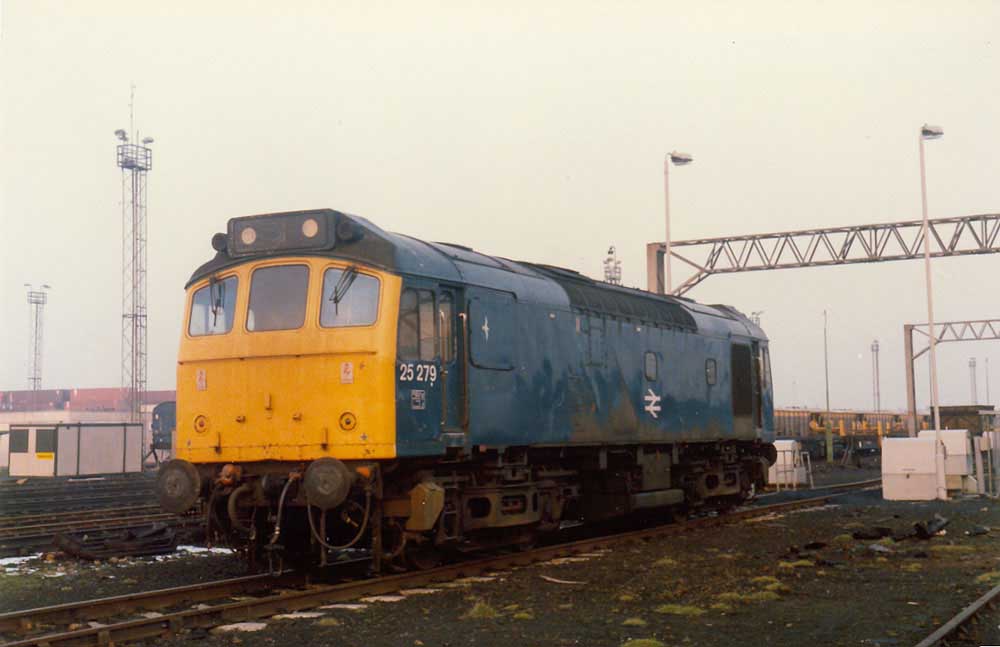
During the late summer 25279 received its last general repair, at Derby from July to September (see photograph at top of page). Return visits quickly followed for rectification work: attention to the milometer, CCB and drivers safety device (late September), governor (mid October) and CCB tripping and a traction motor changed (late October).
On September 8th 25279 made a test run from Derby Works.
The snag sheet for September 8th recorded:
| 25279; September 8th 1979; 1F01 | |||||
| Load | Speed | Amps | Volts | Notes | Other |
| 1 | 31 | 850 | - | - | - | 2 | 48 | 850 | - | - | - | 3 | - | - | - | - | - | 4 | - | - | - | - | - | 5 | - | - | - | - | - | 6 | - | - | - | - | - |
Oil leak B side crankcase generator end
No.1 rocker cover seal
Knecht fuel filter flexibles leak
Radiators unbalanced B side low
Straight air brake pressure to reset?
No.1 driver's side door keeps opening and seal
No.1 bulkhead door seal
Mileage recorder in cab not working
No.1 wheelslip light faulty, lamp holder
Fault on top ?? resistance block temporary repair. To renew
Load regulator securing bolt missing
Spare fuses required
LHR bottom crankcase door to make fit
Brake cubicle pipes to clip
Oil leak governor base.
On December 20th 25279 was stabled at Oxford.
1980
On a wintry January 19th 25279 was noted at Banbury.
25279 was one of a multitude of Class 25s in the area of Bushey & Oxhey station from February 17th onwards following the dramatic derailment there of the 16th's 20.25 Euston - Manchester. The locomotive 87007 was the only part of the train to remain on the tracks, four of the MkIII coaches ended up on their sides, with one (M12162) bringing down the overhead gantries, which blocked the slow lines. Most fortunately there were only minor injuries. Three breakdown cranes attended, from Bescot, Finsbury Park - brought in by 25279 & 25256, and Old Oak Common - arrived behind 25152 & 25189. The slow lines were reopened late on the 17th, the DC lines late on the 19th, the fast lines by the 25th.
25269 & 25279 were noted on the Kennet - Mountsorrell empties on April 16th, presumably having worked the eastbound loaded train earlier in the day.
On the morning of May 28th 25279 worked a Holbeck tripper: Holbeck - Stourton - Hunslet - Holbeck.
On the morning of July 10th 25279 ran light from Holbeck to Leeds PCD, the 4L02 to Bradford Forster Square, then light engine to Skipton via Guiseley Junction.
The 11.35 Poole - Newcastle on July 17th was noted at Sheffield behind 25249 & 25279.
On August 29th 25279 & 25287 were noted at Derby with a passenger service, possibly a relief to Skegness.
1981
On February 15th 25279 was stabled at Thornaby.
On the afternoon of February 28th 25279 & 25115 were stabled at Peterborough.

On May 23rd 25297 & 25279 were northbound at Crewe with a BOC train of tankers.
On June 27th 25279 & 25158 worked the 2J57 04.10 Shrewsbury - Aberystwyth and the 1A46 10.07 Aberystwyth - Euston to Wolverhampton.
On June 28th 25279 & 25158 worked the 1J65 08.45 Birmingham New Street - Aberystwyth (diverted via Bescot) and the 1A51 18.00 Aberystwyth -Euston to Nuneaton.
On July 26th 25279 was stabled at Springs Branch.
On August 5th 25279 & 25271 worked the 1M03 12.40 Glasgow Central - Carlisle.
On August 6th 25279 worked the 1E64 10.15 Birmingham New Street - Norwich and the return 1M68 15.32 Norwich - Birmingham New Street.
On August 11th 25279 ran light from Healey Mills to Leeds Holbeck, arriving about 7.30pm. At 12.35pm on August 12th 25279 arrived at Holbeck off the K59 tripper.
On August 14th 25279 worked the 1E64 10.15 Birmingham New Street - Norwich, presumably throughout.
The Saturday's only Nottingham - Llandudno (& return) working had long been a favourite for the Class 25s, on August 29th 25279 was in charge. During 1982 this working was taken over by Class 47s.
On September 1st 25279 was noted at Derby assisting the 17:15 Nottingham - Birmingham New Street multiple unit.
On the morning of September 22nd 25130 & 25279 were noted at Willesden.
On October 5th 25279 assisted the diesel multiple unit working the Bedford - Bletchley service, handling the 18.10 to Bedford & 19.00, however on the return working the wheels on the unit ran hot, a bus service filling in for the rest of the evening.
On the afternoon of November 28th 25279 was noted at Etches Park.
1982
On January 24th 25279 was stabled at Nottingham Carriage Sidings.

On March 23rd 25279 was stabled at Cockshute.
25279 & 25287 were noted working the 6S89 Ince - Keith fertiliser train over the Settle & Carlisle on April 14th.
On May 17th 25279 was stabled at Kingmoor.
On the early afternoon of July 3rd 25279 was stabled at Saltley.
On July 19th 25279 was stabled at Saltley.
On July 25th (also reported 15th) 25279 assisted several electric services between Tamworth & Rugby due to the power being off.
On July 31st 25279 worked the 08.35 Birmingham - Paddington and 12.50 return Liverpool working, going as far as New Street, a fire having incapacitated the booked Class 50.
On August 30th 25279 was stabled at Crewe Diesel depot.
On August 31st 25279 was noted leaving Crewe Diesel depot light engine.
On September 16th 25266? & 25279 were southbound at Crewe with a freight train.
On September 18th 25279 was stabled at Springs Branch.
On September 22nd 25279 was noted at Chester with 86103 on a WCML service, diverted due to a problem in the Winsford area.
25279 was noted at Gloucester on October 9th.
On November 2nd 25279 worked the 1H03 07.26 Coventry - Manchester Piccadilly to Birmingham New Street.
On November 13th 25072 & 25279 were stabled at Shrewsbury.
On November 28th the 1M86 16.05 Glasgow Central - Nottingham was noted arriving at Nottinghm with 25279 & 25178.
1983
March 18th proved to be a sorry day for the Hereford area with two failed Class 25s dumped at the stabling point. 25240 had expired on the 15.02 Manchester - Bristol parcels, being rescued by 25284, whilst 25279 came to grief on the 19.08 Manchester - Cardiff parcels. The failures spent several days at Hereford, with 40076 taking 25279 & 47212 (also failed) to Cardiff on 21st.
On May 3rd stabled at Bletchley were 25032, 25239, 25276, 25279 & 25302.
25279 & 25211 were noted at Leighton with a ballast job on a damp overcast May 8th.
On May 29th 25279 was stabled at Crewe Diesel depot.
On July 19th 25279 & 25323 were noted running round their cement train at Skelton Junction.
On July 21st 25279 worked the 1F02 06.45 Derby - Leicester and the 1E05 07.48 Leicester - Leeds to Nottingham.
On July 27th 25279 was noted westbound at Northwich with loaded ICI limestone hoppers.
The transfer of a further batch of Class 31s from Toton to Bescot relieved the Class 25s of more local duties in the South Midlands area, although on August 7th 25279 & 40079 were noted south of Coventry station on permanent way work.
On August 13th 25279 was stabled at Northwich.
On August 21st 25279 & 25288 assisted the 1S57 09.45 Euston - Glasgow Central between Bletchley & Rugby due to the power being off for engineering work.
On August 23rd 25279 was shunting wagons at Willesden Junction.
On September 21st handled the Preston station shunt, moving the stock of the 1P22 07.41 Liverpool - Edinburgh on to the rear of the 07.50 Manchester Victoria - Glasgow Central.
On September 28th due to a multiple unit failure 25279 worked the 15.35 Preston - Colne and the 16.46 Colne - Preston.
On November 1st due to a multiple unit failure 25279 worked the 14.30 Gloucester - Cardiff.
25279 was noted at Springs Branch on October 4th. 25279 was noted with four cement wagons at Stamford on October 18th headed for Ketton. 25279 was noted with a down parcels service at Crewe on the evening of October 22nd.
On November 28th 25300 was noted at Kenyon Junction with empty CWR flat wagons.
25279 was stabled at Cockshute on New Year's Eve.
1984
On February 18th 25279 was stabled at Springs Branch.
On the morning of February 21st 25279 & 25325 were northbound at Warrington Bank Quay with loaded oil tankers.
On the afternoon of February 24th 25279 & 25325 were noted at Helsby with bogie steel empties from Dee Marsh to Mossend.
On March 3rd 25279 was light engine at Carnforth.
On March 6th 25279 worked the 1P11 11.30 Liverpool - Barrow and the 1K32 15.24 Barrow - Crewe to Preston.
On March 7th 25279 worked the 1P79 18.05 Euston - Blackpool North forward from Preston.
On March 10th 25279 was noted at Chester station.
On March 26th 25279 worked the 11.30am Liverpool Lime Street - Barrow, taking the return working as far as Preston, then being used the next day on the 18.05 Euston - Blackpool forward from Preston.
On April 18th 25279 was northbound at Warrington Bank Quay with a loaded ballast train.
On April 26th 25279 & 25173 were stabled at Bletchley along with some Class 31s.
The 7V53 14.05 Whittington Oil Depot - Llandarcy was worked by 25279 on June 7th, being noted at Duffryn with ten bogie oil tanks, on this day 25279 also worked an Arpley Yard - Ince & Elton UKF freight with four empty vans. On June 26th 25279 was noted at Birmingham New Street attached to an AM10 unit.
On July 14th 25279 & 25287 worked the 2J61 07.44 Shrewsbury - Aberystwyth and the 1A46 10.10 Aberystwyth - Euston to Wolverhampton.
On July 21st 25279 & 25313 worked the 2J61 07.44 Shrewsbury - Aberystwyth and the 1A46 10.10 Aberystwyth - Euston to Wolverhampton.
On July 24th 25279 was southbound at Bescot with a loaded ballast train.
On July 24th 31127 failed at Nuneaton with the 1M81 18.03 Harwich P.Q. - Wolverhampton, 25279 dragged everything to Birmingham New Street.
On July 28th 25279 & 25325 worked the 1J20 07.35 Euston - Aberystwyth from Wolverhampton, returning with the 2J84 14.00 Aberystwyth - Shrewsbury.
On August 1st 25279 & 25282 worked the 1Z16 07.20 Kidderminster - Tenby to Llanelli via the Central Wales line, returning from Cardiff to Kidderminster.
On August 8th 25279 & 25268 worked the 2J61 07.44 Shrewsbury - Aberystwyth and the 1A46 10.10 Aberystwyth - Euston to Wolverhampton.
On August 13th 25279 was noted at Nuneaton with loaded ballast wagons.
On August 14th 25279 was stabled at Nuneaton.
August 24th found 25259 & 25279 in charge of an early morning Ditton - Margam special, working throughout.
On August 26th 25259 & 25279worked the 1P54 03.33 Crewe - Preston, necessary because of engineering works in the area. They then worked an afternoon Preston - Barrow relief, returning with the 18.21 to Liverpool Lime Street.
On October 24th 40015 expired at Llandudno Junction whilst working the 13.24 Llandudno Town - Scarborough, 25279 took the service forward to Chester where 40086 took over.

On the morning of November 29th 25279 was stabled at Peterborough.
During the mid-morning of December 7th 25279 was noted northbound through Warrington Bank Quay with a steel train.
On December 17th 25279 & 25321 worked the 7L10 Hooton - Ince Moss.
1985
On February 9th 25279 was noted westbound at Leeds with the Heaton - Red Bank newspaper empties.
Overhead wiring problems west of Allerton on February 14th found 25279 dragging three electric service over the dead section.
On February 21st the 2J32 13.55 Blackpool North - Manchester Victoria multiple unit became a failure at Preston, 25279 dragged everything to Manchester Victoria.
Another diesel multiple unit failure on April 12th saw 25279 assisting between Carnforth and Barrow on the 21.16 Preston - Barrow.
On May 25th 25279, 25297, 20185 & 20186 were light engines at Crewe station.
On May 28th 25279 was northbound at Stafford with mineral wagons.
On June 4th 25279 worked the 07.19 Manchester - Cardiff forward from Crewe, and was somehow in place the following day (5th) to work a round trip evening York - Scarborough turn (the return being the 20.50 Scarborough - York). On June 8th 25279 & 25269 were noted at Bristol Bath Road. During the early morning hours of June 23rd 25279 rescued 81010 at Kidsgrove while working a Milton Keynes to Manchester Piccadilly additional, in association with a U2 concert at the Milton Keynes bowl.
On July 4th 25279 worked the Birkenhead T10 tripper (ballast).
25279 was stabled at Bescot on July 27th and was noted light at Birmingham New Street on the same day.
The first week of September was spent at Crewe Diesel Depot having three traction motors changed out! 25283 & 25279 worked the 6E40 Skipton - Hull Tilcon stone train on September 18th. On September 22nd 25279 assisted an ex-Euston service between Northampton and Nuneaton.
On October 2nd due to a multiple unit failure 25279 worked the 06.30 Preston - Barrow and the 09.20 Lancaster - Carlisle forward from Barrow.
On October 3rd 25279 was light engine at Warrington Bank Quay.
During the morning of October 2nd 25279 covered two diesel multiple unit turns, firstly a Preston - Barrow, then a Lancaster - Carlisle (from Barrow).
25279 was noted southbound passing Springs Branch on a sunny October 22nd with fourteen bogies parcels vehicles, presumably empties returning to Red Bank.
On the morning of October 24th 25279 was at Syston with an up parcels.
On November 7th 25279 was noted southbound passing Springs Branch with a mixed freight. 25279 & 25325 were noted westbound through Manchester Victoria with bogie oil tanks on November 23rd, returning from Leeds to Stanlow.
This first week of December saw the afternoon Manchester - Bristol parcels almost totally in the hands of the Class 25s, so noted were 25268 (3rd), 25307 (4th), 25259 (5th), 25279 (6th) and 25288 (10th).
1986
On January 29th 25279 departed Eastfield at around 3.45pm light engine to Glasgow Queen Street to collect the empty coaching stock of the 3.40pm arrival ex Oban. The empty stock was worked up to and deposited at Cowlairs Carriage Sidings, 25279 then returned to Eastfield light engine.
On a snowy February 15th 25279 was stabled at Bedford.
On March 1st 25279 was stabled at Derby.
25279 was stabled at Severn Tunnel Junction on March 8th.
On March 13th 25269 & 25279 were southbound at Springs Branch with oil tankers.
On March 15th 25279 worked the 9L31 Ellesmere Port - Moreton ballast.
25279 was noted at Helsby with four empty ballast hoppers on May 12th.
On May 15th 31212 failed at Stockport with the 1M30 11.22 Sheffield - Liverpool, 25279 took the train forward, returning with the 1E46 14.45 Liverpool - Hull to Sheffield. 25279 then worked the 1M12 13.20 Harwich Parkeston Quay - Blackpool North forward from Sheffield and finally the 18.20 Glasgow Central - Manchester Victoria forward from Preston. 25279 was noted at Manchester Victoria light engine on May 17th.
On June 16th 25279 worked the 13.45 Manchester - Cardiff forward from Crewe, returning with the 1M73 18.15 Cardiff - Manchester Piccadilly to Newport from where 37255 completed the rest of the diagram. On June 29th the 08.40 Carlisle - Euston with 87012 required assistance from 25230 & 25279 between Preston & Stafford (via Manchester) due to the power being off for engineering work.
25279 & 25266 were noted at Stoke on Trent on July 8th.
On August 2nd 25279 was stabled at Crewe Diesel depot.
On August 11th 25279 was noted working an engineers train past Lawley Street. On August 13th 25279 was noted at York light engine. August 20th found the Ditton - Ipswich BOC tanks arriving at their destination behind 25279. The next day (21st) 25279 worked the 7H91 March - Peterborough comprised of five wagons. On August 22nd 25254 & 25279 worked the Hunslet - Stanlow oil tank empties. On August 28th 25279 worked an eight coach empty coaching stock move from Derby Litchurch Lane to Newcastle. The consist included the first two parcels coaches to be painted in Royal Mail livery.
On September 10th 25279 was noted at Guide Bridge. On a gloomy overcast September 21st a Class 25, believed to be 25279 was noted at Woodhead with a demolition train. At this point in time only one track remained.
The Peak Forest - Northwich ICI trains were now in the hands of single Class 47s or pairs of Class 37s. However during the afternoon of October 16th a set of empties arrived at Peak Forest behind 47378 & 25279, both locomotives were working. After dropping the wagons at Peak Forest both locomotives went to Buxton Depot, after dropping the Class 47 off here, 25279 headed back towards Peak Forest.
25279 & 25288 worked the 6M54 Leeds - Stanlow empty bogie oil tanks on November 4th. 25279 was noted passing Hall Royd Junction running light engine on November 18th and also this day worked the 1M40 18.20 Glasgow Central - Manchester Victoria forward from Prestoon.
On the afternoon of November 21st 25279 ran light from Manchester Victoria holding sidings to Thorpes Bridge.
25279 arrived at Crewe Depot at lunch time on Christmas Eve, by New Year the locomotive was in the Bescot area.
1987
On January 7th 25279 suffered a main generator flashover, initially being moved to Springs Branch. On the evening of 9th the locomotive was towed to Crewe Depot, repairs were eventually carried out by 15th. The early morning of 17th saw 25279 diagrammed for the 1F54 03.28 Manchester Victoria - Liverpool Lime Street, returning as the 3J07 before retiring to Newton Heath depot.
More parcel working occurred on 24th hauling the Bangor - Red Bank 3J04. The next day a trip was made from Red Bank to Downhill Carriage Sidings followed by a return to Manchester Piccadilly. Late on 27th a round trip was made between Crewe & Liverpool Lime Street. Unfortunately the locomotive was reported as losing power so visited Longsight late on 28th for investigation and rectification. All must have been well by the 31st since 25279 (with 25288?) reached Willesden Sudbury Yard at tea time.
February 10th - 12th were spent working in the Bescot area before heading south on 14th to Willesden. By the evening of 18th 25279 was back at Manchester Piccadilly on an empty coaching stock working out of Longsight, before heading south light engine to Rugby. February 21st - 23rd were spent in the Crewe area, including a trip to Croft Quarry on 23rd. By the afternoon of the 24th 25279 was at Manchester Victoria, allocated for the following day's 1P55 02.28 Manchester Victoria to Barrow and return 5P55 to Red Bank.
Longsight Carriage Sidings was the location of 25279 on March 1st, from 3rd - 5th the locomotive was in the Crewe - Shrewsbury area. Moved to Garston on 6th the locomotive appears to have remained there at least until 9th. On March 11th a multiple unit failure saw 25279 work the 2E74 07.19 Morecambe - Leeds. At lunchtime on March 12th 25279 was at Preston with a local trip freight. 25279 was noted working in the Carnforth & Lancaster areas until the afternoon of 15th when 25279 arrived at Springs Branch where it was taken out of service (considered stored unserviceable) and set up for a move to Crewe Gresty Lane, the move taking place shortly after midnight on March 18th. Here the working life of 25279 came to an end at 10am on March 18th.
On June 24 25279 was moved to Basford Hall followed by its final trip on July 10th with 26045, 27002 & 27208 moving from Crewe to Vic Berry's Leicester for breaking up.
However late in 1987 it appeared on a BR Tender form and was eventually purchased by Martin Bell for the Llangollen railway in December. The locomotive was moved to Llangollen and restored to operation and green livery.
1997 - 1999
After ten years at Llangollen the locomotive was loaned to the Chinnor and Princes Risborough Railway, then to the Gloucestershire and Warwickshire Railway, before finally ending-up at the Northampton and Lamport Railway in 1999.
The locomotive was unable to return to the Llangollen Railway following the Llangollen's management decision to strictly limit the number of diesel locomotives based there.
Unfortunately, during the hire period a number of faults developed on the locomotive;
Defective turbocharger
Cylinder head water transition leaks
Other water leaks
Worn brushes on auxiliary equipment
With the locomotive last used in December 1999 and seeing no prospect for the locomotive returning to the Llangollen, Martin Bell offered the locomotive for sale in order to give the loco a chance for rectification of the faults and full restoration once more.
2000 - 2001
The locomotive was advertised for sale in the popular railway press in April 2000. Eventually the locomotive was sold privately to Mark Fowler being moved to the GCR at Loughborough by road in the last week of June 2000. Restoration of 25279 took place at Rothley.
Mark reports that the locomotive's condition was worse than had been expected, but having been in the diesel preservation movement for over ten years (with the Type 1 Locomotive Association) the challenges were not insurmountable. Specifically, the major faults were:
A badly damaged turbocharger, requiring a complete rebuild, new bearings and metal spraying of the shaft. (It is not too well known that Sulzer Brothers, in the early 1900's were pioneers in the development of the turbocharger.)
Number 5 cylinder had leaking transitions and liner, requiring new liner seals and transitions, of the originals removed by Mark, they were found to be heavily rusted away.
The fuel pumps on number 3 & 6 cylinders were faulty.
The generator had suffered from a flashover, since rectified and a new brush box has been fitted.
Faulty brake valves.
Batteries replaced.
Restoration of the above faults allowed the power unit to be fired up during March 2001. With the braking system on the locomotive now in working order, the locomotive still suffered from a number of minor problems. This was not surprising after all this time and its long periods out of use after leaving the Langollen Railway. However by the middle of June enough had been fixed to permit a test run on June 20th that would reach beyond the confines of Rothley yard. The road tests were completed in conjuction with 47117 and proved to be quite a success, testimony to the hard work that had so far been carried out on the locomotive. With these successful test runs now under its wheels D7629 was scheduled for its debut to passenger service on the GCR on July 14/15th. The first run on the 14th was a morning round trip 'goods' service to Leicester, completed without any major faults, being diagrammed next for the 13.00 passenger to Leicester. Regrettably on the return trip the turbocharger seized solid, limping into Loughborough prior to returning to Rothley shed the next day.
Turbochargers by their very nature operate at high rpm's within fine tolerances, when they fail they generally need specialised help. For D7629 this meant dispatching the turbocharger to a firm specialising in their repair. With parts donated by other Type 2 operators the repaired turbo was installed back in D7629 mid-September and tested successfully on a number of GCR service trains. With the GCR Diesel Gala less than a week away much midnight oil was burned in getting D7629 and all the other GCR diesels ready. D7629 was diagrammed for a number of turns, including substituting for D123 on one turn, Mark reports that the Type 2 performed excellently with no significant faults appearing over the weekend's running. However what did appear was a significant group of 'Rats' fans who were treated to the remarkable sight & sound of D7629 & 25265 doubleheading on services over the three days.
Mark maintains a website for the Type 1 Association which includes pages on D7629, including a history and a more detailed commentary on the ongoing restoration of this machine. Included are many fine views, not only of the locomotive intact, but also of the components and how time and mother nature take their toll on them.
Distinguishing Features
No.1 cab front: missing paint above handrail, below center window: July 1983 - November 1986.
(With thanks to Neil Cannon for making available the TOPS reports for 1987).
77/6011
flk 1225
Page added ??
Last updated December 27th 2025.
Back to 25278
Forward to 25280