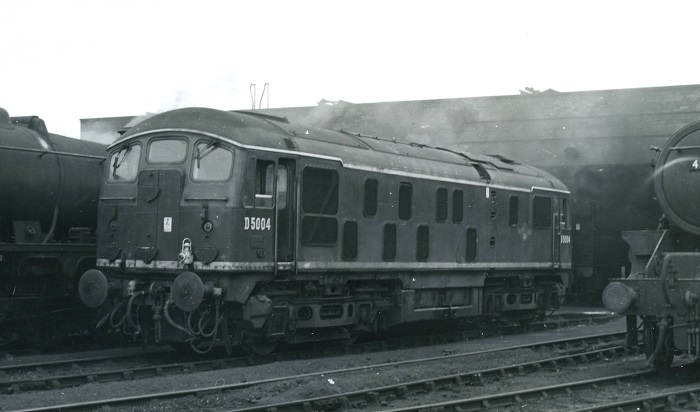
Here D5004 appears in pretty much 'as delivered' state, though with very grimy paintwork. This machine features the split radiator frost screen found on the first handful of Type 2s delivered from Derby. The cab front also carries the additional headcode disc brackets carried by those Type 2s allocated to Hither Green (in practice it appears these additional brackets were rarely used). And unique to this batch is the five ventilators on the top row, instead of the more normal four found on the later series. The locomotives also came with a curved panel to cover the roof access to the boiler water filler. As seen here on D5004 this has been removed, in later years a number of the Inverness allocated Class 24s would have this sheeted over as they were overhauled at Glasgow Works.
The sixteen year ten month career of D5004/24004 saw allocations to London Midland Region, Southern Region & the Scottish Region.
Built: BR Derby Locomotive Works.
Full size fuel & water tanks (shortened water tank fitted later).
Five upper and four lower air filters on non-BIS side, four upper & lower on BIS side.
Split radiator screens.
Additional headcode disc brackets fitted (for use with SR six disc headcodes).
Boiler water tank removed whilst on Southern Region.
Gangway doors sheeted over.
Time between last Classified repair and withdrawal: ?? months.
Time between withdrawal & scrapping: 19 months.
Allocations
The frames for D5004 were laid down at Derby Works during the late summer of 1958 and was delivered new to Crewe South (5B) on December 22nd 1958, but then immediately loaned to Derby (17A). Further transfers were:
January 27th 1959 to Hither Green (73C) on loan.
January 1960 to Crewe South (5B).
March 1960 to Hither Green (73C) on loan.
June 1962 to Willesden (1A).
June 1962 to Hither Green (73C) on loan.
September 1962 to Willesden (1A).
January 1965 to Camden (1B).
February 1965 to Willesden (1A).
September 1965 to Rugby (1F).
April 1966 to London Division (D01).
April 1967 to Stoke Division (D05).
March 1971 to Eastfield (65A) on loan, made permanent May 1971.
January 1975 to Longsight.
February 1975 to Eastfield.
July 7th 1975 to serviceable store.
October 5th 1975 withdrawn.
Renumbered February 1974.
24004 was stored at Carlisle from July 1975 to March 15th 1976 when it was forwarded to Glasgow Works, being mostly scrapped during May 1977, the cabs lingered until December 1984.
Works Visits
Works visits (records incomplete).
Noted Eastleigh Works June & August 1962.
Noted Derby Works March & April 1965.
Noted Eastleigh Works December 1965 (full repaint, green livery with small yellow ends).
Noted Derby Works June & November 1969 (fire damage & continuous?).
Noted Derby Works September 1971.
Noted Glasgow Works February 1973 (no repaint, gangway doors removed and discs centered, at least No.2 cab???).
Highlights
The condition reports assume that throughout the life of D5004/24004 the bodysides had four upper/four lower ventilators on BIS side, five upper/four lower ventilators on non-BIS side, split radiator screens on both sides and SR headcode disc brackets on both cabs until an undetermined point when those on the No.2 cab were removed.
1958/59
It was during the latter half of 1958 that the frames were laid for D5004, part of a batch of twenty machines (D5000 - D5019), which were part of the original order of locomotives for the Modernisation Plan. D5004 was delivered during December 1958, on paper to Crewe South (5B), then immediately transferred to Derby (17A). A month later the Southern Region borrowed a number of these new arrivals including D5004, the move being made in January 1959 to Hither Green. The loan was made pending the arrival of the BRCW Type 3s and the delayed start-up of parts of the Kent electrification scheme.
The use of D5000 - D5014/17 on the Southern Region was not without problems. Like a number of the early classes the Derby built Type 2s were found to be overweight, in this case almost five tons overweight. This heavier than expected axle loading was a major concern for the SR Civil Engineer, leading to D5004 & D5005 visiting Eastleigh Works in February to see what could be done to reduce the axle loadings. The easiest solution was to remove the train heating boiler and boiler water tanks, this being done on locomotives D5002 - D5006, which made them a little more versatile in regard to their route availability, though the boilers were sorely missed during the winter.
During the afternoon of March 10th D5003, D5004 & D5005 were noted on Ashford shed.
The summer dated Margate - Birkenhead had been in the hands of the Type 2s from June 15th, working as far as Redhill, noted on the first four days were D5001/02/05/04. On the heavier Saturday working double heading was frequent.
On August 8th 1958 D5004 was noted on the Deal portion of the down Birkenhead.
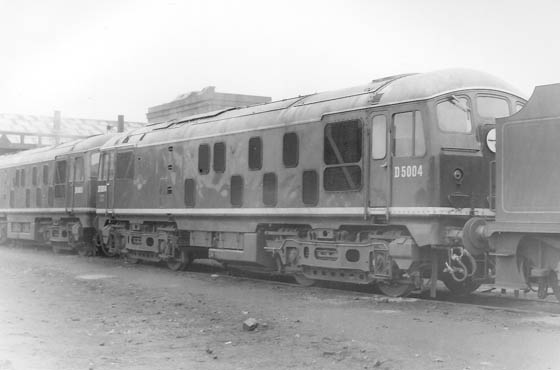
1960
The SR Civil Engineer eased the restrictions affecting the overweight Type 2s, most returned to the LMR to have the boilers and water tanks refitted. D5004 was briefly re-allocated to Crewe South (5B) between January & February for this purpose.
D6505 & D5004 worked the 15.25 Margate - Charing Cross on December 22nd.
1961
On January 28th D6500 & D5004 worked the down 'Golden Arrow', the train was diverted from its normal route due to the closure of Sevenoaks tunnel.
On February 26th D5004 worked the 15.10 Charing Cross - Margate.
1962
Repairs during 1962 included D5004 at Eastleigh in during June & August.
With the arrival of the BRCW Type 3s and the successful start up of the Kent electrification plan the Type 2s were slowly returned to the LMR, D5004 transferred to Willesden (1A) in September. At Willesden D5004 was a frequent runner on the local commuter services, occasionally to be found on the Birmingham - Coventry - Rugby locals as well.
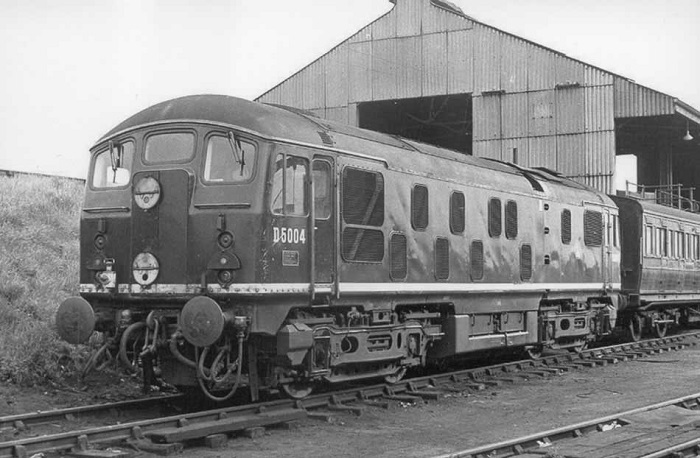
On the afternoon of November 3rd D5004, D5035, D5076, D5134 & D5146 were all noted at Euston.
1963
On the afternoon of June 1st D5001 was noted at Euston.
On June 21st D5004 was noted passing South Kenton with an eight coach passenger train.
On the morning of June 26th D5004 worked an eight coach Northampton - Euston.
D5004 worked the 18.38 Euston - Bletchley on November 25th.
1964
On the morning of April 27th D5004 was light engine at Rugby.
On April 30th D5004 worked the 2B88 07.25 Euston - Rugby.
On the afternoon of May 25th D5004 was at Rugby with the 4E11 12.10 Ford (Halewood?) - Dagenham.
On June 30th D5004 was at Rugby with the 4S68 14.18 Camden - Sighthill freight.
On July 21st the five coach 2B88 07.25 Euston - Rugby was noted at Rugby behind D5004 (failed) and 44813 running tender first.
On July 23rd D5004 worked the five coach 16.07 Rugby - Euston.
On Sunday November 15th D5004, D5006, D5007, D5015, D5032, D5074 & D5080 were stabled at Willesden.
1965
D5004's stay at Willesden was interrupted during January when a brief spell was spent at Camden (1B), by February it was back at Willesden. During March & April a visit was made to Derby Works for repair. As the LMR electrification advanced the passenger workings out of Euston diminished for the Type 2s although they remained in great demand to handle the extra engineering trains required to complete the electrification works.
In October D5004 was were transferred to Rugby (1F).
During December D5004 was noted under repair at Eastleigh Works, one of several sent to Eastleigh to ease the workload on the LMR workshops. The locomotive received a repaint, green livery with small yellow warning panels, with curved upper corners, with the warning panel covering the frame level stripe. The frame level stripe is of interest as it was much narrower than those applied at other Workshops.
Condition December: green livery with small yellow warning panels, curved upper corners, warning panels cover frame level stripe, frame level stripe is narrower than normal, full size fuel tank, shortened water tank, no blanking plates, hand/footholds present, ridge sided sandboxes, two-rung bogie mounted footsteps, all valencing in place.
1967
After five years generally spent at the southern end of the WCML D5004 was transferred to the Stoke Division (D05) in April, calling Crewe its new home. Between April & August the entire batch of D5000 - D5049 were transferred to the Stoke Division, more would follow in 1968.
Condition date uncertain: green livery with small yellow warning panels, curved upper corners, warning panels cover frame level stripe, frame level stripe appears narrower than normal, full size fuel tank, shortened water tank, no blanking plates, hand/footholds present, ridge sided sandboxes, two-rung bogie mounted footsteps, all valencing in place.
On October 29th D5004 was at Stafford with a wiring train.
On the afternoon of October 31st noted at Uttoxeter were D5004 light engine and D5082 on ballast.
1968
On the morning of January 13th D5004, D5007 & D5042 were stabled at Shrewsbury keeping company with condemned 48258, 45440, 45015, 48395 & 48650.
1969
By 1969 many members of the less successful diesel types (from NBL, Metropolitan Vickers, Claytons) had already gone to the scrapman, but there still existed within the diesel fleet a surplus in the Type 1 & 2 categories. Because the original batch of Type 2s from Derby Works lacked certain refinements carried by the later machines, they were selected for withdrawal during 1969. Ten were stored or withdrawn, being held at Shrewsbury, Chester, Crewe & Derby.
5004 remained in service until suffering fire damage in the Stoke area, being noted with an uncertain future at Derby Works in November. However a shortage of power on the Eastern Region and the loss of four Class 24s in a runaway accident at Chester, saw all but 5005 returned to service, with 5004 receiving considerable Works attention at the end of 1969.
1971
After a stay of almost four years at the Stoke Division another northward move was made to the Scottish Region to assist in the removal of the final members of the Claytons & North British Locomotive products. 5004 moved to Eastfield (65A) during March.
5004 was noted at Derby Works during September.
1972
On May 30th 5004 was noted at Eastfield.
Condition June: green livery with full yellow ends, no SR headcode disc brackets on No.2 cab, gangway doors still in place, three rung bogie mounted footsteps, ridge sided sandboxes, no emblem visible.
1973
24004 visited Glasgow Works for repairs during in February.
On the evening of May 27th Class 24/25s noted at Eastfield were 5004 (still in green/yellow livery), 5019, 5096, 5101, 5159, 5161, 5296, 7581 & 7583.
24004 was noted at Polmadie on August 29th in green livery and full yellow ends and with the gangway doors sheeted over and the discs centered on the cab front, a Glasgow modification, possibly quite rare in green livery (noted June 1972 with gangway doors and offset center discs).
1974
On May 30th 5117 & 24004 were noted at southbound Muir of Ord with a lengthy pipe train, the pipes had been coated with concrete at Invergordon.
On July 19th 24004 worked the six coach 13.00 additional Aberdeen - Glasgow service.
1975 - 1977
On January 19th 24004 was noted at Manchester Victoria. On January 20th 24004 was noted passing Windsor Bridge (Manchester). On January 28th 25203 & 24004 were noted at Manchester Victoria with the 5J83. 24004 was noted passing through Manchester Victoria light engine at 6pm on January 30th. 24004 was the Manchester Victoria banker (T42) on January 31st.
24004's spell at Eastfield was broken briefly when it moved to Longsight during January (with 24001/005) and then headed back north in February (with 24001). This was its last official move, for like a great many others it was stored in July, never to turn a revenue earning wheel again. Stored with many others at Carlisle, withdrawal came officially in October. On March 15th 1976 a convoy of 24002/04/10/11 travelled from Carlisle to Glasgow Works for component removal. The end finally came in May 1977 when the remains of 24004 were broken up at Glasgow, athough parts of the cabs lingered until December 1984.
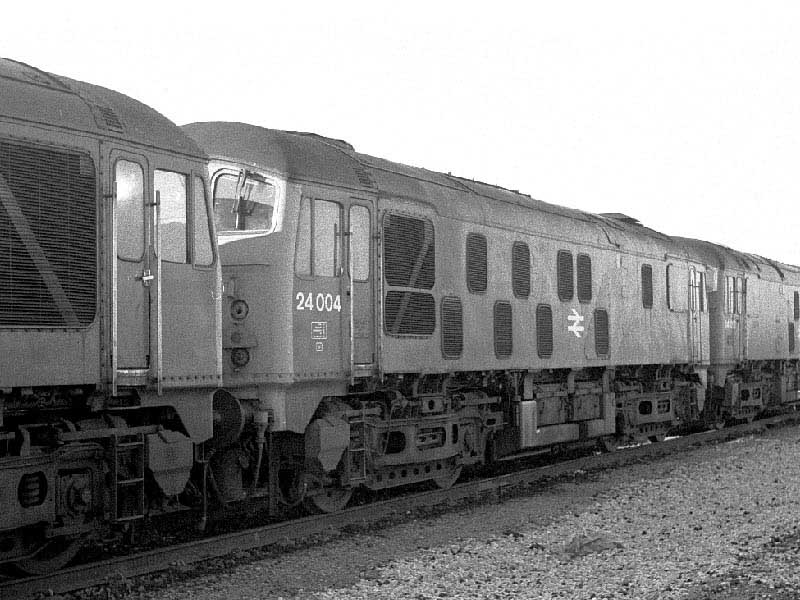
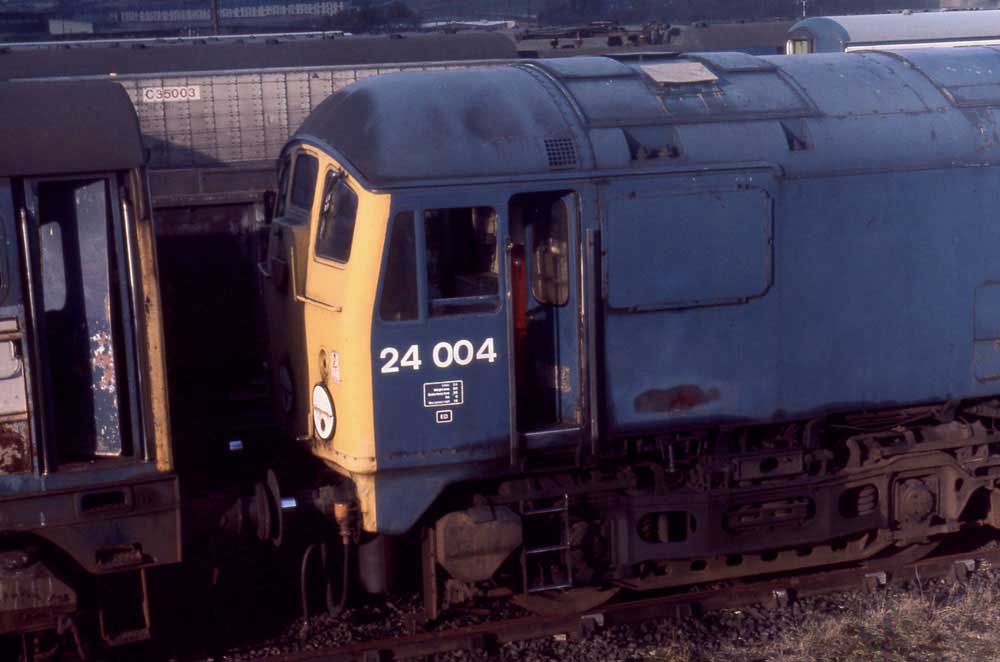
Condition final: blue/yellow livery, gangway doors sheeted over, headcode discs centered on cab front, no SR headcode disc brackets on No.2 cab, full size fuel tank, shortened water tank, blanking plates fitted, hand/footholds plated over, ridge sided sandboxes, three-rung bogie mounted footsteps.
flk 0521
Page added February 20th 2004
Page updated July 13th 2024.
Back to 24003
Forward to D5005