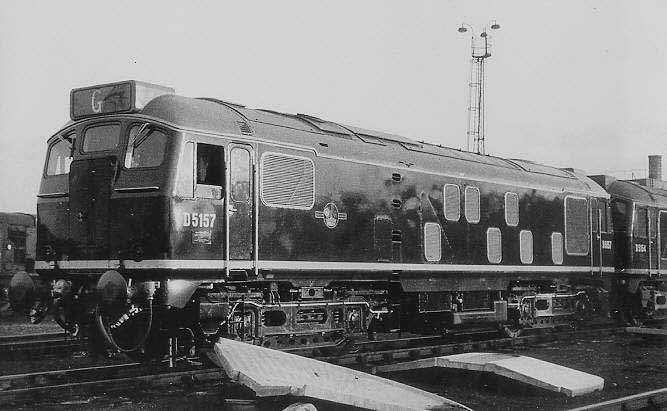
The nineteen year three month career of D5157/25007 included allocations to Eastern and Scottish Region depots.
Built: BR Darlington Locomotive Works.
Circular gauge added to fuel tank.
Final exhaust roof panel: flush.
Time between last Classified repair and withdrawal: 20 months.
Time between withdrawal & scrapping: 22 months.
Allocations
D5157 was new to Thornaby (51L) on July 7th 1961. Further transfers were:
December 1961 to Gateshead (52A).
September 1964 to Thornaby (51L).
July 1971 to Holbeck (55A).
October 1971 to Eastfield (65A).
April 1974 to Haymarket (64B).
February 1975 to Tinsley.
August 1975 to Eastfield.
May 1980 to Haymarket.
September 28th 1980 to unserviceable store.
Withdrawn December 1st 1980.
Renumbered May 1974.
25007 was the 70th Class 25 withdrawn, one of seventeen retired during December 1980, including sisters 25002, 25005, 25006, 25010 & 25011.
25007 was moved to Swindon Works on November 6th 1980 with 25006, being withdrawn whilst at the Works. 25007 was broken up at Swindon during the third week of September 1982.
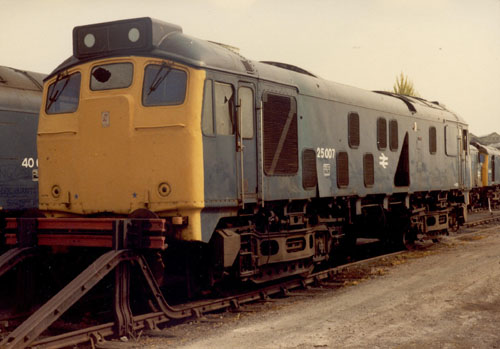
Works Visits
Works visits (records incomplete).
Noted Darlington Works April & May 1963.
Noted Derby Works October 1965.
Noted Derby Works August 1968.
Noted Derby Works June 1970.
Noted Derby Works July 1971.
Noted Glasgow Works May 1973 (Collision repairs)
Noted Glasgow Works June 1974
Noted Glasgow Works February 1975
Noted Derby Works June 1976
Noted Glasgow Works January - February 1979 (Intermediate repair).
Highlights
1961
The frames for D5157 were laid down at Darlington during April, construction on average took about ten weeks. D5157 was released on July 7th and allocated to Thornaby (51L), being noted there in sparkling condition on July 9th.
On July 9th Thornaby shed contained 142 locomotives including three diesel shunters and D5098, D5151 - D5157.
Between 8/8/61 and 10/8/61 D5157's repair book reported electrical faults.
During December Gateshead sent D5112 & D5113 to Thornaby in exchange for D5156 & D5157.
1962
Between 20/7/62 and 26/7/62 D5157's repair book reported compressor issues and a Works visit.
1963
D5157 was present in Darlington yard for part of April & May.
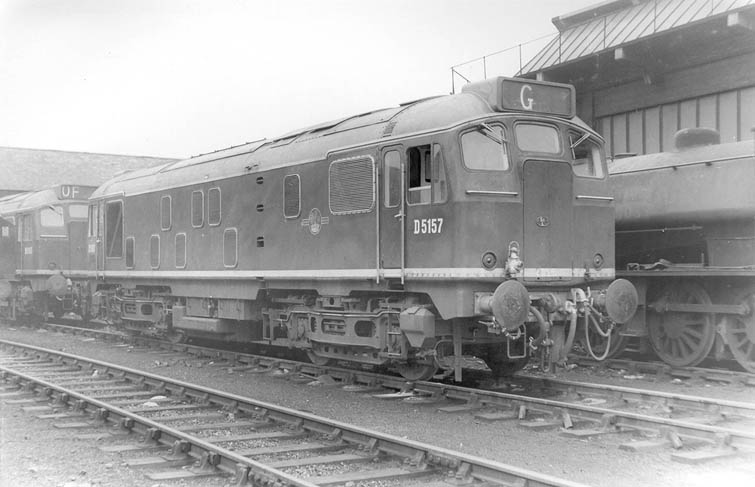
The allocation of this build to Darlington was probably due to Derby being preoccupied with the later batch of BR/Sulzer Type 4's (the Class 46's), and its responsibility for overhauling much of the growing LMR fleet of diesels. The bodyshell of this batch was very similar to the previously built Type 2's, though in the Class 25/0's no boilers were fitted, thus the boiler water tank was omitted, but the ventilation grille for the boiler room remained! Darlington, in painting the locomotives picked out the grilles in grey, as Derby & Crewe had done on the bigger Type 4's.
1965
On Sunday April 18th the following were noted:
Gateshead: D5102, D5150, D5106, D5149, D5180, D5103, D5109, D5113
Heaton Carriage Sidings: D5178, D5108, D5147, D5177
Thornaby: D5163, D5162, D5167, D5154, D5152, D5157, D5155, D5156, D5172, D5169, D5153.
1966
At mid-day on April 2nd D5157 was light engine at Darlington.
On the evening of April 6th D5157 was up light engine at Darlington.
Noted at Thornaby between 18.30 & 19.30 on April 6th were eighteen trains, including one diesel multiple unit, one shunter and freights hauled by Classes 25/37/40, the Class 25s being:
D5248 westbound freight (9K13)
D5250 eastbound freight to yard
D5164 eastbound freight to yard
D5157 eastbound freight to yard, then westbound Class H freight
D5253 eastbound freight to yard
D5164 westbound freight.
On the afternoon of June 13th D5157 was light engine at Darlington.
Noted at Darlington between 5.30pm & 6.30pm on July 6th were:
D5154: up freight
D5168: down light engine
D5163: up light engine
D5157: down light engine
D5166: down freight
1968
On August 31st the Open Day at Derby Works had an interesting display of locomotives, including HS4000 and D5157 in sparkling blue paint, steam was represented by 44888.
1970
Derby received 5157 during June for repair. Possibly during this visit the locomotive received a cab roof at the 'A' end with the sloped 'wings'.
1972
The Open Day held at Eastfield depot during September found 5157 present with a damaged cab, it would soon be moved to Glasgow Works for repair.
1973
During April?? 5157 suffered collision damage somewhere in the Grangemouth area. The locomotive was taken to Grangemouth depot where the damaged cab was removed, the locomotive later proceeding to Glasgow Works for repair.
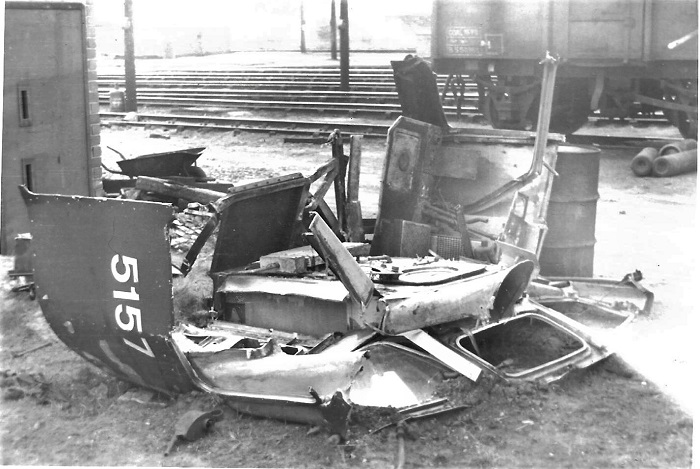
On May 12th Glasgow Works held its first Open Day, remarkably there were sixty four diesels on display that day, although twenty seven of those were condemned Claytons. Two class 25's were present, 5178 and 5157, the latter having a replacement cab fitted from withdrawn 5149. Class 24's noted were 5006/19, 5121/27 under repair and elsewhere withdrawn 5067, 5114/49. Parts of 5068 were still present.
1974
On the afternoon of February 15th 5157 was stabled at York.
1975
More repairs took place to 25007, this time at Derby in February.
The transfer of 25006/07/08/11 to Tinsley during February brought all twenty five members of the Class 25/0's together again.
On the evening of June 13th 25007 & 25012 were stabled at York.
25007 was stabled at Frodingham on June 14th.
On July 26th Ipswich was host to 25007 & 25021 passing through with the empty stock of a Glasgow - Brandon troop special.
On the afternoon of July 30th 25007 & 25014 were stabled at York.
To cover the withdrawal of a number of Scottish Class 24's 25005 - 25014 moved from Tinsley to Eastfield in August.
1976
25007 was back at Derby again during June for further attention.
25007 was at Millerhill on November 6th.
1977
25007 was noted stabled Ayr depot on the evening of January 24th.
25007 was noted at Eastfield on April 11th.
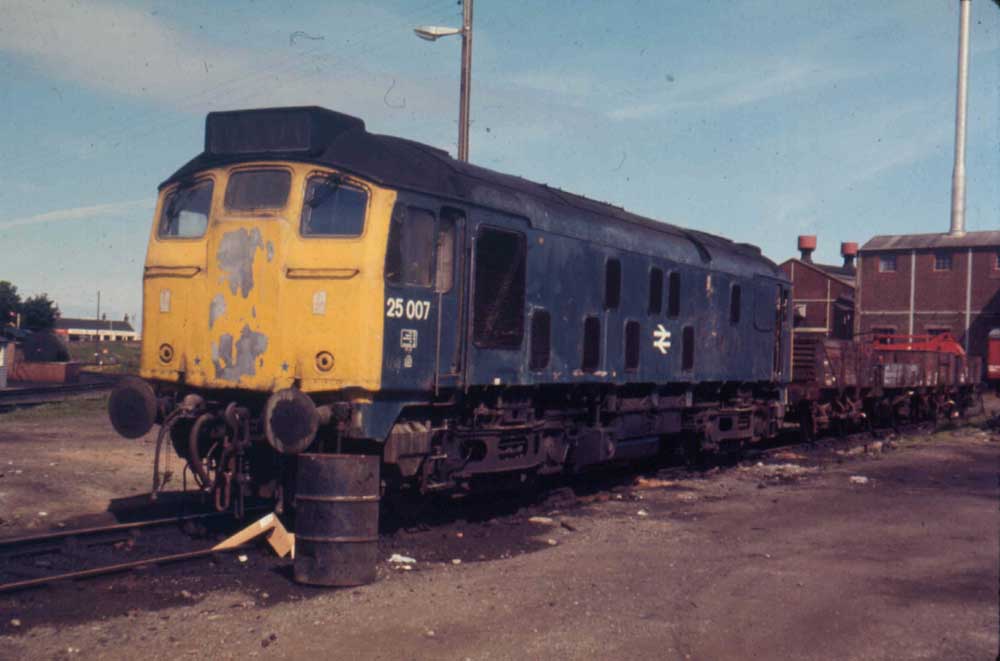
On October 29th 25007 was stabled at Carlisle station.
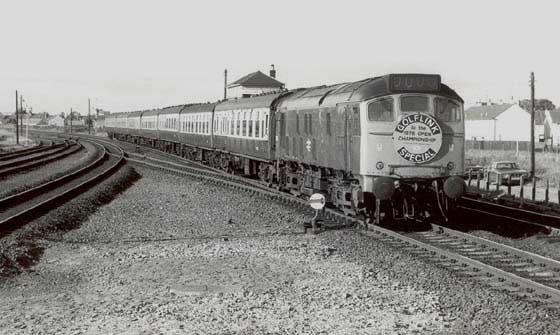
The British Open Golf Championship at St Andrews (July 12th - 15th) brought a number of additional locomotive hauled trains to Leuchars station each day. July 15th saw 25007 arrive from Edinburgh, 20109 from Glasgow and a diesel multiple unit from Perth.
On the evening of August 15th 25007 was noted at Larbert with a westbound oil train (to Cadder?).
1979
Glasgow received 25007 for intermediate repairs during January & February.
25007 was noted in ex-works condition at Eastfield depot on February 10th.
On March 27th 25007 was at Perth with a parcels train.
25007 was stabled at Dumfries station on April 14th.
On July 10th the 21.40 Edinburgh - Carstairs was worked by 25007.
Considerable mileage was covered on August 18th when 25007 & 25062 worked an SRPS special throughout from Dundee via the Forth Bridge and Falkirk to Oban and return. On August 27th 25007 and a brakevan were noted passing Stirling.
On September 11th an early afternoon Dundee - Glasgow Queen Street relief was worked by 25007. On September 12th the 21.40 Edinburgh - Carstairs was worked by 25007 (1C96).
1980
January 14th saw the 17.07 Edinburgh - Newcastle in trouble behind 40060, the journey was completed with the help of 25007, albeit over two hours late.
During May 25006 & 25007 were transferred to Haymarket.
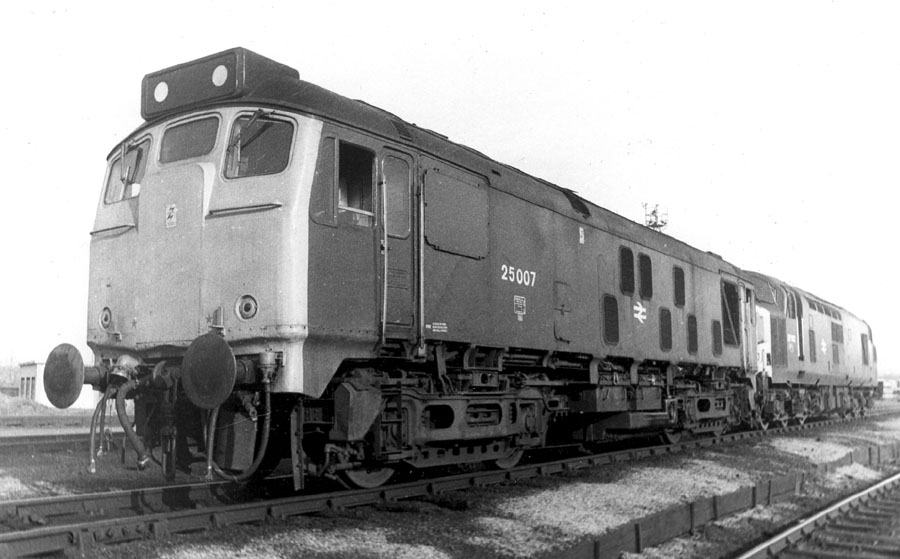
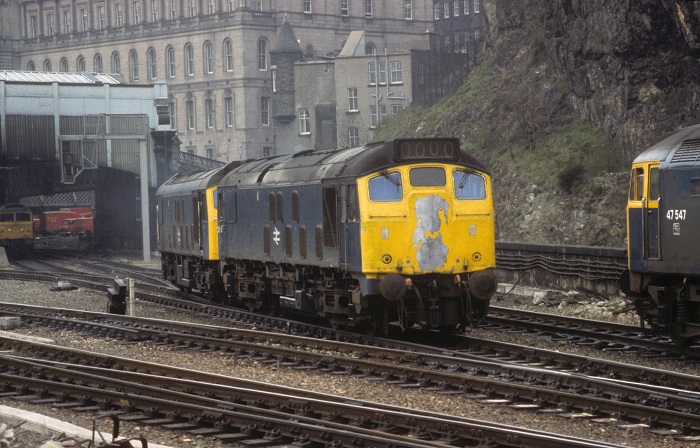
On June 14th 25007 worked the 17.12 Perth - Arbroath and the 18.33 Arbroath - Dundee. On the late afternoon of June 18th 25007 was eastbound at Edinburgh Waverley with parcels vehicles and several coal wagons.
25007 was used on July 12th to take forward the 14.24 Scarborough - Glasgow Queen Street relief from Edinburgh, this may have been 25007's last passenger working.
On August 9th 25007 was noted on a freight at Newtonmore.
At the close of the summer timetable in September (18th?) both 25006/007 were stored unserviceable at Millerhill.
After three months store at Millerhill, during early November 25006 & 25007 were moved to Swindon Works.
During March 2016 a builders plate from 25007 sold on Ebay for GBP536.55. A plate sold at the same time from 25188 only reached GBP275.00
9/828
flk 1021 (1)
Resources:
Repair book information courtesy Peter Maynard.
Page added February 25th 2000.
Page updated May 16th 2023.
Back to 25006
Forward to 25008