With a production run of 478 Classes 24 & 25 it is not surprising to find that there are a number of variations featured on the locomotives. These differences resulted from changing conditions on BR, for example the discontinuance of train identification by lamps & discs, replaced by four digit alpha/numeric headcodes, and the correction of errors found in the early designs, in the case of the BR Type 2s it would be the repositioning of the air filters from the body sides to the cantrail area.

Cab Development (Class 24/25).
With a production run of nine years and 478 locomotives it was to be expected that production changes would occur in the light of operational experience with the locomotives and changes across railway operations in general.
The changes affecting the appearance of the cabs can be broken down into two major variants and one minor variant.
5000 - 5175 (24001 - 25025); Original cab design (ignores headcode changes)
5176 - 5232, 7568 - 7597 (25026 - 25082, 25218 - 25247); Intermediate cab design (gangway doors retained).
5233 - 5299, 7500 - 7677 (25083 - 25327) Final cab design, removal of gangway doors.
Gangway doors were provided for the first 253 locomotives (5000 - 5232, 7568 - 7597). However the first major variant occurs with the cab design from 5176 which features subtle changes, the most prominent being the larger forward facing windows for the driver and second man. The second major variant occurs from 5233 following a major redesign of the Class 25, which saw a redesigned cab that did away with the gangway doors and the removal of the bodyside filters to the cantrail, allowing for a much cleaner appearance of the bodysides.
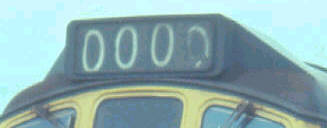
The minor variant affected the method of train identification carried by the locomotives. Initially this utilised the disc and lamp method similar to that carried by steam locomotives and was fitted to 5000 - 5113. During the production run of the Class 24s the identification method was changed to a four digit alpha/numeric display, which for locomotives 5114 - 5299, 7500 - 7677 was carried in a rectangular box moulded into the cabroof.
This headcode housing underwent a change when the locomotive horns were relocated from the buffer beam area to housings either side of the headcode display:
5000 - 5175: original headcode housing (horns mounted in bufferbeam area)
5176 - 5299, 7500 - 7677: headcode housing modified with circular housings to accommodate the relocated air horns. To improve the aesthetics of the cabroof, sloping wings merged the top of the housing to the curved sides of the roof molding.
The cabroof was a steel frame supporting a one-piece moulded affair. However there are two distinct styles:
1/: D5176 - D5232 & D7568 - D7597 (25026 - 25082 & 25218 - 25247) sported the cab roof with longer sloping wings with the horn moulding being slightly below the edge of the sloping flat panel, creating a shadow line.
2/: D5233 - D5299, D7500 - D7567, D7598 - D7677 (25083 - 25217 & 25248 - 25327) were fitted with a slightly modified cab roof with shorter sloped wings and part of the horn moulding being flush with the sloping wings panel.
Close examination of the Class 25 cab roofs indicate there are distinctive differences with regard to the height of the horn moulding and the length of the sloping wings coming down from the top of the headcode box and as it ends how it interacts with the curves of the cab roof moulding. It is presumed there were multiple moulds used to create the cabroof and these may have introduced minor variations.
It is also presumed that the exchange of entire cabs and/or cab roofs at Works overhaul would lead to further mismatched variations occurring during the working lives of the locomotives.
Cab Roof Variants (5114 - 5175).
One oddball post-production variation was found on a number of locomotives from the batch 5114 - 5175. The headcode moulding incorporated the later styling found on 5176 (25026) onwards, but did not include the receptacles for the air horns, these were still retained in the buffer beam location for the locomotives that carried this one-off roof style. This style were applied only to certain locomotives, frequently at one end only, presumably the result of accidents or severe corrosion. Locomotives so identified include 24133, 24134, 24147 (both cabs), 24148, 25008, 25009.
This same batch of locomotives can also be found fitted with the cab roof styles carried by 5176 (25026) onwards. Presumably when this occurred the air horns remained at their buffer beam location. Locomotives that carried the later roofs include 24134, 24142, 25006, 25008, 25010, 25015.
The Class 24 cab roofs incorporated two ventilators in each cab roof, located above the cab doors. These ventilators were omitted when the Class 25s were introduced. However a number of Class 24s have been noted with no ventilators in the cab roofs:
D5036 noted without ventilators whilst allocated to the Eastern Region, at withdrawal the cab roofs had ventilators.
D5039 noted without ventilators whilst allocated to the Eastern Region, at withdrawal the cab roofs had ventilators.
Cab Roof/Headcode Oddities.
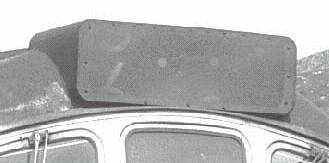 | Whilst not strictly cab roof related, Inverness changed the front panel on the headcode indicator box on their fleet of Class 24's (5114 - 5132). This was probably a winterisation idea to reduce water/snow egress into the cab roof area. Once the use of train identification by headcodes ceased the panels quickly became opaque from layers of dirt! From a photograph courtesy Tony Sayer. |
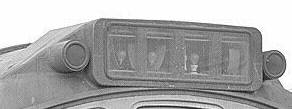 | Not a structural change, but on occasion the headcode panel revealed only the internal light bulbs and dividers. From a photograph courtesy Steve Jones. |
Radiator Frost Screen Variations (Class 24).
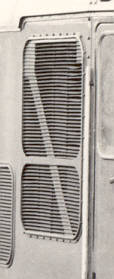 |
The first five Class 24's (5000 - 5004, 24001 - 24005) differed from all the others in regards to the radiator frost screens. In light of the planned livery of the Class 24's, with a waist high stripe along the side, the stripe was to be carried across the frost screen by running a metal band across the panel. As is now well known only 5000 carried this pin-striping, all later Class 24's carried a wider white band at frame level. | 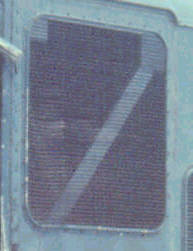 |
Once the split level frost screen was discontinued after 5004 (24004) all following locomotives carried the single piece frost screen. However during overhauls the screens from 5000 - 5004 were occaisonally transferred to other locomotives. At least 24006, 24025 & 24134 ended their days carrying at least one split screen. |
Cantrail Level Water Filler (Class 24 & 25/0).
Glasgow Works modified the roof level water filler access by sheeting it over. This method of filling had become redundant following the dismantling of the platform end water fillers used by the steam locomotives. It would also be one less maintenance headache for the locomotives operating in the harsh Highland winters. Picture evidence suggests this modification began about 1967/1968.
Cantrail water level filler sheeted over: 5114, 24115, 24116, 24117, 24118, 24119, 24120, 24121, 5122, 24123, 24124, 24125, 24126, 24128, 24129 :
Not sheeted over: 24127 & 24130 (as of scrapping?), 24132 (as of Aug 1972)
Boiler Room Grille (Class 24 & 25).
When introduced to traffic Classes 24 & 25 were for mixed traffic useage, requiring that they be able to heat the passenger workings through the use of a steam heating boiler. A compartment within the locomotive body was fitted with a steam heating boiler. To allow air flow into this space, for combustion or cooling purposes, bodyside openings were created with a mesh or grill covering. As orders continued for the Class 25 variant, the final 210 would be built without steam heating boilers, but the bodyside design remained unchanged, with grilles continuing to be fitted through to the end of the order in 1967.
Several post-production changes occurred during the life of the locomotives, the most significant being that over time the boiler room grilles were covered by a solid blanking plate. This was an almost universal modification to both boilered and non-boilered locomotives.
A regional modification of the solid blanking plate occurred to those Class 24s working over the Highland line and Far North lines. The Inverness allocated Class 24s frequently encountered climate conditions that caused freezing conditions within the boiler compartment. To reduce the entry of cold air the standard solid blanking plate was initially fitted over the grilles. However for some of the locomotives this was later modified with the insertion of four or five slats to permit some air circulation.
Condition of the ex-Inverness (5114 - 5132) Class 24s at time of withdrawal.Five slat blanking plate: 5114, 24115, 24116, 24117, 24118, 24119, 24121, 5122, 24125, 24126, 24130, 24132
Four slat blanking plate: 24127
Solid blanking plate: 24120, 24124, 24128, 24129
Original style grill: 24123
The second significant change occurred when Derby Locomotive Works incorporated in their Classified Repair programme a modification to remove the boiler room grilles/blanking plates from non-boilered locomotives and sheet over the opening. This modification commenced about 1975/1976 and was only done by Derby Locomotive Works. Glasgow did not incorporate this modification into their Classified repair programme.
Class 25s known to have had the boiler room grill sheeted over - date in brackets indicates modification date (list may be incomplete):
25100 (5/76), 25101, 25102 (4/76), 25104 (8/77), 25105 (5/77), 25107
25110 (8/77), 25111, 25112 (7/76), 25114 (5/77), 25115 (1/80), 25116, 25118 (7/76), 25119 (4/79)
25123 (3/79), 25124 (7/78), 25126 (8/76), 25127, 25129 (9/77)
25131, 25132 (12/77), 25133 (5/78), 25134 (11/77), 25135 (4/77), 25136 (2/78), 25137 (5/76), 25138 (12/79), 25139 (4/78)
25141 (3/78), 25142, 25143 (3/78), 25146 (7/78), 25147 (3/78), 25148 (6/77)
25150 (3/78), 25152 (6/78), 25158 (5/79)
25160 (6/77?), 25161 (9/77), 25163 (2/79), 25164 (6/77), 25165 (4/77), 25166 (3?/76), 25167 (5/79), 25168 (6/79), 25169 (8/79)
25170 (8?/77), 25177 (3/80)
25180 (4/78), 25186 (4/77), 25187 (4/77)
25195 (8/78)
25211, 25214 (4/79), 25215 (2/78)
25263
25270, 25274
25280, 25281
25292 (6/76), 25294 (2/76?)
25302 (1/80)
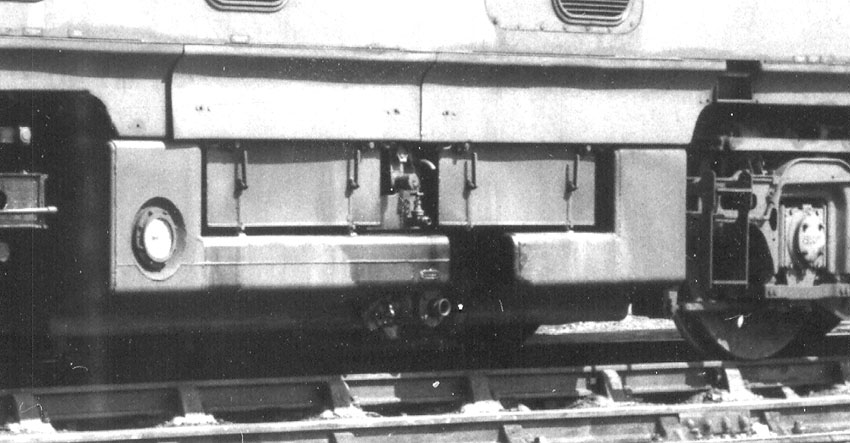
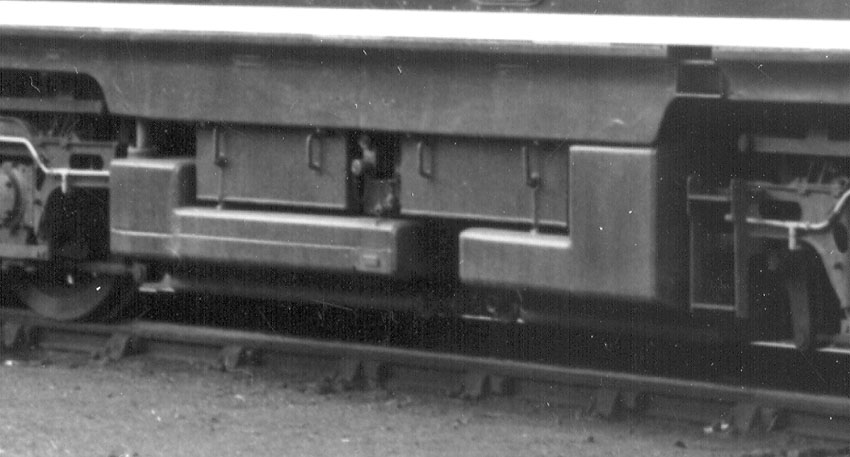
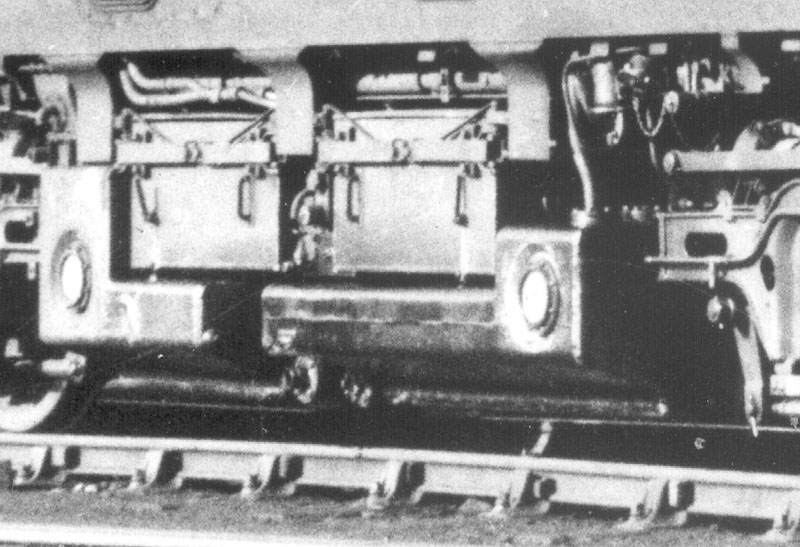
The fuel and water tanks carried by the Class 24's, at first glance appeared to be all the same, in fact they are not. Because these locomotives were over their designed weight when built various changes were made to reduce the weight. These changes included reducing the fuel and water tank capacity, consequently minor design changes took place as the locomotives were built.
All the views immediately below unless otherwise indicated feature the locomotive photographed with the radiator end nearest the camera, the nearest tank to the camera will be the fuel tank.
D5000 - D5049 (24001 - 24049)
The first fifty Class 24's (thirty from Derby & twenty from Crewe) carried the first version of the fuel/water tanks. As can be seen from the views below these, with the batteries gave a solid appearance to the underframe area between the bogies. But because of the locomotives being over their design weight it was necessary to resort to weight saving schemes for the later build, and to take steps for weight saving refinements retroactively for these first fifty machines.
Retro-actively for D5000 - D5049 it was the water tank that was altered by shortening the tank at the end nearest the centerline of the locomotive (see view below of 5025). Not all of the locomotives were retrofitted, at least 24012/16/38/41/42/44/45 carried the full size tanks to the end.
Some tanks gained a circular gauge class usually only on the fuel tank, locomotives so fitted include 5028, 24006/25/34/38/, exceptions include 24046/49 which had the circular gauges on both fuel and water tanks!
Locomotives which had their water tanks removed in this group are 24032/34/35/39.
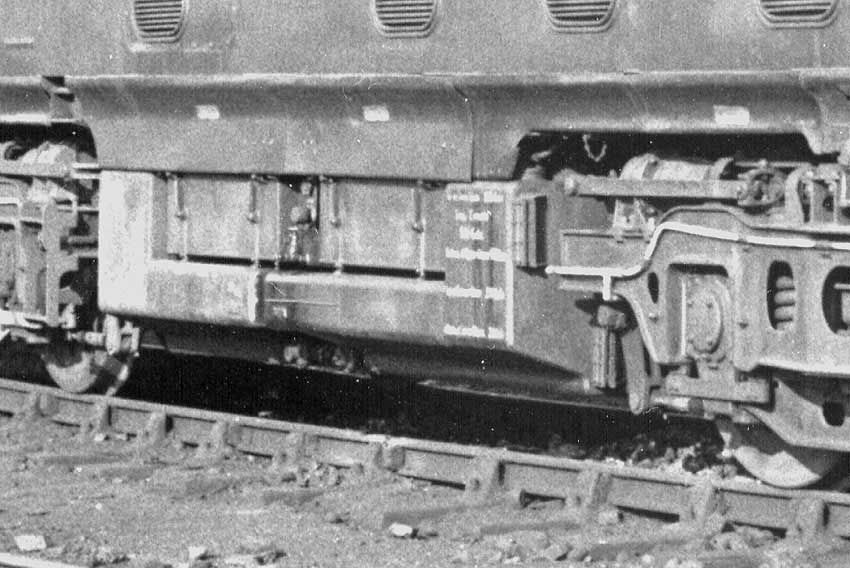
Photograph collection Transport Treasury.
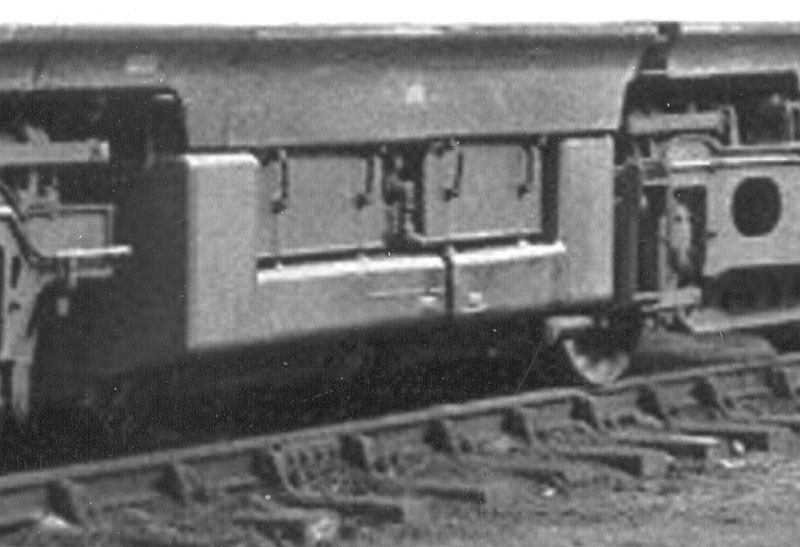
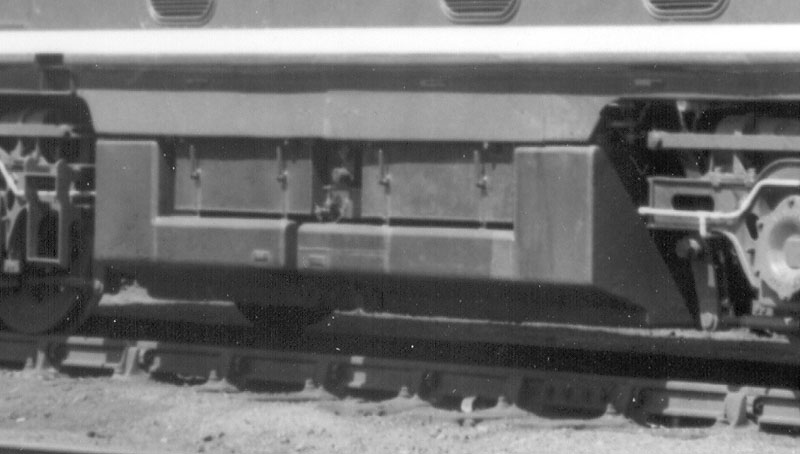
Photograph collection Rex Conway.
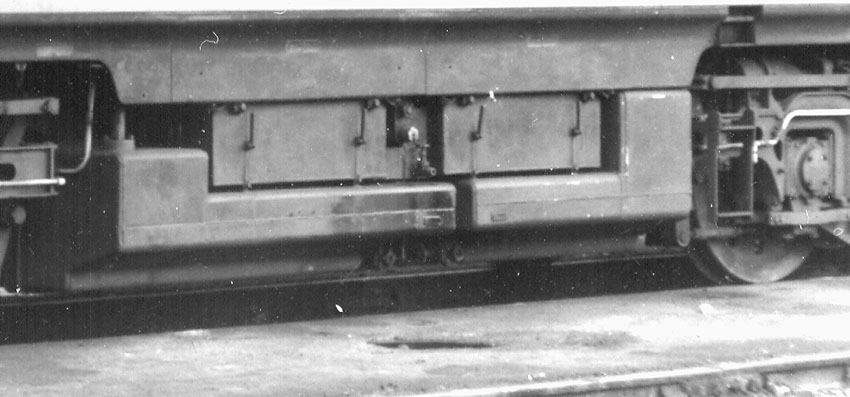
D5050 - D5120 (24050 - 24120)
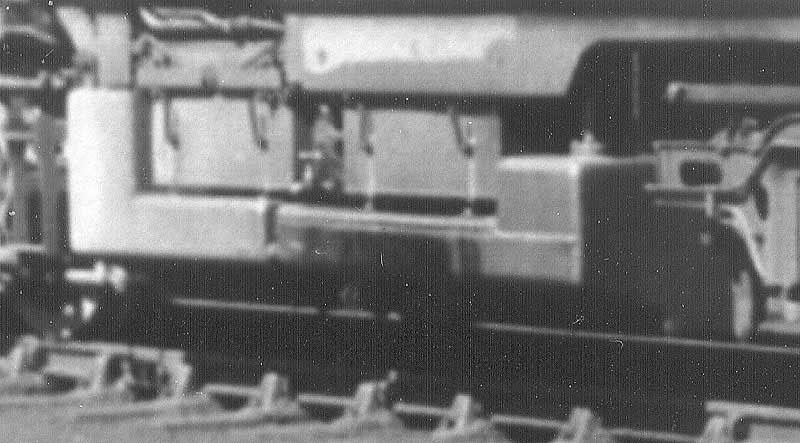
Weight saving measures regarding the fuel tanks went into production beginning with D5050 - where the tank wrapped round the battery box it no longer reached upto the frame level, the modified designed created a shallower end section. This production change affected all the locomotives up to D5120 which included those produced by Crewe, Darlington & Derby.
This batch of locomotives included the Gateshead allocated machines which were later designated for the Tyne Dock - Consett iron ore services - for this their steam heating boilers and water tanks were removed permanently.
Over time some members of this group received the lighter water tank, this was shortened and created a gap between the fuel & water tanks under the battery boxes. Locomotives receiving the lighter tank included 24054/73/76-84/86/87/89/90/92, 24113/118/119.
Other machines saw the circular gauges added to the tanks:
Those with circular gauges on both tanks: 24054/78/80/84/86/99, 24113/115/116/117/120.
Some machines late in their careers had the water tank removed these include 24063/81/86/91.

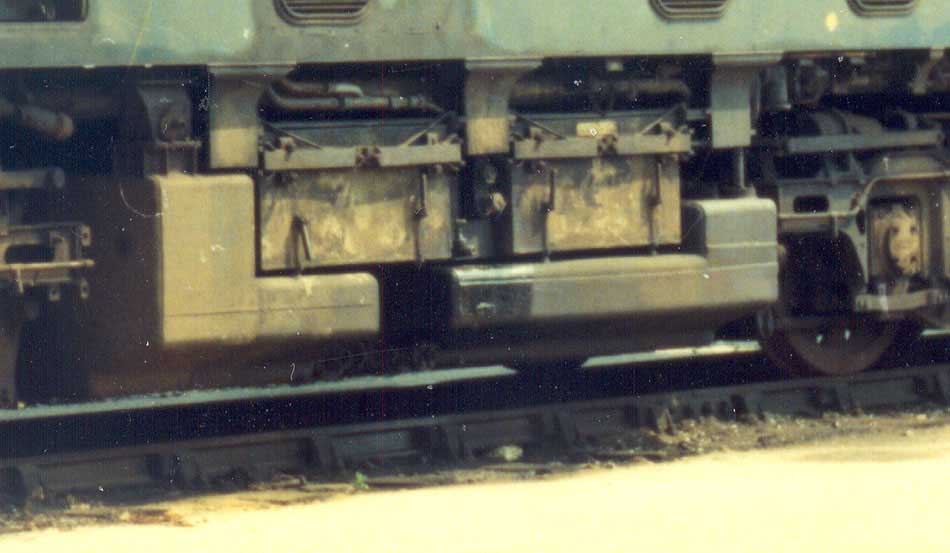
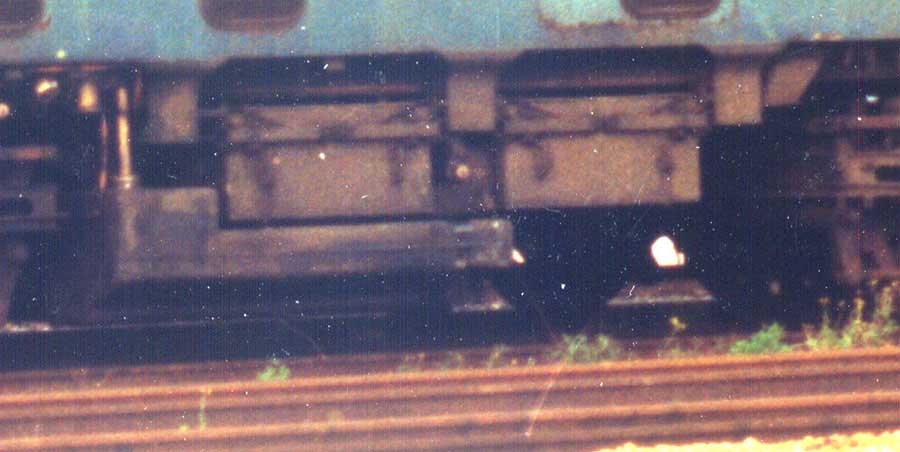
D5121 - D5150 (24121 - 24150)
In the middle of the Derby build for the Scottish Region the design of the water tank was changed. To reduce its size the length was reduced creating a gap between it and the fuel tank beneath the battery boxes. For the Class 24's, after this third production change there were no others. All changes after this point for the Class 24's were done retro-actively.
Many of this group would later be fitted with circular gauges for both the fuel & water tanks, particularly true for the Scottish examples. Those so treated were 24121/123/124/125/128/129/137/146/148.
Several locomotives only had the circular gauge added to the fuel tank, these included 24126/127/130/132/141. Also in this group were a number of locomotives that had the water tank removed, included in this group is 24134.

Battery Isolating Switch Cover.
The battery isolating switch was situated behind a hinged two piece cover midway along the side of the locomotive, close to the handholds that provided access to the cantrail level water filler. The cover remained unchanged throughout the build of the Class 24/25's. In service the lower part of the cover would often appear in the open position, revealing the isolating switch.
Modifications to the access cover to the battery isolating switch were not that common, these changes appear to be mostly the work of the Scottish Region.

Class 24s with this modification include 24066, 24071 & 24123.

Class 25's with this modification include 7578 (25228), 25005, 25037 & 25087.
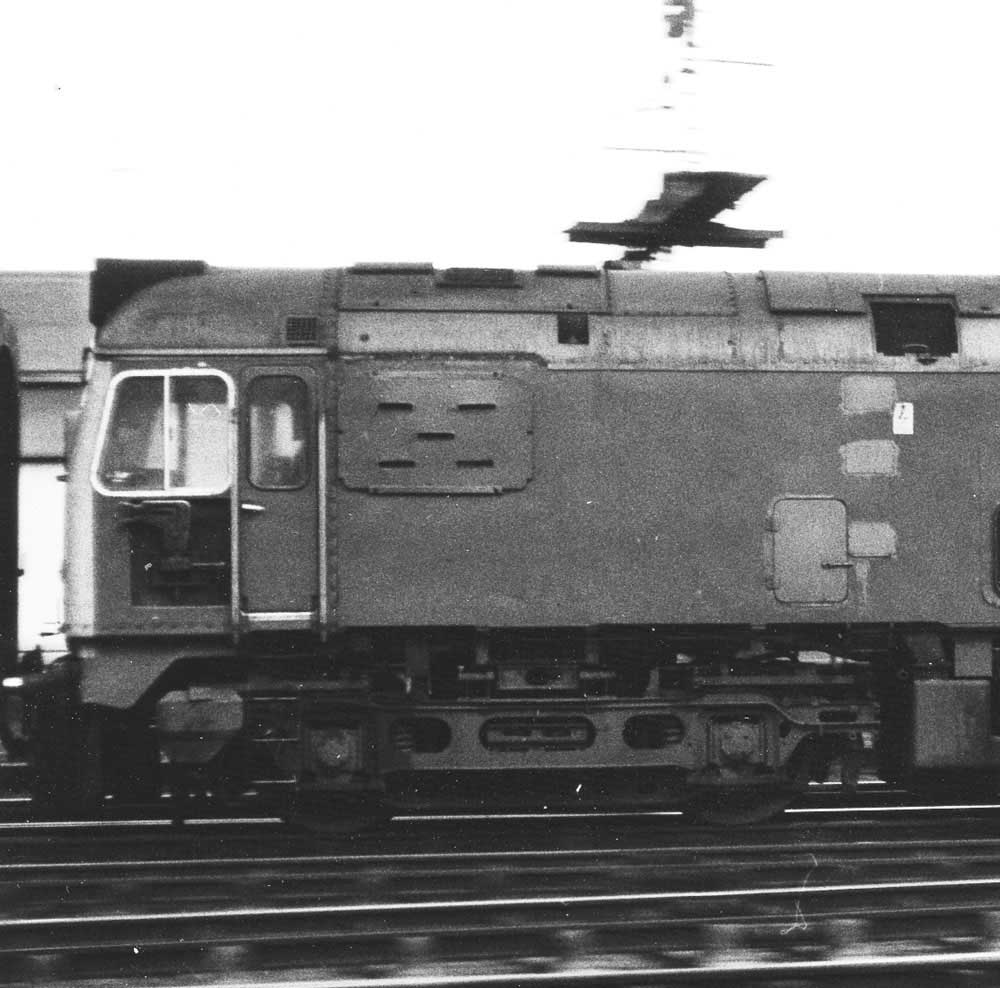
Locomotives with this modification include 24119, 24120, 24126, 24128, 24132.
24129 has the modification but is hinged on the opposite side to the above locomotives.
Builders Plates.
Each locomotive carried builders plates, initially fitted to the cabside but later many were moved to the cab door. In later years many locomotives ran without the plates.
Although only a small item there were variations within the styling of the builders plate.
For the Class 25's the plate styles were similar in 1963, 1964 and early 1965, but later in 1965 the 'D' in 'associated' was no longer capitalised.
Temporary Modifications & Experiments.
From time to time locomotives were temporarily modified in order to test a variety of experiments. Many of these experiments were not of a visible nature apart from a small modification plate usually located somewhere near the cab door.
7500 (25150) carried a cab ventilation modification - a ventilation opening the width of the cab door and about 8 inches tall was located above the door in the roof panel, whilst there was a 6.5 inch square aperture cut into the lower part of the cab door. It is not known how long the locomotive ran with this modification.
Page added June 6th 2001
Last updated September 22nd 2017