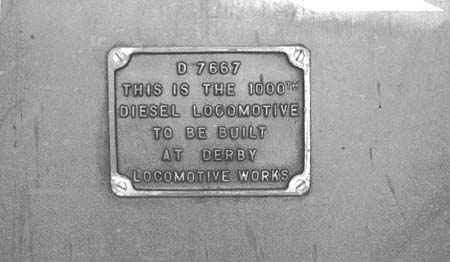
The production details of the diesels that came out of Derby are well documented in a variety of excellent publications. This humble offering is a consolidated look at these locomotives with a few memories thrown in. It came about because in researching the Class 25's the construction of D7667 is recorded as the 1,000th diesel locomotive built at Derby, even carrying commemorative plaques to that effect. Hence the seed was sown to delve a little further into what made up these 1,010 diesel locomotives.
The general totals are:
Shunters: 599
10000/01: 2
Fell Loco: 1
Class 24: 77
Class 25: 226
Class 44: 10
Class 45: 39
Class 46: 56
The story begins however thirty six years earlier.
(All black & white views are from unknown sources - possibly the collection of FW Day - unless otherwise stated & the colour views are mine unless otherwise stated.)
(The numerical listing of the 1,010 locomotives is based on contemporary reports and hopefully is accurate, though where multiple production lines were running, particularly 1958 - 1960 the list is open to dispute as to which locomotive fits into each slot on the overall list).

The Shunters from the 1930's & 1940's
Diesel hydraulic 0-6-0 1831
By the time the LMSR took a serious interest in the possibility of introducing diesel traction into its fleet the basics of the diesel engine coupled to several types of transmission had been well explored in a number of countries, some combinations leading the way in the evolution of the diesel locomotive, others proving to be unsuccessful. The LMSR's pioneer fell into the latter category.
The LMSR took an economical approach to the situation by using the frames and wheels of ex-Midland Railway Class 1F 0-6-0 tank 1831 built at Vulcan Foundry, Newton-le-Willows in 1892. The approval for the conversion had occurred late in 1931, at which time a Davey Paxman engine was chosen to power the locomotive, utilising a hydraulic transmission from Haslam & Newton, Derby. This was another cost saving measure, the capital cost of electrical transmission equipment would have rendered the project uneconomic.
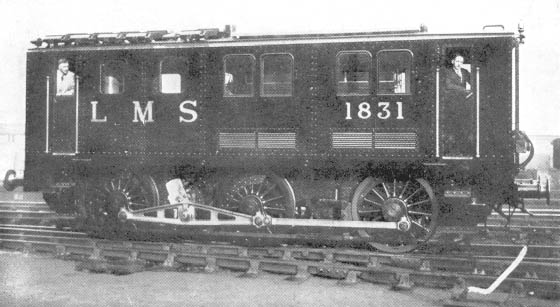
Released from Derby Works during November 1932, the locomotive was delivered to Euston for inspection prior to returning to Derby for testing in general shunting locally and at Toton. Various transmssion failures led to modifications and improvements. It was the destruction of the hydraulic transmission sometime late in 1936 that led to the storing of the locomotive at Derby, although official withdrawal did not take place until September 23 1939. World War II brought a new lease of life to 1831, not as a shunting locomotive, but as a mobile generator. It moved to Crewe for rebuilding in February 1940 and was released from there during November 1940. In its rebuild, the locomotive, now renumbered MPU3 kept its Davey Paxman engine, but now direct coupled to an electric generator. It spent some time at Coventry in 1940/41 before returning to Crewe, later being seen at Derby between late 1945 to early 1948. During 1949 it was noted at Crewe and appeared to remain there until broken up at Crewe Works in the latter half of 1955.
Diesel engine: Davey Paxman & Co, (Colchester) 6cyl 4 stroke 400bhp @ 750rpm.
Transmission: Haslam & Newton, Derby; hydraulic.
Weight: empty - 44t 15cwt; working order - 46t 2cwt
Wheelbase: 15ft 8in Wheel diameter: 4ft 7in
Length over buffers:30ft 3.75in
Height: 12ft 9in
Width: 8ft 7.5in
Tractive Effort: 20,000lb to 22,400lb
Maximum Speed: 25mph
Fuel capacity: 140 gallons
Total Conversion Cost: GBP7,514.77 - initial costs & improvements.
Whilst not a success 1831 provided the LMSR with valuable information. Between 1932 & 1934 the LMSR had also received for testing and evalution nine diesel shunting locomotives from private builders, none were constructed at Derby. Only one featured an electric transmission, which in light of it being heavier than the rest (an 0-6-0 rather than an 0-4-0) proved to be the direction in which the LMSR would proceed. This locomotive from Armstrong Whitworth powered by a Sulzer engine with electrical equipment by Laurence Scott & Electromotors was closely followed by a prototype 300hp shunting locomotive from R&W Hawthorn Leslie Co Ltd utilising an English Electric engine and transmission. These two machines would lay down the general characteristics of future shunting locomotives to be built at Derby.
The success of these two machines led to further orders of ten from each manufacturer, delivered in 1935 & 1936. None were built at Derby but all saw service on the LMSR.
These twenty machines further re-inforced the thinking of the LMSR authorities that the 350hp diesel electric shunter was the way forward. The following table provides details of the locomotives built at Derby that were derived from the Armstrong Whitworth & English Electric designs.
| Shunting locomotives ordered by the LMSR 1936 - 1947 | ||||
| Order #, date & quantity | Initial Cost per Loco | Delivery | Numbers | Retired |
| 458 & 486; July 1936; 20 | GBP6,600 | 5/39 - 7/40 | LMS 7080 - 7099, BR 12003 - 12022 | 1966 - 1967 | 1333 & 1334; June 1939; 20 | GBP7,200 | 10/41 - 6/42 | WD 49 - 58, LMS 7110 - 7119, BR 12023 - 12032 | 1964 - 1994 | Dec 1940 - 100 | GBP9,100 | Order cancelled | - | - | ?? - 20 | ?? | Order cancelled | - | - | 3239 & 3240; ??; 20 | ?? | 5/44 - 12/45 | WD260 - 273 & LMS 7120 - 7125, BR 12033 - 12038 | 1956 - 1978 | ?? - 20 | ?? | Order cancelled | WD280 - 299 | - | 1705; Dec 1945; 10 | GBP10,000 | 8/47 - 12/48 | LMS 7126 - 7135, BR 12039 - 12048 | 1968 - 1969 | 2437; Oct 1946; 10 | GBP11,400 | 12/48 - 10/49 | (LMS 7136 - 7145) BR 12049 - 12058 | 1969 - 1971 | 3285; Oct 1947; 10 | GBP14,400 | 11/49 - 3/50 | (LMS 7146 - 7155) BR 12059 - 12068 | 1967 - 1972 |
Diesel electric 0-6-0 LMS 7080 - 7119 (Order #'s 458, 486, 1333 & 1334)
(BR numbers 12003 - 12032)
The first orders built at Derby were a compromise, featuring the English Electric engine and transmission but using the single large traction motor mounted above the frames in the engine compartment and driving the wheels through a jackshaft arrangement, as initially featured in the 1933 Armstrong Whitworth design. (The two axle hung self-ventilated nose-suspended traction motors driving through a single reduction gearing which featured under the English Electric designs had suffered from serious overheating.) Hence the flawed jackshaft drive would remain until the engineering difficulties in using forced ventilation and double reduction gearing on the axle hung motors had been overcome.
It was also perhaps unfortunate that Armstrong Whitworth had shut down their Rail Traction Division by this time. However the internal layout remained similar to the Armstrong Whitworth design with the exception of the position of the electrical control cubicle, which now formed the driver's desk.
Three of the first order were fitted with vacuum exhausters, for the brake testing of assembled goods trains, this equipment was later removed. The second batch were fitted with a belt driven auxiliary generator for battery charging. In the earlier batch this had been done by the generator when idling. As these machines were to spend much time hump shunting they were fitted with two speedometers, the normal one showings 0-20mph, the second one reading 0-2mph. It was calibrated in 0.02mph divisions, a vernier control handle on the cab desk permitted fine adjustment of the locomotive speed.
The first twenty (7080 - 7099) were used at Toton, Willesden & Crewe South. A couple were borrowed by the War Department (WD) starting in 1941. Of the second batch (7100 - 7119) requests/demands were placed upon the LMSR to release them to the WD as part of the continued war effort. This proved problematic for the LMSR as the success of the existing diesel electric shunters, the increased demands from the wartime traffic and the additional manpower needed when diesel turns reverted back to steam shunters came at a time when the railways were being asked to do more than ever with ever diminishing resources.
The WD required twenty two locomotives, six came from the 1935/36 RS Hawthorn Leslie built batch, ten (7100 - 7109) were diverted to the WD after completion at Derby and were renumbered 49 - 58. The final six wanted by the WD (7110 - 7115), after much pleading from the LMSR were released for use at Kingmoor. 7116 - 7119 went directly to service at Crewe South, Willesden & Toton, the Kingmoor six later being moved to Toton!
As one might imagine the service histories for the LMSR machines was mundane, after Nationalisation they were renumbered 12003 - 12032 and all remained in service until 1964 when 12030 was the first withdrawn. By the end of 1967 all the BR machines were out of service & retired. None reached into industrial service or preservation, by the end of 1968 all had been broken up. They were outlived by the ten WD machines (LMSR 7100 - 7109, then WD 49 - 58). Some of the Egyptian examples lasted until 1974, whilst certain of the Italian machines (7103/05/06/09) were rebuilt in the 1980's and worked at least into the mid 1990's with a track maintenance contractor in northern Italy. By 1999 7106 was still in service with the privately owned La Ferroviara Italiana railway. Remarkably its remaining sister 7103 reached preservation at the Museo Ferroviairio Piemontese in Turin.
Three of the group were scrapped at Derby Works; 12011, 12029 & 12030.
Two cancelled orders
Late in 1940 authorisation had been recieved to build a further one hundred shunting locomotives, the CME stressing the known inherent advantages of the existing diesel electric shunters over their steam counterparts. A further twenty were also ordered to replace the 1935/36 batches which had been commandeered by the War Department. Both orders were cancelled due to the problems created by the escalation of World War Two.
Diesel electric 0-6-0 WD 260 - 273, LMS 7120 - 7125 (Order #'s 3239 & 3240)
(BR numbers 12033 - 12038)
In 1940 LMS 7074 became the guinea pig for the engineers to solve the problem of overheating in the English Electric design. Low speed and high current conditions found in regular & hump shunting produced large quantities of heat that was not quickly dissipated by the armature mounted fans. Reducing the locomotive's maximum speed from 30mph to 20mph allowed the fitting of double reduction gearing, and by installing forced ventilation to the motors solved the problem of overheating.
This modification was now featured in this and all following orders for what would soon become British Railways standard shunter. The layout remained very similar to earlier builds except for the better distribution of the internal components allowing for a reduction in weight of eight tons, these machines weighed 47tons 5cwt.
Visually this build would be the style that would be easily recogniseable as the BR Class 08 standard 0-6-0 shunting locomotive.
This order was placed by the Ministry of Supply, fourteen were delivered to the War Department prior to the end of the Second World War, with the war ended the remaining six passed to the LMSR. Several of the WD machines saw brief service on the LMSR at Toton, possibly as a breaking in turn whilst ex-works from Derby, for the remainder of their WD careers the first nine spent much time in France, Holland & Belgium, the remainder seeing mixed service overseas and within the United Kingdom. Ten locomotives were purchased by the Dutch Railways in 1946 and remained in service into the 1970's. One ended its days in France, another being purchased by the Danish Railways. Those remaining in the UK worked out their time at various WD locations.
Again the WD operated locomotives outlived their BR counterparts, 12033 - 12038 were all withdrawn by 1969 & broken up by the middle of 1971, whilst the others lasted into the mid 1970's, either in the UK or overseas.
One early WD retirement was WD 877 (70271) which collided head on with Stanier 8F WD 512 (later BR 48775) on the Longmoor Military Railway (LMR) on October 13th 1956. Six soldiers were killed and twelve injured in the first fatal accident on the LMR. The diesel shunter was scrapped in 1957.
Two of this order are preserved, WD 70269, after many years of operation in Holland became part of the Dutch National Collection during 1995. And WD 70272 (later AD601) after retirement in 1980 was preserved on the Lakeside & Haverthwaite Railway, Cumbria, UK.
One cancelled order
A second order placed by the Ministry of Supply to follow on from the above order was cancelled due to the cessation of hostilities.
Diesel electric 0-6-0 LMS 7126 - 7155 (Order #'s 1705, 2437 & 3285)
(BR numbers 12039 - 12068)
These were the last three orders placed under the auspices of the LMSR. However only four of the locomotives were delivered prior to Nationalisation (7126 - 7129), two - 7130 & 7131 were delivered in 1948 retaining the LMSR numbers, whilst the first to receive the new numbering was 12045 (7132). 7129 was the last diesel shunter to be built for the LMSR.
The majority of this class lasted into the early 1970's, about half a dozen after withdrawal from BR went into industrial service, mostly with the National Coal Board.
Only one of this batch ended their days at Derby Works, blue liveried 'D' prefixed 12062, broken up in December 1971.
The three LMSR mainline Diesel locomotives
Diesel electric Co-Co 10000 & 10001
Fell locomotive 10100
Since the LMSR had acquired much experience in the field of diesel electric shunting locomotives, it was only logical that they would eventually venture into the arena of building mainline passenger locomotives. The onset of Nationalisation spurred the authorities to put into traffic a mainline passenger locomotive prior to the disappearance of the 'Big Four' into "British Railways'. Thus in May 1946 representatives from English Electric & the LMSR reached agreement on the construction of two 1,600hp six axle diesel electric locomotives.
Another project received approval just prior to Nationalisation, in October 1947 an agreement between Davey Paxman & Co, Shell Refining & Marketing Co & Lt-Col LFR Fell (the LMSR Derby would be the main contractor) led to the eventual construction of the infamous 10100 Fell locomotive.
Of the above three locomotives only 10000 was completed prior to December 31st 1947, 10001 was still under construction and the Fell locomotive would not have the frames laid until March 1949.
The Shunters from the 1950's & 1960's
Diesel Electric 0-6-0
| Shunting locomotives ordered by the British Railways 1948 - 1960 | ||||
| Order #, date & quantity | Initial Cost per Loco | Delivery | Numbers | Retired |
| 4311; ??; 19 | ?? | 7/50 - 12/50 | 12069 - 12087 | 1968 - 1972 | 5127; ??; 15 | ?? | 6/51 - 6/52 | 12088 - 12102 | 1969 - 1971 | ??; ??; 15 | ?? | 1952 | 13000 - 13014, 3000 - 3014, 08001 - 08006 | 1972 - 1983 | 6232; 1953; 10 | ?? | ?? | 13015 - 13024, 3015 - 3024, 08008 - 08017 | 1973 - 1983 | 6739; 1953; 9 | ?? | ?? | 13025 - 13033, 3025 - 3033, 08018 - 08025 | 1972 - 1986 | 6839; 1953; 26 | ?? | ?? | 13034 - 13059, 3034 - 3059, 08026 - 08046 | 1972 - 1985 | 8240; 1954; 15 | ?? | ?? | 13082 - 13096, 3082 - 3096, 08067 - 08076 | 1972 - 1983 | 8340; 1954; 20 | ?? | ?? | 13097 - 13116, 3097 - 3116, 08077 - 08091 | 1972 - 1986 | 8350; 1955; 10 | ?? | ?? | 13117 - 13126, 3117 - 3126 | 1966 - 1967 | 9244; 1955; 25 | ?? | ?? | 13167 - 13191, 3167 - 3191, 08102 - 08124 | 1972 - ? | 9245; 1955; 25 | ?? | ?? | 13192 - 13216, 3192 - 3216, 08125 - 08148 | 1967 - ? | 9248; 1956; 53 | ?? | ?? | 13245 - 13297, 3245 - 3297, 08177 - 08227 | 1972 - ? | 252; 1957; 82 | ?? | ?? | 3337 - 3418, 08267 - 08348 | 1976 - ? | 658; 1958; 70 | ?? | ?? | 3503 - 3572, 08388 - 08457 | 1976 - ? | 1400; 1959; 40 | ?? | ?? | 3763 - 3802, 08596 - 08635 | 1977 - ? | 2277; 1959; 74 | ?? | ?? | 3937 - 4010, 08769 - 08842 | 1978 - ? |
Diesel electric 0-6-0 BR 12069 - 12102 (Order #'s 4311 & 5127)
This order was simply a follow on from the previous LMSR batch, the only change being that it was ordered under the auspices of post-Nationalisation British Railways. A following order for 12103 - 12138 was given to Darlington Workshops for construction.
The Derby built examples remained in service from December 1968 until June 1972. Nine went into industrial service, a number of those lasting long enough to reach preservation.
Diesel electric 0-6-0 BR 13000 series (Various Orders)
(Later number series D3000+, 3000+, 08001+)
After completion of the LMSR/BR orders for the Class 11 shunters British Railways continued ordering what would become a fleet of almost twelve hundred 0-6-0 shunters. Derby would build 508 of these locomotives, Darlington, Crewe, Horwich & Swindon also received orders. The most significant alteration to the existing design was the increase of the wheel diameter to 54 inches, which allowed the coupling rods and cranks to come within the universal 'L1' loading gauge. In addition the chassis was designed to accomodate equipment supplied from various sources with the minimum of alterations.
The first of the standard Class 08's - 13000 to 13014 were completed at Derby during 1952, none went to the LMR, they were about equally divided between the WR, ScR & SR.
The first variation occurred with 13117 - 13126 (later 3117 - 3126). These ten machines were powered by a Crossley 6cyl ESNT engine with Crompton Parkinson providing the two traction motors. Whilst dual sourcing of equipment has advantages it soon became obvious that the non-English Electric equipped shunters were considered 'non-standard' and were the first to be withdrawn. These ten locomotives were retired between December 1966 and July 1967, all were broken up by May 1968. 3121 ended its days at Derby Works.
There followed two other variants but these were not built at Derby. All the remaining Class 08's built at Derby were of the standard design. Although Derby's last shunter built was 4010, its order books originally contained a further order for D4011 - D4027, these were diverted to Horwich at the end of 1960. However the Works would remain heavily engaged in the building and repair of Classes 24/25/44/45/46 and the repair of much of the other LMR diesel fleet, and the commissioning of news diesels left the Workshops very busy!
The Modernisation Plan, 1955 onwards
The Sulzer powered Bo-Bo's & 1Co-Co1's
With the established history of diesel locomotive building at Derby Works it was no surprise that two of the Modernisation Plan designs were to be built there. Frames for twenty of the BR/Sulzer Type 2's & ten BR/Sulzer Type 4's were laid down in 1958/1959. The 'meltdown' of the intended direction of the 1955 Modernisation Plan led to many new orders being placed. The BR/Sulzer Type 2 had become one of the favoured 'standard' designs with the result that a further 131 were ordered, with Crewe & Darlington sharing in the orders. For the BR/Sulzer Type 4's a further 127 were ordered, shared between Derby & Crewe.
The first of the Class 24's, D5000 was completed during the summer of 1958, coming off the production line amidst new Class 08's D3545 - D3555. Based on my humble list D5000 was the 465th diesel locomotive to be built at Derby. A year later, in September, the first of the BR/Sulzer Type 4's was delivered, D1 'Scafell Pike' amidst shunters D3777 - D3783 and Type 2's D5020 - D5023. D1 was (give or take) the 527th diesel locomotive built at Derby.
As the 1950's closed Derby was busy, very busy, the last of the Class 44's, D10 'Tryfan' was about to be delivered, the shunters had reached D3802 and the Class 24's had reached D5068. The Works was also handling the repairs for the growing LMR diesel fleet and was commissioning the new diesels that were to be allocated to the LMR.
During 1960 the Class 08 & Class 24 production lines continued with the first of the Scottish Class 24's, D5114, turned out in April, featuring a redesigned cab roof incorporating a four charachter route indicater, and a cleaned up cabfront with the circular indicator discs removed. During spring a new production line opened up, being a follow on from the Class 44's, now with the uprated 2,500hp engine. The last half of 1960 was probably one of the busiest times at Derby with these three diesel types in production and ongoing repairs to both the diesel & steam fleet. As the year closed out Derby's final shunter, D4010 emerged alongside the last few examples of the Class 24's and the first half dozen Class 45's.
1961 started with the last Class 24, D5150, delivered in February leaving Derby to concentrate on construction of the Class 45's from the block D11 - D49. If my calculations are correct D21 became the 700th diesel built at Derby, outshopped in March. When the order for the Class 45's was completed another fifty six had been ordered (D138 - D193), substantially the same except for the electrical equipment, this last build became the Class 46's. The first of these was outshopped in November 1961.
Production of the Class 46's continued throughout 1962, with the last example, D193 being outshopped in January 1963, just in time to experience one of the severest winters in fifteen years. Coming after this production run was a further batch of Type 2's, now equipped with the uprated 1,250hp engine, the first of which had gone into D5151 - D5175, being built at Darlington. For Derby's examples the bodystyle remained similar to the final Class 24's, though with some noticeable changes, gone were some of the styling features and the boiler/fuel tank arrangement was altered. Derby's batch ran from D5186 - D5222, the order for D5223 - D5232 was transferred to Darlington whilst Derby worked on a cleaned up redesigned bodyshell for the next order of Class 25's. As usual with such a large order there were bound to be 'odd men out' and for Derby it was D7568 - D7577, these ten machines followed on from D5222 retaining the same body style but with GEC series Two equipment, yet numerically out of order.
D5201 was the 800th diesel locomotive built at Derby, delivered during June 1963.
At the end of the summer of 1963 the first of the frames were laid for the redesigned Class 25 bodyshell, by December 1963 D5233 was ready to go into traffic. Unique to this batch (D5233 - D5238) was the fitting of boilers, beyond D5239 all the Class 25's coming out of Derby were without train heating equipment.
Production continued on through 1963 & 1964 with the 900th diesel rolled out in November 1964, the lucky winner being D7502.
More of the same occurred in 1965, Derby's 950th diesel locomotive appearing as D7552 in July 1965. Oddball D5299 was delivered way out of sequence during November 1965. This had been the intended testbed for the R series Sulzer 6 cylinder engine, but major problems with the 12LDA28C in the Class 47's diverted all available resources away from new projects. Thus D5299 was completed as a normal Class 25 a year after its numerical sisters.
In September 1966 D7623 came off the production line, the 992nd diesel constructed at Derby. It would have been the last except for the request by Beyer Peacock Ltd, Manchester, who were building D7624 - 7677, to be released from their contract for the final eighteen locomotives. Derby took back the construction for D7660 - D7677 with the final locomotive delivered to traffic in May 1967, the last of 1,010 diesel locomotives built at Derby Works.
Requiem
If the accounting standards for the economic life of a diesel locomotive are applied to the Derby built units then most were able to meet that target of fifteen years service.
Obviously for the vast majority of the LMSR ordered shunting locomotives (and the follow on BR Class 11's) the fifteen year 'life' was met and exceeded quite considerably in many cases. And for some that included a second lease on life in industrial service. For some of these this proved beneficial as they lasted long enough to find a further span of life in the preservation movement, useful not only as maids-of-all-work on a miriad of preserved lines, but also of historic interest as part of the evolution of the diesel locomotive in the UK.
Similarly for the huge run of Class 08's most proved to be a bargain for their owner. With the exception of the Crossley powered Class 08's - withdrawn in 1966/67 - the first extensive withdrawals of the Derby built Class 08's began in the mid 1970's. A fair number of these withdrawals were purchased for further industrial use, with several of these eventually reaching preservation. Obviously the earlier builds were favourites for retirement as heavy repairs became due and as traffic volumes dwindled during the 1970's & 1980's. For some of the later build life extension was guaranteed by the fitting of dual brake equipment from the mid 1970's, allowing some to have a lifespan of 35 - 40 years (as this is written).
For the mainline diesels the picture was not one of such longevity, but most fulfilled the accountant's standard of fifteen years.
With the exception of several accident damaged/rundown locomotives Derby's Class 24's survived until 1975/76, although 24023, 24073 & 24133 lasted until 1978. Only one Class 24 was broken up at Derby, D5005 in 1969, at the time of the mass withdrawals in 1975 several withdrawn examples were at Derby Works, but these were quickly removed to Swindon. None of the preserved examples were built at Derby.
The Class 25's followed a similar route as the Class 24's with the first inroads into the class occurring during 1977/78 - this ignores the two accident victims, 5278 & 7605. However it would take ten more years for the class to become extinct in March 1987. Derby's longest lived example, 25037, remained in service for almost twenty four years. Of the nineteen examples that reached preservation most were Derby built.
The first Class 44's withdrawn occurred at the same time as that of the later Class 24's - in the summer of 1976. By November 1980 the last three were withdrawn. Two reached preservation, Derby Works breaking up all the rest. The last of the big Type 4's built at Derby - the Class 46's - entered service between late 1961 and early 1963, the first withdrawals in late 1977/78 were due to fire/collision damage. The summer of 1980 brought the first major inroads, principally of Laira based locomotives, by November 1984 the final Gateshead examples had been withdrawn. Three reached preservation whilst 46009 gained infamy in the destructive testing of a nuclear flask at Old Dalby.
Without a doubt the Class 45's were the longest lived of Derby's Type 4's. The first - D11 (45122) - had a working life of almost twenty seven years, prolonged no doubt due to it being fitted with electric train heating equipment in the mid 1970's. Withdrawals had begun in 1980 (apart from accident damaged 45067) and the last of the Class 45's were withdrawn from regular revenue earning service in the summer of 1988. However some would linger for a further six years in storage at March before making one final trip to Glasgow for breaking. Three of Derby's Class 45's reached preservation.
Useless Details
Locomotives built at Derby that were broken up at Derby
No Class #; 12011, 12029, 12030
No Class #; 10100 (Fell locomotive)
Class 11; 12062, 12089, 12091
Class 08; 3020, 3034, 3051, 3089, 3121, 3172, 3193
Class 24; 5005
Class 25; 7605, 25038, 25043, 25045, 25066, 25085, 25092, 25094, 25165, 25170, 25174, 25216, 25217, 25261, 25267, 25271, 25272.
Class 44; 44001 - 44003, 44005 - 44007, 44009, 44010
Class 45; 45011, 45025, 45030, 45031, 45035
Class 46; 46003, 46005, 46024, 46040, 46053
The Wandering Few
Not all the locomotives built at Derby remained in the UK for all their working lives, some travelled further east than Skegness and further south than Bognor Regis.
Algeria 7109
Belgium 70260, 70261, 70262, 70263, 70265, 70270
Denmark 70273
Egypt 7100, 7101, 7102, 7103, 7104, 7105, 7107, 7108
France 70260 - 70270, 70273
Italy 7103, 7104, 7105, 7106, 7109
Liberia 3047, 3092, 3094, 3098, 3100
Netherlands 70260 - 70269
Tunisia 7106, 7109
West Germany 70270, 70273
They made the News, usually the bad News
1961, July; D34 (45119) - recognised by British Railways as the 1,000th main line locomotive built for British Railways.
1962, March 28th; D153 (46016) tested on the 'Royal Highlander' Inverness - Perth.
1965, December; D16 (45016) snowed up at Dent.
1971, December 16th; 7605 with a Liverpool - Nottingham parcels collides head on with a westbound coal train hauled by 8115 & 8142 on the ladder crossover at Lenton South Jct. Two drivers and a guard are killed, my local newspaper, The Derby Evening Telegraph provided front page coverage.
1979, March 1st; 46036 working the 07.40 Cardiff - Newcastle hits a rubbish lorry at Naas Level Crossing (Lydney). The two locomotive crew and the rubbish lorry driver are killed, the story was well covered by the TV & Press.
1979, October 22nd; 25083's failure on a Glasgow - Dundee working at Invergowrie is one of the elements that led to a rear end collision by a following Glasgow - Aberdeen service hauled by 47208. The two crewmen on 47208 and three passengers on the Dundee train were killed. The last two coaches of the Dundee service end up in the Tay estuary. This again was extensively covered by the TV and Press.
1984, July 17th; 46009 of course receives major TV and Press in its destructive collision at Old Dalby whilst testing the integrity of a nuclear flask.
1984, December 4th; 45147 on the 10.05 Liverpool - Scarborough rearends a stationary loaded oil tank train at Eccles where the line parallels the M602.The collision resulted in a major fire, the driver of the Class 45 & two passengers were killed. Such was the newsworthy 'content' of this story that it was carried by a major TV station in Los Angeles on the evening news, & witnessed there by your scribe.
1995, October 1st; 46035 - first preserved diesel to run on 'BR' after certification.
Postscript
Although D7677 was the final diesel locomotive built at Derby, the Works completed one more 'locomotive' order, for six electric non-driving motor coaches to power the six Advanced Passenger Train formations. These were built in 1978/79 and were numbered 49001 - 49006.
Principal Sources Used in no particular order:
Diesel & Electric Disposal; A Butlin, Coorlea Publishing 1987
Diesel Locomotives of the LMS; JWP Rowledge, The Oakwood Press 1975
LMS Diesel Locomotives & Railcars; EV Richards, RCTS 1996
BR Locomotives & Other Motive Power (Combined Volume); Ian Allan - various years
Page update January 19th 2004