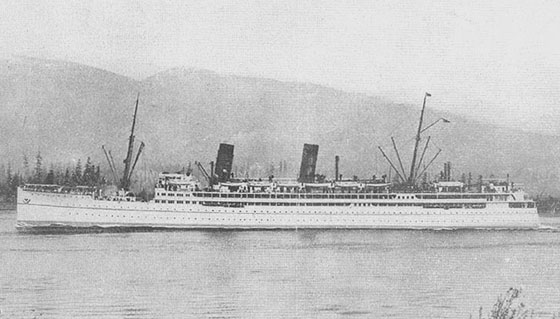
The Aorangi was built by Fairfield Shipbuilding & Engineering Company of Glasgow (hull number 603) for the Union Steamship Company of New Zealand during 1924, it was launched June 17th 1924. It was a quadruple screw vessel powered by four six cylinder Fairfield built Sulzer ST70 two stroke single acting engines of 700mm bore - total of 13,000hp at 127rpm.
The ship was named after Mount Aorangi, a mountain on New Zealand's South Island. Aorangi is from the Maori language 'cloud in the sky'
The Aorangi's maiden voyage commenced from Southampton on January 2nd 1925 for Los Angeles and Vancouver, arriving there on January 30th 1925 after a journey of 9,047 nautical miles at an average speed of seventeen knots. From here the ship commenced her maiden Pacific voyage to Honolulu, Suva, Auckland, Wellington and Sydney on February 6th 1925. On these voyages the ship would spend five days in Vancouver and five days in Sydney, of which thirty six hours of each stop would be spent on disinfecting the ship. This would become her regular route for a number of years. In 1931 potential competition from the American owned Matson Line saw the creation of the Canadian-Australasian Line, from an agreement between the Union Steamship Company and the Canadian Pacific Railway Company, the Aorangi and Niagara were transferred to this new company.
The Aorangi was the first of a new breed of large liners powered by diesel engines. It was running on schedules more suited to slower vessels, thus the Aorangi consistently gained on the timetables. Even on the 'short' legs, such as the 2,400 mile Honolulu - Vancouver leg scheduled for six and a half days, the Aorangi would gain twelve hours on the schedule. During the first year's operation her average speed was 16.54 knots with a daily fuel consumption of 53 - 56 tons which included fuel for the diesel engines, refridgerating plant, heating and laundry operations.
1924
The first large ocean going mail and passenger liner to be propelled by internal combustion engines was successfully launched from the yard of the Fairfield Shipbuilding and Engineering Company of Govan on June 17th 1924 for the Union Steam Ship Co Ltd of New Zealand. When completed the vessel would be the largest vessel of the Union Company's fleet and was intended for the Canadian-Australasian Royal mail service. The vessel, when ordered, was the largest motor ship then known in the world. The new vessel, which was christened the Aorangi by Mrs Charles Holdsworth, wife of the Managing Director of the owning company, had a displacement tonnage of 23,000 tons, which would place her, for size as well as other qualities, at the head of merchant steamers trading through the Southern Pacific. Her chief dimensions were - Length, 600 feet; Beam at the upper deck 72 feet, at the promonade deck 74 feet, and 71 feet at the boat deck; Moulded Depth, 46 feet; and was fitted With two funnels, two pole masts and a cruiser stern, creating a well proportioned and imposing but graceful profile. The Aorangi had four screws, propelled by four reversible single acting two-cycle six cylinder Fairfield Sulzer Diesel engines, with an aggregate of 13,000 brake horsepower, designed for a speed of 18 knots. Four electric generators, driven by Sulzer four-cylinder two-cycle Diesel engines were installed. Steam for driving auxiliary machinery was provided by two single-ended cylindrical boilers, burning oil fuel, with natural draught. The ship's bunkers contained sufficient oil fuel to handle a round trip voyage between Vancouver and Sydney, a total distance of 15,000 miles, equal to about five trips across the Atlantic. On six decks there was accommodation for 440 first class, 300 second class, and 230 third class passengers, looked after by a complement of 330 officers and crew. In addition to the passenger accommodation the Aorangi's public rooms, as designed, combined the stateliness and dignity of the best periods of interior furnishing and decoration with all the comfort and the best hygienic practice of the period, and that the latter is common to the whole of the detail of the ship's passenger accommodation down to the corridors, bathrooms and sanitary offices. Eleven per cent of the total first class passengers have single berth cabins whilst seventy six per cent have two berth cabin. A large area of promenade deck near the first class verandah cafe had been allotted, and equipped for open air dancing, comprehensive programmes of film displays were given in the public rooms during voyages. The ship could carry 1,000 tons of fresh water for drinking purposes. While principally designed for passengers, the Aorangi could carry a considerable quantity of cargo in her eight holds, which were equipped with 16 silent winches. A large part of the hold space were equipped to handle refrigerated cargo, frozen meat, cheese, butter, or fruit. In shipping circles the performances of the Aorangi would be followed with keen attention, for upon the measure of her success would depend the adoption in general of the policy which has inspired the Union Steam Ship Company in their projection of this passenger steamer.
With the Aorangi being outfitted on the Clyde and with comprehensive testing and sea trials expected during November and December, the Union Steam Ship Company set about the reorganisation of its services in anticipation of the Aorangi entering service on the Sydney, Auckland, Suva, Honolulu, Vancouver service. The proposals included transferring the R.M.S. Makura to the Union Royal Mail Line, operating between Sydney, Wellington, Rorotonga, Papeete, and San Francisco. The R M.S. Maunganui would be withdrawn, and the Makura and Tahiti would maintain this service, whilst the Niagara joined the Aorangi on the Sydney - Vancouver service. The first sailing from Sydney of the Aorangi for Vancouver was planned for March 12th 1925, having arrived on its first Pacific crossing from the Vancouver end in February 1925. On the arrival of the R.M.S Makura in Sydney on January 10th 1925, the vessel underwent an extensive four week overhaul, with her Vancouver trip covered by the R.M.S. Tahiti. This vessel will not extend to Sydney from Wellington on her arrival on January 19th, but will proceed to Auckland, whence she sails on January 27th for Vancouver and San Francisco. The steamer Marama, which leaves Sydney on January 16th, will take the Australian passengers for the Tahiti to Wellington, and will bring back from Wellington the Tahiti's passengers bound to Australia from San Francisco. When the R.M.S. Niagara arrives in Sydney on February 7th she will undergo overhaul, and the Makura will take her place in the sailing from Sydney on February 12th. The Niagara will not then leave Sydney until April 9th, and on her return from Vancouver the Makura will take the place of the Maunganui in the San Francisco run.
During the second week of December 1924 the Aorangi commenced sea trials totalling 1,000 miles, the tests being described as some of the most important in the history of the British merchant marine. The trials included operating the ship under varied conditions of fuel consumption and speed. Following the successful completion of the trials the date of January 2nd 1925 had been set for the Aorangi's maiden voyage from Southampton to Sydney.
December 13th 1924 - On the final trip to Glasgow of the Aorangi prior to her maiden voyage from Southampton to Australia, Alfred James, the chief steward, fell overboard and disappeared.
On December 16th 1924 three hundred prominent individuals, including engineering superintendents from the seventy leading shipping companies were invited to a cruise on the Aorangi. Speaking at the luncheon, Sir Alexander Fairfield said that in exhaustive trials the vessel had maintained 18 knots an hour for 60 hours.

1925
Following on from the successful tests and the short cruise the Aorangi departed the Clyde on December 30th 1924 headed for Southampton, running into some bad weather. Waiting to embark here on January 2nd were a thousand Australian and New Zealand passengers, including Sir Charles Hordern, Sir Hugh Denison, Sir John Vicars and General Bismey. Her itinerary for the 17,000 mile passage included Kingston, Colon, Bilbay, the Panama Canal, Los Angeles, San Francisco and Vancouver, with arrival expected there on January 29th 1925. Departing from Vancouver on February 6th 1925 the Aorangi would then follow the regular route to Honolulu, Suva and Auckland, but would be diverted to Wellington prior to reaching Sydney on March 3rd 1925. The Aorangi's arrival in Australia would mark the jubilee of the Union Steamship Company of New Zealand. The Australian and Canadian Governments had admitted that their vessels were loss making, and used the taxpayer to compensate them for their losses. The only way to compete was to give the best service, the Aorangi was certainly capable of providing that.
After clearing Southampton on her maiden voyage the vessel ran into heavy seas, which prevented dropping off the pilot, requiring the Aorangi to drop anchor off Ryde until the pilot could be dropped off the next morning. By January 5th 400 miles had already been covered, early reports stated from the engineering experts aboard that the engines ran excellently in the teeth of an Atlantic gale and huge seas. Despite the challenging start the Aorangi reached Vancouver on schedule allowing her to take up her first sailing from Vancouver to Sydney as planned on February 6th 1925. About four hundred miles off the northern California coast on the afternoon of February 7th an abnormally large wave struck the ship. It smashed the bridge and the promenade deck, breaking a man's leg and injuring a boy with broken glass.
On February 15th the log showed a run of 429 miles in 24 hours. Three days later 436 miles were covered, whilst another 24 hour period recorded 456 miles or an average of almost 18 knots. In contrast her best daily performance in crossing the Atlantic had been 425 miles.
A correspondent from the London Evening Post reported on the maiden voyage:
R.M.M.S. AORANGI
A RECEPTION ON BOARD
CAPTAIN R. CRAWFORD
LONDON, January 1925 - If all goes well and according to programme, the Royal Mail motor-ship Aorangi will arrive at Auckland on the morning of 24th February, she will be in Wellington on 27th February, and next day will start on the final stage of her maiden trip to Sydney. It is evident therefore, that the people of Auckland and Wellington will not have much opportunity on this occasion of inspecting the latest palatial liner which the Union Steam Ship Company is placing on its Canadian service.
With her 300 first-class passengers and 200 in the second class, the Aorangi left Southampton in the most severe weather, even the hardened traveller could not have hoped for a happy time for two or three days, but as the commander, Captain R Crawford, said at a luncheon on board given the day prior to sailing, of the twenty-three ships he had commanded none behaved so well in heavy weather. He had never been on a better boat. The Aorangi had just completed her journey from Scotland in the teeth of a gale in the Irish Channel, but the passengers who embarked at Glasgow had not been unduly disturbed by the passage.
We had drastic tests said Captain Crawford in the same speech, before we left the Firth of Clyde on the present voyage. Among other things we went full astern for one hour. Those on board who had not been told did not know we were going astern. Where one would have expected the greatest vibration, there was no vibration at all. This was the impression that the commander had obtained of his new charge during the first day at sea. Although much of the journey will be done in summer seas, the passengers will, during the first few days out from Southampton have ample opportunity of testing the vessel's capacity in the heavy weather. As to the comfort of the vessel in the calmer waters of the tropics and the Southern Hemisphere there can be no doubt about that.
Guests whom the company invited to inspect the new liner and to have luncheon on board arrived at the docks at Southampton when the Aorangi was still a few hundred yards from the quay. One had an opportunity of seeing her lines from a reasonable distance. She came in stern foremost, escorted and assisted by a couple of tugs. The stern itself is the first thing of interest. It is rounded off like the stern of a naval cruiser. Seeing that there are no furnaces on board, one looked to the funnels with interest. There were two of them and they were ejecting a small amount of smoke. But they are not the very solid looking funnels of a steamer. They are oval rather than round. All the fumes from the Diesel engines and the smoke from the kitchens could very well have been led off through one funnel; but had only one been fitted the appearance of the ship would have been spoiled.
The Aorangi came smartly up to the quay, and a close view revealed the new launching apparatus for the lifeboats, The M'Laughlin type of davits, which are for the first time fitted to a passenger liner, are capable of placing all lifeboats in the water in a few minutes, and one man can launch a lifeboat single-handed. One naturally looked for the patented handrails on the keels of the boats, for use in case of capsizing after launching. Many up-to-date companies are fitting these, for it is realised that very many valuable lives have been thrown away in the past simply because the exhausted victims of shipwreck are unable to cling to the keel of the upturned lifeboats. Where everything else is so modern and up-to-date it seems strange that the Union Company should have neglected to avail themselves of this cheap and humane device.
IN THE ENGINE-ROOM. Some of the visitors had an opportunity of going down into the engine-room. In the past many passengers have given a sympathetic thought to the stokers, especially in the tropics. One could never quite forget that there were men labouring under terrible conditions far down in the pit of the ship. All that is changed, with the internal combustion engines. There are no furnaces, no boilers, no stokers. The four Fairfield-Sulzer Diesel oil-engines take up very little space compared to the boilers and engines of the old reciprocating or turbine installations. Each engine with its six cylinders turns a propeller. If one set were thrown out of gear, the speed of the ship would not be diminished appreciably, and even with two engines and two propellers only in motion a fair speed could be maintained. Moreover, each engine will work with one or two of its cylinders out of action. With this margin of safety passengers will doubtless have plenty of confidence in the new vessel. These engines do away entirely with the great heat one is accustomed to associate with an engine-room. There is, of course, a certain noise with 24 cylinders in action, but this is not communicated to the rest of the ship so severely as is the case with a steamer. The sound is muffled like the sound from the cylinders of a powerful motorcar.
LUXURY STATE-ROOMS. A description of the state-rooms and cabins was supplied even before the vessel was completed, but some impressions from a passenger's point of view would perhaps be acceptable. It is natural of course that the first-class passengers should have the best of everything on board the ship. They have. The dining-saloon, designed after the period of Louis XVI seats 213 people. The tables are for four, six, or eight and a large round table at the head will seat a dozen. Chairs in the first and second saloons are not built to the deck as is the usual custom but are ordinary arm chairs with chains from the centre of the under part of the seat affixing them loosely to the floor. Curtained windows on each side of the saloon give access to the promenade deck. The wall opening above is surrounded by gilded balustrading, and over the chief table is a striking tapestry panel after the manner of Bouchers.
The First Class lounge hall, 64ft by 43ft 6in, is a really beautiful room. One may look down upon it from a fairly wide gallery, and all round the back of this gallery are cosy nooks. One of the features of this area is the oil painting of Mount Cook. It is incorporated in the panelling at the half-landing of the staircase that leads up to the gallery. Just outside the large smoking-room is a winter or summer garden, or, as it is officially called a verandah cafe. The deck here for some considerable distance is free from rail to rail, that is a width of 72ft and those who dance may not only use this open space, but may deviate down the promenade decks on either side. While on the subject of dancing it may be said, that the music of the orchestra will be distributed to the second-class compartments and to the third-class by means of sensitive microphones. For dancing on deck the one orchestra serves for first and second class passengers as their dancing floors are contiguous.
PROVISION FOR ATHLETES. First-class passengers also have a handsome music-room or ladies room. Here the furniture is of French walnut. The Grand piano is of walnut. A large chesterfield is placed before a cosy looking fireplace surrounded with a marble mantelpiece. In all the common rooms the fires are of that variety which is a good imitation of glowing coals. In actual fact they are electric grates. There is a small library, a children's day nursery, fitted with numerous things that children delight in and on the top deck there is a gymnasium, with punch balls, parallel bars, weight-lifting machines, an electric horse, stationary bicycles which can be ridden in contest, the pace being indicated by clock hands. For rowing men going abroad there is a rowing machine, Boxing gloves, Indian clubs, and other small apparatus complete a well-equipped compartment. They are indeed fortunate people who are able to travel in the cabines de luxe. There are eight different period styles such as Empire, Adam, Louis XVI. There are two beds in each, separated by a handsome dressing table. Each spacious chamber has a marble lined bathroom attached. The ordinary firstclass cabins are comfortable. Of these, 76 per cent are two berth, 11 per cent are one berth, and the remaining are three berth. Each berth holder has a wardrobe to himself. So far as the cabins themselves are concerned, the second class passengers are almost as well provided for as the first. It is in the matter of public rooms that the first class passengers have the advantage. Not having experienced the greater luxury, however, the second-class passengers would never miss it, for their own public rooms though fewer and smaller are very attractive. The smoking room, for instance, is panelled and furnished in the style of the old oak cottage. This is an irregular chamber on the one side of the deck. On the other side of the deck and similar in shape is the ladies room, which is brightly furnished in blue and well supplied with comfortable armchairs and sofas. The dining saloon accommodates 180 at tables for four and six people. Public rooms attached to the third class are naturally plain compared to the other sections of the ship, but the cabins are not of that uninviting severity which is often found in this part of the ship. There is plenty of room and a good deal of comfort in the cabins and but for the fact that they are placed near the bows of the vessel, they compare favourably with the secondclass accommodation.
AN IMPORTANT INNOVATION. One feature of the vessel is probably in advance of that of the other luxury ships afloat to-day. This is the laundry. It is fitted up on the lines of an up-to-date laundry ashore. All the machinery is electrically driven. There are linen and flannel washing and extracting plant dryers, ironing machines, clothes and linen presses, cuff and collar machines. The whole of the ship's linen can be dealt with onboard, as well as passengers laundry and valeting. A dress shirt, for instance can be washed and ironed and returned to the owner within three hours, an accomplishment which means very much on a long voyage. As the passage of the ship will be very largely in tropical waters the matter of electric fans has been well attended to. There are rows of these on the ceilings of the public rooms, and when all are in motion there should be the maximum of cool air.
THE FAREWELL LUNCHEON. At the reception on board on the day prior to departure, some 200 guests brought by special train from London were present. The majority of these were agents and others connected with shipping. But Australia and New Zealand were officially represented. Sir James Mills, who is a passenger for California, though he may decide to go on to New Zealand was unable to be present, so Mr C. Holdsworth acted as host and chairman at the luncheon. Others present were Sir James and Lady Allen, Mr. and Mrs. A. F. Roberts, Mr. and Mrs. A. Michie, Mr. R. Forsyth, Mr. G. and the Hon. Mrs Holdsworth, Mr. Robert Mill, Mr. H T.B. Drew.
A NOTABLE JUBILEE. Speaking after the luncheon, Sir James Allen said it was a unique occasion. For one thing 1925 was the jubilee year of the Union Steam Ship Company. He regetted that Sir James Mills was unable to be present, but he was sure that all present and others would wish that a telegram should be sent to Sir James conveying good wishes for the New Year, and the greatest success for the company which he founded. He hoped that Sir James would have a very pleasant voyage to the land which owed so much to him. The Union Steam Ship Company was the first company to build a steel ship, the first to build a turbine and now it had the distinction of building the first motor vessel. It was a credit not only to Sir James Mills, but to Mr Holdsworth, the managing director of the company. Mr. Eva, previously of the Union Company, but now London manager of the Commonwealth Line of steamers, proposed the health of Captain Robert Crawford, the new commander. He predicted that Captain Crawford handle the ship to his own credit and to the credit of the company.
The ship arrived at Suva at 1pm on February 21st after a smooth, trouble free ride from Honolulu, sailing later that day at 6.30pm for Auckland. Amid much fanfare the Aorangi arrived in Auckland at noon on February 24th. The waterfront was bedecked with flags and large crowds assembled on the wharf to witness the arrival. After docking the vessel was thrown open to the public at a charge of one shilling, the proceeds going to charities. That evening over 600 hundred guests attended a reception aboard the Aorangi.
The maiden voyage was uniquely celebrated when at three o'clock on Sunday morning third-class passenger Mrs Devries, wife of a young motor mechanic of Adelaide Road, Wellington gave birth to a daughter. The Devries family had been investigating prospects in Canada, but decided that New Zealand was better. The baby's second name will be Aorangi. A substantial amount was collected among the passengers, and presents of clothes were also made for the baby. It was also reported by Captain Crawford on this day that for the 24 hours ended noon on Sunday the vessel covered 424 miles.
Whilst mechanically the ship may have performed magnificently on its maiden voyage, some of the passengers were not so impressed with regard to the service offered. They complained the service was faulty and lacked a uniform efficiency, apparently the staff of stewards used on this sailing were for this trip only, once the regular timetable began permanent staff would be used, which would mitigate these issues on future sailings. Some of the complaints were published in the Auckland 'Herald' leading the stewards to refuse to serve the next night's dinner until an assurance was given that a modification of the report would be made. Captain Crawford promised to communicate with the "Herald," and to make a statement to the press that on the whole the stewards were competent. On this assurance being given the stewards served dinner. Additionally the first-class passengers complained that as additional cabins were built at the last moment, accommodation was greatly curtailed.
The Aorangi arrived in Wellington on the morning of February 27th 1925 and again attracted great crowds to the wharfs throughout the day. Among the visitors were the Vice-Regal party and a number of Ministers of the Crown. Great numbers of people inspected the vessel in the afternoon. Overcrowding was prevented by the issue of invitation tickets.
The Aorangi arrived in Sydney on Tuesday March 3rd 1925 and as the largest and speediest motor liner afloat she was as interesting to engineers as to the general public. A large number of engineers from all parts of Australia were travelling to Sydney to inspect the vessel during her stay in port. The Institute of Engineers had made arrangements with the Union Steam Ship Company for a special visit of inspection by its members. On March 5th many of these engineers gathered on the Aorangi and were the guests of the company at luncheon.
Speeches after the luncheon praised the Union Steamship Company, its staff and the Captain with regard to the Aorangi:
In proposing the health of the Union Steamship Co. Ltd., Sir Owen Cox said he would like to express, on behalf of the gathering and the people of Australia generally, their appreciation of the enterprise of the company in bringing this new vessel into the Australian trade. (Applause.) The Aorangi had internal combustion engines; never before had a steamer of her size and power been fitted with that class of engines. The world was full of progress, and it was also full of those who tried to throw a wet blanket on enterprise. If ever a company had had a wet blanket tbrown on them it was tha directors of this company and those connected with this particular vessel. Everybody had said that it must be a failure, but all through her building, and right up to the time when the vessel began her voyage, those responsible for her had stuck to their guns and had proved that this class of vessel, which was to be the pioneer of many others of a similar class, would be a success. Sir Owen Cox said he would like to pay a special tribute to one of the company's directors (Mr. Holdsworth), who had been seriously ill, but was happily now recovered, for the interest he had taken in the construction of this vessel. The Aorangi had been Mr Holdsworth's pet scheme, and the internal combustion engines had proved to be such a success that within one year one could expect to see nearly all the steamship owners of the world building vessels of a similar type. He wished the company every possible success in their enterprise. (Applause.)
In replying, the general manager of the Union Steamship Co. in Australia (Mr. C. H. Hughes) said that his directors would be very gratified when he conveyed to them the expressions of appreciation that had been voiced at this representative gathering. He expressed regret that the managing director of the company (Mr Holdsworth) was not present. Mr Holdsworth had made a hobby of this vessel, and had gone specially to witness its construction. He had intended to come out to Australia on the ship, but had unfortunately been taken ill, and had been ordered ashore by the doctors at Vancouver. He (Mr Hughes) had had a cablegram, however, that Mr Holdsworth was now quite recovered and would be leaving for Australia shortly. As Sir Owen Cox had said, great doubts had been expressed as to the vessel's success, and the fact that she had so successfully accomplished her maiden voyage in such severe weather was a tribute to her builders, her commander, her officers and particularly her engineers. When the order was given for her construction the maritime world was not certain that she would be a success, but the result had justified all the company's anticipations and her oil consumption and speed were far better than had been expected. (Applause.)
The company had been the pioneer of many innovations in shipping. It had built the first steel ship, the Rotomahana, and introduced the first quadruple expansion engines in the Pukaki, the first turbine steamer in the Loongana which was running as satisfactorily today as when she first arrived; the first electric lighting system on passenger steamers, on the Manapouri and Wairarapa; the first oil burning engines on the Niagara and as a fitting record of the company's Jubilee which would be celebrated this year it had now introduced the first internal combustion engines on a vessel of this size. It was hoped that the chairman of the company (Sir James Mills) would be out here to take part in the company's Jubilee celebrations. (Applause). Mr Hughes expressed the thanks of the company to the Harbour Trust Commissioners for allowing them to berth the steamer at Circular Quay, and so allow the public to see the vessel with the least inconvenience.
The Premier (Sir George Fuller), in proposing the health of the commander of the ship (Captain Crawford), said he hoped that they would honour the toast with the greatest possible enthusiasm. He had had the pleasure of sailing with Captain Crawford on other vessels. He claimed to be able to speak of Captain Crawford, both in his capacity as a commander and also as a man. Sir George Fuller added that he felt that the Union Steamship Co. must feel great pride, indeed, in the fact that they had this great vessel in Sydney, and that they were the pioneers of the largest passenger boat of this class in the world. That pride was reflected upon the people of this country. The great future of Australia depended largely, not only upon individual enterprise, but also upon company enterprise, and the company were to be congratulated upon their activities. This was an epoch-making time in regard to shipping in this country, and it was a tribute to Captain Crawford that he had been chosen by reason of his splendid seamanship and fine tact, to take charge of this magnificent boat, and to be responsible for the lives and the safety of its passengers. He hoped that Captain Crawford would long remain in the splendid position he occupied at the present time. (Applause.)
Captain Crawford thanked the company for the enthusiastic reception that they had accorded the toast. He was very proud, he said, of being placed in command of this fine ship, and he was pleased to bid them welcome to it. As Sir Owen Cox had said, the great advance which marked the ship was in the engines, which had proved an unqualified success. He had never had the least anxiety about the ship at sea or at work in port. She had proved herself a splendid sea boat and worked, steered, and handled as well as any ship be had ever been on. Captain Crawford also expressed big appreciation of the action of the Harbour Trust in allowing the ship to berth at Circular Quay.
On the evening of March 6th the directors of the Union Steamship Company and the commander gave an "at home" on board the Aorangi at Circular Quay. About 1,200 invitations were issued, so the large vessel was alive with the sound of dancing, music, and gaiety. Festoons of Chinese lanterns and bunting adorned the docks. Supper was served in the dining-room, and on deck, where dancing was also held.
Shortly after the arrival of the Aorangi at Sydney the officials of the Federated Seamen's Union and of the Federated Marine Stewards and Pantrymen's Association expressed dissatisfaction concerning the engagement of a crew for the Aorangi. The seamen's officials allege that the accommodation on the vessel was quite inadequate. Mr. Fleming, secretary of the Sydney branch of the union, arranged to interview the Union Steamship Company in order to have the matter thoroughly investigated. Should the trouble complained of not be satisfactorily settled the departure of the vessel might be delayed. The following day the secretary (Mr. Fleming) stated that everything was all right between the Union Company and the union, improvements were to be made to the crew's quarters. Thirty seamen, whom the company proposed to retain on the Aorangi met at the union office and agreed to leave the ship. A complete new crew would be signed on.
With the ship still docked in Sydney the visitors continued to visit in large numbers. On the weekend of March 7th & 8th 11,000 visitors were counted. On Saturday 3,200 people visited the ship, and on Sunday afternoon the attendance was 7,760. A charge was made for admission, the proceeds were distributed among various charities. The large crowds were handled without incident both on and off the ship. The vessel would be removed at 6 am on March 9th to Woolwich Dock, and after cleaning and painting berthed at No. 5 wharf, Darling Harbour, prior to commencing here regular service, sailing on Thursday (12th) at midday for Vancouver with a total of 640 passengers.
The 1925 sailings - some details incomplete:
Feb 8th depart Vancouver; Honolulu Feb??; Suva Feb 21st; Auckland Feb 24th; Wellington Feb 27th; arr Sydney March 3rd
March 12th departed Sydney; Auckland Mar??; Suva Mar??; Honolulu Mar??; Vancouver April??
April 8th departed Vancouver; Honolulu Apr??; Suva Apr 23rd; Auckland April 26th; arrive Sydney May 1st
May 7th departed Sydney; Auckland May 13th; Suva May??; Honolulu May??; Vancouver June??
June 3rd departed Vancouver; Honolulu June??; Suva June??; Auckland June 21st; arrive Sydney June 26th
July 2nd departed Sydney; Auckland July 5th; Suva July 10th; Honolulu July??; Vancouver July??
July 29th departed Vancouver; Honolulu Aug??; Suva Aug??; Auckland Aug 18th; arrive Sydney August 21st*
August 27th departed Sydney; Auckland Aug 29th; Suva Sept 4th; Honolulu Sept??; Vancouver Sept??
September 23rd departed Vancouver; Honolulu Sept??; Suva Oct 8th; Auckland Oct 14th; arrive Sydney October 17th*
October?? departed Sydney; Auckland Oct 27th; Suva Oct??; Honolulu Nov??; Vancouver Nov??
November 18th departed Vancouver; Honolulu Nov 25th; Suva Dec 4th; Auckland Dec 7th; arrive Sydney Dec 11th*
December 17th departed Sydney; Auckland Dec ??; Suva Dec 25th; Honolulu Jan??; Vancouver Jan 8th
Frequently the Aorangi was able to get ahead of its schedule. On its sailings in April 1925 it made fast time to Vancouver, reaching Victoria a day before the scheduled date. Returning south, the vessel encountered a fresh gale and high seas on the third day out from Vancouver. The storm lasted two days, during which time the speed averaged was 14.5 knots. From Honolulu to Suva the average was 16.9 knots, and from Suva to Auckland 17.2 knots. For the last 24 hours before arriving at Auckland, which was reached 21 hours ahead of schedule, the average was 17.8 knots.
July 2nd 1925 - delayed 7 hours leaving Sydney following breakdown of the port auxiliary electric generator.
As well as interfering with the ship at sea, bad weather could also impact its operations at the dock. On its arrival at Auckland on October 12th heavy rain interfered with the cargo operations, delaying the departure until Wednesday October 14th. When the ship did finally sail for Sydney it was required to run at slow speed for about thirty minutes whilst the ship's surgeon carried out an urgent appendectomy. The surgery was successful.
On October 9th whilst at sea an operation for appendicitis was performed on Mrs H Davis, a passenger by the Aorangi for Sydney. The operation was performed by the ship's surgeon, Dr Leauroyd, and an Auckland doctor. The patient was reported as doing well.
During the first week of November (?) the Aorangi detoured to Hull Island, a tiny atoll two days journey from Fiji. The small island had a copra mining outfit but the owners (the Samoan Shipping & Trading Co?) had gone into bankruptcy leaving one white man and twenty five natives stranded with no resources remaining. The Governor of Fiji, Sir Eyre Hutson had been petitioned to provide relief to those on the small island. The Aorangi landed emergency supplies to assist the marooned men and must have presented an impressive sight for a location well away from the major shipping lanes. A relief ship was then sent out from Suva to take off the community and the fifty tons of accumulated copra. Hull Island is now Orona Atoll, part of the Phoenix Islands in the Republic of Kiribati.
The sailing from Vancouver for Sydney on November 18th was one of the last chances for mail to reach Australia in time for Christmas. On this trip sixty tons of mail was being carried, most of it British. Also in the cargo was 19,000 cases of apples.
The Aorangi was detained at Honolulu for several hours on Wednesday November 25th in the custody of a United States Marshal pending the filing of a bond to cover libel proceedings brought against the owners of the vessel by actor William Howard Doody and his wife. Doody alleged that on the last run of the Aorangi from Sydney a steward 'beat him up' which is reported as American slang for slandered him. Damages were claimed in the amount of 20,000 dollars (about pounds 5,200) for loss of contracts, personal injuries, slander and doctors bills!
On arrival at Auckland on December 7th the 260 through passengers for Sydney were joined by a further 300 crossing from Auckland to Sydney.
The northbound departure from Sydney on December 17th 1925 led to an unusual event for those travelling on the Aorangi. Christmas Day as celebrated in Australia would find the Aorangi berthed at Suva, with the ship departing on Christmas afternoon for Honolulu. In doing so the 180th longtitude was crossed later that evening. With the ship crossing the dateline heading west to east the passengers would find that on rising the next morning the date would still be Friday, December 25th, and another Christmas would need to be celebrated. For the Union Steamship Company this situation was more of a challenge since they might be required to pay the crew overtime rates for two Christmas days!
1926
The 1926 sailings - some details incomplete:
January 8th 1926 arrived Vancouver
January 13th departed Vancouver; Honolulu Jan??; Suva Jan 28th; Auckland Jan 31st; arrive Sydney Feb 5th.
February 11th departed Sydney; Auckland Feb 16th; Suva Feb??; Honolulu Feb??; Vancouver Mar??
March 10th departed Vancouver; Honolulu Mar??; Suva Mar 25th; Auckland Mar 30th; arrive Sydney Apr 2nd.
April 10th (?) departed Sydney; Auckland Apr 13th; Suva Apr??; Honolulu Apr??; Vancouver May??
May 6th departed Vancouver; Honolulu May??; Suva May??; Auckland May 24th; arrive Sydney May 29th.
June 3rd departed Sydney; Auckland June 7th; Suva June 11th; Honolulu Jun??; Vancouver Jun??
June 30th departed Vancouver; Honolulu July??; Suva July 15th; Auckland July 19th; arrive Sydney July 22nd.
July 29th departed Sydney; Auckland Aug 2nd; Suva Aug??; Honolulu Aug??; Vancouver Aug??
August 23rd departed Vancouver; Honolulu Aug??; Suva Sep??; Auckland Sept 12th; arrive Sydney Sept 17th.
September 23rd departed Sydney; Auckland Sept 27th; Suva Oct 1st; Honolulu Oct??; Vancouver Oct??
October 21st departed Vancouver; Honolulu Oct??; Suva Nov??; Auckland Nov 8th; arrive Sydney Nov 12th.
November 19th departed Sydney; Auckland Nov??; Suva Nov??; Honolulu Dec??; Vancouver Dec 10th*
December 16th departed Vancouver; Honolulu Dec 24th; Suva Dec 30th; Auckland Jan 2nd; arrive Sydney Jan 7th.
The ship's first arrival at Vancouver for 1926 was a day late, arriving on the afternoon of Friday January 8th after the ship had been anchored for a day in a fog outside the perilous narrows at the entrance to Vancouver. The delay marred a record run from Sydney, the average speed being 17.1 knots. This was also the trip on which the passengers celebrated two Christmas Days.
The northbound April departure from Sydney was delayed due to the timing of the Easter holidays.
The route worked by the Aorangi was a critical part of the global mail delivery system and occasionally remarkable efforts were made to ensure the mails would reach the vessels before departure. Such an occurrence began with the delayed arrival of the Canadian Pacific steamer Montcalm, sailing from the United Kingdom to Quebec with mails for Australia. The Montcalm had been delayed by fog & ice in the Gulf of St Lawrence and only reached Quebec on May 1st. In an attempt to save the day the Canadian Pacific Railway laid on a special train, departing Quebec at 10am on May 1st and reaching Vancouver on May 6th at 5.30pm, having covered a distance of 3,057 miles. The delayed Aorangi left on the evening of May 6th, the Captain certain that the time could be made up on the journey across the Pacific.
On the southbound voyage during May a bottle containing the message 'R.M.S. Aorangi, May 18th 1926. latitude 8 deg. 9 min. south, longitude 174 deg. 32 min. west. Naval Department, United States Hydro Office, Washington' was dropped overboard. On July 30th 1929 it was reported from Innisfail that the bottle had been picked up one and a half miles south of Double Point, near the Barbard Islands.
A party of gipsies from Sydney by the Aorangi were refused permission to land in New Zealand. Pending official instructions, the gipsies, who numbered about twenty would be returned to Australia.
The Aorangi arrived in Sydney from Vancouver on the evening of July 22nd 1926 two days ahead of time, thereby eclipsing previous records. She took only 3 days and 2 hours to come from Auckland. The ship would anchor overnight in Watson's Bay having arrived too late to have the medical inspections and moved to her berth at No. 6 Wharf, Darling Harbour at about 8.00am the following morning. Included in the arriving passengers was the Indian Army hockey team.
The southbound sailing during August saw the Aorangi carrying 300,000lb of British Columbia onions for the Australian market. Also onboard the ship was money totalling £300,000 being shipped to Australia.
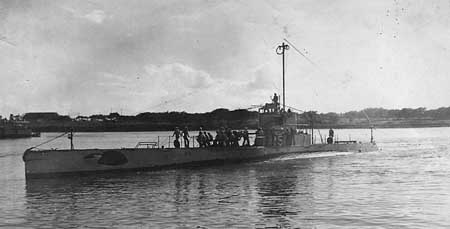
On Christmas Eve 1926 whilst the Aorangi was departing Honolulu for Suva the ship came into collision with the United States submarine R5 at the quarantine wharf. Local investigators blamed the Aorangi, which they allege backed into the submarine whilst she was clearing for Australia. The submarine was badly twisted, her bows being deflected ten degrees from regular. The damage was estimated at 25,000 dollars. The Aorangi was expected to depart Auckland on New Years Day, 1927 and reach Sydney on January 7th 1927.
1927
The 1927 sailings - some details incomplete:
January 7th 1927 arrived Sydney
January 14th 1927 covered by the Tahiti & Marama whilst the Aorangi was overhauled
March ??departed Sydney; Auckland March 14th; Suva March 18th; Honolulu Mar??; Vancouver Mar??
April ??departed Vancouver; Honolulu Apr??; Suva Apr??; Auckland Apr 25th; arrive Sydney Apr 30th.
May 5th departed Sydney; Auckland May??; Suva May 13th; Honolulu May??; Vancouver Jun??
June 1st departed Vancouver; Honolulu Jun??; Suva June 16th; Auckland Jun 19th; arrive Sydney Jun 24th.
June 30th departed Sydney; Auckland July 4th; Suva July 8th; Honolulu July??; Vancouver July 22nd*
July 27th departed Vancouver; Honolulu Aug??; Suva Aug 11th; Auckland Aug 15th; arrive Sydney Aug 19th
August 25th departed Sydney; Auckland Aug 29th; Suva Sep??; Honolulu Sep??; Vancouver Sep 16th*
September 21st departed Vancouver; Honolulu Sep??; Suva Oct 6th; Auckland Oct 10th; arrive Sydney Oct 15th
Oct ?? departed Sydney; Auckland Oct 24th; Suva Oct ??; Honolulu Nov??; Vancouver Nov??
Nov 16th departed Vancouver; Honolulu Nov??; Suva Dec 1st; Auckland Dec 5th arrive Sydney Dec 9th
Dec 15th departed Sydney; Auckland Dec ??; Suva Dec 23rd; Honolulu Dec??; Vancouver Jan 6th*
During October 1926 it was announced that the Aorangi would be taken out of service early in 1927 to allow for a general overhaul, resulting in the missing of one trip. After arrival at Sydney on January 7th 1926 the Aorangi was replaced by the RMS Tahiti, which departed on January 14th taking the northbound passengers to Auckland where they were transferred to the Marama for the run to Vancouver.
Whilst sailing from Sydney to Auckland in the second week of May a delay of four hours was experienced near Three Kings due to a strong easterly gale. The Marama was also was delayed by the storm.
Not all the passengers travelling on the Aorangi were of a reputable nature. On the nortbound sailing due at Vancouver in early June Australian passenger Gaymard was urged by an unidentified American to invest in Vancouver property and to cable A£9,000 to complete the deal. Suspicious of the deal, Mr Gaymard's agent notified the police and cancelled the intended payment - the American vanished on reaching Vancouver.
On September 21st the Aorangi sailed for Sydney with the passenger list including Sir C. and Lady Holdsworth, Sir W. and Lady Brunton and the Australian Band. The freight included the first season's shipment of Canadian apples and onions consigned to New Zealand, and freshly canned salmon consigned to Australia.
On the northbound October sailing from Auckland the cargo included 6,510 boxes of butter bound for British Columbia, 1,858 for Honolulu and 1,487 for Shanghai.
November 24th 1927 - whilst travelling from Vancouver to Auckland Mr Richard E Jamieson aged 61 and managing director of the Gregory Tyre Co. Ltd, Vancouver, died from acute gastritis whilst nearing Honolulu. He was buried at sea.
Towards the end of 1927 the ship's engines were overhauled for the first time since entering service. To this point the ship had travelled just over 200,000 nautical miles at an average speed of 16.44 knots. A total of 12,224 engine hours had been run up with an average daily fuel consumption of 45.8 tons for propelling purposes only. By December 1927 the overhaul was complete and the Aorangi returned to her regular sailings.
On the northbound December sailing of the Aorangi a record 35,293 boxes of butter were loaded at Auckland, with 33,305 for Vancouver, 1,360 for Honolulu and 628 for Shanghai & Japan.
1928
The 1928 sailings - some details incomplete:
January 11th departed Vancouver; Honolulu Jan??; Suva Jan 27th; Auckland Jan 29th; arrive Sydney Feb ??
February 9th departed Sydney; Auckland Feb 12th; Suva Feb??; Honolulu Feb??; Vancouver Mar??
March 7th departed Vancouver; Honolulu March 14th; Suva March 23rd; Auckland March 25th; arrive Sydney March 29th
April 6th departed Sydney; Auckland April 9th; Suva Apr??; Honolulu Apr??; Vancouver April 27th
May 2nd departed Vancouver; Honolulu May ??; Suva May ??; Auckland May 21st; arrive Sydney May 26th*
May 31st departed Sydney; Auckland June 4th; Suva June??; Honolulu June??; Vancouver June 22nd*
June 27th departed Vancouver; Honolulu July ??; Suva July ??; Auckland July 16th; arrive Sydney July 20th
July 26th departed Sydney; Auckland July 31st; Suva Aug 3rd; Honolulu Aug??; Vancouver Aug 17th*
August 22nd departed Vancouver; Honolulu Aug ??; Suva Sept 6th; Auckland Sept 10th; arrive Sydney Sept 14th
September 20th departed Sydney; Auckland Sept 25th; Suva Sept 28th; Honolulu Oct??; Vancouver Oct ??
October 11th departed Vancouver; Honolulu Oct ??; Suva Nov ??; Auckland Nov 5th; arrive Sydney Nov ??
November 15th departed Sydney; Auckland Nov 19th; Suva Nov 24th; Honolulu Nov??; Vancouver Dec 7th*
December 12th departed Vancouver; Honolulu Dec ??; Suva Dec 27th; Auckland Dec 30th; arrive Sydney arr Jan 4th
On its first trip south in 1928 on the night of January 11th(?) the Aorangi responded to a distress call recieved from the British steamer Griffco reported as 200 miles off the coast of North America. Distress signals were recieved but before full details of the plight of the ship could be obtained the wireless faded. The Aorangi had been passing Cape Flattery when the distress call was heard, and then headed south at full speed in the hopes of providing assistance. The 1,426 ton Griffco with a crew of 22 had sailed on Tuesday from Seattle for Honolulu. Its distress calls had been transmitted for about an hour until the signal faded, but no position or its condition was given in the messages. However the direction finders at the Vancouver Island wireless station had been able to work out an approximate position. Captain Herbert Martin was the master of the Griffco. Travelling on this voyage was Mr Howard Heinz, the noted Pittsburg industrial magnate.
Passengers on the Aorangi on arrival at Auckland on January 30th included 11 officers and 44 lascars who were survivors of the wreck of the Clan MacWilliam. The party was in charge of the chief officer Mr. M G McLean.
On its departure from Vancouver on March 7th 1928 the Aorangi was carrying 350 passengers and 600 tons of cargo. The cargo included flour, lumber, box shooks, canned fish, eighty motor cars and 350 crates of eggs.
Whilst approaching Honolulu en route from Vancouver to Sydney during the latter half of March the Aorangi developed a leak in the rudder trunk. Water entered the engine room and pumping was required. After an examination was made by a diver the decision was made to make repairs when the ship reached Sydney. In order to maintain the schedule the Aorangi would leave Auckland at 3 pm Monday, whether the working of cargo was finished or not. The ship entered the Heads at 6.25pm but did not reach the wharf until 10.10pm due to the examination of the passengers by the medical authorities taking longer than expected. (Under normal circumstances this would have been done the next day).
Officials of the Commonwealth Health Department stated that the delay in the berthing of the Aorangi on arrival from Vancouver on March 29th was due to the fact that the medical examination of the passengers and crew, numbering more than 800 was performed under artificial light. The examination occupied more than tuo hours, about twice the ordinary time. It was pointed out that the months of March and April constitute the danger period of the year, as far as smallpox is concerned. For the reason that a rash was not readily discernible under an electric light, the regulations provided that vessels should be cleared only between sunrise and sunset, except in exceptional circumstances, and then only up to 10pm at the discretion of the chief quarantine officer. The Aorangi was cleared because water was reported to be entering the crew's quarters from the defective rudder trunk, and the department desired to meet the convenience of the passengers rather than compel them to wait for daylight.
Twelve hours were spent alongside the berth No.5 Darling Harbour, allowing about half the cargo to be unloaded. At about noon (30th?) the ship moved to Cockatoo for the rebushing of the rudder trunk, no small task since the rudder weighed 12 tons.
In addition to the mechanical problems on this trip, there was also reported a pair of stowaways who had joined the ship at Honolulu on March 14th. The two were a recently married couple: Mr Basil Stanley (32) & Miss Evelyn Andersen (23). They had met on 12th, were married on 13th and sailed the next day, bluffing their way on to the ship and settling down in a 2nd Class cabin. They carried no passports and little money, when finally confronted about the tickets they were only able to produce $140 which was enough to purchase one 3rd Class passage. At Auckland the pair were questioned by the authorities, with the intention to keep them on the ship and return them to Honolulu. However in the melee of passengers joining and leaving at Auckland, the husband disappeared, the wife now being held by a constable on the ship.
On the northbound April sailing of the Aorangi, 14,000 boxes of butter were loaded at Auckland, with 12,000 of these bound for Vancouver.
In continuation of her voyage from Vancouver the Aorangi departed Auckland at 1 o'clock on May 20th (?) for Sydney. The captain was attempting to reach Sydney Heads before sunset on Thursday, in order to allow the port health authority to clear the vessel before nightfall thus allowing the passengers to disembark that night. In fact the Aorangi entered Sydney Heads at 4.14 pm on May 23rd (?), having crossed the Tasman Sea from Auckland ïn 3 days 4.5 hours steaming time. Earlier this year under similar circumstances she made the crossing in almost the same time.
Cargo on the northbound August 1st sailing of the Aorangi from Auckland included 4,400 boxes of butter for British Columbia, 1,092 boces for Honolul and 700 boxes for Shanghai.
A couple of items made the news in September with regard to the southbound sailing of the Aorangi. A United States scientific expedition which recently visited New Guinea and travelled 10,000 miles by seaplane, 600 miles by canoe, and 400 miles on foot returned to civilisation on the Aorangi with the seaplane shipped complete on the deck. Whilst travelling with her mother & brother to Australia, 17 year old second class passenger Olga Sydes died shortly after leaving Honolulu and was buried at sea.
On its September 25th sailing from Auckland to Vancouver included in the cargo were 16,829 boxes of butter, with 1,293 cases for Honolulu, and 15,215 cases for Vancouver. Also in the cargo hold were the equivalent of three carloads of Australian Valencia oranges. These were intended for sale in Western Canada and it was the first time these oranges had been exported to Canada.
On the Aorangi's southbound trip from Vancouver which commenced in mid October, two deaths were reported of second class passengers. Mr. H. Penhall, aged 60, bound for Australia, died suddenly the day before reaching Honolulu, and was buried at sea. Miss M, Mabson, a New Zealander, died suddenly just before reaching Suva. This working also had the heaviest passenger list of the season, 700+ passengers.
The northbound sailing from Sydney on November 15th included cargo picked up at Auckland of 20,819 boxes of butter for Canada, 2,086 boxes for Honolulu, and 400 boxes for Shanghai. The ship was also carrying a record volume of Christmas mail.
Two passengers on the December 12th departure from Vancouver were found to travelling without tickets, an Englishman, Harry Gunter and a 19 year old Estonian lady, Sylvia Hinn visiting her brother in Australia. Both stowaways were removed at Honolulu, and would return to Vancouver on the Niagara.
1929
The 1929 sailings - some details incomplete:
January 10th departed Sydney; Auckland Jan 13th; Suva Jan 18th; Honolulu Jan??; Vancouver Feb 1st*
February 6th departed Vancouver; Honolulu Feb??; Suva Feb ??; Auckland Feb 21st; arrive Sydney March 2nd*
March ?? departed Sydney; Auckland March 11th; Suva March 15th; Honolulu Mar??; Vancouver March 29th
April ?? departed Vancouver; Honolulu April 11th; Suva April 18th; Auckland April 22nd; arrive Sydney April 26th
May 2nd departed Sydney; Auckland May 6th; Suva May 10th; Honolulu May??; Vancouver May??
May 29th departed Vancouver; Honolulu June ??; Suva June 14th; Auckland June 18th; arrive Sydney June 22nd
July 25th departed Sydney; Auckland July 29th; Suva Aug 3rd; Honolulu Aug??; Vancouver Aug 15th
Aug 21st departed Vancouver; Honolulu Aug 28th; Suva Sept 5th; Auckland Sept 8th; arrive Sydney Sept 14th
September 19th departed Sydney; Auckland Sept 23rd; Suva Sept??; Honolulu Oct??; Vancouver Oct 11th
October 16th departed Vancouver; Honolulu Oct 23rd; Suva Oct 31st; Auckland Nov 5th; arrive Sydney Nov 9th*
November 14th departed Sydney; Auckland Nov 20th; Suva Nov 22nd; Honolulu Nov??; Vancouver Dec 6th
December 11th departed Vancouver; Honolulu Dec ??; Suva Dec 26th; Auckland Dec 30th; arrive Sydney Jan 3rd
The sailing of the Aorangi from Sydney on January 10th included two young stowaways who were discovered on the day of departure. On the vessel's arrival at Auckland they were arrested. Cargo on the northbound January 16th sailing of the Aorangi from Auckland included 26,328 boxes of butter, 22,000 for British Columbia and 500 for Shanghai.
The sailing on February 6th from Vancouver was filmed for showing in Australian cinemas.
The northbound March sailing of the Aorangi from Auckland included 400 tons of Auckland onions and 19,759 boxes of butter, mostly headed for Canada.
On March 29th 1929 two men and one woman, all third class passengers on the Aorangi, were questioned on the arrival of the ship at Victoria BC, on cabled instructions from Australia. It is reported that they were suspected of having possession of stolen naval plans. Considerable secrecy marked the investigations made by the Royal Canadian Mounted Police and naval officers from the Esquimalt Naval Station. The three passengers were also searched.
The sailing from Sydney on May 2nd towards Auckland saw the Aorangi run into a fresh easterly on May 6th, strengthening to gale force in the evening. The motor liner arrived three hours later than expected at Auckland.
May 20th 1929, Auckland - Tom, a tortoiseshell cat, the pride and joy of the crew of the liner Aorangi, met a tragic end last week, being drowned in Auckland harbour. In pursuit of a seagull, Tom climbed to the Aorangi's rail, but the bird swerved wide, and a splash in the water coincided with the cry of "cat overboard." The ciew of the Aorangi lined the rall to watch their pet swimming bravely against the harbour swell, while in answer to a signal a Press launch in the vicinity went to the rescue. After much angling with a boathook the cat was retrieved, but apparently it had been its ninth life, and Tom, after a piteous sigh, succumbed. There was much sorrow in the Aorangi fo'c'sle as the result of the tragedy, as Tom had been a privileged passenger and companion.
The southbound sailing from Vancouver departing May 29th was full of incidents. On arrival at Victoria the ship was delayed due to problems with the mail service. Two deaths occured and one person fell overboard. A member of the Young Australian League party, Frank Gilmour, age 17 of Melbourne died of Bright's disease two days out from Vancouver and a pantryman, Thomas Quinsey fractured his skull after falling down a companion way on June 8th and died from his injuries whilst at the Equator. Both were buried at sea. As the steamer was passing the Rough Reef, after leaving Suva, Hans Huber, a second class passenger to Australia, fell overboard. Lifeboats were launched, the passenger was rescued after being in the water for ninety minutes. The Aorangi had to be brought about to retrieve the boats causing further delay. On arrival at a foggy Auckland some passengers witnessed the collision of a ferryboat with the wharf. And after arrival at Sydney an outbreak of chickenpox required all the ship's passengers to be contacted and checked (see paragraph below).
Unfavourable weather south of Honolulu on the mid-June southbound sailing prevented an early arrival in Sydney which would have allowed a more fitting welcome to the 160 Young Australian League boys, who were returning from a successful tour of Canada and the United States. With the early arrival thwarted a longer period was planned at Suva to enable the boys to see something of life In the Fijian capital. The Aorangi was expected at Sydney on the morning of Saturday, June 22nd 1929 - its arrival was not without incident when a number of passengers were later quarantined with having possibly contracted smallpox. This included three of the Young Australia League boys. With the exception of between 15 and 20 persons, all the passengers and crew were traced by the Health Department. Medical officers later determined that the third Young Australia League boy who was admitted to quarantine did not have smallpox.
During late June & July the Aorangi underwent a refit whilst at Sydney. On July 22nd the ship carried out sea trials off Sydney Heads in charge of a skeleton crew whilst hundreds of electricians, decorators, painters, carpenters and other tradesmen worked in every part of the vessel preparing for the departure to Vancouver on Thursday. The beautification of the vessel's interior was the last act of an extensive refit that had been going on since the Aorangi reached Sydney on June 22nd. After the vessel had been placed in dry-dock, for external treatment, the Diesel engines were taken to pieces, and repaired or renewed where necessary. In perfect weather the liner went due east for two hours and ten minutes covering 26 miles and working upto 15 knots. The return journey was made in slightly less than two hours. With the known reserve of speed it was apparent that no difficulty would be experienced in maintaining the 16.422 knots which the ship had previously averaged during more than four years in the trans-Pacific trade. With a daily average of 394.12 miles, and a total mileage of 450,099 to her credit since being commissioned in December 1924, the Aorangi had always been at sea except for a previous refit, calls at intermediate ports and the five-day periods spent at Sydney or Vancouver after each crossing of the Pacific.
July 25th - a party of seventeen supposed Gipsies who arrived from Honolulu by the Niagara last week and were refused a landing by Customs officers on the ground that they were not desirable migrants left Sydney on July 25th by the Aorangi. Though the decision of the Minister for Home Affairs (Mr. Abbott) that they should return to Honolulu was at first received with hostility, all members of the party were apparently reconciled to the position at sailing time yesterday. Among them was the young woman who had been an inmate of the Coast Hospital, suffering from the effects of prolonged sea-sickness, medical opinion having pronounced her now fit to travel. Several members of the party claimed that they were induced to come to Australia by representations made to them at the British Consulate at Honolulu. The Canadian-Australasian line would carry the party back to Honolulu at the company's expense. It was also responsible for their maintenance in port on the Niagara. The party were constantly under the supervision of two watchmen, and as the liner's crew had been paid off a staff of stewards had to be engaged to attend to their welfare, with a dynamo kept running in the engine-room. Also departing Sydney on July 25th were members of the Australian Rugby team bound for England. This northbound voyage ended in a 24 hour early arrival in Vancouver on August 15th.
An analysis of stores consumed on the liner on a typical voyage from Sydney to Vancouver and back revealed that the travelling public was most partial to poultry, asparagus and ice cream. To meet the demand the freezers were drawn upon for 11,000 pounds of fowls and chickens, 9,000 pounds of ducks and turkeys and 6,000 pounds of game. The consumption of asparagus on the round trip was 2,000 tins, and of ice cream 1,600 quarts. Among the more commonplace foodstuffs consumed were 40,000 pounds of beef and mutton, 11,000 pounds of pork and veal, 6,000 pounds of bacon and hams, 32,000 pounds of fish, 80,000 pounds of potatoes and 100,000 eggs. The approximate quantity of other items drawn from stores were 1,500 pounds of biscuits and a similar quantity of cheese, 1,000 pounds of coffee, nearly 4,000 pounds of jam and marmalade, 2,000 pounds of dried fruits, 18,000 pounds tons of flour and oatmeal and 560 cases of fruit.
The Aorangi averaged more than 17 knots on the run from Suva to Auckland, where she berthed at 4 pm on Sunday September 8th. Owing to heavy rain which delayed loading, the Aorangi did not continue the voyage until 10 o'clock on September 10th, with an expected arrival at Sydney on Saturday morning of September 14th.
The November 14th sailing from Sydney included Lord Craigavon, the Prime Minister of Northern Ireland.
The November 20th sailing of the Aorangi from Auckland northwards included passenger John Grey who was being extradited to Texas in charge of Sheriff Bignam. Green was charged with defrauding a Texas bank of US$250,000. Cargo loaded at Auckland included 22,961 boxes of butter for British Columbia, 1,657 for Honolulu, 602 for Shanghai and 46 for Kobe & Yokohama.
The southbound December departure of the Aorangi would result in the passengers not having a Christmas Day. The problem arose from the fact that the motor liner would lose Christmas Day through crossing the 180th meridian late on Christmas Eve. The following day, of course, would be Boxing Day, the ship then being in waters east and not west of Greenwich. Commander Crawford had arranged for the Christmas festivities to take place on Christmas Eve (western time), so that passengers and crew Would sit down to Christmas dinner a few hours before the people in Australia.
1930
The 1930 sailings - some details incomplete:
January 9th departed Sydney; Auckland Jan 14th; Suva Jan 17th; Honolulu Jan??; Vancouver Feb??
February 5th departed Vancouver; Honolulu Feb ??; Suva Feb 20th; Auckland Feb 25th; arrive Sydney Feb 28th
March 6th departed Sydney; Auckland March 11th; Suva March 14th; Honolulu March??; Vancouver March??
April 2nd departed Vancouver; Honolulu April ??; Suva April 17th; Auckland April 20th; arrive Sydney April 25th
May 1st departed Sydney; Auckland May 5th; Suva May 9th; Honolulu May ??; Vancouver May 23rd*
May 28th departed Vancouver; Honolulu June ??; Suva June 12th; Auckland June 16th; arrive Sydney June 20th
June 26th departed Sydney; Auckland July 1st; Suva July 4th; Honolulu July ??; Vancouver July 17th
July 23rd departed Vancouver; Honolulu July ??; Suva Aug 8th; Auckland Aug 11th; arrive Sydney Aug 15th
August 21st departed Sydney; Auckland Aug 26th; Suva Aug 29th; Honolulu Sept ??; Vancouver Sept 12th*
September 17th departed Vancouver; Honolulu Sept 25th; Suva Oct 3rd; Auckland Oct 5th; arrive Sydney Oct 10th
October 16th departed Sydney; Auckland Oct 21st; Suva Oct ??; Honolulu Nov ??; Vancouver Nov 7th*
November 12th departed Vancouver; Honolulu Nov ??; Suva Nov 27th; Auckland Dec ??; arrive Sydney Dec 5th
December 11th departed Sydney; Auckland Dec 15th; Suva Dec 19th; Honolulu Dec ??; Vancouver Jan 2nd*
At the beginning of January 1930 the Union Steamship Co. Ltd announced that a sister ship of the Aorangi was to be built for the Canadian-Australia line.
The southbound February sailing of the Aorangi from Vancouver to Sydney brought it into the spotlight when a case of smallpox was discovered on the ship. On the evening of February 23rd the Acting Health Officer at Auckland boarded the ship, then quickly summonsed the Auckland Health Officer for consultation. The ship was ordered not to dock pending instructions from the Health Department at Wellington. The case was reported as mild, in a single woman, of about 30, travelling second class from Vancouver. It was considered that the infection occurred before leaving Vancouver, but definite symptoms did not develop until after departing Suva. At Auckland the passengers were vaccinated and the ship fumigated whilst nearly 200 passengers joined at Auckland for Sydney.
Coincidentally on the same date on which the Aorangi arrived at Auckland a passenger from the Naldera in quarantine at the Woodman's Point quarantine station, Perth, died from smallpox.
The Aorangi arrived at Sydney on Friday February 28th with all the passengers being transferred to the quarantine station at North Head for medical inspection. The quarantine officers worked all night in order to allow release of some passengers on Saturday morning should the results of the inspection be satisfactory. Of the 105 passengers placed in quarantine at Auckland, 81 would be released on Friday with a further 20 on the following Monday. Any of the passengers vaccinated for the first time in New Zealand would be obliged to stay at North Head for nine days, 14 days from the date of innoculation.
The Quarantine Department's launches transferred the 250 passengers and 300 crew from the Aorangi to the Quarantine Station after the liner anchored in North Harbour. Initially only 34 passengers qualified for release under surveillance, being brought to Darling Harbour by ferry on Saturday night. The ship itself could be released from quarantine as early as Saturday. The woman passenger suffering from smallpox was progressing favourably. Amongst the passengers detained were golf stars Walter Hagen and Joe Kirkwood, who would probably be held for nine days. Most of the 250 passengers would have to wait at least five days.
On Sunday March 2nd 218 passengers and 12 members of the crew remained in quarantine at North Head. Thirty-one passengers and the remainder of the crew (288) had been released the previous day. Others would be gradually released over the coming week. Those with satisfactory reactions to the vaccination carried out at Auckland would be released on March 10th, others would have to remain until March 14th. A series of complaints were made by the released passengers, but according to an official statement they contained 'on the whole very little truth.' The sole topic of conversation among them were the conditions encountered at the quarantine station. Mr. G. K. Aikman, a Victorian grazier, said that on the previous night they had been herded like sheep with no care whatever for anybody's comfort. Mr Andrew Iddings, a visitor from America, described the quarantine building as the worst he had ever seen. Mr. Walter Hagen, the champion golf player, declared that mosquitoes, crickets, fleas and cockroaches awaited the passengers at the quarantine station. The beds were too hard to sleep on, and the food supplies were both late and poor. Many were the complaints about the telephone system at the station, and some people said that they had slept in the open because of the stuffiness of the closed rooms. An indignation meeting was held amongst the passengers yesterday afternoon. Miss Ann Davis, an actress, discounted the complaints. The conditions were not ideal, she agreed, but she would have been content to remain for another day.
Meanwhile letters had been received by the Union Steamship Company from the Welfare Committee formed at the quarantine station on the Sunday dissociating themselves from published reports concerning conditions at the station. A letter from the passengers committee asked for the adjustment of certain details, and suggested that arrangements for the reception of passengers was somewhat inadequate. A letter from members of the crew in quarantine contradicted statements published in the Press and spoke highly of the efforts made to provide for their comfort.
Whilst the fallout from the treatment of the passengers at the quarantine station raged on, the Aorangi sailed from Sydney to Vancouver on March 6th. In accordance with the usual practice, the Aorangi called at North Head to take on members of the crew required for the voyage. It is understood that all but a small number sailed with the vessel under the International Sanitary Agreement of 1920 which was signed by all the leading nations of the world, local authorities have only limited powers with regard to overseas vessels. A ship cannot be held longer than is necessary, and must be allowed to proceed on her way as soon as the health authorities have concluded their investigations, which implied the release of the vessel's regular complement. On the sailing to Auckland three young labourers from Sydney were found to be stowaways, they were later sentenced to 14 days imprisonment. One man had 3/-, and the other two only a few pence between them, when they arrived.
The Committee's letter signed by Mr T A Bland of Sydney University, as chairman, and Professor G L Wood of Melbourne University, as secretary, a letter received by the "Herald" last night from the committee of Aorangi passengers at North Head Quarantine Station.
As a committee we have deliberately ignored Dr Metcalf's statements in the Press, because of their patent inaccurary, but when Mr Anstey himself as Minister for Health enters the ranks of the unbelievers we are compelled to take him seriously. Mr Anstey asserts that there is more defined segregation ashore than afloat. This simply reveals how little Mr Anstey knows of the real situation, due probably to Dr. Metcalf's a own singular lack of interest in the administrative arrangement at the station. Owing to the camaraderie of all classes there is no segregation save for eating. All three classes and the ship's company mingle indiscriminately on the various verandahs. The sleeping accommodation is allotted according to need without distinction between classes. Mr Anstey is confident about the place being as clean as a new pin. Had he seen the insanitary condition of some of the bathrooms, the films of dust which lay over everything. In some of the rooms which were opened for occupation on Friday night, the stained condition of much of the bed linen and the cracked crockery and decrepit cutlery, ho might have waited for the promised inquiry instead of prejudging our case in the columns of the Press.
J H Kirkwood, the golfer, is very disappointed. Last night, when a "Herald" representative spoke to him at the Quarantine Station by telephone, he was most outspoken in his complaint regarding differential treatment meted out to the passengers of the Aorangi. I was born in Australia, and I always thought this was a white country, he said, but when I have seen Chinamen, Indians, and Fijians with the same bathing and toilet facilities as white men in this quarantine station I cannot help having a feeling of disgust. However we are resigned to our fate here. The committee that was formed among the passengers has done considerable good. We have to thank them for the improvements that have taken place within the last two days, but they were the outcome only of constant agitation. Most of us expect now to be released on Sunday, but what we cannot make out is that we should be detained here, while the New Zealand passengers on the Aorangi were all allowed to proceed to their homes.
Miss D Sparke, daughter of a prominent Newcastle solicitor, who was released from quarantine yesterday, said that the quarantine regulations needed considerable tightening up. We have been pioneers, added Miss Sparke, and we hope that our experiences will lead to an improvement. The whole thing was a terribly bad advertisement for Australia. Some provision should be made for the amusement of passengers. For two days they had sat about with nothing to do but wait for the next medical inspection. At least a selection of literature should be provided. Personally, Miss Sparke concluded, she always found the medical officer at the station most courteous and obliging.
It was reported on March 6th that a full investigation into the complaints by passengers from the liner Aorangi on the conditions at North Head quarantine station, Sydney, had been ordered by the Minister for Health (Mr. Anstey). When questioned, Mr. Anstey said that if the Aorangi passengers wished that an inquiry should be held in public they could have one, and every passenger who had made a complaint would be invited to give evidence to substantiate it. If the result of the inquiry showed that the Department of Health had erred he would admit it. Mr Anstey continued to stick to his statement that the station was as clean as a new pin when the Aorangi passengers went into it. He regarded the allegations that the place was bug-infested as absolute nonsense. Fortunately, he advised, he made a surprise visit to the station three days before the passengers were landed, and the place smelt so strongly of disinfectant that not even a human being could live in it, much less a flea. The station had been closed for three years, and how could fleas have subsisted in it all that time. A large staff is kept there to maintain the station in good order. No credence was placed in the statement that the passengers were forced to toil up the hill to the station carrying heavy luggage. There is a trolley line on which all luggage could be placed. The Manly Council has asked that the site of the station should be converted into a recreation reserve, and that does not seem to indicate that the hill slopes are too steep for elderly people to climb. All the complaints seem to have come from the first-class passengers: the others apparently were quite satisfied. The first-class passengers were given at the station every privilege they enjoyed on board the ship.'
Canberra, March 12th - The Minister for Health (Mr. Anstey) said this afternoon when questioned in the House of Representatives by Mr. Parkhill (Nat.. N.S.W.); that he had received a report concerning the complaints arising from the stay of the Aorangi's passengers and crew at the North Head quarantine station. He was convinced that the majority of complaints made by the committee of passengers were well founded. The landing of passengers at night was a grave mistake and the resulting confusion was without excuse. He expressed regret and said that it was his intention to take steps so that such regrettable incidents would not take place again.
The last of the Aorangi contingent in quarantine were released on March 15th. Six days later on March 21st the smallpox patient who had been in quarantine since late February was discharged as cured.
A shipment of Australian apples and pears had to be destroyed on arrival at Vancouver late in March after it was discovered the shipment was badly infected by the Codlin moth.
The arrival of the Aorangi at Auckland from Vancouver on Sunday April 20th was the fastest time since her maiden voyage with the actual steaming time reported as 15 days 16 hours 38 minutes. However the last leg of the journey to Sydney saw the ship's arrival delayed by four hours due to strong headwinds.
On June 26th 1930 the Aorangi sailed from Sydney for Canada with the Australian team for the 1930 Commonwealth Games aboard, the team reaching their final destination of Hamilton on July 23rd.
August 1930 - Charles Voyce, 20, and Richard Pearce, 17, pleaded guilty at the Auckland Police Court to a charge of having stowed away on the Aorangi from Sydney. Each defendant was fined £8, in default 14 days imprisonment.
During October the Canadian authorities increased the duty on imported New Zealand butter, this seriously affected the export of butter from New Zealand, during September the Niagara carried 37,500 boxes, but in October the Aorangi only carried 6,800. Additionally Nearly 8,000 cases of Valencia oranges from the irrigation area were shipped from Sydney for Vancouver by the Aorangi. It was the fourth shipment of oranges to Canada this season, and probably the largest consignment of citrus fruit which has ever left Australia in one ship. It was hoped to establish a permanent market in the dominion, in competition with the Californian product. It had been hoped that 10,000 cases would be loaded, but recent rains seriously interfered with harvesting of the fruit.
After arriving at Sydney on December 5th passenger Mr W H parsons, age 84 was refused permission to disembark by the Customs officials because of insufficient means of support. Shortly after the notification the passenger collapsed and died, reportedly of old age and heart failure.
1931
The 1931 sailings - list incomplete:
January 7th departed Vancouver; Honolulu Jan ??; Suva Jan ??; Auckland Jan 25th; arrive Sydney Jan 30th
February 5th departed Sydney; Auckland Feb 8th; Suva Feb ??; Honolulu Feb ??; Vancouver Feb 27th*
March 4th departed Vancouver; Honolulu Mar ??; Suva March 19th; Auckland March 23rd; arrive Sydney March 27th*
April 2nd departed Sydney; Auckland April 6th; Suva April ??; Honolulu April ??; Vancouver April 21st*
April 29th departed Vancouver; Honolulu May ??; Suva May 14th; Auckland May 17th; arrive Sydney May 22nd
July 23rd departed Sydney; Auckland July 27th; Suva July ??; Honolulu Aug ??; Vancouver Aug ??
Aug ?? departed Vancouver; Honolulu Aug ??; Suva Sept 3rd; Auckland Sept 6th; arrive Sydney Sept 11th
September 17th departed Sydney; Auckland Sept 21st; Suva Sept 25th; Honolulu Sept ??; Vancouver Oct ??
October 14th departed Vancouver; Honolulu Oct ??; Suva Oct ??; Auckland Nov 1st; arrive Sydney Nov 6th
November 13th departed Sydney; Auckland Nov 17th; Suva Nov 20th; Honolulu Nov ??; Vancouver Dec 4th*
December 9th departed Vancouver; Honolulu Dec ??; Suva Dec ??; Auckland Dec 27th; arrive Sydney Dec 31st
On arrival of the Aorangi at Sydney on January 30th 1931 a number of cooks, butchers and bakers were ordered by their Union to take their holiday leave of 14 days. This required standing down from the vessel for one round voyage, lasting about seven weeks, hopefully this created temporary work for some unemployed men. The men were not expected to object to the Union Order.
On the February 5th departure of the Aorangi from Sydney to Vancouver the regular master, Captain Crawford was not in charge, he had recently undergone surgery, a brief return to service had been countermanded by his doctor for further rest. On the bridge was Captain J D S Phillips, the assistant marine superintendent at Sydney for the Union Steamship Company, who would take her at least as far as Auckland. Captain Phillips commanded the previous vessel named Aorangi for more than seven years. This famous old vessel was used as one of the blockships sunk at Scapa Flow in order to make penetration of the harbour more difficult for enemy submarines. Captain Crawford retired at the end of May 1931 after 42 years at sea, 33 of which were with the Union Steamship Company, the last eight years as master of the Aorangi.
During May and June the Aorangi would be laid up at Syndey for inspection and overhaul. She was temporarily replaced by the new liner Monowai, which would handle the sailing to Vancouver on May 28th. The Monowai normally operated the trans-Pacific route to San Francisco. The Aorangi was noted during the middle of July being prepared for a return to service.
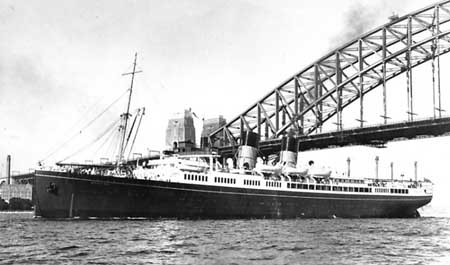
Early in August the Canadian Pacific Steamship Co. announced that a new company had been formed to take over the vessels Niagara and Aorangi. It would be known as the Canadian-Australasian Line Ltd., and be jointly owned and operated by the Canadian Pacific Co. and the Union Steamship Company of New Zealand, receiving support from both. No additions to the fleet were contemplated. Mr. J C Irons, representative of The Union Co. of New Zealand here, was appointed general manager of the new company.
August 26th 1931 - the death was announced of Captain Robert Crawford, aged 59 in Auckland. Captain Crawford had spent three months in retirement and was sailing to Auckland to take up his new job as manager of the Grand Hotel, Auckland. He bacame ill on the crossing and passed away in a private hospital in Auckland.
The September 17th sailing of the Aorangi included 9,500 cases of New South Wales oranges for Canada. On the return sailing, leaving Vancouver on October 14th the cargo included 6,000 boxes of British Columbia apples.
The crews of the Aorangi and Niagara were dismayed to learn of rumours that suggested the crews would soon be signed to Canadian Articles rather than Australian Articles, which carry higher pay than those from Canada.
On arrival at Sydney on New Year's Eve 1931 a southerly gale was blowing, which whilst the Aorangi was docking caused her to swing heavily against the pier at No. 5 Darling Harbour. Seven tugs were required to assist her to berth safely, no damage was done to the pier. The southerly gale may have been responsible for assisting the Aorangi in making a record run from Auckland to Sydney. A record which had stood for 16 years was eclipsed when she covered the journey in just over three days, clipping fifteen minutes from the time established by the Royal Mail liner Niagara in 1915. The Niagara's record for the journey waa 73 hours 12 minutes. The Aorangi left her berth in Auckland Harbour at 3 o'clock on Monday, and dropped the pilot 58 minutes later. She picked up the pilot off Sydney Heads at 2.55 o'clock on the afternoon of December 31st. Allowing for the difference in time between Sydney and Auckland and the daylight saving of half an hour then in force in the Dominion, her time was thus 72 hours 57 minutes, or less than an hour over three days.
1932
The 1932 sailings - some details incomplete:
January 7th departed Sydney; Auckland Jan 11th; Suva Jan 13th; Honolulu Jan ??; Vancouver Jan 29th*
February 3rd departed Vancouver; Honolulu Feb ??; Suva Feb ??; Auckland Feb 22nd; arrive Sydney Feb 25th
March 3rd departed Sydney; Auckland March 8th; Suva March ??; Honolulu March ??; Vancouver March 24th
March 30th departed Vancouver; Honolulu April ??; Suva April 14th; Auckland April 16th; arrive Sydney April 22nd
April 28th departed Sydney; Auckland May 2nd; Suva May ??; Honolulu May ??; Vancouver May 20th
May 25th departed Vancouver; Honolulu May ??; Suva June ??; Auckland June 12th; arrive Sydney June 17th
June 23rd departed Sydney; Auckland June 27th; Suva July 1st; Honolulu July ??; Vancouver July 15th
July 20th departed Vancouver; Honolulu July ??; Suva Aug ??; Auckland Aug 7th; arrive Sydney Aug 12th
August 18th departed Sydney; Auckland Aug 22nd; Suva Aug 26th; Honolulu Aug ??; Vancouver Sept 9th
September 14th departed Vancouver; Honolulu Sept ??; Suva Sept 29th; Auckland Oct 3rd; arrive Sydney Oct 7th
October 13th departed Sydney; Auckland Oct 17th; Suva Oct 21st; Honolulu Oct ??; Vancouver Nov 4th*
November 10th departed Vancouver; Honolulu Nov ??; Suva Nov 25th; Auckland Nov 28th; arrive Sydney Dec 2nd
December 8th departed Sydney; Auckland Dec ??; Suva Dec 17th; Honolulu Dec ??; Vancouver Dec 30th*
Some 250 tons of wheat were sent to Canada by the Aorangi on January 7th as an experiment. It was hoped that the shipment wouldf result in a regular market with the Canadians.
This first southbound sailing of the year found the Aorangi arriving at Sydney on February 25th twelve hours ahead of schedule.
On March 7th 1932 thick, stormy weather delayed the arrival from Sydney of the Aorangi at Auckland. After proceeding slowly for several hours, she was hove-to at noon about 24 miles from Mokohinau Island some 80 miles from Auckland. The ship reported at 1.20 pm that a strong east-south-easterly gale of cyclonic character had been encountered, with high precipitous seas, a very heavy swell, and low visibility. Conditions improved later in the afternoon allowing the Aorangi to resume her voyage, arriving in Auckland harbour shortly after 10 o'clock at night, some twelve hours late. The passengers went through a severe ordeal, but nobody was hurt and no damage was done. The crew reported that not since her maiden voyage when a cyclone was encountered near Honolulu, had such huge seas been encountered as. It was as thick as pea soup at times and they were unable to see the forecastle head. Also on this voyage the Aorangi arrived at Vancouver one day ahead of schedule, arriving on 24th instead of the expected 25th, perhaps because of the bad weather assisting the ship in its direction of travel.
The motor tanker Brunswick, en-route to Newcastle NSW also ran through the full force of the storm encountered by the Aorangi. Continuous heavy seas swept over her, with her speed reduced to two knots for a considerable period. Her arrival was delayed 30 hours.
During this voyage American saloon passenger Mr. John F Atkinson aged 73 complained of acute indigestion, after receiving medical aid the patient felt a little better. However five hours later at about 8.30am on the Sunday morning Mr Atkinson died suddenly. After embalming the body was returned to Los Angeles for burial.
A Russian passenger on the Aorangi, Valadimi Grigovivich Gavriluk, was not allowed to land at Auckland when the ship arrived on June 13th. He formerly resided in Australia, but went to America, where he was refused permisison to enter the United States.
The June 23rd sailing of the Aorangi from Sydney to Vancouver was in charge of Captain W. Martin. The regular commander, Captain J. P. Spring Brown was ashore on furlough. Other changes included the appointment of Dr. Lindsay P Brent as surgeon, succeeding the retiring Dr H C Snow. Also on this sailing were several thousand cases of navel oranges and lemons, the first shipments of the season bound for the Canadian market. Elsewhere on the ship for the same market were 2,465 cases of canned fruit and about 500 cases of canned meat. Whilst on this voyage the Aorangi collided on July 1st with the King's Wharf, Suva at an angle of 80 degrees on an ebb tide. The wooden decking and beam of the wharf were smashed to a depth of 30ft, with the damage to the wharf estimated at about £2,000, no damage was sustained by the ship. The 3 o'clock pm sailing was not delayed.
Also on the June 23rd sailing there occurred the event of the Aorangi, heading north, passing the Niagara, heading south on the evening of July 4th at the equator.
The arrival of the Aorangi on September 9th at Vancouver saw the ship arriving one day ahead of schedule.
It was reported during September 1932 that a bottle which was thrown from the Aorangi, whilst sailing between Auckland and Suva in April 1931 had been found on a beach at Wallaby Point, North Coast. The bottle had drifted about 1,700 miles.
On the northbound voyage commencing October 13th from Sydney, the command of the ship returned to Captain J F Spring Brown, with Captain W Martin coming ashore for further orders. For this trip the Aorangi had been equipped with talking picture apparatus. It would be operated under the supervision of the wireless operator.
The last northbound voyage of the year saw the death of a passenger by a heart attack, a Mrs Rutherford who was travelling from Suva to Vancouver with her husband, who was taking up a new position in British Columbia. The burial took place at sea on the morning of December 17th.
1933
The 1933 sailings - some details incomplete:
January 4th departed Vancouver; Honolulu Jan ??; Suva Jan 19th; Auckland Jan 22nd; arrive Sydney Jan 27th
February 2nd departed Sydney; Auckland Feb 6th; Suva Feb 10th; Honolulu Feb ??; Vancouver Feb 24th*
March 1st departed Vancouver; Honolulu March ??; March 17th; Auckland March 21st; arrive Sydney March 25th
March 30th departed Sydney; Auckland March ??; Suva April 7th; Honolulu April ??; Vancouver April 21st*
April ?? departed Vancouver; Honolulu May ??; Suva May 11th; Auckland May ??; arrive Sydney May 21st
July 20th departed Sydney; Auckland July 25th; Suva July 28th; Honolulu Aug ??; Vancouver Aug 11th*
August 16th departed Vancouver; Honolulu Aug ??; Suva Aug ??; Auckland Sept 3rd; arrive Sydney Sept 8th
September 14th departed Sydney; Auckland Sept 18th; Suva Sept ??; Honolulu Oct ??; Vancouver Oct 6th
October 11th departed Vancouver; Honolulu Oct ??; Suva Oct 26th; Auckland Oct 29th; arrive Sydney Nov 3rd*
November 9th departed Sydney; Auckland Nov ??; Suva Nov 17th; Honolulu Nov ??; Vancouver Dec 1st
December 6th departed Vancouver; Honolulu Dec ??; Suva Dec 23rd; Auckland Dec 26th; arrive Sydney Dec 30th
Whilst sailing from Auckland to Sydney during the last week of January the Aorangi developed engine trouble. The vessel was expected to reach the Heads on the morning of January 27th, some 18 hours late. The trouble had developed in No. 5 crankshaft web of the starboard outer main engine, the liner was proceeding at 14 knots, using only three engines. Passengers on the ship included Prince Uliame Tugi, Premier of Tonga and husband of Queen Salote and Tongan Crown Prince Taupa'ahau, who would be attending school in Sydney. Cargo included on the manifest included 2,300 cases of bananas from Fuji for Sydney.
On departure from Sydney on March 30th the Aorangi carried 3,440 cases of New South Wales grapes bound for the Canadian market.
During a fierce gale off the coast early on Saturday morning (May 20th) the Aorangi, which was travelling without the use of one of her four engines, received a severe buffeting. It was one of the worst gales experienced by the liner, the wind having blown at hurricane force for many hours. So high were the seas and so terrific was the wind at 3 a m., when the liner was 50 miles from the coast, that the commander, Captain J. F. Spring-Brown, apparently anxious about the possibilities of entering the port, wirelessed for a report on the conditions at the Heads. With the gale increasing in intensity, the Aorangi made remarkable headway. The distance of 50 miles was covered in less than six hours. At 8.30 am the liner came within sight of the Heads, but vision was not clear, and she must have been then only about two miles from shore. The seas between the Heads were running high and Captain Spring-Brown decided to wait outside. The liner went almost as far south as Port Hacking, and came up the coast and made an entry at 10.54 am. The pilot steamer Captain Cook led the liner into the channel near Chowder Bay, where the pilot went aboard. The Aorangi berthed at Darling Harbour jetty at 1.15 pm, four hours late. Among the passengers was Captain V G Webb, marine superintendent of the Union Steamship Co., Ltd., at Wellington, who was visiting Sydney in connection with the overhaul of the vessel.
Following its stormy arrival at Sydney the Aorangi was taken out of service for a previously scheduled overhaul. The ship would return to service for the sailing on July 20th. The Monowai would cover the workings in the absence of the Aorangi. Following the return to service of the Aorangi the Niagara was taken out of service for scheduled overhaul, again the Monowai covered the services.
September 8th 1933 - Two third-class passengers on the Aorangi, which arrived in Sydney from Auckland were prevented from disembarking. They were returned to New Zealand where they had joined the ship. One was a Norwegian sailor with no landing permit, the other was alleged to have absconded from parole in New Zealand where he was wanted by the police.
1934
The 1934 sailings - some details incomplete:
January 4th departed Sydney; Auckland Jan ??; Suva Jan 12th; Honolulu Jan ??; Vancouver Jan 26th*
January 31st departed Vancouver; Honolulu Feb ??; Suva Feb 15th; Auckland Feb 18th; arrive Sydney Feb 23rd
March 1st departed Sydney; Auckland March 5th; Suva March 9th; Honolulu Mar ??; Vancouver March 23rd*
March 28th departed Vancouver; Honolulu April ??; Suva April 12th; Auckland April 16th; arrive Sydney April 20th
April 26th departed Sydney; Auckland April 30th; Suva May 4th; Honolulu May 13th; Vancouver May 18th*
May 23rd departed Vancouver; Honolulu May ??; Suva June 7th; Auckland June 11th; arrive Sydney June 15th
June 21st departed Sydney; Auckland June 26th; Suva June 29th; Honolulu July ??; Vancouver July 12th
July 18th departed Vancouver; Honolulu July ??; Suva Aug 3rd; Auckland Aug 7th; arrive Sydney Aug 10th
August 16th departed Sydney; Auckland Aug ??; Suva Aug 24th; Honolulu Sept 1st; Vancouver Sept ??
September 12th departed Vancouver; Honolulu Sept ??; Suva Sept 27th; Auckland Sept 30th; arrive Sydney Oct 5th*
October 11th departed Sydney; Auckland Oct 15th; Suva Oct 19th; Honolulu Oct ??; Vancouver Nov 2nd*
November 7th departed Vancouver; Honolulu Nov ??; Suva Nov 23rd; Auckland Nov 26th; arrive Sydney Nov 31st
December 6th departed Sydney; Auckland Dec 10th; Suva Dec 11th; Honolulu Dec ??; Vancouver Dec 28th*
Whilst docked at Honolulu during January steward J Smith retrieved a bottle from the water, it contained a note that this was one of several bottles dropped into the flooded Shoalhaven (Nowra) on February 22nd 1934 by D'Arcy Stuckey.
When American passenger H W Orr, aged 19, reached Sydney on February 23rd aboard the Aorangi, he was not allowed to land since he had no passport for Australia. Orr, a junior meterologist with the Byrd Antarctic expedition said he had withdrawn from the Antarctic expedition after sustaining an injury caused when he fell down the hold of the Jacob Rupert. The Customs officials locked him in his cabin and made arrangements for him to return to New Zealand by the Aorangi. However on Monday it was found Orr had disappeared, the lock on the cabin door had been picked. Early in March Mr Orr surrended to the shipping company, and was returned to the ship pending its departure to Auckland.
Whilst departing her berth at Darling Harbour for Auckland on March 1st a heavy gust of wind struck the Aorangi. She was swept off course and narrowly missed a number of ferry boats moored at Blues Point on the opposite side of the harbour. Anchors were dropped, and they checked the vessel as it was approaching shallow water. Two tugs raced across the harbor, and aided by the Aorangi's engines were able to drag her back into the stream.
On the May 23rd departure from Vancouver the Aorangi was carrying more cargo than ususal due to much cargo having been diverted to Canada for transshipment due to strike action by dockworkers in the United States.
The northbound July sailing of the Aorangi saw the passenger list increase by one en-route when the wife of American boxer Billy Townsend gave birth to a baby girl, the baby was named Aorangi.
On July 20th whilst at Vancouver passenger Mr Robert David Collins, a butcher, collapsed aboard the Aorangi from a heart attack, and died whilst being transported by ambulance to the hospital. He was buried at Vancouver on July 23rd.
Captain J F Spring Brown would take command of the Aorangi following her arrival at Sydney on October 5th. Captain T V Hill would go on a short furlough until the Niagara returns from Vancouver on November 3rd.
Early Christmas celebrations took place on the Aorangi on December 5th 1934 (at Auckland?) when seventy children attended a Christmas party organised by the New Zealand Women's Association. Three hundred adults attended a musical programme or played bridge in the various saloons. Santa Claus was also observed on board. At the afternoon tea for the adults the commander of the Aorangi, Captain Spring-Brown cut the large Christmas cake, a piece of which was handed to each guest.
1935
The 1935 sailings - some details incomplete:
January 2nd departed Vancouver; Honolulu Jan ??; Suva Jan 17th; Auckland Jan ??; arrive Sydney Jan 25th*
January 31st departed Sydney; Auckland Feb 4th; Suva Feb 8th; Honolulu Feb ??; Vancouver Feb 22nd*
February 27th departed Vancouver; Honolulu March ??; Suva March ??; Auckland March 17th; arrive Sydney March 23rd*
March 28th departed Sydney; Auckland April 2nd; Suva April 5th; Honolulu April ??; Vancouver April ??
April 24th departed Vancouver; Honolulu April ??; Suva May 9th; Auckland May 13th; arrive Sydney May 18th
May 23rd departed Sydney; Auckland May 28th; Suva May 31st; Honolulu June ??; Vancouver June ??
June 19th departed Vancouver; Honolulu June ??; Suva July 4th; Auckland July 7th; arrive Sydney July 12th
July 18th departed Sydney; Auckland July 23rd; Suva July 26th; Honolulu Aug 2nd; Vancouver Aug ??
August 12th departed Vancouver; Honolulu Aug ??; Suva Aug 29th; Auckland Sept??; arrive Sydney Sept 6th
Sept 7th (?) departed Sydney for Melbourne (BMA Conference)
Sept ?? departed Sydney; Auckland Sept??; Suva Sept ??; Honolulu Sept??; Vancouver Oct??
Oct ?? departed Vancouver; Honolulu Oct ??; Suva Oct ??; Auckland Nov??; arrive Sydney Nov ??
November 7th departed Sydney; Auckland Nov 12th; Suva Nov 15th; Honolulu Nov??; Vancouver Dec??
December 5th departed Vancouver; Honolulu Dec ??; Suva Dec 20th; Auckland Dec 24th; arrive Sydney Dec 28th
On Friday January 25th 1935 the Aorangi and 320 passengers arriving from Auckland were ordered into quarantine with a case of smallpox aboard. The victim was a member of the crew. The customary period of quarantine for smallpox is 14 days. By Monday 28th forty-five passengers had been released after they were able to show that they had been vaccinated within the required period, and were conveyed by the Sydney ferry Kookaburra to Darling Harbour. It was anticipated that about half of the remaining passengers would be released on Wednesday 30th. The steward suffering from smallpox was making good progress, no other cases had occurred. A number of Indians who landed by the ferry would remain in Sydney for a few days, their connection, the steamer Mongolia bound for India refused them passage, in view of the possibility of the Mongolia being held by the health authorities in Melbourne. Mr A du Cros. a retired director of the Dunlop Rubber Co., Ltd., England, making a world tour with his wife, said the experience was worth having once. The quarantine doctors were very kind, with plenty of nice food to eat and the accommodation very good. After they had been given a carbolic bath and had had their clothes disinfected, they were left to go about as they pleased. All the passengers left behind were perfectly satisfied. Mr du Cros commented 'The sleeping quarters were built like a sanatorium, and were not very sound-proof. We did not sleep very much, on account of the mosquitos and strange noises at night. The grounds abound with cicadas, and they are very noisy creatures'.
Dr. Albert E. Platt, of Cambridge, travelling to Adelaide to take up the position of deputy-director of the Laboratory of Bacteriological and Pathological Research at the Adelaide Hospital, said that the arrangements and care of the passengers were perfect. This case justified the strict supervision of the port authorities. He had seen several quarantine stations in England, and the Sydney station was more up to date than he had anticipated. He believed that the steward had contracted the disease before reaching Auckland, as he developed a rash and other symptoms before the ship arrived at that port. The Aorangi and the majority of her crew on board, proceeded to No. 5 wharf. Darling Harbour, after fumigation by the port health authorities. The Union Steamship Company announced that the Aorangi would sail from Sydney next Thursday for Vancouver, via ports.
The work of the stewards from the Aorangi was praised by almost one hundred passengers who landed on January 30th after being in quarantine, despite the shortlived strike, which occurred on Tuesday. Dr. Metcalfe, the chief quarantine officer, explained that the stewards had asked for a slight increase of pay owing to the fact that they were working in an infected area. Representations had been made to the Union Steamship Co. of N.Z. Ltd. by the men, and the matter was adjusted. The stewards had worked in a fine manner and had done their best at all times. Those remaining in quarantine would be held at least until February 8th, when the full period of 14 days quarantine elapsed. Several passengers who refused to be vaccinated when they entered quarantine would remain in isolation until February 12th. The steward who originally showed the first signs of smallpox was diagnosed with a mild form of the disease.
After the complete fumigation of the Aorangi and with the full staffing of the ship, she was set to depart Sydney on January 31st 1935 for Vancouver. A brief dispute delayed the departure until about 7pm when the seamen and the ship's owners experienced difficulty in settling the terms on which the seamen replacing some of those still detained in quarantine should be engaged.
On February 8th a further 178 passengers and crew were released from quarantine. With impressions of regret at their departure and cheers for the staff, many of them declared that they were genuinely sorry to leave and paid high tributes to the officials at the station. Those who were unwilling to receive vaccination when they entered quarantine and a number of the crew will remain in isolation for a while longer. A ferry steamer chartered by the Union Line conveyed 162 of the passengers and crew to Darling Harbour, the remainder being allowed bv the Customs authorities to depart by the north gate of the quarantine station.
During March 1935 the Union Steamship Co of New Zealand announced that alterations to the first class accommodation on the Aorangi would be completed shortly. The size of the cabins on C deck was increased and a number of single berth cabins were added. A hot and cold water system was being installed throughout the C deck, and additional bathrooms would be fitted to cabins. A complete model of one of the new delux cabins, with private bathroom was later shown at the company's Melbourne office.
Whilst sailing between Auckland and Suva on April 5th the ship's officers reported having sighted an abandoned ship's boat at a point 500 miles from Auckland which bore the name Korregane. It was damaged and awash but was no danger to shipping. The wooden topsail schooner Korregane was owned by Count de Ganay, of Paris, which was travelling from Europe to Noumea. The ship's boat had evidently come adrift and washed overboard, it was not picked up by the Aorangi.
May 11th 1935 - whilst en-route from Auckland to Honolulu the Aorangi became part of a dramatic effort to assist an expectant mother on Fanning Island, a remote island used by a British company as a relay station for cable and wireless traffic. The wife of one of the employees was expecting a child, but the only doctor on the island had died the week before. A message was flashed to London explaining the woman's plight, and from London all ships likely to be within 1,000 miles or so of the island were wirelessed. Many attempts were made, eventually contact was established with the Aorangi, which relayed the information to the Dickenson, the only ship to normally visit the island and which was then on her way there. The Dickenson's doctor hurried ashore and twelve hours later a baby girl was born. Both mother and child were reported as doing well.
During the May sailings there was some drama onboard the Aorangi. On Saturday May 18th 1935 when the Aorangi arrived at Watson's Bay from Suva. Detective Sergeants Nye and Leary and Detectives Holmes and George boarded the vessel and arrested a man, who was later charged with the theft of a diamond bracelet valued at £185 from a flat at King's Cross some weeks ago. And on the morning of Thursday May 23rd John Morris Breen, the assistant purser was found shot dead in his cabin. Detectives were convinced the bullet wound was self-inflicted, but no reason for the suicide was offered. One report stated an automatic pistol was found near the body which was lying in the bunk. Another report stated the body was lying on the floor, dressed in a dinner suit, with the automatic pistol clenched in his left hand. The ship was due to sail later that day for Vancouver.
Whilst docked at Honolulu during May steward J Smith retrieved a bottle from the water, it contained a note that this was one of several bottles dropped into the flooded Shoalhaven (Nowra) on February 22nd 1934 by D'Arcy Stuckey.
On June 19th the Aorangi sailed from Vancouver under a cloud of potential Union trouble. Striking dockside workers at Vancouver attempted to interfere with the loading of vessels in the port. The prohibiting of picketing, the presence of massed police, and the use of some non-striking dock workers and non-union labour caused the strike efforts to fail, by which the Aorangi sailed on time. The facts were relayed by cable to the Australian Marine Union inquiring of their views with regard to the use of non-union labour in loading the Aorangi. It was reported that three of the crew, including a former secretary of the Sydney branch, had become involved in a disturbance which marked the departure of the vessel from Vancouver and suffered fom the effects of tear gas bombs.
The arrival of the Aorangi at Sydney on July 12th was delayed two hours by the presence of the most dense fog recorded that year. Ferries and other shipping were also delayed, and throughout the period foghorn and whistles blew incessantly. Ships affected included the Orsova, Aorangi and the Magdeburg.
The Aorangi arrived in Sydney on July 12th with the union matter still unresolved. A meeting was held on Tuesday July 16th where efforts by the militants to withdraw the crew from the Aorangi in sympathy with the strikers in Vancouver failed. At a special meeting of the Sydney branch of the Seamen's Union it was decided that the crew should remain at work. The union was asked by the strikers to declare the vessel 'black', and the demand was heavily supported by Communists on the Sydney waterfront, who placarded the wharves with pamphlets. Despite strong speeches in favour of strike action the seamen refused to sanction a strike after members of the crew had given explanations of the trouble at Vancouver. However a motion expressing sympathy with the strikers in Vancouver was carried.
When departing from Auckland on September 3rd the ship was sailing without one of her stewards, who had missed the departure by a few minutes. A launch was procured and set of after the Aorangi, but by this time the Aorangi was halfway down the harbour. A message was sent to the Aorangi from the signal station, and the launch reached the liner in Rangitoto Channel at 12.20 am.
September 6th found the Aorangi arriving at Sydney. However her next journey was not back to Auckland, but a rare brief trip to Melbourne to deliver 350 British, Canadian & American delegates to the major British Medical Association conference being hosted by the city. Many of these delegates had left London on July 26th and would spend 106 days on a westbound round the world voyage, not returning to London until November 8th. This would be the Aorangi's first visit to Melbourne, arriving there on September 9th at about 7am, the ship began her return passage to Sydney at 3pm. The costs for the use of the ship in transporting the party to Melbourne were in the neighborhood of £150,000. The baggage insurance alone totaled about £60,000 to cover over 1,500 pieces of baggage.
On her return to Sydney the Aorangi would recieve her annual overhaul which would include improvements to the accommodations on C deck. The Aorangi would re-enter service on November 7th on the regular Sydney to Vancouver run. The Monowai handled the round trip to Vancouver from Sydney on September 13th in place of the Aorangi.
Over six hundred workers were involved in the £60,000 overhaul. All of the first-class accommodation on C deck was removed and entirely new rooms constructed, many with private bathrooms attached, and all with hot and cold running water and other modern conveniences. These rooms were singles and doubles, and contained bedsteads, dressing tables and other modern furnishings. Two or three large windows opened on to the proménade dock, providing much natural light to the cabins. Some of the cabins were panelled in native Australian timbers. The extensive improvements reduced the passenger accommodation on C deck by 50 per cent. D deck underwent minor changes with all bedrooms on this deck were either now singles and doubles. Other improvements included modern talkie equipment, children's nursery and dining-room, well-stocked library, swimming pool, hairdressing saloon, laundry, ironing rooms and electric irons for use of passengers in all classes, and facilities for all types of deck sports.
Minor problems were encountered with the unions carrying out the overhaul but these were quickly resolved. On October 30th the Aorangi moved to Cockatoo Dock for painting. Although the refit was moving along according to plan a dockworkers stoppage in Vancouver was causing issues. The Seamen's Union at a meeting in Sydney chose to refuse a call for a crew for the Aorangi unless the company withdrew the non-union crew from the Niagara. The meeting also decided that before men were supplied the company would give an undertaking that the seamen would not be called upon to work cargo, or give steam to work cargo in Vancouver, except at the discretion of the strike committee controlling the stoppage there. A successful call for the crew took place in the first week of November, the ship departed on November 7th for Vancouver.
On Saturday December 28th the Aorangi arrived from Vancouver but the men did not give notice. The company did not intend to pay off the crew whilst the vessel was in Sydney because of a strike. The union crew eventually gave notice but the vessel was later manned by licensed men. The strike was more about a power struggle within the Union, for the average seaman there were no obvious benefits. The Union's actions had proved unfavourable with almost all concerned and their attempt to involve the Niagara and the Aorangi in the action would make or break the strike. The developing of the strike into a faction fight and the seamen tiring of their idleness led to the manning of a number of vessels including the Westralia and others at Newcastle during the last week of the December.
When the Aorangi berthed on the Saturday morning of December 28th her commander, Captain J F Spring Brown, said good-bye to the sea after nearly 48 years' service. Retirement would find him settling in Sydney. Captain Brown began his career in 1888 as an apprentice officer in the full-rigged ship Queen of Scots. His first voyage lasted four years and eight months. After several eventful voyages he forsook sail for steam, and was appointed third officer in the crew which was selected to bring the Tyrian to Australia and deliver the vessel to Howard Smith Steamship Co. He spent three years on the Australian coast on Howard Smith steamers. In January, 1900 he joined the Union Company as third officer, and obtained his first command in the steamer Wainui in 1910. For the following six years he was engaged in crossing and recrossing the Tasman Sea. During the war he commanded the troopships Mokola and Willochra, transporting troops from Australia and New Zealand to Egypt. After the war he took prisoners of war from Australia and New Zealand to Rotterdam. He then conveyed infantrymen from England to Archangel and later Russian refugees to Baltic ports. Rejoining the Union Company early in 1920, Captain Brown was for various periods in command of the Makura, Marama, Maunganui, Tahiti, Sussex and Niagara. In February 1931 he was placed in command of the Aorangi and appointed commodore of the company's fleet. Captain Spring Brown was popular with both passengers and crews, and on the occasion of his last voyage received presentations from admirers in Auckland, from the ship's passengers and from the officers and crew. Captain T V Hill of the Niagara will succeed Captain Spring Brown as master of the Aorangi and Captain W Martin will relieve Captain Hill.
1936
The 1936 sailings - some details incomplete:
January 3rd departed Sydney; Auckland Jan 6th; Suva Jan 10th; Honolulu Jan ??; Vancouver Jan ??
January 29th departed Vancouver; Honolulu Feb ??; Suva Feb 14th; Auckland Feb 17th; arrive Sydney Feb 21st
February 27th departed Sydney; March ??; Suva March 6th; Honolulu March ??; Vancouver March 20th*
March 25th departed Vancouver; Honolulu March ??; Suva April 9th; Auckland April 13th; arrive Sydney April 17th*
April 23rd departed Sydney; Auckland April 27th; Suva May 1st; Honolulu May ??; Vancouver May 15th*
May 20th departed Vancouver; Honolulu May ??; Suva June 4th; Auckland June 7th; arrive Sydney June 12th
June 18th departed Sydney; Auckland June 24th; Suva June 26th; Honolulu July ??; Vancouver July 10th*
July 15th departed Vancouver; Honolulu July ??; Suva July 31st; Auckland Aug 3rd; arrive Sydney Aug 8th
August 13th departed Sydney; Auckland Aug 17th; Suva August 20th; Honolulu Aug ??; Vancouver Sept 4th*
September 9th departed Vancouver; Honolulu Sept 16th; Suva Sept 25th; Auckland Sept 28th; arrive Sydney Oct 3rd*
October 8th departed Sydney; Auckland Oct 12th; Suva Oct 17th; Honolulu Oct 23rd; Vancouver Oct 30th*
November 5th departed Vancouver; Honolulu Nov 11th; Suva Nov 20th; Auckland Nov 23rd; arrive Sydney Nov 28th*
December 3rd departed Sydney; Auckland Dec 8th; Suva Dec 11th; Honolulu Dec ??; Vancouver Dec 25th*
December 30th departed Vancouver; Honolulu Jan 6th; Suva Jan ??; Auckland Jan 18th; arrive Sydney Jan 23rd*
The first sailing of the year for the Aorangi departed Sydney on January 3rd bound for Vancouver with a licensed (volunteer) crew and 500 passengers on board. This was the second passenger liner to break the strike cordon. Extraordinary precautions were taken to prevent any demonstration by the strikers. A large body of plain-clothes police mingled with the crowd that gathered on the wharf, whilst many uniformed police were on duty. The crew was on board long before the vessel was scheduled to leave, and steps were taken to prevent their being interfered with. No friends of passengers were allowed on board. The sailing of the Aorangi was considered in shipping circles to be one of the worst setbacks suffered by the strikers. Many men said they tired of the strike and were returning to work whilst there were still vacancies offering.
On arrival at Auckland on January 6th the dockside workers declined to work the Aorangi, the cargo was handled by several of the company's officials, the crew and a number of volunteer workers.
On the first southbound sailing of the year, from Vancouver on January 29th, the New Zealand rugby team the All Blacks sailed for home.
Whilst sailing from Sydney to Auckland a call was received on March 1st from the steamer Beatus in the Tasman Sea for medical aid. The Aorangi changed course but regrettably the patient died of peritonitis whilst the vessels were still about 400 miles apart.
During April the Aorangi became part of a twelve month global scientific research study to determine the intensity of cosmic rays! The equipment, weighing about two tons was mounted on the after-deck of the Aorangi and was overseen by Professor Arthur H Compton, professor of physics at the University of Chicago. The north-south route operated by the Aorangi would highlight any variations over the route, other installations already in place were at Christchurch, which is the nearest practicable elevated land to the south magnetic pole, another in Peru, on the magnetic equator. Others to be located were in Greenland, which is the nearest place possible to thc north magnetic pole, in Mexico, and in the Rocky Mountains of Colorado. To check the workings of the meter on the Aorangi, Professor Compton recently travelled on the vessel as far as Honolulu. The delicate mechanism comprising the meter is insulated from surrounding radiations by succcessive layers of lead and copper, leaving it active only to the cosmic rays. The apparatus contains argon, which when struck by the rays becomes intensified, and indicates the intensity of its charge on a sensitive electroscope. The series of experiments to determine the intensity of cosmic rays will take place over a period of eleven years, the sunspot cycle, as a result of which it is hoped to find what time variations there are in cosmic rays and what rules govern them. By the measurements taken aboard the Aorangi it is hoped to determine which hemisphere of the earth receives the highest proportion of thc rays.
June 23rd 1936 - Auckland detectives searched the Aorangi for the man sought in the Sydney 'Wardrobe Murder', their search was not successful.
On the voyage of the Aorangi from Sydney to Auckland during the middle of August three thefts of money occurred. A G Lawson, ship's plumber, had £17 removed from his wallet in his cabin. K M Ramsay, a member of the Australian Rugby Union team, missed £12 from a pocket of a coat which was hanging in his cabin wardrobe. K L Elliott, ship's wireless officer, missed £3/10/- from a coat in his cabin. As a result of inquiries by the Auckland police, a 15-year-old boy, employed on the Aorangi, was set to appear in the Children's Court.
September 1936 - it was announced in London by Sir Edward Beatty, president of the Canadian Pacific Company, that if the British and Dominion Governments could reach an agreement on the value of the Pacific trade to the Empire, in terms of a subsidy, two new ships would be built for the Canadian-Australasian Line. The new ships, of 22,000 tons gross with a speed of 22 knots would replace the Aorangi and Niagara and would provide tough competition to the newer American Matson liners Mariposa and Monterey which were operating between the USA and Australia. If terms for the subsidy could be agreed the ships would take two years to build at a cost of £2,500,000.
Whilst en-route from Suva to Auckland during the last week of September it was reported that Matthew Guy a steward on the Aorangi had died.
Six months after the installation of the cosmic ray detector on the Aorangi, a total of 5,000 readings had been obtained from the equipment. On October 8th Dr. Arthur Compton announced there was tentative proof that cosmic rays come from outside the earth's atmosphere, and are pressing most heavily on the Northern hemisphere. This finding had also been confirmed by parallel experiments, conducted by other physicists at Innsbruck, Austria, and Capetown, South Africa.
The sailing of the Aorangi from Vancouver to Sydney on October 29th (or November 5th??) was delayed for a day to permit the arrival from the United States of passengers stranded by the Pacific coast seamen's strike.
The northbound December sailing of the Aorangi from Auckland included increased supplies for Hawaii, which continued to be greatly affected by the seaman's strike. To replace the shortage of foodstuffs from the USA, butter shipments from New Zealand were increased to about 5,000 boxes of butter, as well as a quantity of frozen meat and general produce.
Five American seamen stranded at Hawaii during mid-December stowed away on the Aorangi when she sailed for Vancouver and through the goodwill of the ships' officers and the Canadian immigration authorities were placed on a train at Vancouver in time to reach home for the Christmas holidays.
Following the decision of the Union Company to withdraw the Royal Mail Line to San Francisco after the sailing of the Makura from Sydney on October 22nd, the Canadian-Australasian Line changed the sailing dates from Sydney and Vancouver. The alteration in the schedule would take effect after the departure of the Aorangi from Sydney on December 3rd 1936. Instead of sailing from Sydney for Vancouver on December 31st, the departure of the Niagara was postponed until January 21st, and the Aorangi would sail on February 18th instead of January 28th. The two ships would then sail from Sydney alternately every 28 days. From Vancouver for Sydney the change took effect after the departure of the Aorangi on December 30th.
Strike action in the United States had seen many travellers journey to Vancouver in order to take the Aorangi to Australia. On the December 30th departure from Vancouver the passenger list totalled 656.
1937
The 1937 sailings - some details incomplete:
January 23rd arrived Sydney
February 18th departed Sydney; Auckland Feb 23rd; Suva Feb 26th; Honolulu March 5th; Vancouver March 12th*
March 18th departed Vancouver; Honolulu Mar 24th; Suva April 1st; Auckland April 4th; arrive Sydney April 9th*
April 15th departed Sydney; Auckland April 20th; Suva April 24th; Honolulu April 30th; Vancouver May 8th*
May 12th departed Vancouver; Honolulu May 20th; Suva May 28th; Auckland June 1st; arrive Sydney June 6th
August 5th departed Sydney; Auckland Aug ??; Suva Aug 13th; Honolulu Aug 20th; Vancouver Aug 27th*
September 1st departed Vancouver; Honolulu Sept 8th; Suva Sept ??; Auckland Sept 21st; arrive Sydney Sept 25th
September 30th departed Sydney; Auckland Oct 4th; Suva Oct 8th; Honolulu Oct 15th; Vancouver Oct 22nd*
October 27th departed Vancouver; Honolulu Nov 3rd; Suva Nov 12th; Auckland Nov 16th; arrive Sydney Nov 21st
November 25th departed Sydney; Auckland Nov 30th; Suva Dec 3rd; Honolulu Dec 10th; Vancouver Dec 17th*
December 22nd departed Vancouver; Honolulu Dec 29th; Suva Jan 6th; Auckland Jan 10th; arrive Sydney Jan 15th
With the departure of the Aorangi on December 31st 1936 with 683 passengers, the largest list in a decade, the stranded Australians situation was believed to be virtually relieved.
Further remodelling of the Aorangi took place during February 1937 to complement that which had been done two years earlier in 1935. The current remodelling affected the first-class cabins on the two lower decks D and K to bring them into line with the remodelled accommodation on the upper decks. Nearly all the rooms on C and D decks have been reconstructed, some have been enlarged whilst others have had the number of beds or berths reduced. Additional furnishings have been provided and the accommodation renovated throughout. First class accommodation would now include 73 one passenger cabins and a large number of cabins for two passengers, in addition to 21 two-bed and three-one bed cabins deluxe. The Aorangi was scheduled to leave Sydney on Thursday February 18 for Auckland, Suva, Honolulu, Victoria & Vancouver. On the day of departure there were so many visitors on board that it was necessary to begin the call "All visitors ashore" more than half an hour before the sailing time of 4pm. Many of the travellers were setting out for the coronation in England.
Eric Allen, aged 14, had plans to see the world - his first step was to board the Aorangi on April 20th as a stowaway. He was discovered after the ship had sailed for Auckland, a radio message was sent to the surprised parents in Sydney, they made arrangements for the payment of his fare and his return home from Auckland on the Awatea.
Whilst sailing from Sydney to Auckland on April 20/21 the Aorangi developed a fault in the crankshaft of the inner starboard engine, necessitating cutting out that engine. The necessary reduction in speed and strong headwinds caused a two day late arrival in Vancouver. Additionally, whilst in the period of the stormy weather four days out from Vancouver, part of the engine being worked on fell on Thomas Ashworth, an engineer. One arm was broken and the other crushed. He underwent an operation aboard the liner, and his condition was fair on arrival. It was determined that the fitting of a new crankshaft would take place on the vessel's return to Sydney during June. The June sailing to Vancouver would be covered by the recently overhauled Monowai.
Unsettling events in the Far East were curtailing visits by tourist from Canada/America, many were choosing to visit Australia/New Zealand instead. On the late October sailing from Vancouver were over 500 passengers with many being tourists.
When the Aorangi sailed from Sydney for Vancouver on November 25th she returned to the charge of Captain T V Hill, who had been on leave. Captain Martin, her previous captain took charge of the Niagara which would sail from Sydney on December 23rd. On the departure of the Aorangi on November 25th many residents of South Head, Manly and neighbouring suburbs were puzzled when they saw the ship stationary off the Heads for several hours. Her berth had been vacated shortly after 4pm, and passed to sea at 5.5 pm and then stopped off the Heads until about 7.15 pm whilst her navigating instruments were tested and adjusted, a fairly lengthy process.
The sailing of the Aorangi from Vancouver on December 22nd was delayed six hours by the record amount of mails being loaded onboard.
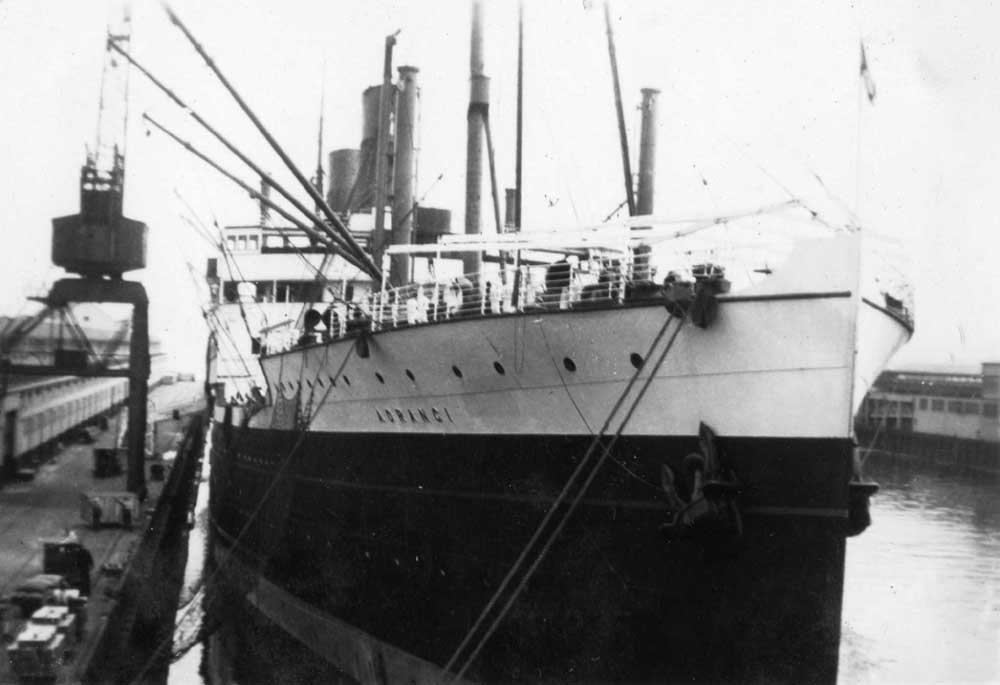
1938
The 1938 sailings - some details incomplete:
January 20th departed Sydney; Auckland Jan 25th; Suva Jan 28th; Honolulu Feb 4th; Vancouver Feb 11th*
February 15th departed Vancouver; Honolulu Feb 23rd; Suva Mar ??; Auckland Mar 6th; arrive Sydney Mar 11th
March 17th departed Sydney; Auckland March 21st; Suva March 25th; Honolulu April 1st; Vancouver April 8th*
April 12th departed Vancouver; Honolulu April ??; Suva April 28th; Auckland May 4th; arrive Sydney May 6th*
May 12th departed Sydney; Auckland May 16th; Suva May 20th; Honolulu May 27th; Vancouver June 3rd*
June 8th departed Vancouver; Honolulu June 15th; Suva June 23rd; Auckland June 26th; arrive Sydney July 1st*
July 7th departed Sydney; Auckland July 12th; Suva July 15th; Honolulu July 22nd; Vancouver July 29th*
August 3rd departed Vancouver; Honolulu Aug 10th; Suva Aug 18th; Auckland Aug 21st; arrive Sydney Aug 26th
September 1st departed Sydney; Auckland Sept 5th; Suva Sept 9th; Honolulu Sept 16th; Vancouver Sept 23rd*
September 28th departed Vancouver; Honolulu Sept ??; Suva Oct ??; Auckland Oct 17th; arrive Sydney Oct 23rd
October 28th departed Sydney; Auckland Nov 1st; Suva Nov 4th; Honolulu Nov 11th; Vancouver Nov 18th
November 23rd departed Vancouver; Honolulu Nov 30th; Suva Dec 8th; Auckland Dec 11th; arrive Sydney Dec 17th
December 22nd departed Sydney; Auckland Dec 28th; Suva Dec 30th; Honolulu Jan 6th; Vancouver Jan 13th*
On arrival at Suva on April 27th passenger Mr Alfred Sandys was arrested by the local authorities on instruction from the Vancouver police, on a charge of false pretences.
The early May departure from Auckland to Sydney was delayed by heavy rain which affected the loading of the cargo. The ship was still in port on May 4th.
A sign of the changing times was the decision to have mail from New Zealand to the United Kingdom and other parts of the Empire be carried by air on its first leg to Sydney. The sailing of the Aorangi on July 12th would be the last time this mail would be despatched by sea.
During these troubled times many refugees fled from Germany and central Europe, with parties of Jews travelling on the southbound voyages during June & August. On the southbound trip from Vancouver to Sydney during October 1938 there were 73 Jewish refugees in transit, comprising Germans and Austrians. Ten would disembark at Auckland, the remainder at Sydney. The stewards had complained about the behaviour of a few of the German-Jewish passengers during the vojage. The commander of the Aorangi (Capt. T V Hill) stated that although complaints had been made to him, an amicable settlement had been reached. Over half the Jews were travelling second-class, many were disappointed when they found that they could not have the run of the ship. Stewards in the second-class said that although most of the Jews were considerate and friendly, a few made the trip a nightmare. 'We have always gone out of our way to please the Jewish people,' the stewards stated. 'We have been sorry for them, and have done our best to make them feel that they were travelling to a friendly country, but on this voyage some persons could not be pleased. They growled when they boarded the ship at Vancouver. They growled all the way across the Pacific, and they are still growling. We could not please them, the food was not good enough for them. They demanded special food, and found fault with everything.'
December 10th 1938 - a passenger on the Aorangi, Mr. A B Foxcroft, 54, of Melbourne, who had been suffering from a severe illness, died in the ship's hospital on Saturday, and was buried at sea. Mr. Foxcroft, who was on the staff of the Public Library, Melbourne, had been ill for the greater part of the voyage.
On the southbound sailing of the Aorangi from Vancouver which arrived at Sydney on December 17th were another contingent of German & Austrian Jewish refugees, numbering about 140, including 35 children under 16 years of age. These refugees had sailed from England to Quebec (arriving on November 20th), then crossing Canada by rail to connect with the Aorangi. Joining at Auckland was Dr. W S Matsdorf, formerly of Berlin, who had been attached to the Australian Jewish Society to advise the Jewish refugees about Australian social and economic conditions and other details about Australia. Although many of the refugees spoke some English, they arrived with little baggage, their money and possessions having been confiscated by the authorities in Germany and Austria
1939
The 1939 sailings - some details incomplete:
January 19th departed Vancouver; Honolulu Jan 25th; Suva Feb 2nd; Auckland Feb 5th; arrive Sydney Feb 10th
February 16th departed Sydney; Auckland Feb 21st; Suva Feb 24th; Honolulu Mar 3rd; Vancouver March 10th*
March 15th departed Vancouver; Honolulu Mar 22nd; Suva Mar 31st; Auckland Apr 3rd; arrive Sydney April 6th*
April 13th departed Sydney; Auckland Apr 18th; Suva Apr 21st; Honolulu Apr 26th; Vancouver May 5th*
May 11th departed Vancouver; Honolulu May 17th; Suva May 26th; Auckland May 29th; arrive Sydney June 4th
June 8th departed Sydney; Auckland June 12th; Suva June ??; Honolulu June 23rd; Vancouver June 30th*
July ?? departed Vancouver; Honolulu July ??; Suva July ??; Auckland July ??; arrive Sydney July ??
August 3rd departed Sydney; Auckland Aug 8th; Suva Aug 11th; Honolulu Aug 18th; Vancouver Aug 25th*
August 30th departed Vancouver; Honolulu Sept 6th; Suva Sept ??; Auckland Sept 18th; arrive Sydney Sept 22nd*
On the first southbound sailing of the year, the Aorangi departed Vancouver with a passenger list including 120 mostly German Jewish refugees headed for New Zealand & Australia.
On March 3rd 1939 whilst the Aorangi was docked at Honolulu customs officials seized eight tins of opium valued at 2,000 dollars (£Aust.500) and arrested a seaman named Walter Roxsin. The departure of the liner for Vancouver was delayed for half an hour.
It was reported from Auckland on Monday May 29th that five of the Aorangi's passengers, four children and an adult, were in the ship's isolation hospital recovering from chicken pox. None of the cases were serious and all would be out of quarantine by the time they reached Sydney. The Aorangi was granted pratique here (the right of a ship to enter a port based on the captain's statement that the ship is free from contagious disease). The Aorangi was also a day late arriving at Sydney due to bad weather encountered between Suva & Auckland.
Whilst crossing the Tasman Sea en-route from Sydney to Auckland August 6/7 the Aorangi was delayed by strong head winds causing several hours delay. On the same trip a 14 year old Australian girl stowaway was found occupying a cabin a day after the liner left Sydney. She was placed in charge of the ship's patrolman and questioned on arrival at Auckland, being kept on the ship overnight. She was not taken into police custody, officials at Auckland communicated with the Child Welfare Department to find what action might be taken until she was sent back to Australia in the first available ship.
On September 6th whilst heading south in the vicinity of Honolulu the Aorangi picked up radio transmissions from four German vessels sailing in the North Pacific. The Aorangi was operating under blackout conditions and steering a zigzag course.
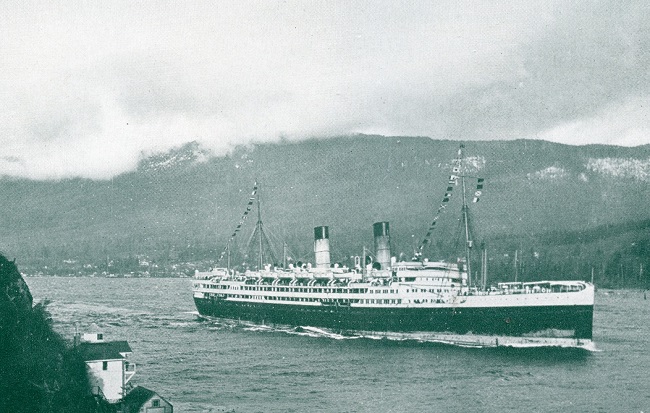
The war years saw the Aorangi as active as ever, on a great variety of duties and visiting places far removed from its trans-Pacific workings of the 1930's.
1939 - 1945
Although the regular route plied by the Aorangi was far removed from the major conflicts in Europe, there still remained great danger off the coasts of Australia and New Zealand. The RMS Niagara, a sister ship to the Aorangi, which also worked the Sydney - Vancouver route became a very early casualty of the war when it hit a mine during the early hours of June 19th 1940 shortly after leaving Auckland. The mine was part of a barrage laid by the German auxiliary cruiser Orion. The ship sank off Bream Head, Whangarei in 360 feet of water. All 349 passengers and crew were rescued because the ship sank slowly in calm seas allowing for an orderly evacuation of the vessel.
Sunk with the ship were 590 bars of gold (about eight tons) in transit from New Zealand to Canada representing payment to the United States from the Bank of England for munitions. Salvage operations were begun immediately by United Property Salvage Ltd of Melbourne, but it took six weeks just to locate the wreck of the Niagara. Using only the most basic of equipment 555 gold bars were recovered. A further 30 were salvaged in 1953 leaving five unaccounted for.
In October 1940 Aorangi sailed with troops from New Zealand to Fiji. During the first half of 1941 she was moving troops from Australia to Canada including airmen. In the summer of 1941 the Aorangi was requisitioned by the British Ministry of War Transport and steamed from Sydney to the United Kingdom. After conversion to troop ship service, she sailed with convoys carrying troops and supplies to the Near East, Middle East and India and brought US and Canadian troops to Europe.
The Aorangi was now classified as a Defensively Equipped Merchant Ship (DEMS). Equipment fitted for this role included degaussing gear and a variety of armament including a rear gun emplacement fitted with one 4.7" gun, a 3" high angle and two 20mm Oerlikon pom-poms just in front of it. Two more Oerlikons were amidships, two 5" Brownings on the bridge, and two more Oerlikons on the forecastle.
The Aorangi left the United Kingdom on November 13th 1941 as part of convoy WS 12Z bound for Suez. The convoy arrived at Freetown on November 25th 1941 and departed on November 28th 1941. Refuelling took place in Durban, departing here on December 24th 1941. The Aorangi and three other ships headed for Singapore as the retitled convoy DM1 to provide urgent aid for the forces there, arriving there on January 13th 1942.
For the above paragraph a reader to this webpage has graciously provided an expanded chronology and source(s) below:
1941-11-12 MS Aorangi, part of Convoy WS12Z departs Gourock on the river Clyde Scotland at 1145 (into the 13th) – source ADM199-1138. The convoy was destined for Basra Iraq.
1941-11-25 Convoy WS12Z arrives in Freetown, Sierra Leone – source ADM199-1138
1941-11-28 Convoy WS12Z departs Freetown, Sierra Leone – source ADM199-1138
1941-12-07/8 Japan attacks Pearl Harbor and invades Philippines, Malaya, Thailand and Hong Kong.
1941-12-18 Convoy WS12Z arrives Durban, South Africa – source ADM199-1138.
Upon arrival in Durban, changes are made to ships loads and destinations – source “The Winston Specials“ by Archie Munro, pages 230 and 231.
1941-12-24 Convoys WS12Z-A (Aden), WS12Z-B (Bombay) and WS12Z-M (Malaya) depart Durban. – source ADM199-1138
1941-12-30 USS Mount Vernon and escort HMS Emerald join WS12Z-A, WS12Z-B and WS12Z-M. At 1000, USS Mount Vernon, escort HMS Emerald and WS12Z-M (SS Narkunda, MS Sussex, MV Abbekerk and MV Aorangi) detach and become convoy DM 1. – source ADM199-1138.
1941-12-31 Convoy DM 1 Latitude 3° 8' S – Longitude 52° 23' E – source USS Mount Vernon Deck Log
1942-01-01 Convoy DM 1 Latitude 2° 41' S – Longitude 57° 21' E – source USS Mount Vernon Deck Log
1942-01-04 Convoy DM 1 arrives Port ‘T’, Addu Atoll, Maldives – source USS Mount Vernon Deck Log
1942-01-05 Convoy DM 1 departs Port ‘T’, Addu Atoll, Maldives – source USS Mount Vernon Deck Log
1942-01-09 escort HMS Durban joins convoy DM 1 – source ADM53-11580 (Durban’s log)
1942-01-10 Convoy DM 1 Latitude 5° 13' S – Longitude 100° 8' E – source ADM53-11580
1942-01-11 Convoy DM 1 Latitude 6° 17' S – Longitude 105° 20' E – source ADM53-11580
1942-01-12 Convoy DM 1 Latitude 2° 21' S – Longitude 105° 41' E – source ADM53-11580
1942-01-13 Convoy DM 1 arrives in Singapore – source ADM53-11580 and USS Mount Vernon Deck Log.
A total of 3838 men were carried between the Narkunda and the Aorangi – source “The Winston Specials“ by Archie Munro, pages 231. (including men from the 53rd Infantry Brigade, 232 Squadron RAF, 6th Heavy & 35th Light Artillery Regiments RA and the 85th Anti-Tank Regiment RA – source of count is the Embarkation Roll Greenock, Scotland 11 November 1941.
The Aorangi later sailed with evacuated civilians from Singapore, leaving on January 16th 1942 and arrived in Fremantle, Western Australia on January 24th 1942.
On April 15th 1942 the Aorangi sailed from the United Kingdom as part of convoy WS 18. Freetown was reached on April 29th 1942, departing here on May 3rd 1942. The convoy arrived off Capetown on May 15th 1942, the Aorangi was in that part of the convoy due to refuel at Durban. However a minefield had been laid recently by the raider Doggerbank, two ships fell victim to the mines. After unloading the Aorangi set sail with two other ships bound for the River Plate.
On July 1st 1942 the heavily protected convoy AT 17 departed New York bound for the Clyde with eight ships including the Aorangi. At some point the Aorangi & Siboney became detached from the main convoy and put into Halifax. These two ships sailed from Halifax on July 5th 1942 as convoy AT 17B and reached the Clyde on July 12th 1942.
The Aorangi sailed from the Clyde on July 29th 1942 as part of convoy WS 21. Also in the convoy was the Sulzer powered Rangitiki. Freetown was reached on August 10th 1942, departing August 15th 1942. Cape Town was reached on August 27th 1942, the Aorangi being in the group of ships set to refuel here, departure from here was on August 30th 1942. On September 10th 1942 the convoy divided as they normally did with the Aorangi bound for Aden and Suez, arriving at the latter towards the end of September 1942.
The small convoy WS 29A with two ships, one being the Aorangi sailed from the United Kingdom on April 20th 1943 to Casablana, Dakar and Freetown arriving May 4th 1943. Here further ships were added, the convoy now identified as the WS 29. Cape Town was reached on May 18th but the Aorangi was in the group that went to Durban for refuelling, arriving here on May 20th 1943, which appears to have been her destination.
Convoy KMF 25A with twenty six ships including the Aorangi sailed from Liverpool on October 27th 1943 bound for Alexandria, arriving there on November 11th 1943, although the Aorangi may have only gone as far as Algiers.
Convoy MKF 26 sailed from Port Said on November 17th 1943 with the Aorangi joining from Oran on November 30th 1943 bound for the United Kingdom, reaching the Clyde on December 8th 1943. This convoy comprised mostly large troop carrying ships.
On February 21st 1944 convoy KMF 29 sailed from the Clyde with twenty three ships including the Aorangi bound for Alexandria (?), reaching there on March 5th 1944. The Aorangi was carrying 1,551 troops. Following this trip the Aorangi departed Malta with 3,143 troops bound for Liverpool and using convoy MKF 29 to make the journey, arriving Liverpool on March 16th 1944.
In May 1944 the Aorangi was fitted out as an accommodation ship for small craft personnel. During the Normandy invasion she served as a depot ship for a fleet of tugs and auxiliary ships, providing food, water, ammunition, engine parts and relief crews. From D-Day until the end of July, the Aorangi serviced 1,200 vessels and countless other small craft. Her hospital took in wounded men from the beachheads. Not far away at the D-Day landings the Monowai was used in the transport of troops across the English Channel.
After these D-Day & Normandy adventures the liner was converted to serve as the commodore ship and joined the British Pacific Fleet at Hong Kong. On March 31st 1945 convoy KMF 42 sailed from the Clyde with nineteen ships including the Aorangi bound for Gibralter. The Aorangi was carrying 433 troops, her ultimate destination was Bombay.
After the Japanese surrender, she remained at Hong Kong as an accommodation ship for men released from war service and waiting to go home.
It was estimated that during the war years, this ship transported 36,000 troops and evacuated 5,500 refugees from war zones.
On September 25th 1945 the hospital ship Aorangi was reported due to arrive in Brisbane shortly carrying 700 former Australian prisoners, the Minister for the Army (Mr Forde) said. One hundred of the men would leave the ship at Brisbane and the Aorangi would reach Sydney next weekend with the remaining 600. These were but a fraction of the recently freed Australian prisoners yet to be recovered from territory formerly controlled by the enemy.
1946 - 1947
After being returned to her owners in May 1946, the Aorangi underwent a lengthy refit at Sydney to make good the wear and tear sustained during World War II and to update the passenger accommodation. The Aorangi would resume service in August 1948 with accommodation now for 212-1st, 170-cabin and 104-3rd class passengers for the Vancouver - Australia service. The passenger accommodation was reduced by one hundred cabins to create better quarters for the crew.
On June 21st 1946 seventy ship repair workers employed on the Union Steam Ship Company's vessel Aorangi gave the company a week's notice of their intention to leave the job because of a dispute over dirt money. The Amalgamated Engineering Union said that during the war the men received dirt money for working in dirty places and that the company had refused to pay the extra amount. An industrial officer of the company said dirt money was paid only when granted by a board of reference and the company had no authority to pay it as regular practice.
During late August 1947 another waterfront dispute ended as members of the Ship Painters and Dockers Union and the Operative Painters Union returned to work on August 25th. They had been on strike because of a demarcation dispute. The dispute slowed up repair work on many ships undergoing refit in Sydney, including the Aorangi, Monowai, Chang Te and many other smaller vessels.
1948
The 1948 sailings - list incomplete - (northbound unless otherwise stated):
August 19th 1948 departed Sydney for Vancouver
September 16th 1948 (southbound) departed Vancouver for Sydney
October 11th 1948 (southbound) arrived Sydney from Auckland
November 18th 1948 (southbound) departed Vancouver for Sydney
The delays to the repair and overhaul of the Aorangi drew the attention of the Australian Government late in April 1948. 'Every effort is being made to speed up refitting of the Canadian-Australasian liner Aorangi in Sydney to enable her to return to the Pacific service within the next two or three months', said Mr. Chifley, Prime Minister. Additionally no information had been received by the Government of proposals that a larger and more modern liner would be placed on the Pacific run to replace the Marine Phoenix, now making her last trip. He added that the Government could not do anything where expenditure of dollars was involved, 'We will do our best to help any company at our end in regard to Australian expenditure, but that is limited,' Mr. Chifley said.
Such was the advancement of the repair work on the Aorangi that on June 6th it was reported that the Aorangi would sail from Vancouver on September 16th 1948 on her first commercial voyage from there since 1941. The vessel would sail from Vancouver to Australia every nine weeks, calling at Honolulu, Suva, Auckland and Sydney. To reach Vancouver for the first southbound trip would require the Aorangi to leave Sydney about August 19th. About the same time the Matson Line announced that the Marine Phoenix would make one more voyage to Australia, leaving San Francisco on July 7th.
After two years refitting at a cost of a £1,400,000 (more than the original cost of the ship) and bourne by the British Government, the Aorangi commenced sea trials on Sunday August 1st. She was expected to leave Sydney on August 19th for Vancouver. On August 2nd the sea trials continued for at least five hours with the ship tested to her maximum speed. The Matson vessel Marine Phoenix was due in Sydney on July 27th on her last voyage on the Australia-U.S.A. run. There would be no regular passenger service between Australia and North America until the Aorangi re-entered service.
Prior to the first sailing of the Aorangi it was announced that fares payable in Australian currency between Australia and New Zealand would rise by 25% for all services operated by the Union Steam Ship Co. of N.Z., Ltd. This was caused by the recent revaluation of New Zealand currency to par with sterling. No decision had yet been made about fare rates of the Canadian-Australasian Line, which operated the Aorangi.
Early in September 1948 a fare increase was reported for those sailing on the Aorangi. The fare increase for those sailing from Sydney to Vancouver was 25 per cent with local agents instructed that fares are now based on the Canadian dollar.
History was witnessed early on the morning of September 11th 1948 by crowds at Vancouver as the motor ship Aorangi, captained by William Whitefield arrived on its first postwar trip. Hundreds of residents thronged the shore of English Bay to watch the Aorangi glide into the harbour with nearly 500 passengers and a cargo of wool, hides, bananas and mail. An official welcome was extended earlier at Victoria by Mayor Percy George.
When the Aorangi sailed for Sydney on September 16th she carried 300 tons of emergency food for Hawaii, which had been hit by the US maritime strike. The ship carried 500 passengers and cargo, including newsprint, and sulphate of ammonia. Although her capacity was 485 persons, extra accommodation was provided for children returning with their parents. The cargo carried was only about 25% of her capacity, the shortage of US dollars restricting imports into New Zealand and Australia.
In compliance with his wishes, the ashes of Captain Thomas Hill, former commodore of the Union Steamship Company, were cast into Auckland Harbour from the Aorangi on October 6th. Captain Hill, who retired in 1941 passed away in Vancouver in 1942. His relatives had been waiting for the Aorangi to resume service in order to have the ceremony performed. The ashes were thrown into the sea as the ship rounded North Head on her arrival from Vancouver. Vessels commanded by Captain Hill were the Tahiti (foundered in mid-Pacific in August, 1930, after losing her propeller), Niagara (sunk by a mine in the Tasman in 1940), Marama (sold to Japan for breaking up), Monowai (sunk by a German raider in the Atlantic in 1940), and the Aorangi which had recently returned to service after an extensive refit.
Four stowaways were discovered on the Aorangi after she sailed from Vancouver on November 18th. One stowaway, a young boy, was discovered before the ship reached Victoria; and was put ashore there. The three others were most likely landed at Hawaii.
It was reported late in December from high Government sources that the service provided by the Aorangi had been running at a loss on every trip. Even on her maiden post-war voyage £150,000 was lost. Although passenger numbers were high it was on the freight side that a profit would be made but foreign currency shortages were affecting the amount of cargo carried. At the same time a request to the Australian government to provide a subsidy to restart the Matson Line's America - Australia service was rejected for similar reasons.
1949
XXX The 1949 sailings - list incomplete - (northbound unless otherwise stated):April 18th 1949 (southbound) arrived Sydney
April 29th 1949 depart Sydney (?) for Vancouver
June 30th 1949 departed Sydney for Vancouver
August 4th 1949 (southbound) arrived Honolulu from Vancouver
August 17th 1949 (southbound) arrived Auckland from Suva
August 22nd 1949 (southbound) arrived Sydney from Auckland)
November 24th 1949 departed Sydney for Vancouver
December 23rd 1949 (southbound) departed Vancouver
Two difficult appendix opertions were performed at sea on the Aorangi which arrived Sydney on April 18th 1949 from Vancouver. Two days after the Aorangi left Honolulu the assistant purser, H. P. McQueency, of Hobart developed a gangrenous appendix and was immediately operated on by Dr K. Addison, of Sydney. The Aorangi was stopped two hours for steadiness during the operation. A Newcastle nurse, Miss Joan Truscott, who was a passenger returning from Canada, volunteered to care for McQueeney in the ship's hospital. On Saturday, on the way from Auckland, Miss Truscott developed acute appendicitis and Dr. Addison performed a second operation. When the Aorangi berthed McQueeney was able to hobble around the ship but Miss Truscott was taken to a private hospital.
During June 1949 the Aorangi's owners put up for sale four Sulzer generators, each of four cylinders, 2-Cycle, blast injection, 200rpm, 300KW, 220 Volts DC, 900amps working load, 3 Breakers, 1,500amps each along with a full supply of spare parts including a spare crankshaft & armature. The material was being discarded to allow for the installation of four higher powered generators, with the existing equipment available for examination under working conditions following the arrival of the Aorangi at Sydney on June 20th 1949. All equipment was advised as in first class condition.
August 5th 1949: Striking watersiders at Honolulu stopped unloading relief food cargo from the Aorangi yesterday, when six members of the Teamsters Union picketed the wharf. The teamsters had previously been suspended for having refused to cross the picket lines of the striking International Longshoremen's Union. The chairman of the emergency food committee issued a copy of an agreement between employers and the Longshoremen's Union, which said that relief cargo would be unloaded from the Aorangi at pre-strike wages. A clause said 'No pickets will be in the vicinity of the pier nor will other means be taken to interfere with this project during the vessel's stay here.' A union spokesman said 'We are not crossing any picket lines.'
On arriving at Auckland on August 17th no cargo was handled due to the waterside strike. On its journey across the Tasman Sea to Sydney, the Aorangi was delayed several hours by rough weather, as was the Wanganella and the South Africa Star. It was also reported from Auckland that two elderly passengers had died en-route from Vancouver. One, a Mr Alfred Fowler of British Columbia had been intending to settle in Sydney.
The northbound sailing of the Aorangi during November 1949 included forty tons of tuna from Sydney for the United States.
1950
The 1950 sailings - list incomplete - (northbound unless otherwise stated):January 16th 1950 arrived Sydney
March 20th 1950 (?) (southbound) arrived Sydney
May 22nd 1950 (southbound) arrived Sydney
June 1st 1950 departed Sydney for Vancouver
July 24th 1950 arrived Sydney from Auckland
August 3rd 1950 departed Sydney for Vancouver
September 27th 1950 (southbound) arrived Sydney from Vancouver
October 5th 1950 departed Sydney for Vancouver
November 28th 1950 arrived Sydney from Auckland
December 7th 1950 departed Sydney for Vancouver
December 30th 1950 arrived Vancouver from Honolulu
When the Aorangi arrived at Sydney during the third week of March a shortage of dockside workers found the unloading of the passenger baggage in the hands of the ship's passengers! Elsewhere in Sydney the labour shortage had idled twelve ships.
April 27th 1950 - The Seamen's Union decided to declare "black" any Australian vessel carrying U.S. Government officials or U.S. Government freight. This is in retaliation for the refusal of the American Consul to give the Federal secretary of the Union, Mr. E. V. Elliott, a transport visa to land at Honolulu on his way to Canada. The Seamen's Union described the refusal of the Consul as "vicious discrimination." The ban affects only one ship, the Aorangi which has an Australian crew and carries American passengers and cargo. A shipping official of the Union Steamship Company said that very little U.S. Government cargo came to Australia in the Aorangi. Few Government officials would be affected because they mostly travelled by air. Other ships on the North America - Australia run operated with British, American, Canadian and Swedish crews.
On July 3rd 1950 it was announced that the Canadian-Australasian Line would withdraw the Aorangi from passenger and freight service between Australia and America next January because of heavy losses. The Aorangi is the only large passenger vessel providing a regular service to America. The withdrawal was announced by C B V Wheeler, manager of the Union Steamship Co., Australian agents. After the Aorangi leaves the only passenger service to America by sea will be cargo freighters on irregular schedules with minimal passenger accommodation. The Aorangi has accommodation for 486 passengers and has been sailing from Sydney to Vancouver, via Auckland and Honolulu. Mr. Wheeler said that the Canadian-Australasian Line has decided to withdraw the Aorangi on her arrival in Sydney from Vancouver on January 29th, 1951. The Aorangi's latest losses began with her post-war maiden voyage to Canada from Australia in August and September, 1948, which were estimated at £150,000. The losses continued on subsequent voyages because of the small amount of freight carried. After she completed her war service, the Aorangi began her refit back for commercial use in April 1946, at No. 5 Darling harbour wharf, because no dock facilities were available.
The Canadian - Australasian Line, have announced that they can no longer carry the 'substantial financial losses' which they have been incurring with the liner since the war ended, and they have fixed January 29th next as the date on which she will be taken off the run. While higher operating costs account for part of the company's losses, the main factor is the paucity of freight traffic. So far as passengers are concerned, the Aorangi is 'booked out' every voyage, in spite of the current dollar restrictions, but, even so, with her holds half-empty, or worse, she cannot nearly pay her way. The root of the difficulty, is the acute dollar shortage. The rigid rationing of North American imports which Australia and New Zealand, like every other country, has been compelled to introduce, has had the effect of cutting cargoes to the barest practical minimum. For a ship of the Aorangi's size the trade has thus become intrinsically unprofitable and inevitably it will remain so until some solution of the dollar problem is forthcoming. New Zealand favors a combined subsidy in order to keep the Aorangi in the service, and her Prime Minister is obviously disappointed by the refusal of the Australian and Canadian Governments to support this offer. It is true that Australia could expect to recoup part of what such a subsidy would cost her, especially in the form of dollars brought in by American tourists, but at the best a subsidy would be only a palliative and an expensive one at that. Far more effective would be a dollar loan to permit a freer flow of trade between North America and the Commonwealth. Indeed, every circumstance of relations with the United States and Canada points to the need for an approach to Washington along these lines. The threatened withdrawal of the Aorangi is but one more reason to act as soon as possible. (The Advertiser, Adelaide: July 5th 1950)
The announcement that the only regular passenger service between Australia and New Zealand and North America is to end with the withdrawal of the Aorangi next May will cause general concern. Before the war four big liners - Aorangi, Niagara, Monterey and Mariposa - were on the transpacific run, and provided a total of 22,000 berths a year. When the Aorangi is laid up, the only surface passenger facilities will be the limited cabin space in a few cargo ships, unless the Matson Line resumes its service. If the Mariposa were put back on the run, as is hoped, a hope encouraged by the settlement of the long dispute between the United States Government and the Oceanic Steamship Company, it would compensate for the loss of the Aorangi, so far as maintenance of a passenger service is concerned. But it would still be a sad blow to the prestige of the British Merchant Marine were the 'Red Duster' finally hauled down on the Pacific passenger run, in whose inauguration it played a pioneer's part. At a time when all the emphasis must be on strengthening the links between the great Pacific democracies, a need recognised by the implementation of the Anzus Pact, it is little short of a calamity that the discontinuance of an important communications service is in imminent prospect. The Aorangi is a very old ship, and the ruling that she is no longer fit for service must be accepted, although there will be sentimental regrets at the passing of such a Pacific identity. But since the three Dominion Governments concerned are, according to the New Zealand Prime Minister, prepared to continue their substantial annual subsidy, it is to be hoped that the Canadian Australasian Line will consider finding another vessel to take the veteran's place. (September 30th 1950, source??)
A strike by wharfside workers in New Zealand delayed the September southbound journey for the Aorangi by two days, the ship eventually reaching Sydney on September 27th 1950.
November 24th 1950: the Canadian Government is reconsidering its decision not to subsidise the liner Aorangi, which plies between Vancouver and Australia, the Minister for Transport, Mr. Lionel Chevrier, said.
December 12th 1950: The well known Canadian Australasian liner Aorangi. 17,500 tons, is being offered for sale. A London firm of shipbrokers is seeking offers for this trans Pacific liner, with delivery offered in Sydney in the second week of January, offers in the range of £2,750,000 were being sought. The owners are withdrawing the vessel from the service because they can no longer operate at a profit. They have been seeking a 100,000 Pounds a year subsidy from the Australian and New Zealand Governments but the offer of the vessel for sale suggests that negotiations have failed. At Canberra Mr. Holt, Immigration Minister, said he would investígate whether the Commonwealth should acquire the Aorangi for tourist purposes.
1951
The 1951 sailings - list incomplete - (northbound unless otherwise stated):January 5th 1951 (southbound) departed Vancouver for Sydney
April 5th 1951 departed Sydney for Vancouver
May 28th 1951 (southbound) arrived Sydney from Auckland
July 5th 1951 departed Sydney for Vancouver - delayed since June 4th 1951 because seamen refused to man her
October 29th 1951 arrived Sydney from Auckland
December 27th 1951 (southbound) arrive Auckland from Suva
The Aorangi, apparently reluctant to leave Vancouver, sailed for Sydney on Friday January 5th 1951 for the last time with 455 passengers and 310 crew. The liner wrenched off a heavy bollard fastened to the wharf when one of the connecting cables was not cleared in time. The rope cable had to be cut. The ship was expected in Auckland on January 23rd and Sydney on January 29th 1951. The agents said that Captain W Whitefield, Aorangi's commander had transferred to the Union Steamship Co. of New Zealand. The crew, mostly Australians, would be paid off.
February 1st 1951 - John Gordon McGregor, for 22 years barman in the liner Aorangi, said when he was paid off today with the rest of her crew of 316, that he felt as if he had "lost a home." The crew was paid off because Aorangi's owners, the Canadian-Australasian Line, say the liner can no longer be run without heavy loss. But McGregor, who signed on in Aorangi on her second voyage in 1925, has not given up hope of sailing in her again. He said today: "I'll have a few months' spell ashore, to see what happens to the old girl. "If she is put in commission again for new owners, I'll apply for a berth." A Canadian Australasian Line spokesman said today that Aorangi's officers and some of her crew would be transferred to the Union Steamship Company's fleet. Aorangi has been offered for sale to ship owners' within the British Commonwealth.
It was announced on February 22nd 1951 that the liner Aorangi would shortly resume the Canada-Australia passenger service, under financial assistance from the Canadian, Australian and New Zealand Governments. Announcing this, the Prime Minister, Mr. Menzies, said that the Governments of Canada and New Zealand were prepared to co-operate with Australia in providing a subsidy for operations of the vessel. Mr Menzies said he hoped, as a result of the decision to provide a subsidy for Aorangi, that the ship would soon be returned to the important work of maintaining a passenger, mail and freight service between Australia and Canada. It is believed authoritatively that the total subsidy will be £A100,000 per year, of which Australia's contribution will be £A40,000.
On February 26th 1951 it was announced that the Aorangi would resume service on the Pacific run on April 5th. This was announced last night by the assistant manager of the Union Steamship Co., Mr. P J Kilby. There would be no change in the service. The liner would leave Sydney on April 5th for Auckland, Suva, Honolulu and Vancouver. Bookings would open to-day. Mr. Kilby said it was costing the company more than £1,500 a month to keep the Aorangi inactive in Sydney. On March 6th the Aorangi was moved from her anchorage at Bradley's Head to a berth at 5 Darling Harbour where she will be fitted out ready for her return to service on April 5th.
A waterfront dispute in New Zealand led to serious problems for the Aorangi and many other vessels during May & June 1951. The dispute impacted the southbound trip of the Aorangi, which called at Auckland, but in order to avoid being blacked no cargo was handled there. At Sydney a one day stoppage occurred on Friday May 25th but there was expected to be no impact to the Aorangi upon her arrival, either from the dockside workers or the ship's unionised members.
Several days later on about June 5th the ship did become embroiled in the situation when sixty nine members of the Seamen's Union resigned from the Aorangi's crew because the vessel was carrying passengers bound for New Zealand. The Union Steamship Company then announced that because a Seamen's Union crew could not be obtained, the departure of the ship had been postponed indefinitely. The Aorangi was to have sailed for Vancouver, via Auckland, with 480 passengers and cargo. Later calls to offer on the ship were ignored. The ship's 250 officers and stewards were paid off. The tie-up of the Aorangi has ended the only liner service between Australia and Canada and the last passenger service link with New Zealand. The trans-Tasman liners Wanganella and Monowai were also tied up because the seamen refused to man them. On the Aorangi more than 1,000 cases of crayfish tails and rabbits were unloaded and placed in cold storage until another ship became available. Crayfish tails and rabbits were among Australia's big dollar shipments to the United States. The Aorangi still had about 500 tons of Vancouver cargo for Auckland, which was over carried in an effort to avoid the ship being declared black. The tie-up of the Aorangi has caused heavy air bookings to the United States for the next few weeks. Tasman Empire Airways Ltd was also running special flights for New Zealand passengers.
The shipping company continued to offer calls twice daily for a crew for the ship, but each was refused by the seamen. The latest line from the Communist union officials was that there was no official ban on the ship, shipping company officials believed the situation would be resolved once the stoppage in New Zealand was over. The use of naval ratings was considered but rejected due to a number of operational issues, one of which was the return of the ratings from Canada. Into the third week of June further calls continued to be rejected. The Sydney Herald interviewed a number of seamen who had been members of the Aorangi's crew, many of them had been employed on the Aorangi for years. The seamen said they were prepared to take the ship to sea if their union allowed them, and they thought the strike was a waste of time as all other unions had declared it off. One seaman said "if the Commos were not running our union we would be back at work tomorrow We have no dispute with the company'.
By the end of June the delay continued to draw anger in Canberra. The Government delay in settling the Aorangi dispute was playing into the hands of Communists, the deputy Labour Leader in the Senate (Senator Armstrong) said today (June 27th). He said the Government had ample power to bring the dispute to a quick close under the Crimes Act. 'What Is the National Service Minister (Mr. Holt) saying to Messrs. Elliott and Healy?' he asked. 'I have asked the Minister repeatedly what progress has been made in the dispute, but am told that 'negotiations are in progress.' The Government was parleying with the Communists, Senator Armstrong continued. Seamen had said they would not man the ship because she was bound for New Zealand. The Crimes Act gave the Government power to deport any person inciting a strike who had come from another country. 'Why doesn't the Governrment make use of its power, instead of seeking further anti-Communist legislation, which is not necessary?' he added.
The Government acted swiftly on June 28th by advising that naval ratings would man the Aorangi. Announcing this in the House of Representatives, the Labor Minister (Mr. Holt) said the owners of the vessel had been instructed to have the ship ready to sail as soon as possible. He expected that the Aorangi would leave for Vancouver, via New Zealand, next Thursday (July 5th). Mr, Holt said the Government viewed seriously the hold up of the Aorangi, which was the last passenger link between Australia and Canada.
The next day, June 29th, seamen walked off thirteen ships in Newcastle in protest against the Government's decision to use naval ratings on the Aorangi. The seamen were expected to return to work the next day.
Continued twice daily calls were ignored by the seamen. On Tuesday afternoon (July 3rd) sixty-nine naval ratings travelled to Darling Harbour and boarded the Aorangi, at which time eleven watersiders walked off, but 150 remained on the job. A spokesman for five maritime unions said last night that members would work the Aorangi with naval personnel. On July 4th the seamen at a final call soon after noon decided to man the Aorangi. When the call was made most of the old crew stepped forward, and within a few minutes most positions on the liner were filled. The naval ratings then disembarked and the Aorangi sailed on July 5th for Vancouver via Auckland with her full union crew and 480 passengers, cargo and a large quantity of mail.
1952
The 1952 sailings - list incomplete - (northbound unless otherwise stated):January 19th 1952 Auckland to Suva delayed by engine trouble at sea
March 18th 1952 (southbound?) arrived Auckland
May 5th 1952 (southbound) arrived Sydney from Auckland
May 25th 1952 arrived Suva from Auckland
June 7th 1952 arrived Victoria BC from Honolulu
July 12th 1952 (southbound) arrived Sydney from Auckland
September 25th 1952 departed Sydney for Vancouver
November 18th 1952 (southbound) arrived Sydney from Auckland
December 11th 1952 departed Sydney for Vancouver (arr Jan 3rd)
On the first northbound sailing of 1952 the Aorangi experienced engine trouble on Friday January 18th en-route from Auckland to Sydney. The ship was delayed fifteen hours in reaching Suva, departing there on January 20th for Honolulu.
A wide variety of contraband goods was seized by customs officers in a widespread search on board the liner Aorangi in Sydney on May 7th. The items included American cigarettes, tobacco, propelling pencils, novelty figures, plastic playing cards and an electric cooker hidden in the air vents.
Three Australian and five New Zealand yachts were part of the cargo carried by the Aorangi to Suva to compete in the international 18ft yacht championships, scheduled for the first week of June.
Thirteen feet of the bow of the liner Aorangi was crumpled on Saturday June 7th when the ship struck a cement piling at Ogden Point docks at Victoria, British Columbia. The Union Steamship Company said they had no details of the incident and could not say whether the ship's schedules would be upset. A two foot thick bumper log was sliced in half by the liner whilst docking after the voyage from Sydney.
It was announced mid July 1952 that the Aorangi was to tie-up in Kerosene Bay for two months, during which time she will undergo a Lloyds survey. The Aorangi arrived from Vancouver on July 12th and was set to resume the Sydney Auckland Vancouver service on September 25th 1952.
On September 29th 1952 it was announced that the liner Aorangi will end her service between Vancouver and Sydney after she finishes her voyage to Sydney on May 25th next year. This will leave Australia without a regular passenger liner service to North America. The Union Steamship Company of New Zealand, as Australian agents for the Canadian-Australasian Line, announced last night that the reason for the discontinuation of the Aorangi's service was her age. It said that the vessel was now in her 28th year, and that operation of the Pacific service beyond May 25th 1953, could not confidently be maintained. The Minister for Shipping, Senator G. McLeay, said that he hoped that the Matson Line would announce soon that it would restore the service between Australia and North America. "I conferred with representatives of the Matson Line when they were in Australia about a year ago and the company was considering either building or buying two smaller modern ships for this service," he said.
New Zealand's Prime Minister, Mr. S G Holland said 'I am sure everyone will deplore the cessation of this service'. New Zealand, Australia, and Canada would be prepared to continue their substantial subsidy to keep the ship running, 'But the question is entirely one of seaworthiness and no risks can be taken,' he added.
Whilst departing her berth at Auckland on September 30th the Aorangi was delayed for sixteen hours when she lost a gun port door whilst leaving the wharf. She was moving from her berth when the door swung open, fouled a wharfpile, and dropped into the harbour. A plate was welded over the hole, and she left for Vancouver in the afternoon. Permanent repairs will be made at Vancouver.
The Aorangi encountered a severe storm on Monday October 27th whilst working southwards from Vancouver. Winds of 80 miles an hour and 55 foot waves slammed at the Aorangi 800 miles south-west of Cape Flattery as she headed out on her last voyage from Australia. The vessel radioed the Dominion Public Weather office to report that she was in the midst of a storm off Cape Flattery, the northernmost tip of Washington State. Two hours later it was reported the winds had 'dropped' to 55 mph. A huge wave smashed windows and tore away woodwork. The wave hit the ship at 4 am flooding the cabin of the master, Captain W. Whitefield, who was in bed. Crockery was broken in the storm, which lasted 24 hours, Glassless windows and splintered woodwork showed the effects of the wave, but much of the damage has been repaired by the time the Aorangi reached the next port. The Aorangi was two days late reaching Auckland, partly because of the storm and partly because of engine trouble at Honolulu.
The last northbound sailing of 1952 for the Aorangi should have left Sydney in the last week of November (27th?) but the company pushed this date back to December 11th, reportedly due to engine trouble. There was then no prospect of Christmas goodwill parcels and letters/cards now reaching America before Christmas. The original schedule would have seen the Aorangi reach Vancouver on December 19th.
1953
The 1953 sailings - list incomplete - (northbound unless otherwise stated):
April 6th 1953 (southbound) arrived Sydney
May 15th 1953 (southbound) departed Vancouver for Sydney
June 4th 1953 (southbound) departed Auckland for Sydney.
On May 12th 1953 it was reported that the Aorangi had been sold for scrap to a British firm.
As the Aorangi departed Vancouver for the last time on Friday May 15th bagpipes played the 'Skye Boat Song' whilst a myriad of steam whistles and sirens witnessed Vancouver saying goodbye to an old friend. With all the dignity of her 28 years, the Aorangi moved amid tugs under the Lion's Gate Bridge as the Canadian Pacific Railway's liner Princess Patricia signalled a wistful 'Goodbye and good luck' with her flags. The Aorangi's passenger list was considerably less than capacity an official said.
On her final departure from Auckland on the evening of June 4th the ship was delayed for two hours due to a mechanical fault.
The 17,491-ton liner Aorangi reached Sydney on June 9th 1953 after her last trans-Pacific voyage from Vancouver. She arrived a day late after fighting westerly winds off the coast of Australia. On the ship were 366 passengers and a crew of 317. A big crowd cheered the Aorangi as she berthed at No.5 Darling Harbour. Ships at nearby wharves gave a friendly blast of welcome on their sirens. One of the many people who greeted her was Captain J G MacPhail, the wharf superintendent, who in February 1925 supervised the Aorangi's berthing at No. 2 Circular Quay, when she made her maiden voyage. The master of the Aorangi, Captain W Whitefield, said at his last press conference on board that the Aorangi had covered 1,300,000 Pacific miles during the nine years he has been in command. Two members of the crew have served 24 years with the Aorangi, the chief radio operator, C F G Taylor, and the ship's barman, John Gordon MacGregor. Mr. Taylor said: 'The Aorangi seemed to bear a charmed life throughout her career. Even an enemy flying bomb which fell into the sea 400 yards away failed to hurt her.' The chief steward, Mr. George Cooper, said the Aorangi was the finest ship he had sailed in. 'She is splendid in bad weather,' he said. 'I am sad to see her going off the run, but she is old and has given magnificent service.'
The Aorangi left Sydney on June 18th for a ship breaker's yard in Scotland. She left as a dead ship, stripped of all her furnishings, without passengers or cargo and manned only by a skeleton crew. The crew making the last trip was selected by a draw from a hat outside the shipping master's office. The draw was needed because more men volunteered for the trip than was required. Seamen regarded the voyage to Scotland as a first-class holiday on full pay because amongst other things it allowed a holiday in England before being flown back to Australia. The skeleton crew of one hundred signed-on on the morning of the departure.
Even the last day in Sydney for the Aorangi was filled with alleged conflict between the Seamen's Union and the Union Steamship Company. In the morning the Seamen's Union protested against the crew being granted only seven days leave in Great Britain. As soon as this problem was overcome the dispute over the presence of the doctor arose. The Aorangi had to sail without her purser, Mr. B. Hurley, in order to defeat a last minute effort by the Communist dominated union to prevent her sailing. It was demanded that because the crew numbered one hundred a doctor should be present on the trip. Since there was insufficient time to recruit a doctor the crew number was reduced to ninety-nine by removing the purser. The shipping company later announced that the removal of the purser was a company decision and was not caused by an action on the part of the Seamen's Union. Mr. Hurley waved good-bye to the ship from the wharf as she departed about an hour late, it would be left to the second mate to handle the duties of the purser.
Before Aorangi sailed the Sydney manager of the Union Steamship Company, Mr. W E Hancock entertained business associates at an impromptu cocktail party in the ship's music room. 'Aorangi at times has caused us all many headaches, but on behalf of the company I thank you all for your teamwork and cooperation,' Mr. Hancock said. In Aorangi's crew was a bedroom steward, Mr. Harry Hammond, who was a member of the crew when she made her maiden voyage to Sydney.
The liner Otranto at an adjoining wharf flew a signal of farewell as Aorangi backed from her berth for the last time. All the way down the harbour liners, freighters, ferries, and small harbour craft sounded a friendly farewell on their sirens and whistles. The Royal Australian Navy sent the following farewell message from H.M.A.S. Australia: "We are sorry to lose an old friend of many years standing in these waters. Captain, officers, and ship's company, wish you luck on your last voyage.' After Aorangi had cleared the Heads her master, Captain W Whitefield radioed to Sydney the following message: 'We are now on our last trip to the shipbreakers yards. The ship is putting her best foot forward as though she is telling us there is life in the old girl yet.
In addition to Captain W. Whitefield as her master, Mr. W Falconer was the chief engineer and Mr. G Cooper the chief steward. The Aorangi would travel the southern route around Australia, then Aden for refuelling, Suez and Glasgow. The crew will be repatriated back to Sydney by air.
As one might expect a number of 'relics' from the ship survived to see another day. Some silver was saved as was the dinner chime which was used by the ship's steward. The ship's wheel also escaped the scrapper and passed through a number of hands, with its authenticity supported by paperwork from the Consulate-General, Seattle. The wheel carries serial number A1813O.S., as built by Rosebank Iron Works Edinburgh. They also built the wheel for Titanic, photographs of both wheels indicate they are of a very similar design.
Built: Fairfield Shipbuilding & Engineering Company, Glasgow
Launched: 1924
Tonnage: 17,491 tons
Deadweight: 23,000 tons
Length: 600 feet
Breadth: 72 feet
Draught: 29.9 ft
Propulsion: Four Fairfield-Sulzer 6ST70 two-stroke single acting 6 cylinder diesel engines 3000/3600hp at 130rpm.
Auxiliary engines: four x 4SS34 and one x 2RV24 totalling 1,660hp
Screws: Four
Speed: 17.5 knots
Passengers (as built): 436 first class, 284 second class, 227 third class
Crew: 230
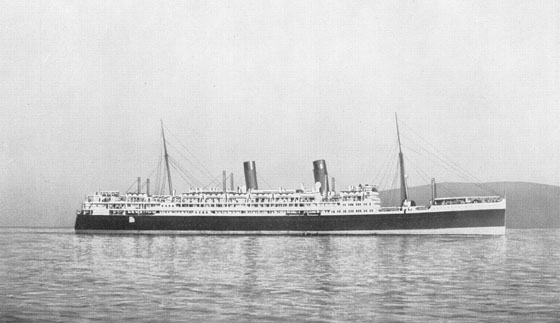
Distances between ports in Nautical Miles:
Vancouver - Honolulu = 2,383
Honolulu - Suva = 2,761
Suva - Auckland = 1,251
Auckland - Sydney = 1,281
Southampton - Vancouver via the Panama Canal = 8,746
Southampton - Singapore via the Suez Canal = 8,063
Southampton - Singapore via Cape Town = 11,671
Singapore - Freemantle = 2,190
Liverpool - Halifax = 2,617
Liverpool - Cape Town = 6,055
Liverpool - Alexandria = 3,059
Article from the March 25th 1925 edition of The Argus, Melbourne:
The illustration (not shown here) of the Aorangi's engines shows how low it has been possible to keep these, and thereby to save much valuable space by the adoption of four six-cylinder sets. The design has been criticised on the grounds that three eight-cylinder sets would have been preferable; but it is evident that the quadruple engine arrangement is justified for with three engines a large space to port and starboard would have been wasted to all intents and purposes the engine-room would have been considerably longer. The Sulzer Diesel engines of the Aorangi are two-cycle, with cylinders 27.5in by 39in at 125 rpm, the piston speed is 825ft per minute. The indicated horse-power at this speed is 17,000, and the shaft horsepower is 13,500. Scavenging is effected by three electrically driven turboblowers. The cylinder casings are unusually massive, for they weigh over five tons each. The scavenge ports are placed directly one over the other. The lower ports are uncontrolled and admit scavenging air to the cylinder as soon as they are uncovered by the piston, but automatic scavenging valves control the upper series of ports. These valves do not allow any communication to take place between the cylinder space and the scavenging air receiver on the down stroke of the piston, but on the up stroke they admit air to the cylinder and continue to do so after the lower ports have been closed by the piston. By this means a supercharging effect is obtained which experiment has shown greatly increases the power developed in a given size of cylinder. Five groups of six valves are fitted to each cylinder but they are of the flat disc type and require practically no attention. This new design is a considerable improvement on the rotary scavenge valve positively driven from the vertical shaft which was fitted to earlier Sulzer type engines.
Article dated September 13th 1927 source??:
The Aorangi, built by the Fairfield Company, Govan, Scotland, for the Union Steamship Company of New, Zealand, carries the distinction of being the largest motor ship afloat, her total shaft horse-power of 13,500 being double that of any other motor-propelled vessel. She is 600 feet long, with a gross tonnage of 17,500, and she carries 440 first class, 330 second, and 230 third class passaengers at a sea speed of about 18 knots. Her motive power consists of four six-cylinder, two-stroke, single-acting motors of the Fairfield Sulzer type, driving four shafts. The cylinders are 27.5 inches in diameter. by 30 inches stroke and the normal piston speed is 825 feet per minute at 127 revolutions per minute. The total shaft horsepower is 13,500, and the total indicated horse-power is 17,000. The Aorangi is a handsome vessel with cruiser stern. The spacing of her two pole masts and two funnels is pleasing and helps to give her an undeniably smart appearance. The machinery occupies the centre of the ship and the aft funnel houses the four exhaust pipes of the main engines. Forward of the main engine room is the auxiliary engine room and the forward funnel accommodates the exhaust pipes of four auxiliary engines and the up takes from the boilers and ventilating trunks. The ship carries sufficient oil for a round trip from Vancouver by way of New Zealand to Sydney, Australia, and back, a distance of over 15,000 nautical miles. The trials of the ship included an endurance test of over 60 hours operation, during which she made 18 knots, and the absence of vibration was noticeable, the machinery in spite of its great size and power running with remarkable smoothness, thus setting at rest the fear that when motor machinery ran to large sizes its operations would be attended with unbearable vibration. During the sea trials, lasting over a week, there was a 60-hour trial, during part of which time heavy weather was encountered, and both the engines and the ship gave an excellent account of themselves. The fuel consumption of the main engines was 0.395 pounds per brake horse-power hour, and that of the auxiliary Diesel engines was 0.036 pounds, making a total of 0.431 for the whole installation. The ship represents a notable forward step in application of the Diesel engine to ship propulsion.
Article dated March 5th 1925 (Sydney Morning Herald):
Many inspections are to take place during the stay in port of the motor liner Aorangi. An inspection of the vessel was made yesterday by representatives of the Press and shipping companies, and during the week-end the vessel will be thrown open on Saturday and Sunday to the public. A small charge will be made for admission, the proceeds going to charity. On Monday the vessel will be taken to Woolwich Dock, and on being re-floated will berth at the company's wharf No. 5 Darling Harbour.
While advantage has been taken in the design of the Aorangi of the latest improvements in passenger accommodation the greatest advance is shown in her engine room and navigating devices. Captain Crawford, the commander of the Aorangi yesterday explained the working of the most modern navigating devices which are installed on the bridge. Automatic steering mechanism is provided by a Sperry gyro compass and gyro pilot. The Sperry gyro pilot is situated on the port side of the hand steering wheel, and by a single lever can be connected or detached. Under normal weather conditions the automatic steering device commences to apply the helm at the first departure from the course of one-sixth of a degree. In heavy weather howover there is an arrangement which permits the vessel to maintain her natural period of yaw through the water. On top of the gyro pilot is a gyro repeater compass, used for observation during automatic steering, and as a steering compass when hand steering. An automatic recorder in the chartroom gives the actual course of the vessel at any moment. An electrical indicator on the bridge registers the state of each of the bulkhead doors throughout the ship. The doors are controlled from the bridge or locally. The subdivision of the hull into compartments is such that if two are pierced the vessel will remain afloat.
Two separate engine-rooms have been provided for the main-propelling engines, and the auxiliary generating sets connected by a tunnel, and on each side of the tunnel are four tanks, one for boiler oil, and the remainder for diesel fuel. The vessel has in all a capacity of 3,000 tons of oil, which is considerably more than is needed for a round voyage from Vancouver to Sydney and back.
The installation of diesel engines has lessened the demand for engine-room labour, and the men required for each watch is stated to be only a sixth of that required for a similar sized steamer. In addition to this economy there is a great saving of fuel. The vessel consumes about 50 tons of oil a day, while an oil-burning steamer of the same dimensions would require about 100 tons. Taking the quotations for oil on the West Coast of America, this represents a saving of £125 per day. By reason of her motors instead ot steam machinery the vessel has 18 per cent more space available for passengers, and for the accommodation provided a steamer would have to be at least 30ft longer.
Article dated February 2nd 1951 (Sydney Morning Herald):
Canadian master of the Aorangi stood on the 17,940-ton liner's bridge for perhaps the last time on Wednesday as the ship entered Sydney from Vancouver and Auckland. The Union Steamship Co. of New Zealand, Ltd., agents for the owners of the vessel - the Canadian Australasian Line - said they planned to lay up the ship in Sydney until she is sold. Constant losses, the owners have lost about £600,000 since her first post-war voyage have forced the Aorangi's sale. Captain Whitefield said: "I have become quite attached to the old ship. I guess I'll be sorry to leave her when I do." Captain Whitefield has been master of the ship since early 1944, except during her refit in Sydney from 1946 to 1948. He went to sea with the Canadian Australasian Line in 1908 as a cadet on the full-rigged training ship Doubtful. After four years under sail he served as an officer aboard many of the company's ships until 1926, when he was given his first permanent command. She was the collier Koromiko, running between New Zealand and
Australia. During the early part of the Second World War he commanded the Maunganui, a hospital ship running between the Middle East and Australia and New Zealand. He took over the Aorangi in Liverpool in 1944 and the ship was based at Portsmouth as a tug control ship during the Normandy invasion. The ship carried spare parts for and controlled nearly 180 tugs working with the invasion fleet. Captain Whitefield left the Aorangi before the invasion of Normandy on June 6th 1944, and commanded the Monowai, which landed troops on the beachhead on D-Day. He rejoined the Aorangi after a second trip to Normandy, and she was used as a 300-bed hospital for invasion casualties. Captain Whitefield said he hoped to go now to the Waitamata, a passenger and cargo vessel trading from the Pacific coast of Canada. He hoped to return to Sydney soon with his wife and daughter to settle.
Condensed Article from The Motorship: January 1925
"The Motor Ship" for January, devotes 24 pages, in addition to inset plans, to a description and numerous illustrations of the Union Steamship Company's new vessel, the Aorangi, the largest, fastest and highest powered motor ship in the world. When the order was placed with a Govan firm at the end of September 1922, for a motor passenger ship of 23,000 tons, a sensation was caused throughout the shipping and shipbuilding industries of the world. Up to that time the biggest motor ship that had been constructed was a vessel of about 485 ft. long, equipped with machinery of 4500 bhp. The Aoraugi was to be a first-class passenger liner 600ft. long, displacing 23,000 tons, and propelled by quadruple screws driven by oil engines totalling 13,000 shp. in service and 14,500 shp on trial. Such an outstanding advance in design and construction is not taken without a considerable amount of thought being given to the problem, but the example was freely followed, with the result that there are now about a dozen larger motor liners in course of construction. In fact, since tlhe order for the Aorangi was placed more contracts have been fixed for oil-engined vessels of this class than of those driven by steam machinery. The following are the main particulars relating to the Aorangi: Length, overall, 600 ft; beam, 72ft; depth to lowest deck 46ft. 6in; number of decks 7; engine power, 13,000 shp.in service; speed of, engines, 125 rpm. Passenger accommodation: First, 380; interchangeable first and second, 56; second, 284; third, 227. Crew, 328. Voyage speed, 17 knots. She is propelled by four Sulzer internal combustion engines of the two-stroke single-acting type, each with six cylinders 27.5in diameter, and a stroke of 39in, and developing 3,250 horse power each. There are in addition auxiliary engines for lighting and other purposes, as well as steam generating boilers fired with oil.
In addition to economy in fuel consumption (estimated at £125 per day compared with steam driven vessels of the same size, there is a saving in space for passengers of 18 per cent. Practically all the firemen and the trimmers are eliminated, there being only two comparatively small oil-fired auxiliary boilers. The Aorangi, owing to her small fuel consumption will be able to bunker enough oil at her home port to serve for the round voyage from New Zealand to Vancouver and back. All the controlling mechanism of the four engines is located at the level of the top platform, and each pair of propelling motors is sufficiently close to allow of one engineer controlling the two quite conveniently. Although the most novel feature of the Aorangi is her propelling plant, the passenger accommodation also has received speoial attention, and it must be admitted that the claim that she is the finest vessel of her type afloat is justified. Those interested in furnishing would be particularly attracted by the number of saloons and cabins with historical period decoration, and in particular, at the eight special cabins de luxe may be mentioned, every one of which represents a certain period in its furnishing. Each suite has a marble lined bathroom, and they are all situated on the main promenade deck. The various periods are respectively, the Jacobean, Sheraton, Regence, Queen Anne, Elizabethan, Louis XVI, Adam, and Empire. The windows in these cabins, as well as those of the shelter deck and the smoke-room are of the vertical motion spring-balanced type, which can be operated at will by the passenger, or can be entirely under the control of the steward.
Apart from the dining saloons, most of the public rooms, first and second class, are located on the promenade decks, and the promenade space to port and starboard for the first-class passengers is some 275 ft. long, special provision having been for dancing. The first-class lounge is of particular beauty and dignity with its Georgian scheme of decoration, being 43ft 6in" wide, and 64ft long, with exceptional height. A very handsome open staircase leads from the after end to the gallery aboVe, where are arranged recessed settees, the balustrading being of wrought iron. There is direct access from the smoking-room to the veranda cafe. Trellis work is arranged on the walls and the roof and the usual garden cane chairs, tables and other fittings serve to make this section of the deck a very welcome retreat. The sccond-class public rooms on the promenade deck are at the after-end and comprise a lounge forward, with a ladies sitting-room and a smoking-room aft, separated by the main entrance. At the forward end of this same deck is the third-class promenade space and public rooms. On the boat deck above is a gymnasium which has a rubber tiled floor. Included in its equipment is a large number of mechanical gymnastic appliances, which are intended not only for the general use of passengers anxious to keep fit, but also for professional sportsmen. The shelter deck is given over mainly to first and second class passenger cabins, with a third class promenade forward. A large proportion of the cabins through-out the ship, both first and second class, are of the single and two-berth type, 11 per cent of the first-class passengers being in single berth, and 70 per cent in two berth cabins, whilst the remainder are accommodated ina three-berth cabins. In every cabin is a fan, and heating is by steam radiator under the control of tha passenger. There are many two berth cabins in the third class, and none accommodating more than four people except in one or two cases. There is no open sleeping accommodation for emigrants on the ship. Not only is the number of lavatories ample, but many spray and needle baths have been fitted in the first and second class accommodation. The dining saloons are all on the upper deck. The first-class dining saloon seats 213, the second class 180, and the third class 144, small tables being the prominent feature in the two former. The first class saloon is finished in Trianon grey, and is decorated in Louis XVI style. It is not surprising on a ship with so many novelties that automatic steering is provided. The navigation equipment includes a Sperry gyro compass and gyro pilot.
The trials of the Aorangi lasted in all about eight days, and they included a 60 hour non-stop run at full speed, during which well over 1,000 miles were covered. An average of over 18 knots was attained, with a fuel consumption of .395lb per bhp per hour for the main engines, and 036lb for the auxiliary Diesel engines. During the 60-hours trial the vessel was cruising in the Irish Sea, St. Georges Channel, and along the south coast of Ireland to Fastnet. For part of the trial there was a half gale of wind with high head seas, which tested the machinery thoroughly, the ship and machinery behaving excellently. The freedom from vibration was remarkable especially at the stern, where in the majority of vessels, the tremor is so pronounced as to be uncomfortable. In the accommodation at the stern of the Aorangi it was difficult to say if the engines were running or at rest.
Article dated December 5th 1931 (The Examiner, Launceston, Tasmania)
Captain J F Spring-Brown, who after a lengthy experience at sea, is the commander of the Union Company's Aorangi, was formerly in command of the t.s. Loongana on the Melbourne-Launceston service. As a lad of 16, he decided upon a maritime career, and the particulars of his advance contained in the "Manawatu Evening Standard," Palmerston North, New Zealand, make interesting read ing. Captain Spring Brown's first position was as as apprentice on the sailing ship Queen of Scots, in which for seven years he sailed all over the world. Hiis first voyage occupied four years and eight months, without even calling at a single port in Europe or the British Isles. After leaving the Queen of Scots he joined the steamer Tyrian at Southampton as a junior ofitcer, and proceeded in her to Australia, where he was engaged in the coastal trade in the interests of Howard Smith and Co. Captain Spring-Brown was in the service of Howard Smith and Co. for four and a half years, and in October 1899 obtained his master's certificate, when he secured an appointment with the Union Steamship Company of New Zealand. His first command with the latter company was in 1910, when he had charge of the s.Wainui, of 684 tons, a steamer which will be remembered by travellers on the Australian and New Zealand coasts two or three decades ago. While in the service of the Union S.S. Co., Captain Spring-Brown has had command of no less than 30 steamships, among the nummber being the Makura, Monowai, Niagara, and Aorangi, having taken charge of the latter in the early part of this year. During the war Captain Spring-Brown, for a period of three years, had charge of New Zealand troop ships, thousands of Dominion soldiers being conveyed by him to Egypt and England and landed safely at their destinations. After the Armistice he was placed in charge of the Willochra and entrusted with the duty of taking 870 German prisoners and internees to Germany from New Zealand and Australia. After landing these people in their own country, Captain Spring-Brown proceeded to London. Here he took on board the Willochra 1,150 men of the Highland Light Infantry, and conveyed them to Archangel, where they assisted in the evacuation of British soldiers at the latter port. On steaming out of this port he had on board his ship 1,580 Russian refugees, all of whom were taken into the Baltic and landed at Dantzig, Liban, and Riga. On returning to London the Willochra was sold to shipping interests in the United States, and Captain Spring-Brown departed for Melbourne, where he landed on January 2, 1920, thus terminating an interesting period of war service.
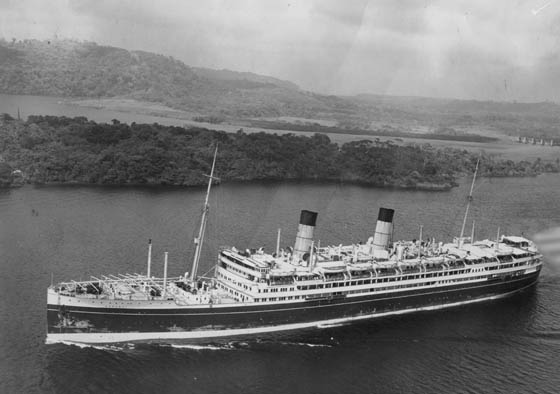
Resources:
Miscellaneous sources from a variety of websites and other period printed materials.
National Library of Australia : Trove website of archived Australian Newspapers (trove.nla.gov.au)
Sulzer Technical Revue #2 1928
Bernie Fleming
Convoy Web
Page added April 30th 2007.
Last updated April 19th 2022.
TROVE - next = 268 (seq 5320 for 267)
Return to Ship menu
Return to Picture menu