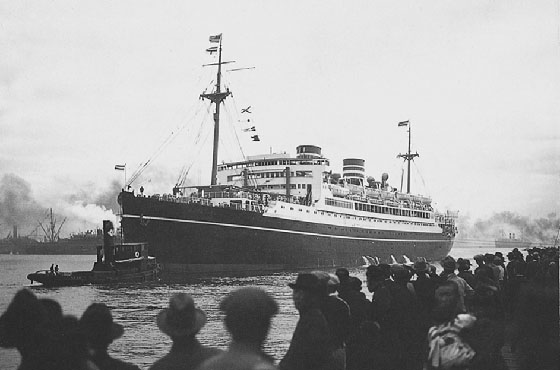
Built: Mitsubishi Shipbuilding & Engineering Co. Nagasaki, Japan
Laid down: September 1927, Launched: October 30th 1928, Completed September 1929
Displacement: 16,975 tons
(Lloyds gross tons 16,975; below deck 11,576; nett 10,017)
Length: 560 feet (583 feet OL)
Breadth: 72 feet
Draught: 42.5 feet
Draught (loaded): 28.5 feet
Propulsion: Four Sulzer 8ST68 diesels - two from Winterthur & two license built by Mitsubishi, Japan. (bore 680mm, stroke 1000mm, max HP/cylinder - 1,000; first ordered 1927).
Auxiliary engines: four 675hp engines
Screws: Four
Speed: 17.5 knots
Passengers: 822 (first class 222, second class 96, third class 504)
Crew: 330
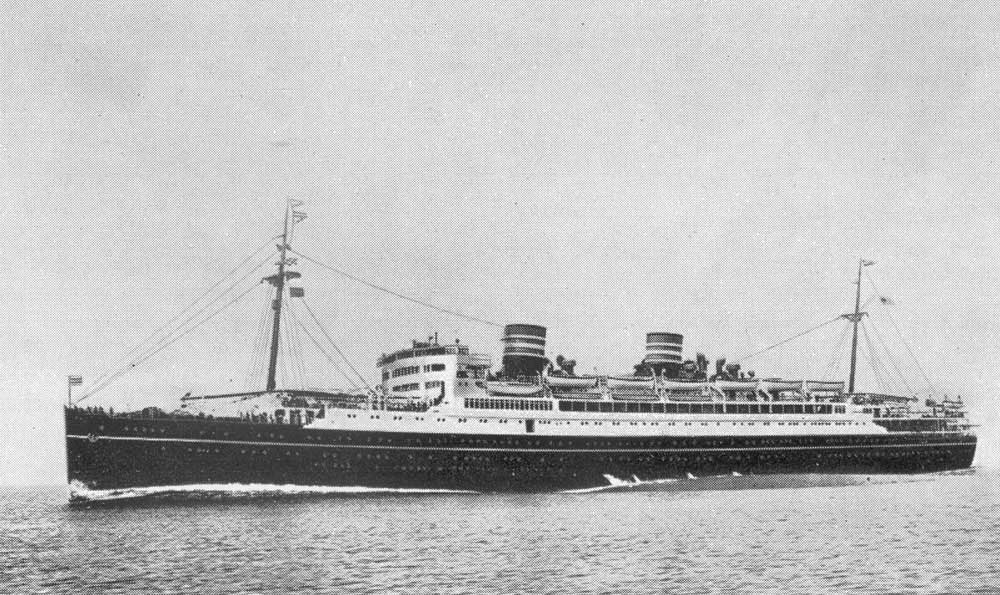
These three ships (Asama Maru and sisters Tatsuta Maru & Chichibu Maru) were built for the NYK Line (Nippon Yusen Kaisha) for service between the Far East & the United States of America. Their interior design had a very period British style, Japanese influences were held to a minimum. Principal ports visited included Hong Kong, Shanghai, Kobe, Yokohama, Honolulu, Los Angeles & San Francisco. The Yokohama - San Francisco crossing would take about fifteen days, by the end of the 1930s such a trip would cost US$190 for 2nd Class or US$315 for 1st Class.
The Asama Maru left Kobe on October 7th 1929 for Yokohama. On October 11th 1929 the Asama Maru, built at a cost of about £1,000,000, began her maiden voyage from Yokohama to Honolulu and San Francisco. This was the first passenger liner in Japan propelled by diesel engines. The ship arrived at San Francisco on October 24th 1929, to a raucous welcome from the whistles and horns of many ships. Representatives of the Chamber of Commerce & Industry of California as well as thousands of onlookers also welcomed the ship. Captain Shinomiya advised a speed of 21 knots had been maintained for most of the voyage, giving an arrival in San Francisco two days ahead of schedule.
1929: October 3rd (scheduled) Nagasaki - San Francisco.
During December 1929 the visit of Douglas Fairbanks and Mary Pickford to Japan was marked by scenes of extraordinary enthusiasm with Japanese admirers frantically mobbing the cinema stars wherever they went. They departed Japan on the Asama Maru on December 21st.
The Asama Maru would set the record for the fastest crossing of the Pacific on the Yokohama - San Francisco route, this passage was normally a fortnightly service. From time to time the Asama Maru would also call at Hong Kong, Shanghai, Kobe and Los Angeles.
February 1930 - at the half yearly meeting of the Nippon Yusen Kaisha mail line, the president of the company Mr K Kagami said that new motor ships were being built of which the largest would be capable of a speed of l8 to 19 knots. He expressed satisfaction with the new motor ship Asama Maru, which was the largest and fastest merchant vessel ever launched by a Japanese shipbuilding yard. Two sister ships to the Asama Maru had been launched, and would be commissioned in March or April. Six other vessels were to be added to the fleet that year, all of which would be propelled by diesel engines. The new vessels would take part in the London, South American and Canadian trade.
1930: February 27th (scheduled) Hong Kong - San Francisco (did this utilise the Asama Maru?).
1930: May 1st (scheduled) Hong Kong - San Francisco.
1930: September 26th - a shipment of gold bullion in the amount of Yen 5,000,000 was aboard the Asama Maru for delivery to New York, in order to cover foreign exchange trading.
1931: September 30th (scheduled) Hong Kong - San Francisco.
1931: December 9th (scheduled) Hong Kong - San Francisco.
1932: February 24th (scheduled) Hong Kong - San Francisco.
1932: April 10th - arrived Yokohama.
1932: during the spring about 13,000 Japanese sought temporary refuge in Japan following trouble in Shanghai. In the third week of April the Asama Maru stopped at Nagasaki (not her normal stop) to pick up a number of the 4,350 former refugees returning to Shanghai.
1932: May 4th (scheduled) Hong Kong - San Francisco.
1932: July 13th (scheduled) Hong Kong - San Francisco.
1932: September 7th (scheduled) Hong Kong - San Francisco.
1932: December 15th - the headquarters buildings used by the Japanese teams at the Los Angeles Olympics were dismantled and shipped on the Asama Maru for further use in Japan.
1933: June 30th - the Federal Court in San Francisco saw the arraignment of one-time Shanghai millionaire Juda Ezra (a British subject) and twin brother Isaac (a San Francisco property owner) with regard to their allegedly heading up a major narcotics ring. They had been initially arrested in connection with a shipment of $250,000 worth of narcotics, concealed in oil drums shipped on the Asama Maru. It is reported eight shipments valued at $1.5 million were made before the ninth shipment was discovered.
1933: September 6th (scheduled) Hong Kong - San Francisco.
1933: November 1st (scheduled) Hong Kong - San Francisco.
1934: January 10th (scheduled) Hong Kong - San Francisco.
1934: March 7th (scheduled) Hong Kong - San Francisco.
1934: May 9th (scheduled) Hong Kong - San Francisco.
1934: July 4th (scheduled) Hong Kong - San Francisco.
1934: September 9th?? (scheduled) Hong Kong - San Francisco.
1934: November 14th (scheduled) Hong Kong - San Francisco.
1935: January 9th (scheduled) Hong Kong - San Francisco.
1935: March 6th (scheduled) Hong Kong - San Francisco.
1935: May 8th (scheduled) Hong Kong - San Francisco.
1935: July 3rd (scheduled) Hong Kong - San Francisco.
1935: September 4th (scheduled) Hong Kong - San Francisco.
1935: October 25th arrived Hong Kong.
1935: October 30th (scheduled) Hong Kong - San Francisco.
1936: January 8th (scheduled) Hong Kong - San Francisco.
1936: March 4th (scheduled) Hong Kong - San Francisco.
1936: May 6th (scheduled) Hong Kong - San Francisco.
1936: July 2nd (scheduled) Hong Kong - San Francisco.
1936: September 2nd (scheduled) Hong Kong - San Francisco.
1936: October 28th (scheduled) Hong Kong - San Francisco.
1937: January 6th (scheduled) Hong Kong - San Francisco.
1937: March 3rd (scheduled) Hong Kong - San Francisco.
By September 1937 the Asama Maru had made 46 complete roundtrip voyages between Hongkong and the United States.
On September 2nd 1937 a strong typhoon hit the Hong Kong area, although not the strongest recorded it was the most powerful one remembered by those living at the time. Twenty eight ocean-going vessels were caught up in the storm, with many more fishing vessels and junks going down with their crews. In all an estimated 11,000 lives were lost. The tide rose to a level of eighteen feet, a high of eight feet being the norm. An eighteen foot tidal wave was responsible for the great loss of life and property damage. At the time of the typhoon the Asama Maru was present in the harbour, but broke her moorings during the storm, and was not alone in being swept away. The Italian liner Conte Verde of 17,900 tons went aground at Sai Wan Bay, the British India steamer Talamba of 8,000 tons, ran ashore at Lyeemoon whilst the Asama Maru eventually grounded in Sai Wan Bay (see image below).
The Asama Maru had gone ashore in Sai Wan Bay at about 4am after drifting helplessly in Junk Bay during the height of the typhoon, when the wind velocity reached 167 mph. At daylight her unfortunate position was truly revealed to the officers and crew, an anxious morning for all onboard as her position became clear. Although the damage was limited only to the bottom plates of the ship it would be the salvage of the vessel which presented a much larger problem. At the time of the typhoon the ship was carrying no cargo and the typhoon created abnormally high tides, both of which contributed to stranding the ship higher on the rocks.
Five days after the Asama Maru went ashore Japanese salvage experts were on the job. The problem was attacked from two sides - on the inside of the ship many items would be removed, whilst on the outside a channel would be blasted in the rock to provide a means of floating the Asama Maru off the rocks to deeper water at the next suitable high tide. Substantial resources were provided - two salvage tugs (including the Yusho Maru), 213 workmen including 36 divers and 5,000 pounds of dynamite. Rock, clay & sand totalling 7,300 tons was removed from an area of 22,000 square feet, being blasted and dredged away over a period of two hundred days using 25,000 dynamite charges. To lighten the ship two of the main engines, fuel oil, water, ballast, ship fittings, anchors, winches, life boats and stores weighing 4,000 tons were removed. Externally ten buoyancy tanks, each of fifty tons capacity, were fitted alongside the ship.
Attempts to refloat the ship during November 1937 failed, the next best opportunity would occur during the spring tides of March 1938. Elsewhere the N.Y.K. Line was charged by the owners of British and Italian ships that their vessels were allegedly forced aground by the drifting Asama Maru, and were suing the company for redress.
On Friday March 11th 1938 the Asama Maru was successfully refloated and moved to a wharf in Hong Kong. Here temporary repairs were carried out with the ship departing on March 18th for Nagasaki, arriving there on April 2nd for thorough repairs and overhaul, prior to re-entering service. The six month overhaul and refit was carried out by Mitsubishi Heavy Industries Company in Nagasaki. She put to sea again on September 15th 1938, almost as a new ship, returning to her regular route between Japan and the United States.
1939: February 16th (scheduled) Hong Kong - San Francisco / Los Angeles.
1940
At noon on January 6th 1940 the Asama Maru under the command of Captain Watabe Yoshisada sailed from San Francisco for Yokohama via Honolulu, on a voyage that would feature an international incident, a small facet perhaps of the 'phony war' period of World War II. Having left Honolulu on January 11th the westbound voyage sailed into severe gales en-route and very near the end of its journey it encountered and was stopped by the British light cruiser HMS Liverpool (Gloucester class?) at about 12.50 hours on January 21st at a point 35 miles off Nojima Zaki, Chiba Prefecture.
Initially the Asama Maru failed to yield but a blank round fired by the HMS Liverpool saw the ship stopped and boarded by a party of thirteen armed sailors. In the face of the captain's protestations, the inspection party questioned the fifty German passengers on the Asama Maru. From the information obtained twenty one of the German passengers were removed from the ship. The Asama Maru was allowed to proceed later that afternoon, arriving at Yokohama shortly after nightfall. Meanwhile the HMS Liverpool had set course for Hong Kong.
One source suggested the Germans removed to the HMS Liverpool were all highly qualified technicians being sent to Japan to service German surface raiders and U-boats which were soon to begin operating in the Pacific area. In reality their story was less dramatic, the seamen had previously worked on Standard Oil Company tankers and having been dismissed from their duties were trying to make their way home to Germany, at this time throughout the Americas there were approximately 450 German sailers stranded in ports trying to find a way back to Germany. In addition Ellis Island also held 576 seaman from the scuttled German liner Columbus. (The Columbus had been scuttled in international waters 450 miles east of Cape May, New Jersey, USA on December 19th 1939. The obvious route of reaching Europe by the North Atlantic routes was now almost impossible).
The Japanese government protested the boarding on the basis of Article 47, London Declaration of 1909 (which was in fact not ratified by any government), that only persons actually enlisted in the armed services of belligerent nations could be removed from the ships of neutral countries while Great Britain adhered to the broad interpretation that any male personnel 18 to 50 years of age and physically fit for military service could be taken as prisoners of war whether they were passengers or crew members.
On January 23rd about one hundred people protested outside the British Embassy in Tokyo. A deputation was eventually allowed into the embassy requesting release of the detainees and an apology.
This action occurred very close to the coast of Japan and had all the makings of 'a first class scandal' to quote Joseph C Grew, American ambassador to Japan. Since the British were preparing for a major land engagement in Europe and the Japanese were weary of a campaign in China, neither government was looking to open up a new front. So it would be left for the diplomats to resolve the fallout from this matter. Additionally the leadership of the Japanese government had only just changed, the newly-organized moderate Yonai Cabinet had rejected military efforts to create a closer alliance with Germany whilst endeavouring to maintain favourable relations with Great Britain and the USA. Thus there was a large segment within Japan hoping to see the new government fail. For about two weeks following the incident the diplomats worked through their channels with resolution reached to the satisfaction of both governments. On January 30th the Japanese Foreign Minister H. Arita and the British Ambassador to Japan, Sir Robert Craigie met for several hours. A further meeting was planned for the next day. Other meetings took place on February 2nd & 23rd with the Foreign Vice-Minister M Tani and the British Ambassador. The Japanese would no longer provide passage to Germans of military age across the Pacific Ocean, whilst British passengers would be accepted for passage by Japanese shipping companies with minimal inquiry about their military status. The agreement also called for the return of nine of the Germans taken from the ship.
1940: February 14th (scheduled) Hong Kong - San Francisco / Los Angeles.
March 20th: whilst at Los Angeles the Asama Maru suffered a three hour delay caused by the customs inspectors examination of all the passengers baggage. From this point in time the NYK Line would no longer accept passengers hand baggage unless accompanied by an American license.
On March 22nd it is reported that nine of the 21 Germans taken off the Asama Maru by HMS Liverpool had reached Berlin. The nine Germans released were those least likely to enter military service. They had been taken by the British authorities to Hong Kong, where on March 1st they were taken by a British auxiliary crusier to a rendezvous off Yokohama and handed over to Japanese authorities. From Yokohama they were handed over to the German Consul General, later moved to Russia to travel westwards by the Trans-Siberian railway.
As the furor subsided so the Asama Maru returned to its regular duties in crossing the Pacific. Captain Watabe 'retired' after the HMS Liverpool incident, Captain Fujita Toru was appointed the new captain.
1940: April 8th (scheduled) Shanghai - San Francisco /Los Angeles.
April 13th: departed Yokohama, the British Ambassador Sir Robert Craigie was supposed to travel on the ship for leave in the United States of America, however this was postponed at the last moment.
1940: May 29th (scheduled) Shanghai - San Francisco.
On the journey commencing October 25th 1940 from San Francisco (voyage No.60 homeward) were fourteen crew members of the scuttled German ocean liner Columbus, who were traveling 2nd Class under the disguise of American students. The ship reached Yokohama on November 12th 1940.
1940: November 27th (scheduled) Kobe to San Francisco & Los Angeles.
1941
1941: February 11th (scheduled) Hong Kong - San Francisco / Los Angeles.
Departing Yokohama for San Francisco on February 4th 1941 the ship carried a contingent of Polish Jewish refugees fleeing Soviet internment.
1941: March 17th - departure from Los Angeles was delayed for three & a half hours due to customs officials carrying out a detailed search of the baggage room and holds, it had been reported that a Japanese person was attempting to export a tractor without the necessary licence.
1941: April 12th (scheduled) Hong Kong - San Francisco / Los Angeles.
On its eastbound crossing at the beginning of May 1941 the ship was almost completely filled with Jewish refugees from Poland who had come via Siberia & Japan with the help of famed Japanese counsel Sugihara.
The Asama Maru arrived at Batavia on June 4th 1941, reaching Kobe on June 14th 1941.
On June 29th 1941 the Asama Maru sailed for Batavia (Djakarta) (expected arrival July 2nd) under temporary German charter to pick up four hundred German and Italian nationals detained in the Dutch East Indies since the invasion of the Netherlands by Axis forces. The ship would also evacuate six hundred & seventy German women and children refugees from Indonesia. On Thursday July 11th the Asama Maru reached Shanghai where 120 disembarked, the remainder headed for Japan.
1941: July 1st (scheduled) Hong Kong - Shanghai (4th) - San Francisco / Los Angeles.
On July 18th 1941 the Asama Maru departed Yokohama for San Francisco, carrying 98 passengers including 47 Japanese born in the United States. Whilst the ship was crossing the Pacific events with regard to the occupation of southern Indochina on July 23rd & 24th caused the Asama Maru to turn around and head back towards Japan. On the 24th the ship turned north and stopped when fog banks were encountered. With Japanese troops now entering Indochina President Roosevelt signed an Executive Order on July 26th 1941 that seized all Japanese assets in the United States. American trade with Japan, including the sale of oil and scrap metal ceased. Britain and the Dutch East Indies followed suit. Japan lost access to most of its overseas trade and its imported oil. On the same day the crew of the Asama Maru painted her funnels black and painted out the Japanese flags on the hull and deck.
On the evening of July 27th the ship was ordered back to Yokohama, turning around and then headed west for thirty six hours. Twenty four hours later the ship reversed course and headed for Honolulu, arriving there at 3.30pm on July 31st. At 9.00am the next morning the ship sailed for San Francisco August 4th 1941 but after sailing east almost 1,000 miles the Asama Maru was recalled to Japan, reaching Yokohama on August 10th, still with a cargo of silk valued at £750,000 sterling in her holds.
The ship received attention during October 1941 at Mitsubishi Heavy Industries Ltd. shipyard, Kobe.
On November 6th 1941 the Asama Maru departed Yokohama for Singapore, arriving on the evening of November 13th to assist in the evacuation of approximately 450 Japanese civilians, believed to be from Malaya. The same month it was noted in Manila and had reached Kobe by November 26th 1941.
At the end of November 1941 all three of the Asama Maru class passenger ships were chartered by the Imperial Japanese Navy. Its first voyage as a navy ship saw it depart Yokosuka for Saipan on December 2nd 1941, arriving there four days later. Here 2,900 soldiers and 2,800 tons of cargo including ammunition were loaded for ??? The remainder of December was spent operating between Japanese ports.
1942
The arrival of 1942 saw the attachment of the Asama Maru to the 11th Air Fleet HQ and the commencement of many sailings that were far removed from its former north Pacific runs. Its first tour of duty took it to Takao, Formosa (now Kaohsiung, Taiwan) (January 1st); south to Jolo in the southern Philippines (January 9th); then to Davao on Mindanao (January 12th); Tarakan, Borneo (January 16th) - troop were disembarked here for use on Timor the following month; the ship then retraces its route to Takao, Formosa (January 29th).
On February 2nd it retraced its route back to Davao (February 13th) which included several round trips between Jolo & Davao. After twelve days at Davao the Asama Maru departed for Kendari, Celebes (March 27th). From here the ship returned to Yokosuka (Tokyo Bay) (April 6th).
The next sailing, from Yokosuka on April 16th took the Asama Maru to the Marianas, New Britain, the Caroline Islands and the Marshall Islands. Ports visited were Saipan (April 20th), Truk (April 22nd), Rabaul (April 25th), Ponape (April 30th), Kusaie - to load phosphorus (May 3rd), Jaluit (May 4th), then back to Kusiae, Roi (May 6th), Brown Island (May 8th), Kwajalein (May 12th), then returned to Japan for temporary duties involving the movement of Allied diplomats and other civilians from Japan and other occupied territories.
The Asama Maru sailed from Nagasaki on June 7th for Kobe, arriving the next day to embark some Latin American diplomats and the families. Departing Kobe on June 12th the ship reached Yokohama the next day. On June 17th 1942 a group of US & British diplomats including the American Ambassador to Japan, Joseph Grew were transferred from Tokyo to Yokohama, here a total of 416 Americans (142 diplomats and 274 civilians) then boarded the Asama Maru which remained at anchor until all the details of the diplomatic exchange were completed. In the meantime the Gripsholm departed New York on June 18th headed eastbound for Lorenco Marcques. The Asama Maru departed on June 25th shortly after midnight, arriving at Hong Kong on June 29th where further diplomats and families embarked and similarly at Saigon on July 3rd 1942.
The Italian liner Conte Verde was scheduled to leave Shanghai on June 29th, both ships were at Singapore on July 6th to sail jointly to the Portuguese East African port of Lourenco Marques in order to exchange their passengers with the Gripsholm. The Conte Verde carried 636 American and other 'enemy' nationals, all were former residents of Shanghai, Nanking, Hankow and Hainan Island. After taking on supplies the two ships sailed from Singapore on July 9th 1942. The Gripsholm had sailed from New York with homeward bound diplomats, employees of Japanese companies and students. It had called in at Rio de Janeiro en-route. Two other NYK ships (Tatsuta Maru & Kamakura Maru) were also present.
The passenger ships reached Lourenco Marques on July 22nd 1942, where greetings were exchanged between passengers and sailors. Newspaper reports stated that the Ambassador (Admiral Nomura) and Mr Kurusu. who had been negotiating with Mr Cordell Hull when the Japanese attacked Pearl Harbour, were met by the German Consul and Vice-Consul. Many Japanese admitted they were sorry to leave their American friends and realised that life in Japan was not likely to be as comfortable. Passengers on the Asama Maru shouted as the ship tied up, 'What is the news? We have had none for some time.' Ambassador Grew, also the United States Minister for Siam and the Canadian Charge d'Affaires at Tokyo, were aboard. The Conte Verde's passengers included 32 missionaries. There were two births aboard the Gripsholm, including a Siamese princess, and two deaths aboard the Conte Verde. The ships tie up side by side with passengers transferring via gangways bow to bow or stern to stern.
By July 26th the Asama Maru had completed its exchanges and departed for Japan. On their return the ships carried large white crosses on the decks, they remained well lit at night and passengers constantly carried life vests. They called in at Singapore on August 10th 1942 before arriving back at Yokohama on August 20th. The Asama Maru was also carrying almost 7,000 Red Cross parcels for Allied prisoners-of-war held in Japan. After the completion of the diplomatic exchange voyage the Asama Maru remained at Yokohama until September 5th 1942 when she sailed for Yokosuka. Here the Asama Maru was re-requisitioned by the Imperial Japanese Navy and registered as a charter ship in the Yokosuka Naval District.
The last three months of 1942 saw the Asama Maru working a number of voyages, reaching a number of ports not visited before and acting as a prisoner of war transport on several occasions. The first voyage, of about six weeks departed September 12th 1942 from Yokosuka, and included visits to Leisui, China (September 17th), Saipan (September 23rd), Fais Island (September 25th), Palau, to load ammonium nitrate (September 26th), Kendari (October 1st), Makassar (October 4th), Balikpapan Borneo (October 7th), then back to Makassar, Celebes to load 1,000 Allied Prisoners of war bound for Japan, arriving at Nagasaki on October 23rd 1942 where the POWs disembark.
On October October 27 the Asama Maru departed Yokohama for Wake Island, arriving November 1st to load twenty prisoners of war bound for Yokohama, arriving there on November 6th. The ship then entered the drydock at Asano Shipyard for repairs, which were completed by December 1st. For the remainder of December 1942 sailings were limited to Japanese ports ending the year at Yokosuka.
1943
During 1943 the Asama Maru continued to be a well travelled ship, but as the year wore on the ship more frequently received an escort or was part of a larger convoy. During February anti-submarine gear was added: hydrophones and depth charges. Many of the sailings were between ports in Japan but the more distant locations included Truk (January 10th); Shanghai (February 1st); Manila (March 12th) - whilst sailing between Takao and Manila with the escort of the destroyer Hagikaze on March 10th the USS Sunfish (SS-281) under Lt Cdr Richard Peterson fired four torpedoes at the Asama Maru, which was able to take evasive action and avoid the torpedoes. The Sunfish escaped from the destoyer's depth charge attack; Singapore (March 30th). After returning to Japan the ship travelled locally until sailing to Manila, arriving May 13th; Singapore (May 30th); St Jacques (June 14th); by June 24th the Asama Maru was back in Japan and travelled locally until about July 22nd when she sailed for Takao & Singapore.
After departing Japan the Asama Maru joined convoy HI-03 in the Formosa Straits on the morning of July 22nd 1943. Just before midnight on 22nd the USS Sawfish (SS-276) commanded by Lt Cdr Eugene Sands attacked the convoy on the surface and badly damaged the transport Seia Maru. This ship was taken in tow by the Nichinan Maru and they returned to Japan. The others head to Takao, add two other vessels here and departed for Singapore on July 26th. On July 29th the convoy encounters German U-boat U-511. Singapore is reached on August 1st. Whilst discharging cargo at Balikpapan on August 7th a case of cholera is discovered, the ship was quarantined for approximately one month.
On September 21st, 1943 the ship took seventy one Allied POWs on an eighteen day voyage from Singapore to Moji, Japan, including a brief stop at St. Jacques (Vung Tau) to join convoy HI-10 and later MA-06. The conditions under which the POWs were moved were bad, the holds were poorly vented, with little food & water, no medical attention or toilet facilities.
After two weeks sailing locally in Japan the Asama Maru sailed from Moji on the late afternoon of October 28th October as part of convoy HI-17 bound for Singapore consisting of the Asama Maru, three tankers and three escort vessels.This was the last major voyage for the Asama Maru during 1943. On November 2nd the convoy departed Takao having added six more vessels. Manila is reached during the evening of November 4th, one ship is detached here. Singapore is reached on November 11th. The Asama Maru leaves Singapore on November 25th (after a round trip to Truk?) as part of convoy G bound for Japan, arriving Sasebo on December 9th 1943. By December 17th the Asama Maru enters the Hitachi Shipbuilding, Ltd., yard at Innoshima spending a month here under repair.
1944
The Asama Maru came out of dry dock on January 18th 1944 and reached Moji by the end of January for inclusion in convoy HI-41 bound for Singapore. This convoy included the Teia Maru, formerly the Aramis which was also equipped with Sulzer engines. The convoy reached Singapore safely on February 11th. The Asama Maru did not linger long in Singapore, late on the afternoon of February 13th it set out for Moji as part of convoy HI-40 which included five tankers. Six days later as the convoy crossed the South China Sea some 300 miles west of Luzon the USS Jack (SS-259) commanded by Captain Thomas Dykers sank four of the tankers, the fifth succumbed to the USS Grayback (SS-208) under the command of Lt Cdr John Moore in an attack on February 24th 1944 some twenty miles east of Formosa (Taiwan). This attack also damaged the Asama Maru.
On February 25th the Asama Maru entered a dry dock at Keelung for repairs, remaining here until released on May 15th.
Asama Maru sailed as part of the large convoy HI-69 from Mutsure on July 13th bound for Manila. The convoy consisted of over twenty ships, including escorts. Submarines USS Rock (SS-274), USS Sawfish (SS-276) & USS Tilefish (SS-307) separately attack the convoy, several ships are damaged, but none are sunk. The majority of the convoy reached Manila late on the evening of July 20th. Convoy MAMO-01, including the Asama Maru departed Manila on July 25th for Nagasaki, arriving on August 3rd.
On September 8th the Asama Maru departed Moji for Keelung, reaching there safely and returned to Moji by September 24th.
On October 8th 1944 the Asama Maru under the command of Agawa Ryosaburo departed Japan for the last time, leaving Moji for a trip to Shanghai, with 5,000 army and navy troops and fifty 'Maru-yon' explosive motorboats and crew for these boats. Whilst en-route news of an enemy force east of Formosa led to the Asama Maru stopping on October 10th at Ssu-Chiao Island (Raffles Island), south of Shanghai. Convoy MOMA-04 carrying over 12,000 troops sailing from Shanghai to Manila joins the Asama Maru at anchor, remaining here until October 20th. By the early morning of October 23rd the convoy with the Asama Maru has reached the Sabtang Channel and takes continuous action to deter attacks from Allied submarines. Just before midnight on October 26th Manila was reached and the troops disembarked.
Late on October 29th the Asama Maru departed Manila with a total of 1,383 military personnel, civilian employees and survivors from sunken merchant ships, the mixed cargo included scrap iron, hemp and raw rubber. The movement was designated MAMO-04 and was protected by a torpedo boat and two minesweepers. Just before midday on October 30th a B24 bomber was sighted, the ship was readied for action, the Asama Maru had been equipped with a variety of anti-aircraft guns. The B24 remained in sight for about one hundred minutes, then flew off, no doubt having radioed the convoy's position to nearby submarines.
Later that evening an enemy submarine was detected, one minesweeper was sent to the scene and depth charges were dropped. The next day the weather worsened whilst an unidentified small ship drew the attention of the lookouts. Later a drifting lifeboat with several occupants suggested the presence of a nearby submarine. The previously unidentified small ship reappeared, a minesweeper was sent to investigate, whilst the torpedo boat was still away assisting the drifting lifeboat. In order to keep in touch with the escorts the Asama Maru slowed to 11 knots, but the suspected presence of a submarine led to course changes and zigzagging.
During the early hours of November 1st 1944 contact with a submarine was made, the Asama Maru resumed its original speed and continued zigzagging. At about 04.35am whilst in the Bashi Channel the Asama Maru was hit by two torpedos fired from the USS Atule (SS-403) captained by Lt Cdr John Maurer. The torpedos hit the starboard side, hitting the auxiliary engine room and the main engine room. A heavy list to starboard quickly developed, not helped by two more torpedo hits in the area of the No.3 and No.4 holds. The stern settled rapidly, at 04.46am the Asama Maru disappeared, going down vertically, stern first at position 20-09N, 117-38E. Of the 1,874 crew, gunners and military personnel on board, 474 were lost in the sinking. Many of the survivors, including Captain Agawa were landed at Takao on the afternoon of November 2nd.
The USS Atule survived World War Two and through several de-commissionings & re-commissionings saw service into the 1980s. It was sold to the Peruvian Navy during July 1974, and renamed Pacocha. Late on the afternoon of August 26th 1988 whilst returning on the surface to its home port the Pacocha was struck by the 410 ton Japanese fishing vessel Kiowa Maru. The trawler's hull was reinforced for ice breaking, the bow causing tremendous damage to the aft port quarter of the submarine. Six crew died as an immediate result of the collision whilst one crewman died later after those crewman trapped in the submarine were rescued but suffered varying degrees of decompression sickness.
Sister Ships
Same dimensions as the Asama Maru - the ship was laid down during December 1927, launched during April 1929, completed March 1930 and commencing her maiden voyage on April 25th 1930 between Yokohama & San Francisco. The normal ports of call would be Yokohama, Kobe, Shanghai, Hong Kong, Honolulu, San Francisco and Los Angeles, with occasional visits to Nagasaki and Manila.
During her official trial run on December 27th 1929 a maximum speed of 21.232 knots was attained, with an average of 20.93 knots reported.
For the 1932 World Olympics held in Los Angeles the sailing of the Tatsuta Maru from Yokohama on June 23rd 1932 finds Olympic athletes from many Asian countries on board. Arrival dates on this voyage were Honolulu (June 30th); San Francisco (July 6th) and San Pedro (July 9th)
During 1938 the ship's named is changed to Tatuta Maru.
At the outbreak of World War II the Tatuta Maru was preparing for an eastbound journey across the Pacific to San Francisco.
On July 10th 1941 the Tatuta Maru departed Yokohama on voyage No.68 bound for the United States, a voyage that would be overtaken by political actions on both sides of the Pacific. On July 23rd/24th the occupation of French South Indochina by Japan commenced. Four days later Executive Order No. 8389 was signed by President Roosevelt permitting the seizure of all Japanese assets in the United States. In addition the sales of oil and scrap metal to Japan ceased. With the Tatuta Maru approaching San Francisco, Captain Takahata seeks assurance that the 5,568 bales of raw silk, worth US$2.5million will not be seized and that diesel fuel can be obtained for the return trip. Both conditions are granted, by August 4th the ship has been refuelled, the silk unloaded, at which point the ship headed east for Yokohama, arriving there on August 17th 1941.
With the political situation worsening repatriation schedules were arranged for three voyages between Japan and the United States. The Tatuta Maru departed Yokohama for Honolulu & San Francisco on October 15th 1941, after having been requisitioned by the Imperial Japanese Navy and attached to the Yokosuka Naval District. Under strict radio silence for the voyage the ship reached Honolulu on October 23rd and San Francisco on October 30th. Having disembarked its contingent of American and other foreign national repatriates a number of Japanese nationals embarked and the ship headed west, calling at Honolulu and arriving Yokohama on November 14th. It is reported this was the last passenger ship to journey between Japan and America before the outbreak of World War II.
On December 2nd December 1941 the Tatuta Maru departed Yokohama headed eastwards towards the United States, a second repatriation voyage? In fact the voyage is some sort of feint or hoax, with the ship reversing course during the night of December 6th/7th and arriving back at Yokohama on December 14th.
1942
The Tatuta Maru was re-requisitioned by the Department of the Navy as a charter vessel on January 17th 1942 and attached to the Yokosuka Naval District.
The first voyage in 1942 departs Yokohama on February 2nd and visited Pusan (February 4th), Truk (February 11th), Mereyon (February 24th), Kwajalein (March 1st), Wake Island (March 11th) and returning to Yokosuka by March 17th. The rest of March is spent sailing between Japanese ports.
On March 30th the Tatuta Maru set sail from Yokohama visiting Tarakan (April 5th), Balikpapan (April 8th), Makassar (April 11th), Kupang (April 20th), Ambon (April 22nd), Davao (April 24th), Takao (April 28th), Keelung (May 1st) and arriving back at Yokohama on May 5th.
The third voyage was much shorter departing on May 10th from Yokosuka for the Phillipines - Davao (May 15th) & Manila (May 19th), then on to Sasebo (May 24th) and back to Yokohama by May 28th.
On June 4th the ship sailed on Yokohama for Saipan (June 7th), Truk (June 10th), Jaluit and Emidji (June 16th), Taroa (June 18th). Wotje (June 20th), Kwajalein (June 23rd) and returned to Yokohama by June 30th.
The next voyages for the Tatuta Maru would take her from Japan across the Indian Ocean to Portuguese East Africa as part of the English-Japanese repatriation exchanges. On July 30 1942 the Tatuta Maru sailed from Yokohama with sixty British internees including Ambassador Sir Robert Craigie and embassy staff from Tokyo, Yokohama and Kobe. Other foreign embassies were represented from Belgium, Greece, Egypt, Australia, Norway, the Netherlands and Czechoslovakia, in addition to other British and foreign citizens.
On August 4th the Tatuta Maru arrived at Shanghai and was joined by sister ship Kamakura Maru, and embarked further repatriates from China and Manchuria. Saigon was reached August 9th, more repatriates joined the ships, Singapore was reached on August 14th, sailing the same day for the thirteen day voyage across the Indian Ocean to Lourenco Marques. Here the British personnel were exchanged for Japanese diplomats and 48,818 Red Cross parcels and other supplies from England, Australia and India for Allied POW's. The Tatuta Maru departed on September 2nd, reaching Singapore on September 17th and Yokohama on September 27th.
During December the ship was re-requisitioned by the Department of the Navy as a charter vessel and attached to the Yokosuka Naval District and sailed to Manila, arriving December 23rd, Balikpapan (December 28th), Makassar (January 1st), Singapore (January 11th) & Hong Kong (January 18th).
1943
During the early afternoon of January 19th 1943 the Tatua Maru departed Hong Kong carrying 1,180 men including 663 Canadian POWs from the Sham Sui Po prisoner of war camp. The conditions for the prisoners on the ship were deplorable, the ship takes four days to reach Nagasaki (January 22nd) where the prisoners disembarked for transport to a coal mine. For the rest of January the ship remained local to Japan.
The Tatuta Maru's last voyage commenced on the afternoon of February 8th sailing from Yokosuka and headed for Truk with the destroyer Yamagumo as the escort. Patrolling the sea lanes around Truk was the submarine USS Tarpon (SS-175) captained by Lt Cdr Thomas Wogan. Approximately 40 miles east-south-east of Mikurajima the Tarpon's radar picked up the two ships with the submarine giving chase. At about 11.15pm four torpedos were fired by the Tarpon, hitting the Tatuta Maru, within twenty minutes the ship had sunk at position 33-45N, 140-25E, taking with her approximately 1,400 troops, passengers and crew. The Yamagumo was unable to assist any survivors due to the darkness, a fierce gale and her distance from the Tatuta Maru during the attack.
Chichibu Maru
A half sister to the above two ships - was slightly larger with only one funnel.
Length: 178 metres
The ship was renamed Titibu Maru in 1938 and then to Kamakura Maru in 1939.
In 1942 she became a transport ship for the Japanese Navy and was also used as a hospital ship.
Reported Prisoner of War movements were from Singapore on November 28th 1942 to Nagasaki, Japan by December 7th with a total of 2,213 POW's.
And on February 26th 1943 she sailed from Makassar, Celebes to Singapore by March 1st with ten POW's aboard.
The ship was scheduled to be converted to an escort-carrier around 1943 (38 aircraft) but before this could commence the ship was sunk on April 28th 1943 by USS Gudgeon (SS 217) some thirty miles south west of Naso Point, Panay Phillipines in position 10.25 N., 121.50 E. The Gudgeon claimed three hits out of four torpedoes fired.
The Kamakura Maru was unescorted at the time, probably relying on her speed to keep clear of submarines. The torpedoes were fired at 01.00 hrs and according to the submarine report she sank in twelve minutes. In the dark the Gudgeon had only seen the silhouette of the liner. About a year later the Gudgeon would sail into history, lost without trace, presumably sunk by Japanese air attack.
The Kamakura Maru was the largest Japanese troopship sunk.
Further notes on the Asama Maru incident of January 1940
The following notes come from two emails received from a descendant of one of the German civilian seaman caught up in the events that preceded the Asama Maru incident and are recorded here as an interesting offshoot of a difficult time and the result of much research.
First email
I have documents from the German, English, and Japanese archives which dispute the information (as initially recorded on this webpage). The 21 Germans who were removed from the Asama Maru were all civilian seaman who shipped on oil tankers for the Panama Transit Company, a wholly owned subsidiary of the Standard Oil Company. None were in the military, rather they were just of military age. None of the men onboard the Asama Maru were from the scuttled Columbus. The men were initially interned in Hong Kong at LaSalle College. On February 29th 1940 nine of the men were transported via the Australian Cruiser Canibula to Japan and released.
In May of 1940 a telegram was sent to the Hague informing the Dutch that the remaining civilian seamen were to be transferred from internment in Hong Kong to Ceylon. These same men were subsequently interned in Singapore and Alberta, Canada. According to a daughter of one of the seaman removed from the Asama Maru, her father was not returned to Germany until 1946.
What was important about this event, was that hundreds of civilian seaman of axis nations were stranded in American ports in 1939. The Asama Maru incident justified not repatriating any of the seaman. Basically, Standard Oil retained the men's passports starting in August of 1939 until they were interned in May of 1941 (7 months before Pearl Harbor). However by confiscating the passports the seamen could not leave the country anyway. The government could not intern them legally in 1939 since the US was a neutral nation. (Britain and it's protectorates & colonies, Canada, and Australia did intern the men that were caught in ports across the western hemisphere).
The men always wondered why they were allowed freedom until May of 1941 and then rounded up for internment. After reviewing the archival documents, my conclusion is that the presidential election made it politically inconvenient to intern the men until 1941. (My opinion is confirmed in the book "Shooting the War" by one of the officers of the scuttled Columbus, Otto Giese.) Only 3% of the US public favored involvement in the European war in 1939. Although Roosevelt received much pressure from England to enter the war in 1939 he had to influence public opinion first. If he would have interned the men in 1939 it might have influenced his re-election bid.
Almost immediately after the Asama Maru incident Standard Oil announced that they would scuttle all plans to repatriate the seaman. By stopping the Asama Maru and seizing the seaman the Allies removed all axis national seaman from oil tankers and stopped all repatriation on the basis that the "Atlantic was to dangerous to repatriate the Standard Oil seaman." Almost all of the seaman stranded in US ports were sent to Ft. Lincoln, ND for internment. (my father was one of the seaman).
List of the 21 men removed from the Asama Maru and their ages (the last nine on the list ended up released on 2/29/40) Four of the men retained in internment did have registered patents in Germany. After reviewing the patents, however none were related to national defense.
Bohnsack, Rudolf 29;
Gnirs, Karl 31;
Grimm, Fritz 31;
Gottke, Walter 29;
Heino, Xaverius 30;
Jachowski, Walter 30;
Kempfer, Kurt 26;
Hartmann, Oswald 34;
Oesterle, Karl 33;
Schleyer, Karl 19;
Schroder, Hermann 39;
Wesselhofft, Johnny 36;
Herman Groth 40;
Arthur Kruger 36;
Willy Plucas 29;
Hans Hartwig 19;
Rudolf Kaselau 30;
Paul Rupprecht 18;
Otto Wantke 59;
Eduard Lege 34;
Albert Dankowski 36.
Men from the scuttled Columbus were on the Asama Maru's 60th voyage homeward in October of 1940 rather than the 55th voyage homeward in January of 1940. The men were listed on the passenger roster as American students.
Second Email
Thank you for your quick and receptive response. Perhaps, you can tell by my comments that I have went to great lengths to confirm the details of the Asama Maru. Internet resources have proved to be most helpful in my journey to understand the Asama Maru incident but many times, maybe even most of the time information on the web has detailed the Asama Maru events incorrectly. Not on purpose, but rather due to a lack of primary documents. Since I believe your website was trying to detail the truth regarding the incident, I felt you would appreciate the corrections. Certainly, I appreciate it when my research is challenged or corrected.
About a year ago, I found a gentlemen who was on the Asama Maru when the incident took place. He had a one line post on an obscure blog stating that at 17 he was traveling on the Asama Maru when it was apprehended. He further stated that if any one was interested in the details of the incident he would be happy to respond. Unfortunately, the blog comments were several years old and the email address was no longer valid. Fortunately, he had signed his full name on the blog. I searched for his name across the US and through a process of elimination sent a letter out asking if he might be the person who made the post. I could not believe my luck when he called me and confirmed he was one and the same.
He had written a paper on the Asama Maru incident but never published it. He had hoped one day to write a book but never quite got around to it. He is now 85 and suffers from prostate cancer and has given up any desire to write a book. Anyway, he has been wonderful in providing information on the incident. In fact, he has given me permission to use the information in anyway I desire. I asked Gerald Steele from the UK to post Mr. Dunham's narration of the incident on his website at http://www.lancs.ac.uk/staff/ecagrs/C%20G%20Dunham.pdf since I do not have a website. Gerald's interest in the incident is because of his father's WWII military experiences in the British navy.
As you probably can tell my research is personally motivated, I am searching for my father's WWII experiences. I never set out to write a book rather I had two objectives to find out the details of my father's journey in the context of the times and to try to find out if I have any living relatives in Germany. My father died when I was a child of six he took his WWII history to his grave. Shortly, after his death his mother died and then we lost contact with his only living brother. Unfortunately, I have not been able to obtain my Uncle's military records from the German archives because his name is too common and I need his precise birthdate which I do not have. So the search continues.
As I continue the research, I am hopeful that one day I can partner with a known author interested enough in the story of the German WWII civilian seaman's story to use my research to write a book. If I wrote the book, most likely few would read it. Consequently, until a book is written I thought the best way to make information available is on the internet through others websites by providing documented information.
Thanks again, for your response.
Shirley A Weiss
Resources:
SINGAPORE NEWS NEXT= PAGE 21 for vessel news only no adverts
Singapore pages checkd for adverts: 36 - 97
Page added October 1st 2005.
Return to Ship menu
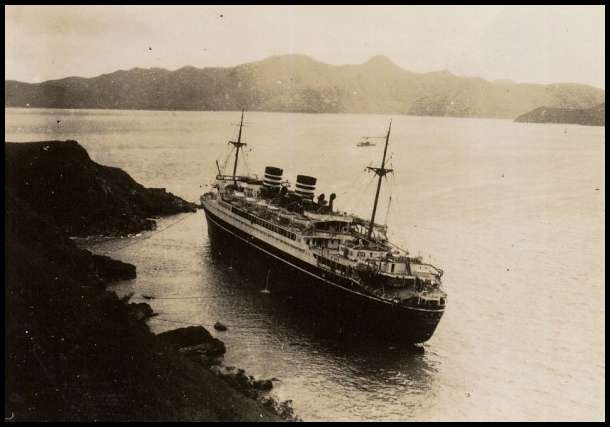
The hazardous position of the Asama Maru is revealed in the above view, sitting about eighty feet offshore with a starboard list of about six degrees.
1939: April 16th (scheduled) Hong Kong - San Francisco / Los Angeles.
1939: June 11th (scheduled) Hong Kong - San Francisco / Los Angeles.
1939: October 5th (scheduled) Hong Kong - San Francisco / Los Angeles.
1939: December 8th (scheduled) Shanghai - Kobe (December 11th ?) - San Francisco / Los Angeles.
1940: August 8th (scheduled) Hong Kong - San Francisco.
1940: September 29th (scheduled) Shanghai (Kobe October 2nd) - San Francisco / Los Angeles.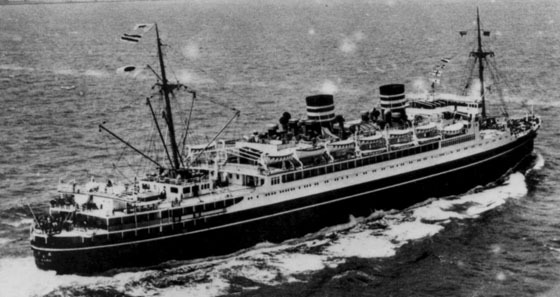
Post-script:
Tatsuta Maru
Beam: 22.6 metres
Gross tonnage: 17,498 tons
Speed 19kn
Passengers: 817
Built 1930 by the Yokohama Dock Co, Yokohama, Japan.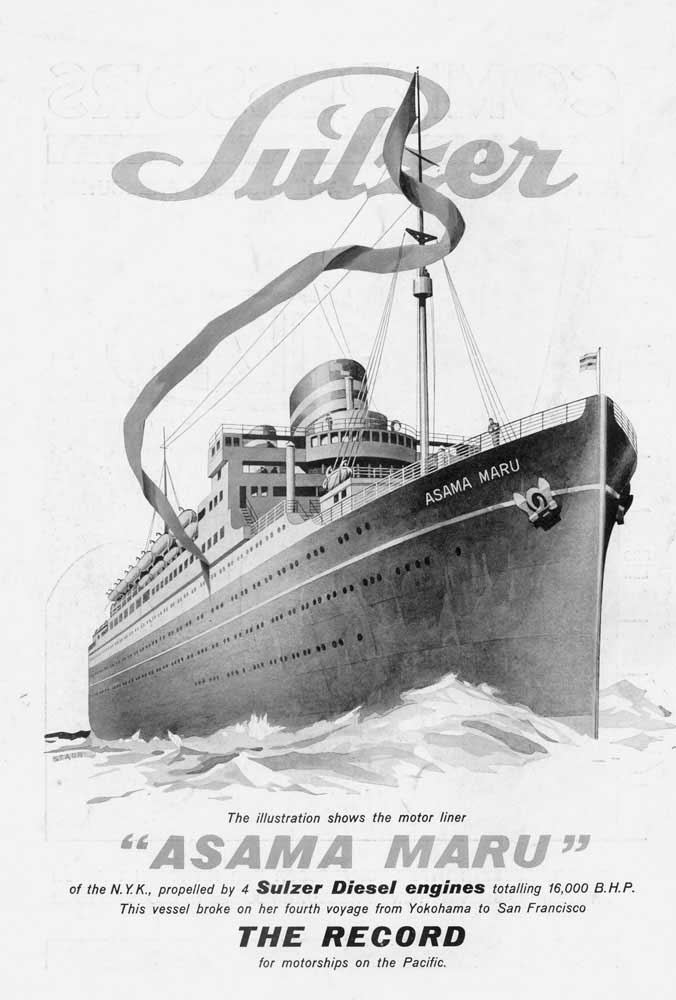
Imperial Japanese Navy page (www.combinedfleet.com) Messrs Bob Hackett & Sander Kingsepp
Various publicity materials produced by Sulzer Bros
National Library of Australia : Trove website of archived Australian Newspapers (trove.nla.gov.au) (next 10)
Last updated July 22nd 2014.
Return to site menu