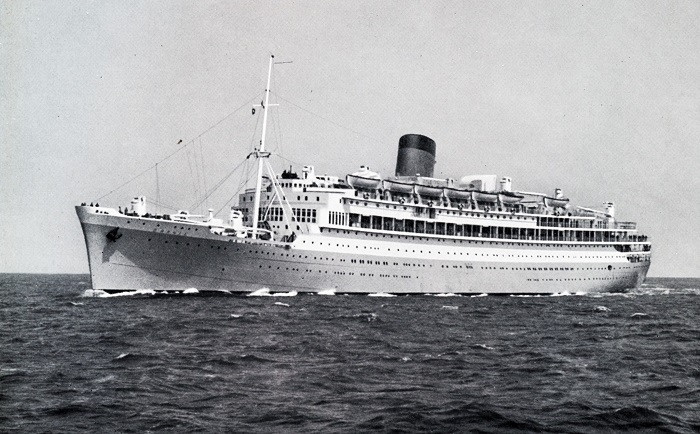
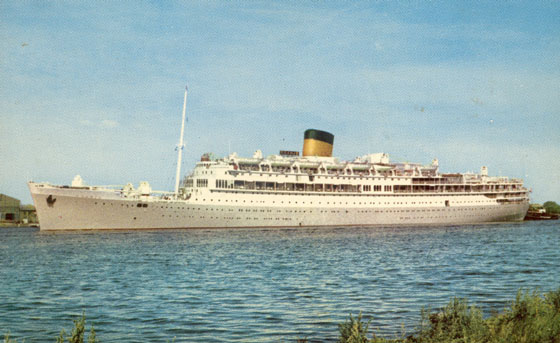
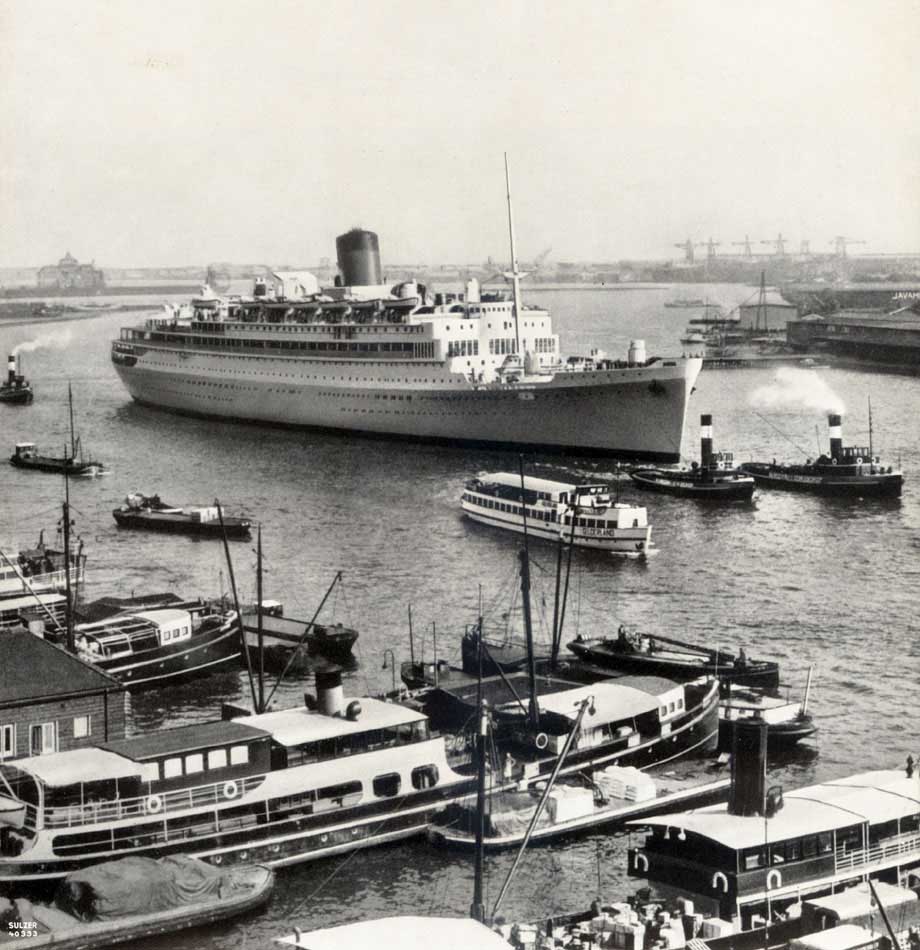
The 'Oranje' was laid down on July 2nd 1937 at the Nederlandsche Scheepsbouw Maatschappij, Amsterdam yard (Yard No.214) for the Nederland Line. When launched by Queen Wilhelmina on September 8th 1938 the ship became the world's most powerful motorship with three two-stroke 12,500hp main engines and five 1,800hp auxiliary engines. In launching the ship an ivory hammer was used to release the mechanism that sent the bottle of champagne into the bow of the ship. Unfortunately the ship did not then move down the slipway as expected, it took a further hour to actually get the ship down the slipway and into the water. Three days of sea trials in the North Sea took place at the end of June 1939. The official trial voyage took place on July 15th 1939. Initially the Oranje completed two ten day Amsterdam - Madeira/Azores cruises before starting her scheduled sailings on the Amsterdam - Capetown - Batavia (Djakarta) run. The first voyage on the new schedule commenced on September 4th 1939, the day after the Allied declaration of war.

1939
September 5th 1939 - departed Amsterdam one day before scheduled and under the command of Captain B.A.Potjer, sailing via the Cape of Good Hope to Colombo, Sabang, Belwan-Deli and Singapore, due to arrive at Singapore on October 1st, a day ahead of the schedule which had been set for travel through the Suez Canal! The ship arrived at Singapore at 1pm with 640 passengers, of which 90 were to disembark. The Oranje would sail the same day at 5pm for Batavia. In her sea trials the Oranje reached 26 knots, her regular cruising speed was 21 knots, though it is presumed that on her maiden voyage 24-25 knots was maintained for much of the time. En-route two SOS calls were recived from British freighters. Near Lisbon an SOS from the Defender (8,258 tons), reporting some sort of nearby explosion. The Oranje changed course to assist, but this was declined by the Defender. The next day north of Las Palmas an SOS from the Silverthorn (436 tons) suggested she was being hunted by a submarine. The Oranje increased speed to 24 knots with the intent to render aid, but a radio call was later received advising the Silverthorn had shaken off the pursuer.
October 20th 1939 - timetabled to depart Singapore for Amsterdam via Cape of Good Hope.
November 20nd 1939 - The Lisbon correspondent of the United Press (American) says that passengers on the Dutch liners Oranje (19,850 tons), Jan Pieterszoon Coen (11,140 tons) and Johan de Witt (10,474 tons) bound for Holland, were advised to disembark at Lisbon owing to increasing danger in the North Sea.
December 6th 1939 - The Oranje along with the Marnix van Sint Aldegonde and the Dempo were anchored at Sourabaya having been taken out of service because of the war in Europe.
1941
February 10th 1941 - The Dutch government offered the Oranje to the United Kingdom for use as a hospital ship, the offer being quickly accepted. The vessel was currently laid up at Sourabaya. During the middle of March 1941 the Oranje was inspected by doctors and engineers to advise what changes would need to be made. Later during March the Oranje, under the command of Captain Potjer, travelled to Australia for the refit to be completed. Some air-conditioned cabins were to be retained for serious cases, whilst the vibration proof promenade deck would be used to house an operating theatre.
June 29th 1941 - Representative of the Dutch Government formally presented the Oranje to the Australian & New Zealand Governments for use as a hospital ship. The Dutch Government paid for its conversion (£150,000) and ongoing annual maintenance (£150,000). An all Dutch crew manned the ship, which included about 100 Javanese. The medical staff were mostly British, Australian & New Zealanders, but with a small contingent of Dutch, approximately 750 wounded could be cared for on the ship. Facilities include sixteen wards, an operating theatre, a dental surgery and was fitted with lifts for stretcher patients. Illuminated Red Cross signs adorn the ship.
July 11th 1941 - the Oranje arrived at Batavia, Tandjong Priok harbour, remaining here at least until July 13th.
August 15th 1941 - the conversion to hospital ship was completed. In addition to the hospital related conversions, the bridge and wireless room have been fitted with armour plating to minimise damage from attacks by machine gun equipped aircraft.
September 1941 - on its first run to the Middle East (Egypt) to pick up 630 wounded Australian & New Zealand troops, the Oranje was unsuccessfully attacked in the Red Sea by a torpedo carrying enemy plane. On this journey the Oranje was sailing without formal recognition from Germany that this was a hospital ship. Whilst embarking the wounded at the Egyptian port the ship moved into deeper water at night to minimise the risks from air attacks. The journey from Egypt to Australia took only 11 days 18 hours, a record for the crossing of the Indian Ocean. Australia was reached on September 9th?. The ship also travelled to Wellington, New Zealand with the New Zealand government honouring the crew with a luncheon (on or about October 9th?)
1944
During March 1944 the Oranje arrived in the United Kingdom with wounded troops from the battlefields in Italy. This was her first visit to the United Kingdom since leaving Amsterdam five years earlier.
1945
August 6th 1945 - arrived at an Australian port with 655 New Zealand & 90 Australian servicemen from Europe. The serviceman had been collected from ports in England, Italy & India, most were recovering from war wounds and sickness contracted in prison camps.
August 25th 1945 - at Sydney loading medical supplies and hospital personnel, initially believed for movement to the United Kingdom, but later changed for one round trip to Rangoon.
September 23rd 1945 - arrived Darwin with 760 members of (ANZAC?) Eighth Division, members of the British Army and civilian internees, many of whom had been prisoners of war for three and a half years. The arrival of the Oranje was celebrated by Liberator and Catalina aircraft circling the ship, whilst the Duke of Gloucester's Avro York transport dipped its wings in salute as it headed off to Singapore. The Oranje departed late in the afternoon for Brisbane, arriving there on September 26th. Sydney was reached on September 28th with 637 ex-prisoners of war on board, 55 ambulances were on hand to assist in the transport of the wounded. Other travelled to the Concord Military Hospital on double decker buses. Once clear of the port facilities the cavalcade was greeted by huge cheering crowds.
October 1st 1945 - arrived Melbourne for an (engine?) overhaul after visiting Darwin, Brisbane & Sydney with freed prisoners of war from Singapore. After release from Melboure the ship sailed via Fremantle to Java, to act as a mercy ship.
October 1st 1945 - (As reported in The West Australian) Melbourne: It was painful that Dutch ships like the hospital ship Oranje which, with their crews, had played an important share in saving Australia from invasion, were now prevented from bringing relief to hundreds of thousands of starving people due to the efforts of certain Australian elements who claimed that a quisling republic in Java should be acknowledged said a statement issued today by the N.E.I. Government Information Service. The Oranje and nearly all the Netherlands aircraft in the South Pacific have, in the past weeks, transported only liberated Australian prisoners of war from Singapore while starved and sick Hollanders and Indonesians have had to remain in their former concentration camps, the statement continued. The word 'mercy' certainly has no hollow meaning with Dutch sailors and airmen. (A response to actions which led to delays in the loading of Dutch ships at Australian ports with medical and other cargoes bound for Java & Sumatra to aid the malnourished and sick victims of Japanese oppression).
October 27th 1945 - Arrived at Fremantle for refuelling en-route to Batavia (Djakarta) to bring approximately 900 Dutch women and children for a time of recuperation after three years of internment. It was reported that Japanese neglect of the facilities at Batavia would require the Oranje to remain outside the port facilities due to too shallow water in the port. The Oranje was back at Fremantle by November 15th with 1,050 Dutch men, women and children on board. The Oranje had boarded about 300 persons at Bandoeng, with the remainder coming on board at Tandjong Priok (12 miles from Batavia). The situation at this time in Batavia was one of civil unrest with British & Indian troops in conflict with Indonesia troops, particularly at night.
November 20th 1945 - whilst mooring at Melbourne the Oranje was blown onto the corner of the pier, an iron bollard caused damage to one of the ship's steel plates.
November 30th 1945 - departed Melbourne for Holland, travelling on the ship were Dutch nurses returning to Holland. Arrived at Fremantle to load stores initially for Batavia.
December 2nd 1945 - arrived Fremantle, noted Batavia about December 11th to board approximately 1,000 sick refugees bound for Australia, many of whom would settle in Australia.
As a hospital ship the Oranje and its crew and medical staff completed thirty five voyages, assisting 30,000 patients and travelled 330,000 miles.
After relinquishing her hospital ship duties the Oranje returned to the Amsterdam - Southampton - Djakarta run between 1947 & 1957.
1946
January 26th 1946 - to depart Southampton for Singapore & Batavia.
February 15th 1946 - due at Singapore from Europe with about 2,500 passengers, although the ship arrived on February 15th, docking did not occurr until the 16th. Friends and relatives of the disembarking passengers were not allowed to enter the docks area. The ship had travelled through the Suez Canal, reportedly the first ship to travel through the Canal with civilians aboard.
April 16th 1946 - at Penang to disembark 25 civilian passengers, with a further 275 to disembark at Singapore.
July 1946 - on arrival at Amsterdam for the first time in six years, the Oranje was the first ship to use the great north lock at Ijmuiden, which had only just been repaired after it was heavily damaged by the retreating German forces in 1944. Amongst other things four 1,200 ton lock gates required reconstruction.
August 19th 1946 - due to arrive at Singapore during the morning from Europe, to sail on August 22nd for Batavia. On the return westbound sailing the Oranje would carry nearly 1,000 evacuees from Java, both men & women who had been held in Japanese prisoner-of-war & internment camps.
October 5th 1946 - to depart Amsterdam for Singapore & Batavia.
October 24th 1946 - due at Singapore with 150 disembarking here, with 900 passengers headed for Batavia. During this voyage many babies onboard suffered bouts of whooping cough, gastric influenza and measles. A special ward was set up for those who fell ill. The ship had been completely reconditioned following her wartime service, making her first voyage since being derequisitioned by the Dutch government as an evacuee vessel. The Netherlands Indies Shipping Organisation had controlled all vessels in the Dutch shipping pool during the war.
November 16th 1946 - to depart Singapore via the Suez Canal to Amsterdam, passengers were to be dockside no later than 1.30pm.
December 30th 1946 - to depart Southampton for Singapore & Batavia. On the sailing from Europe a rough passage of the Bay of Biscay led to a very low attendance for the New Years Eve party aboard ship. A stop was also made at Gibraltar to allow a small child to receive onshore treatment following a minor accident aboard ship. Passengers on this voyage included 200 men, 900 women and 250 children, many were Dutch residents returning to the East Indies.
1947
January 16th 1947 - due Singapore late in the afternoon from Amsterdam, to sail the same day for Batavia.
January 29th 1947 - timetabled to depart Singapore for Southampton (journey time 17 days). Included in the cargo of the Oranje were 30,000 tropical fish headed for Europe for the collectors market. Unfortunately 5,000 of the fish died en-route due to the effects of a spell of cold weather. A replacement batch of a 5,000 fish were part of the Oranje's cargo March 19th sailing. It was intended to have only two sailings between Europe & Batavia during the first five months of 1947, but a third was added to cope with the increased number of passengers on the westbound sailings.
March 12th 1947 - due to arrive at Singapore from Europe. 171 passengers were to disembark at Singapore along with 657 bags of mail. Distinguished passenger disembarking included the Sultan of Deli and the Prince & Princess Bhanubandh of Siam.
March 19th 1947 - to depart Singapore for Southampton (journey time 17 days) & Amsterdam. 100 passengers would embark at Singapore along with 75 tons of cargo.
April 6th 1947 - A severe storm in the Bay of Biscay led to the deaths of four persons on the Oranje which was transporting 800 Dutch repatriates and other passengers from Netherlands East Indies to Holland. Whilst crossing the deck stewardess Miss G Broer caught her leg between a pipe and the side of the deck, nurse Schimmel and chief steward G W Meyer came to assist, but all were swept overboard, the ferocity of the storm making rescue virtually impossible. Later the chief mate received fatal injuries when he was thrown against deck fittings. Several passengers also recieved minor injuries, the ship arrived at Southampton on April 6th with her flags flying at half mast.
The storm which struck the Oranje with 30 foot waves also swamped the British ship Willodale (1,777 tons) which had sailed from Bordeaux on the afternoon of April 3rd. Survivors of the British ship Willodale told the Daily Express that the engine room was flooded by seawater, a seven hour struggle to save the ship failed when a deck cargo of pitprops broke free, causing the ship to list. Six crew members went down with the ship and a further six lives were lost in the churning waters filled with pitprops, the lifeboats had been battered to fragments by the pitprops whilst they were being lowered. A survivor said that five minutes after being abandoned the ship put her nose down and plunged out of sight at the mouth of the Gironde River. The Captain of the French pilot boat Eglefin said Willodale's crew were putting up a courageous fight on the wave-washed deck against the shifting pit props when the Eglefin approached. The Eglefin brought back 10 survivors and 6 bodies. Six others, including the captain, were missing.
At least twelve other lives were lost in the storm, including ten French fisherman washed overboard off Brittany. The French ship Polynie which sailed from Concarneau, Brittany in response to an SOS was reported missing.
April 29th 1947 - due at Singapore in the morning from Amsterdam, to sail later in the day for Batavia. On this voyage the Oranje stopped for an hour in the Bay of Biscay to drop wreaths in honour of four ship's crewmen who lost their lives here during a violent storm three weeks previously. Despite this stop it was expected the Oranje would attempt the Southampton - Singapore leg in 15 days 12 hours, to arrive two days ahead of schedule. This attempt was later called off due to there being no berth available at Batavia until May 1st. 150 passengers had boarded at Southampton for Singapore, whilst a further 900 Dutch passengers were bound for Batavia.
May 2nd 1947 - A major fire at the Rotterdam Lloyd storage depot at Tandjong Prick, Batavia harbour required the moving of several vessels to safety including the Oranje.
May 6th 1947 - to depart Batavia for Europe. Prior to departure eight British Indians headed for Colombo were visited by Customs, smuggled gold valued at 200,000 Dutch guilders was discovered upon their persons, in the form of rings, bracelets & belt buckles, gold soles inside their shoes, jewels sown in their coats and pants. After surrendering the gold items the men were allowed to sail on the Oranje. On May 7th the Oranje departed Singapore during the morning for Southampton (journey time 17 days) & Amsterdam. 100 passengers embarked at Singapore, joining 800 passengers already onboard from Batavia.
July 23rd 1947 - due to arrive Singapore from Batavia and sail later in the day for Amsterdam.
September 2nd 1947 - due to arrive Singapore from Europe. This was the first Dutch vessel to berth alongside the Harbour Board wharves since August 12th after Singapore dock workers lifted their ban on handling Dutch ships, providing they are not carrying arms & munitions to Netherlands Indies ports.
October 28th 1947 - due at Singapore from Europe. More than 200 passengers would disembark at Singapore, including the Sultanah of Johore. 800 passengers remained onboard to disembark at Batavia.
November 5th 1947 - due to depart Singapore for Southampton, expected to arrive November 21st. 127 passengers were to embark at Singapore for Europe. On arrival at Southampton the wind caught the stern of the ship whilst docking, the stern swung right across the dock and hit the quay wall. The nearby P&O liner 'Strathmore' barely escaped being hit. The Oranje's sailing was delayed whilst a diver checked for damage.
1948
January 9th 1948 - the Oranje called in at Gibraltar to effect engine repairs, shortly after leaving Gibraltar the problems resurfaced, leaving the ship to complete the voyage with two of the three engines running; departed Suez January 17th for Singapore, due to arrive January 29th. 170 passengers were due to disembark at Singapore.
January 30th 1948 - departed Singapore eight days late for Batavia, engine trouble and heavy weather at Singapore contributed to the delays. The North-East monsoon produced wind velocities between 39 knots and 47 knots at Singapore harbour, requiring the Oranje to anchor off Blakan Mati with launches being used to transfer passengers.
April 11th 1948 - timetabled to depart Singapore for Southampton.
May 5th 1948 - due at Singapore from Europe.
May 26th 1948 - due to depart Singapore for Amsterdam, due to many polio cases in Singapore transitting passengers & crew members were not allowed to go ashore and no visitors were allowed aboard.
June 3rd 1948 - timetabled to depart Singapore for Southampton.
July 12th 1948 - due to arrive at Singapore in the morning from Europe, due to many polio cases in Singapore transitting passengers & crew members were not allowed to go ashore and no visitors were allowed aboard.
July 28th 1948 - due to depart Singapore for Southampton, due to many polio cases in Singapore transitting passengers & crew members were not allowed to go ashore and no visitors were allowed aboard.
September 14th 1948 - at Singapore from Europe.
September 30th 1948 - at Singapore from Batavia.
1949
January 18th 1949 - due at Singapore from Amsterdam during the early evening.
February 1st 1949 - will depart Singapore at 1pm for Amsterdam.
March 19th 1949 - due at Singapore late in the evening from Amsterdam.
March 31st 1949 - due Singapore from Djakarta.
June 3rd 1949 - at Singapore.
July 23rd 1949 - due at Singapore from Europe, to depart at noon.
August 4th 1949 - at Singapore.
October 10th 1949 - to arrive at Singapore in the morning from Amsterdam.
December 6th 1949 - due at Singapore.
December 15th 1949 - at Singapore from Djakarta.
1950
May 24th 1950 - expected from Europe during the afternoon at Singapore. The arrival had been delayed due to engine troubles. Likewise the return westbound sailing was rescheduled.
June 5th 1950 - due to depart Singapore at 11am.
July 15th 1950 sailing of the Oranje from Singapore was cancelled.
August 16th 1950 - whilst visiting the Oranje at Singapore (?), Cornelius Hagers, Chief Officer of the nearby s.s. Saida, an Anglo Saxon petroleum tanker fell down a spiral staircase. He was transported to the local hospital but died from his injuries on August 19th. The Singapore Coroner's verdict was death by misadventure. The Oranje later sailed for Djakarta.
August 27th 1950 - arrived at Singapore from Djakarta. Docking of the Oranje was delayed due to quarantine issues because Djakarta was an infected port because of a plague outbreak.
October 24th 1950 - on arrival at Singapore the Oranje was delayed docking for two hours due to an outbreak of measles on the ship affecting eight children, three of whom were disembarking at Singapore.
December 28th 1950 - due to arrive at Singpore during the morning from Europe.
1951
January 9th 1951 - Just before the Oranje sailed from Singapore 200 Indonesians in the crew walked off following a dispute over what type of head-dress should be worn. The Indonesians wanted to wear the songkok (national headgear) instead of the customary turban-like tanjak. The Dutch Line officials insisted that the tanjak should be worn until January 15th 1951, when the issue would be decided at a meeting of both parties. The Dutch crew members filled the breach on the voyage, the vessel ran to schedule and the 650 passengers had few complaints. Twenty reinforcements were being flown out from Holland to meet the ship at Colombo. Additionally the Djakarta tug-boat crews came out in sympathy with the Javanese crew, leaving the Oranje to sail without assistance from the tugs.
February 27th 1951 - arrived Singapore from Europe. Manning the ship were 90 temporary stewards & messmen who had replaced 200 Javanese crewman who had walked off at Djakarta prior to the January's westbound sailing.
May 2nd 1951 - arrived Singapore from Europe. On board the Oranje was a former Luftwaffe Messerschmidt 262 ace & test pilot travelling to the Far East on business. Whilst trying to enter Singapore as the Oranje laid over Herman Kersting was delayed by Singapore Immigration authorities as the passenger had a West German temporary travel document issued by Allied authorities. Access to Singapore was eventually granted.
July 11th 1951 - due to arrive Singapore about noon from Europe.
September 11th 1951 - due Singapore during the morning from Europe(?).
September 22nd 1951 - departed Singapore during the afternoon for ??
November 13th 1951 - due at Singapore about 9am from Europe. Cargo on the Oranje included 2,020 mail bags from Europe.
1952
January 16th 1952 - due at Singapore about 1pm from Europe. Cargo for unloading at Singapore from the Oranje included 4,000 cases of milk, 2,847 boxes of radio sets and parts, 739 packages of sundries, 270 cases of liquor, 154 cases of tobacco and 47 cases of cheese.
January 25th 1952 - due at Singapore about 5pm from Djakarta and sailing for Amsterdam on January 26th 1952 at 10am.
March 16th 1952 - due at Singapore about 8am from Europe.
March 26th 1952 - arrived Singapore from Djakarta. The docking of the Oranje was delayed three hours due to the windlass jamming on the 7,207 ton American cargo vessel Clarence M. Matson. The Singapore Harbour Board floating crane Nimrod was used to assist in moving the cargo ship. On departing on March 27th for Europe a huge crowd of wellwishers waived off the Sultan of Johore, Sir Ibrahim along with the Sultanah and Princess Mariam. The Sultan would be visiting London & Zurich specialists to resolve an old injury that had recently been giving a lot of trouble.
May 20th 1952 - due at Singapore about 8am.
May 31st 1952 - due Singapore to sail for Amsterdam.
July 21st 1952 - due at Singapore about 8am from Europe.
July 31st 1952 - due at Singapore about 4.30pm from Djakarta and departing for Europe on August 1st 1952.
September 15th 1952 - due at Singapore about 8am from Europe.
September 25th 1952 - due at Singapore about 4.30pm from Djakarta and departing for Europe on September 26th 1952.
November 17th 1952 - due at Singapore about 7.30am from Europe, then sailing later in the day at 10pm for Djakarta.
November 27th 1952 - due at Singapore about 4.30pm from Djakarta and sailing for Amsterdam at 3pm on November 28th 1952.
1953
January 7th 1953 - the eastbound Oranje and the westbound Willem Ruys collided in the Red Sea about 10pm local time. Both continued on their scheduled sailings, the Oranje to Indonesia (but missing the stops at Colombo, Belawan & Singapore, with passengers being flown from Djakarta to missed ports of call; there being 32 passengers for Columbo and about 169 for Singapore) and the Willem Ruys to Holland after six days of repairs at Port Said. It had been planned for the Oranje to anchor off Columbo, but bad weather prevented the transfer of the Columbo bound passengers.
Damage to the two ships was estimated from $1.6 million to $2.4 million (Singapore $).
Repairs to the Oranje would delay its next westbound sailing, scheduled to arrive Singapore on January 25th, but rescheduled for February 4th. Cargo from Europe carried by the Oranje finally reached Singapore on January 23rd after transfer to the MV Tabintha at Djakarta. Whilst the cargo was being transferred from the Oranje to the Tabintha about 5% was damaged or stolen by looters.
The damage to the Oranje was considerable, primarily affecting a large part of the bow, with 30 feet of damage reaching almost as far back as the ship's name and almost down to the waterline. A brief fire was also reported to have occurred in the damaged area of the ship following the collision. The anchor was torn away in the collision. Whilst temporary repairs were made at Djakarta, a new bow section was being constructed at Amsterdam. On this sailing at about the time of the collision Captain HW Hemmes caught a chill which developed into pleurisy, the westbound sailing was handled by Captain Jan Lassche.
February 4th 1953 - due Singapore at 3pm, to sail at 1pm on February 5th to Amsterdam??
June 17th 1953 - due to arrive Singapore at 8am from Amsterdam, and sailing later that evening for Djakarta.
June 27th 1953 - scheduled to depart Singapore for Amsterdam. Whilst crossing the Arabian Sea the Oranje encountered a very severe south-westerly monsoon. The ship sustained some damage, requiring a one day stay at Aden to make good the repairs. The Willem Ruys, heading eastbound, avoided the worst of the storm by detouring after receiving a radio message from the Oranje concerning the severity of the monsoon.
August 12th 1953 - due to arrive Singapore at 8am from Amsterdam.
August 22nd 1953 - due Singapore at 3pm from Djakarta, then sailing about 10.30pm to Amsterdam. A scheduled stop at Naples was included for this and all following sailings. Advertised sailing times were: Naples 14 days, Southampton 19 days, Amsterdam/Rotterdam 20 days.
October 7th 1953 - expected Singapore during the morning, to sail the same day to Djakarta.
October 17th 1953 - scheduled to depart Singapore for Amsterdam.
December 9th 1953 - due to arrive Singapore by 9am from Amsterdam. Cargo on the Oranje included 3,430 mail bags from Europe.
December 19th 1953 - scheduled to depart Singapore for Amsterdam.
1954
February 4th 1954 - due to arrive Singapore about 9am, then to sail to Djakarta later the same day.
February 13th 1954 - scheduled to depart Singapore for Amsterdam.
April 1st 1954 - due to arrive Singapore by 9am from Europe, to sail later in the evening for Djakarta.
April 11th 1954 - due to arrive Singapore from Djakarta by 3pm, then sail that evening for Amsterdam.
June 2nd 1954 - due at Singapore by 9am from Europe, to sail later that evening for Djakarta. Because of the Hari Raya celebrations, there were no Malay mooring rope crews to assist any ships docking this day. Despite this the Oranje moored safely without even a bump.
June 12th 1954 - due to arrive Singapore from Djakarta by 3pm and later that evening to sail for Amsterdam (to arrive July 2nd).
July 28th 1954 - due to arrive Singapore in the morning then sail for Djakarta later the same day.
August 7th 1954 - scheduled to depart Singapore for Amsterdam (to arrive August 27th).
September 23rd 1954 - due to arrive Singapore by 9am from Europe, to sail the same evening for Djakarta.
October 2nd/3rd 1954 - scheduled to depart Singapore for Amsterdam (to arrive October 23rd). On this voyage the Oranje was unable to make her scheduled stop at Southampton due to nationwide dock strikes.
November 24th 1954 - due to arrive Singapore from Europe by 9am, to sail later that evening for Djakarta. Included in the cargo to be unloaded at Singapore were 4,943 bags of mail (170 tons total) from Britain & Europe, a record for a single ship. The high volume represented all the backlog of mail from Britain following the end of a dock/postal(?) strike. A new addition to the first class verandah area was the fitting of a navigation table and charts, to allow passengers to follow the ship's movements.
December 4th 1954 - scheduled to depart Singapore for Amsterdam (to arrive December 24th).
December 22nd 1954 - Fierce gales affecting much of the United Kingdom delayed the arrival at Southampton from Jakarta of the Oranje, the ship hove-to off the Isle of Wight. On January 7th 1955 the Oranje departed Southampton en-route to Djarkarta.
1955
January 25th 1955 - due at Singapore about 9am from Europe and to sail later in the day for Djakarta.
February 4th 1955 - scheduled to depart Singapore for Amsterdam (to arrive February 24th).
March 22nd 1955 - due Singapore by 9am from Europe and to sail later that evening for Djakarta. On arrival at Singapore the port health officers kept the ship at quarantine anchorage for three hours after nine cases of chickenpox were discovered in children. Three of the children were travelling beyond Singapore and remained in the ship's hospital, the others disembarked leaving the dock by ambulance.
April 1st 1955 - expected at Singapore during the early afternoon, from Djakarta bound for Amsterdam (to arrive April 21st).
May 23rd 1955 - expected at Singapore about 9am from Europe. At Singapore the Hari Raya holiday prevented the Oranje from docking due to the fleet of tugs, operated by Malays, being idled for the day. Instead two fast 50-seat launches were used to bring the 145 landing passengers and their baggage to shore.
June 2nd 1955 - scheduled to depart Singapore for Amsterdam (to arrive June 21st?). On departure from Singapore under light rain the Oranje's passengers were treated to a flypast of Royal Air Force & RNZAF Venoms, Vampires, Meteors & Mosquitos and a 17-gun salute from Blakan Mati island, carried out by the 1st Singapore Battery, the Royal Artillery. These celebrations were a farewell salute for the Governor of Singapore, Sir John Nicoll as he sailed on the Oranje to retirement in the United Kingdom. Sir John had been Governor for three years and took the salute in full ceremonial dress, complete with red & white plumed hat.
July 19th 1955 - expected at Singapore about 9am from Europe and to sail later in the day for Djakarta. The Oranje was carrying 2,884 bags of mail from Europe to Singapore, far more than usually carried.
July 29th 1955 - scheduled to depart Singapore for Amsterdam (to arrive August 18th).
September 13th 1955 - due at Singapore by 9am from Europe and to sail later that evening for Djakarta.
September 23rd 1955 - scheduled to depart Singapore for Amsterdam (to arrive October 13th).
November 15th 1955 - expected at Singapore about 8am from Europe and to sail later in the day for Djakarta. Singapore immigration officials checked about 600 landing & transit passengers in 75 minutes, a post-war record clearance time.
November 25th 1955 - due to arrive Singapore about 2pm from Djakarta and depart about 5.30pm for Amsterdam (to arrive December 15th).
1956
January 15th 1956 - expected to arrive at Singapore by 9am and depart for Djakarta later the same day.
January 25th 1956 - due to arrive Singapore about 2pm and to sail later that evening for Amsterdam (to arrive February 14th).
March 11th 1956 - expected at Singapore during the early morning, from Amsterdam bound for Djakarta.
March 21st 1956 - scheduled to depart Singapore for Amsterdam (to arrive April 9th).
May 8th 1956 - due at Singapore about 9am from Europe and sailing later in the day for Djakarta.
May 19th 1956 - expected at Singapore during the early afternoon, from Djakarta bound for Amsterdam (to arrive June 8th).
July 4th 1956 - arrived Singapore from Amsterdam. Prior to departure from Amsterdam many of the Indonesian crew walked off the ship in protest following the dismissal of ten of their fellow workers. Within two days 129 students had been recruited at union rates for the one trip hiring. Regrettably a few days out of Aden the ship encountered a south-west monsoon which created high seas and much seasickness amount passengers and the newly hired crew. So severe was the storm that furniture had to be lashed down. The storm may have also been partly responsible for the record amount of crockery and glasses broken on this voyage. The dispute with the Indonesian crew members had since been settled and they would later rejoin the ship.
July 14th 1956 - scheduled to depart Singapore for Amsterdam (to arrive August 2nd). It was reported on August 1st that the Oranje and the Willem Ruys came alongside each other mid-ocean (location?) after the Willem Ruys put out a request for a doctor to assist with a possible case of acute appendicitis. A boat was sent over from the Willem Ruys. The ships remained stopped for about two hours.
August 31st 1956 - due at Singapore about 2pm from Europe and to sail later that day for Djakarta. The six hour late arrival at Singapore was due to taking extra time to navigate the Suez Canal. 224 passengers would disembark at Singapore.
September 9th 1956 - due to arrive Singapore about 2pm from Djakarta and to sail later in the day for Amsterdam (to arrive September 29th).
October 31st 1956 - due at Singapore about 9am from Europe and to sail later in the day for Djakarta.
On October 31st 1956 the Suez Canal was closed due to the Suez Crisis which involved conflict between Egypt, Israel, United Kingdom & France. The canal would re-open on April 24th 1957. When the canal was closed an additional 4,300 miles was added to any ship having to divert via the Cape of Good Hope.
Passenger fares for three shipping companies between Europe and Singapore & Djakarta were increased by 20%, this would affect passengers using the Oranje sailing from Singapore on November 9th. The diversion of ships via the Cape of Good Hope may have been partially responsible for this increase. The fare by sea from London to Singapore via the Cape would be $1,836, compared to a tourist air fare of $1,504 or first class $2,083.
November 9th 1956 - due at Singapore about 5.30pm and to sail later that evening for Amsterdam (to arrive November 29th).
1956 - Despite the blocking of the Suez Canal during late 1956 the frequency of sailings for the SMN liners remained unchanged. Eastbound passenger loadings remained steady whilst westbound passenger loadings exceeded available space, requiring extra sailings to be made.
1957
January 8th 1957 - due at Singapore about 9am from Europe and to sail later that day for Djakarta.
January 18th 1957 - due at Singapore about 2pm from Djakarta and to sail later that day for Amsterdam.
March 26th 1957 - due at Singapore about 9am from Europe and to sail later that day for Djakarta. On arrival at Singapore chicken pox was reported in six children aboard.
April 5th 1957 - due at Singapore about 3pm from Djakarta and to sail later that day for Amsterdam.
The Suez Canal reopened on April 24th 1957.
May 11th 1957 - departed Amsterdam for Djakarta, this would be the first trip through the Suez Canal since it had reopened during April. It was due at Singapore about 9am on May 28th 1957 and would sail later in the day for Djakarta.
June 7th 1957 - due at Singapore about 2pm from Djakarta and to sail later that day for Amsterdam (to arrive June 27th).
July 23rd 1957 - due at Singapore about 9am from Europe and to sail later the same day for Djakarta.
August 2nd 1957 - due to arrive Singapore about 1pm from Djakarta and sail later that day for Amsterdam (to arrive August 22nd). The Oranje arrived at Singapore three hours late due to engine troubles encountered shortly after leaving Djakarta. On arrival at Singapore two hundred passengers were waiting to embark, in order to minimse delays these passengers and friends assisted with loading the baggage on to the ship.
September 29th 1957 - due at Singapore about 9am from Europe and to sail later that day for Djakarta.
October 9th 1957 - due to arrive Singapore about 2pm from Djakarta and sail later that day for Amsterdam (to arrive October 29th).
November 24th 1957 - due to arrive Singapore about 9am from Europe and sail later in the day to Djakarta.
December 4th 1957 - due at Singapore about 2pm from Djakarta and to sail later that day for Amsterdam (to arrive December 24th). The Oranje was three hours late departing Djakarta as hundreds of Dutch families hurriedly boarded the ship to escape the escalating tension and unrest in Indonesia.
1958
January 22nd 1958 - due at Singapore by 9am from Europe and to sail later that day for Djakarta.
January 30th 1958 - due at Singapore from Djakarta and to sail on February 1st at 7pm for Europe. About 500 businessmen, technicians and estate owners arrived at Singapore on the Oranje from Indonesia, being evacuees from Indonesia due to the deteriorating conditions in the country.
March 21st 1958 - due at Singapore by 2pm from Europe and to sail later that day for Djakarta. Arriving at Singapore from Belawan were about 500 American, Dutch & British women & children evacuated by the Oranje from rebellion torn Medan area of Sumatra. The Oranje had plenty of cabin space available prior to picking up the evacuees, with only 157 passengers from Europe. A further 200 evacuees arrived on the vessel Zuider Kruis. Most evacuees were housed temporarily at the Singapore Military Forces Camp in Changi. By the end of April about 5,000 Dutch national evacuees from the West Irian area had passed through Singapore.
March 30th 1958 - due at Singapore from Djakarta and to sail that same evening for Amsterdam.
May 15th 1958 - due at Singapore about 9am from Europe and to sail later in the day for Djakarta.
May 22nd 1958 - due at Singapore from Djakarta and to sail for Europe on May 24th.
During the summer months the Oranje was scheduled to work four Mediterranean cruises before returning to the Singapore & Djakarta sailings.
September 8th 1958 - scheduled to depart Amsterdam and ports to Singapore (September 28th) & Djakarta (September 30th).
September 28th 1958 - due at Singapore by 9am from Europe and to sail later that day for Djakarta.
October 4th 1958 - scheduled to depart Djakarta for Singapore (October 5th) and ports to Amsterdam (October 28th).
Late in 1958 the Oranje began operating on the Amsterdam - Southampton - Suez - Singapore - Australia run.
November 5th 1958 - scheduled to depart Amsterdam and ports to Singapore (November 25th - actual), Djakarta (November 27th), Melbourne (December 5th) & Sydney (December 7th). This was the first sailing of the Oranje in civilian use beyond Djakarta to Australia, 670 passengers were aboard and the extension to Australian ports would add 25 days to her schedule.
December 9th 1958 - scheduled to depart Sydney for Melbourne (December 11th), Fremantle (December 15th), Djakarta (December 19th), Singapore (December 21st) and ports to Amsterdam (January 12th 1959).
December 21st 1958 - due at Singapore about 3pm from Australia.
December 23rd 1958 - scheduled to depart Singapore at about 4pm for Europe.
1959
February 2nd 1959 - scheduled to depart Amsterdam and ports to Singapore (February 24th - actual), Djakarta (February 26th), Melbourne (March 6th) & Sydney (March 8th).
March 10th 1959 - scheduled to depart Sydney for Melbourne (March 12th), Fremantle (March 16th), Djakarta (March 20th), Singapore (March 22nd - actual) and ports to Amsterdam (April 13th).
April 22nd 1959 - scheduled to depart Amsterdam and ports to Singapore (May 12th - actual), Djakarta (May 14th), Melbourne (May 22nd) & Sydney (May 24th).
May 26th 1959 - scheduled to depart Sydney for Melbourne (May 28th), Fremantle (June 1st), Djakarta (June 5th), Singapore (June 7th - departed June 9th) and ports to Amsterdam (June 29th).
September 6th 1959 - scheduled to depart Amsterdam and ports to Singapore (September 26th - actual), Djakarta (September 28th), Melbourne (October 6th) & Sydney (October 8th).
October 10th 1959 - scheduled to depart Sydney for Melbourne (October 12th), Fremantle (October 16th), Djakarta (October 20th), Singapore (October 22nd - actual) and ports to Amsterdam (November 13th). The Oranje departed Djakarta about two and a half hours late after Indonesian soldiers armed with sub-machine guns carried out a cabin to cabin search to ensure passengers identification papers were in order and that customs regulations had been complied with. 200 embarking passengers were delayed in boarding, remaining on the quay until the search was completed. One Dutch passenger was removed from the ship, allegedly for currency infringements. Travelling on the ship from Sydney to Singapore were Lord Carrington, until recently the United Kingdom High Commissioner in Australia, and his wife Lady Carrington. Lord Carrington was travelling to London to take up the position of First Lord of the Admiralty. Their brusque treatment was advised to the British Ambassador to Indonesia. An 18 year old Indonesian stowaway was discovered on the Oranje shortly after leaving Djakarta.
November 19th 1959 - scheduled to depart Amsterdam and ports to Singapore (December 9th - actual), Djakarta (December 11th), Melbourne (December 19th) & Sydney (December 21st).
During December it was announced that the Oranje would commence a westbound round-the-world service sometime during 1961.
1960
Fares for the 1960 sailings from Singapore eastbound were to Melbourne: 1st Class £90 to £181, Tourist Class £50 to £70; to Sydney: 1st Class £96 to £187; Tourist Class £54 to £74; to Fremantle (via Sydney & Melbourne): 1st Class £120 to £211; Tourist Class £70 to £90; westbound Fremantle to Singapore: 1st Class £72 to £163; Tourist Class £38 to £58.
January 5th 1960 - scheduled to depart Sydney for Melbourne (January 7th), Fremantle (January 11th), Djakarta (January 15th), Singapore (January 17th - actual) and ports to Amsterdam (February 2nd).
February 16th 1960 - scheduled to depart Amsterdam and ports to Singapore (March 7th - actual), Djakarta (March 9th), Melbourne (March 17th) & Sydney (March 19th).
March 21st 1960 - scheduled to depart Sydney for Melbourne (March 23rd), Fremantle (March 27th), Djakarta (March 31st), Singapore (April 2nd, actual was March 31st and sailed on April 1st) and ports to Amsterdam (April 24th).
May 4th 1960 - scheduled to depart Amsterdam and ports to Singapore (May 24th - actual), Djakarta (May 26th), Melbourne (June 3rd) & Sydney (June 5th).
June 7th 1960 - scheduled to depart Sydney for Melbourne (June 9th), Fremantle (June 13th), Djakarta (June 17th), Singapore (June 19th - actual) and ports to Amsterdam (July 12th).
The ship was refitted in Amsterdam during the summer of 1960 and commenced a round-the-world service on September 7th 1960 following the previous route to Australia, then on to New Zealand - Panama - Port Everglades - Bermuda - Southampton - Amsterdam.
September 7th 1960 - scheduled to depart Amsterdam and ports to Singapore (September 27th - actual), Djakarta (September 29th), Melbourne (October 7th) & Sydney (October 9th) under command of Captain J.H.Schulting. With 830 passengers on board whilst at Singapore on September 28th 224 Indonesian seamen walked off the ship, representing more than half the ship's crew. The Indonesians had responded to the recent severing of relations between Holland and Indonesia over the West Irian (Dutch New Guinea) issue. The remainder of the crew were mostly Dutch & Chinese. 158 seamen were quickly recruited in Singapore to cover the loss of the Indonesians whilst a further 20 Singapore seamen were flown to Amsterdam to join the ship when it docked there on November 13th. After departing Singapore as scheduled passenger assisted in the galley washing dishes and similar duties.
October 11th 1960 - scheduled to depart Sydney for Melbourne (October 13th), Fremantle (October 17th), Djakarta (October 21st), Singapore (October 23rd) and ports to Amsterdam (November 14th).
November 20th 1960 - scheduled to depart Amsterdam and ports to Singapore (December 10th - actual), Djakarta (December 12th), Melbourne (December 20th) & Sydney (December 22nd). Included in the cargo from Europe were 1,300 bags of mail, which included many Christmas related cards, letters & packages. Less favourably about 60 Singapore seamen were dismissed when the ship reached Singapore, allegedly due to unruly behaviour and frequent fights. A further 100 seamen left the ship of their own accord, complaining of long work hours and restricted shore leave. Replacement seamen totalling 150 were recruited before the ship sailed.
1961
On February 26th 1961 the round-the-world journeys commenced sailing in the opposite (westerly) direction, with the last voyage commencing on May 4th 1964, the Oranje having completed sixteen circumnavigations of the globe, eight in each direction.
April 14th 1961 - due at Singapore about 7.30am from Australia and to sail on April 15th by 3pm for Europe. Whilst docked at Singapore a variety of local entertainers performed for passengers in the ship's theatre lounge. This was the Oranje's first westbound world cruise.
July 1st 1961 - due at Singapore about 7.30am from Australia and to sail on July 2nd by 3pm for Europe.
October 17th 1961 - due at Singapore about 7.30am from Australia and to sail on October 18th by 3pm for Europe. In charge of the ship for the first time was Captain Pieter Jan Groenland, previously he was captain of the Johan Van Oldenbarnevelt.
1962
March 13th 1962 - due at Singapore about 7am from Europe and to sail by 3pm the same day for Australia, New Zealand, USA & Europe. En-route to Australia the Oranje took a 1,000 mile detour to avoid Indonesian waters. With a large portion of the ship's 1,000 passenger being Dutch it was feared Indonesian rebels may try and commandeer the ship.
May 23rd 1962??? - in celebration of Queen Juliana's silver wedding anniversary two days of celebrations took place in Amsterdam. Part of the festivities included a ball aboard the Oranje with many heads of state attending.
May 29th 1962 - due at Singapore about 7am from Europe and to sail on May 30th by 11am for Australia, New Zealand, USA & Europe.
October 13th 1962 - due at Singapore about 7am from Australia and to sail on October 14th by 6am for Europe.
1963
March 10th 1963 - due at Singapore about 7am from Europe and to sail on March 11th by 11am for Australia, New Zealand, USA & Europe.
May 29th 1963 - due at Singapore about 7am from Europe and to sail on May 30th by 11am for Australia, New Zealand, USA & Europe. Whilst docked at Singapore no visitors were allowed aboard the Oranje. On June 18th, whilst at Sydney (?). steward T.H.Wah slipped on the rain slick deck and fell into a hold, falling 60 feet to his death.
October 16th 1963 - due at Singapore by 7.30am from Australia and to sail that same evening for Europe.
1964
January 1964 - it is announced that the Oranje, which has been operating at a loss, has been sold to the Flotta Lauro Line based in Naples. The Oranje will be transfered to its new owners in September and is expected to remain on the Europe - Singapore - Australia run.
March 1st 1964 - due at Singapore about 8am from Europe and to sail on March 2nd by 1pm for (assumed) Australia, New Zealand, USA & Europe.
May 24th 1964 - due at Singapore about 7am from Europe and to sail on May 25th by 1pm for (assumed) Australia, New Zealand, USA & Europe. Whilst on this voyage, a British Army Officer, Capt. Colin Beadle died unexpectedly, possibly from poliomyelitis. As a precaution several hundred passengers received oral polio vaccine. Capt W. Morzer Bruyns was the master of the Oranje.
In September 1964 the Oranje was sold to the Italian owned Lauro Line, being rebuilt at the Cantieri del Tirreno dockyard in Genoa during 1965/66 and renamed the Angelina Lauro. During the refit the ship was extensively damaged by fire, delaying the completion until 1966. Her new sailings took the Angelina Lauro from Bremen to Southampton - Italy - Suez - Australia - New Zealand & return.
April 23rd 1966 - the Angelina Lauro, in command of Captain Enzo Ummarino, arrived at Singapore with 1,337 passengers, 52 of which disembarked, many others visited Singapore prior to the ship continuing on her maiden voyage from Australia to Europe.
From 1967 - 1972 this run was made via Cape Town since the Suez Canal was closed. From 1971 the return voyages were via South America. Her last major voyage took the ship from Australia to New Zealand - Tahiti - Acapulco - Panama - Port Everglades - Bermuda -Southampton.

From this point she was used mostly for cruising, receiving a refit for this purpose during 1972, being chartered for three years to the Costa Lines in 1977 and 'renamed' Angelina.
On March 24th 1979 the ship set sail from San Juan for a week's cruise, by March 30th the Angelina was anchored dockside at St Thomas, Virgin Islands. At approximately 3.30pm a skillet fryer in the crew's galley was turned on to its highest setting and left unattended. The oil in the fryer eventually overheated, flames spread through the vent hood/exhaust duct into an unoccupied nearby dining area. Despite attempts by the crew, the Virgin Islands Fire Department & the United States Coast Guard the fire eventually spread to the whole ship. Water used to quell the flames caused the ship to settle on the bottom with a considerable list. The Angelina was one of four ships dockside in St Thomas at this time, presenting a rather grim image for the other ships passengers & crew. The three other cruise ships left early that day taking the Angelina's 669 passengers & 380 crew with them back to San Juan.
The local fire department were supported by a fire fighting tug from an oil refinery on St Croix and United States Coast Guard & Navy personnel & equipment. The fire burned until April 4th, though smoke continued to come from the ship for several more days. The ship was a total loss and after being pumped out it was sold during July to a scrap dealer in Taiwan. Whilst being towed to her final resting place by the tug Nippon Maru the ship developed a serious list whilst crossing the Pacific (midway between Panama & Hawaii), rolled on her side and sank, September 24th 1979, taking her three 12,500hp Sulzer Diesel engines to the bottom.
The USCG report on the fire can be found at USCG Report 'Angelina Lauro'
Length: 674 ft
Breadth: 84 ft
Depth (keel to promenade deck): 63ft 8in
Draft (loaded): 28 ft 10in
Gross Weight: 24,377 tons
Engines main: 3 two stroke x 12,500hp 760mm x 1250mm at 145rpm
Engines auxiliaries: 6 x 1,800hp auxiliaries
Screws: three
Speed: 26.3knots
Passengers: 713
Crew: 383

Resources
Trove next #45 (Last #44 page 860)
Newspapers SG 'mv oranje' complete
Newspapers SG 'oranje' done:1938-65
Newspapers SG 'angelina lauro' article all
Page added February 12th 2005.
Last updated June 16th 2020.
Return to Ship menu
Return to site menu