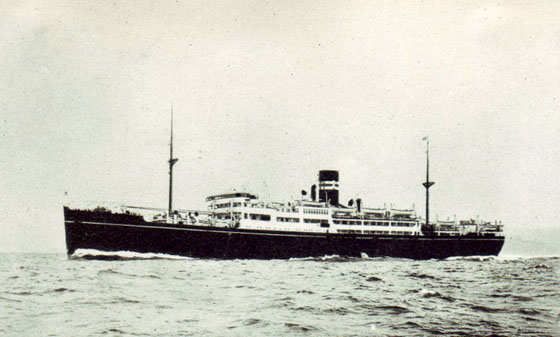
The Rio De Janeiro Maru was laid down during May 1929 at the Nagasaki yard of Mitsubishi Shipbuilding, ordered by the Osaka Shosen Kaisha (OSK) Line as a passenger-cargo liner. It was launched during November 1929 and completed in May 1930. Her maiden voyage commenced on June 1st 1930 from Kobe to South America. The ship could carry approximately 1,140 passengers with cargo space available in five holds.
1930: June 19th at Singapore on her maiden voyage for South Africa.
A sister ship to the Rio de Janeiro Maru was the Buenos Aires Maru which was commissioned during October 1929. Other express liners sharing the service were the Santos Maru, La Plata Maru & Montevideo Maru. Vessels on the secondary service were the Arizona Maru, Arabia Maru, Africa Maru, Manila Maru & Hawaii Maru. The round-the-world voyages began at Kobe then Hong Kong, Singapore, Columbo, Durban, Cape Town, Rio de Janeiro, Santos, Montevideo, Buenos Aires, New Orleans, Galveston, Cristobal, Balboa, Los Angeles & Yokohama. The voyage would cover 30,000 miles and last about four and a half months.
1930: December 4th at Singapore for South Africa on her second round the world sailing.
1931: January 24th departed Buenos Aires for Japan, arrived Kobe April 1st (?) 1931.
1931: May 30th at Singapore from Japan for South Africa.
1931: November 12th at Singapore from Kobe for Buenos Aires via Columbo.
1932: May 3rd (?) departed Singapore for South Africa. On May 12th the ship arrived in Durban flying the yellow flag, with passengers on the ship suffering a multitude of diseases, ranging from typhoid to pneumonia, measles & chickenpox, threatening the 1,200 mostly Japanese emigrant passengers. Three persons had already died and were buried at sea whilst forty others remained ill. The ship carried two doctors, several nurses and a sick bay that could accommodate 28 patients.
1932: October 3rd at Singapore from Kobe for South Africa.
1933: Round-The-World fares offered by the O.S.K. Line from/to Singapore via Ceylon, East & South Africa, South & North America, Japan, China, Indo-China and Straits Settlements allowed travel times of between 5 months to two years at a cost of between 172 Pounds & 190 Pounds depending on the vessel used.
1933: March 11th at Singapore from Japan for South Africa.
1933: August 9th (?) at Yokohama from Los Angeles with two American stowaways on boards, who had been discovered three days out from Los Angeles.
1933: August 29th at Singapore for South Africa.
1934: Fares offered for the 1934 season included Columbo $154 1st, $120 cabin class; Mombasa $270 cabin class; Zanzibar $275 cabin class; Beira $309 cabin class; Lourenco Marques $330 cabin class; Durban $378 1st, $343 cabin class (17 days from Singapore); Algoa Bay $390 1st; Cape Town $403 1st, $368 cabin class (20 days from Singapore); Rio De Janeiro & Santos $695, $630 cabin class (31 days from Singapore); Montevideo & Buenos Aires $712, $643 cabin class (40 days from Singapore).
1934: January 30th at Singapore from Japan for South Africa.
In April 1934 the ship ran aground in the Mississippi River estuary.
1934: June 29th at Singapore from Japan for South Africa.
1934: December 4th at Singapore for South Africa.
1935: May 1st at Singapore from Kobe for South Africa via Columbo - timetabled arrival dates Durban May 16th, Cape Town May 19th, Rio De Janeiro May 30th, Santos May 31st, Buenos Aires June 6th, New Orleans July 8th - fare $1,024 1st class.
1935: September 27th at Singapore from Yokohama for South Africa.
1936: March 2nd (?) departed Singapore for South Africa.
1936: July 25th at Singapore from Japan for South Africa.
1936: December 26th/28th at Singapore from Japan for South Africa.
During 1937 the Round-The-World service called at Kobe, then calling in at Yokkaichi, Yokohama, Kobe (2nd), Hong Kong, Singapore, Colombo, Durban, Cape Town, Rio de Janeiro, Santos, Montevideo, Buenos Aires and returning via Santos, Rio De Janeiro, Belem, Cristobal, Balboa, Los Angeles, Yokohama and Kobe.
1937: May 18th a launch boarding passengers alongside the Queens's Pier, Hong Kong for delivery to the waiting Rio de Janeiro sustained a terrific explosion, killing at least twenty passengers with twelve missing, presumed dead and thirteen seriously injured. One British family of three who were emigrating to South Africa were killed. It was a grim scene along the Bund as wreckage and victims were scattered over a wide area.
1937: May 25th at Singpore from Japan for South Africa.
1937: October 1st at Singapore for South Africa.
1938: February 10th at Singapore for South Africa.
1938: March 5th, two agricultural workers, believed enroute from Japan to South America left the Rio de Janeiro Maru at Capetown and were arrested a short while later by police after they were discovered trespassing inside a military enclosure at Lion battery, Signal Hill. Attempts by the Japanese Consul and the ship's officials to settle the matter met with no success.
1938 June 28th: at Singapore at South Africa.
1938: November 20th timetabled at Singapore for South Africa.
1939: April 4th at Singapore from Japan.
1940: June 15th timetabled at Kobe eastbound for Los Angeles and ports to Buenos Aires, homeward bound calling at Rio Grande, Pernambucq & Belem.
1940: October 28th timetabled Kobe departure eastbound for Los Angeles and ports to Buenos Aires, homeward bound calling at Rio Grande, Pernambucq & Belem. Obviously this sailing did not occur.
The onset of World War Two saw the Rio De Janeiro Maru requisitioned by the Imperial Japanese Navy during October 1940. The ship was sent to Kure Navy Yard for conversion to an auxiliary transport, this included the addition of 25mm anti-aircraft guns, the conversion was completed by the end of November 1940. After four months in this role the ship visited Harima's shipyard for conversion to an auxiliary submarine depot ship. The conversion included improved goods storage, a medical facility and motor launch loading equipment. The armament was considerably beefed up - four 5.9 inch guns and range finder were added. This was completed early in May 1941.
Late in November 1941 the ship headed out of Sasebo for Palau with other members of the fleet. The day after the attack on Pearl Harbour the ship was part of the fleet involved in the support of the invasion of Malaya, initially docking at Camranh Bay. After a month here the ship sailed to Singora, Malaysia to unload personnel and equipment. From here it was on to Kota Bharu, Brunei and back to Sasebo by early April.
On May 14th 1942 the Rio De Janeiro Maru sailed from Sasebo for the Dutch East Indies. Whilst in the Balbac Strait on the night of May 29th 1942 the ship was hit by a torpedo believed to be from the USS Swordfish (SS-193), putting a large hole in hold No.1. Action by some members of the crew was successful in sealing the leak. The repair ships Asahi Maru & Yamabiko Maru took the ship in tow to Singapore. Repairs were made in the former King George V Graving Dock, once completed the ship sailed to Sasebo at the very beginning of July. During the third week of July the ship sailed from Sasebo, on the night of July 27th east of Camranh the ship was hit by a torpedo from the USS Spearfish (SS-190). Though damaged the Rio De Janeiro Maru was able to reach Hong Kong for repairs. By the beginning of August the ship had reached Camranh Bay.
During the first half of 1943 the ship was operating out of Surabaya, Java as a tender in the Southwest Area Fleet, visiting Kokas, Ambon, Balikpapan and Sorong. The trip to Ambong included the transport of Allied prisoners of war. Further destinations were Tarakan, Davao and Manila, arriving here in the middle of September. Whilst here the ship was demilitarized and became a civilian transport based at Sasebo. The latter half of 1943 saw the Rio De Janeiro Maru visiting Balikpapan, Makassar, Batavia, Surabaya, Singapore, Cap St Jacques, Takao, Sasebo, Kure & Osaka. The trip to Batavia involved the movement of 200 prisoners of war.
After arrival at Osaka the ship was transferred to the Aioi shipyard for modifications. The work was completed by the middle of January 1944 when the ship departed for Miike, followed by a trip to Kure for the loading of ammunition destined for the light cruiser Agano at Truk. At Yokosuka further supplies of armaments, food and mail were loaded before leaving on February 3rd 1944 for Truk, arriving there eight days later.
Six days after arrival at Truk the American forces launch operation Hailstone with the intent to eliminate the use of Truk as a Japanese navy base. The action was successful - sinking thirty one transports, ten naval vessels and destroying or damaging 300 aircraft. The Rio De Janeiro Maru was an early casualty, whilst at anchor east of Uman Island, the ship was hit by 1,000lb bombs in one of the first attacks on February 17th. The ship came to rest on her starboard side at depth of 115 feet and was removed from the Navy List on March 31st 1944.
The ship came to rest on her starboard side relatively intact although whilst on the surface fires had burned until she sank. The sea bottom here is about 130 feet, with parts of the ship rising up to within forty feet of the surface. The increasing popularity of wreck diving, coupled to the large number of wrecks here and the location of Truk itself have led to the accurate reporting of the ship's location, its condition and contents. This is the fourth largest wreck at the Truk Lagoon, located about 500 yards from shore on the east side of Uman Island.
Well reported are the two deck guns (with fifteen foot barrels), the two bronze propellors, the degaussing wires around the hull, the presence of the still visible ship's name on the hull. The No.1 hold contains artillery shells and debris, the No.2 hold has large guns with winches and cargo equipment nearby. The other holds contain coal, guns, beer bottles, oil drums and living quarters. China and other pottery can still be found in the galley and some of the portholes in the bridge area still contain glass.
At some point in recent times the port side bow was apparently used as a mooring point for diving vessels, this has led to damage which has resulted in the collapse of the bow structure.
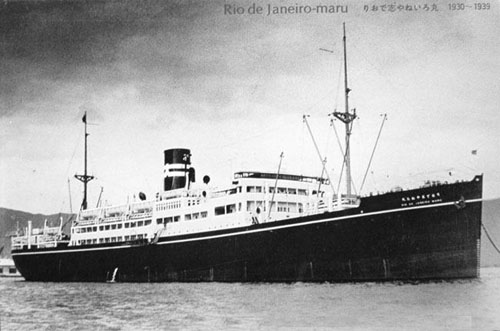
Builder: Mitsubishi Shipbuilding, Nagasaki
Launched: 1929
Length: 450 feet
Beam: 62 feet
Draught 39 feet
Weight: displacement 9,627 tons
Deadweight: 12,000 tons
Engines: Two Mitsubishi Sulzer 6ST68 diesel engines, each producing 6,000hp at 120 rpm
Auxiliary engines: Three 4 cycle engines totalling 1,000hp at 250rpm
Screws: Two
Service Speed: 17.6 knots
Passengers: 60 first, 1,076 third
Resources: Singapore Newspapers - all
Page added July 23rd 2009.
Last updated September 28th 2014.
Return to Ship menu
Return to Picture menu