 Sulzer powered locomotives in Tunisia
CFT Compagnie fermière des Chemins de Fer Tunisiens (1922-1956)
SNCFT Société Nationale des Chemins de Fer Tunisiens (1957-)
| Owner | Engine Model | Builder/Wheel Arrangement/Gauge | Electrical Equipment | Total | Running Numbers |
| Chemins de fer du Tunisiens (CFT) | Four stroke airless injection 8LV21 250hp @ 550rpm | CCM, Paris 1926, Bo-Bo, 3ft 3.3in (1000mm) | Brown Boveri Company | 1 | 2-2 DE 2 |
| Cie des Phosphates | 6LDA25 635hp | FAMH (Marine-Homecourt) 1938, Co-Co, 3ft 3.3in (1000mm) | Jeumont | 2 | 060-DB-1 & 2, later 060-DB-201 & 202(1) |
| Sfax-Gafsa Railway | 6LDA25 610hp | Alsthom, Belfort 1950, Bo-Bo, 3ft 3.3in | Alsthom | 17 | 201 - 217 |
| Chemins de fer de Tunisiens (CFT) | 6LDA25 610hp | Alsthom, Belfort 1951, Bo-Bo, 3ft 3.3in (1000mm) | Alsthom | 30 | SNCFT 040DA1 - 30 |
| Chemins de fer de Tunisiens (CFT) | 6LDA25 610hp | Alsthom, Belfort 1951, Bo-Bo, 4ft 8.5in | Alsthom | 3 | SNCFT 040DA31 - 33 |
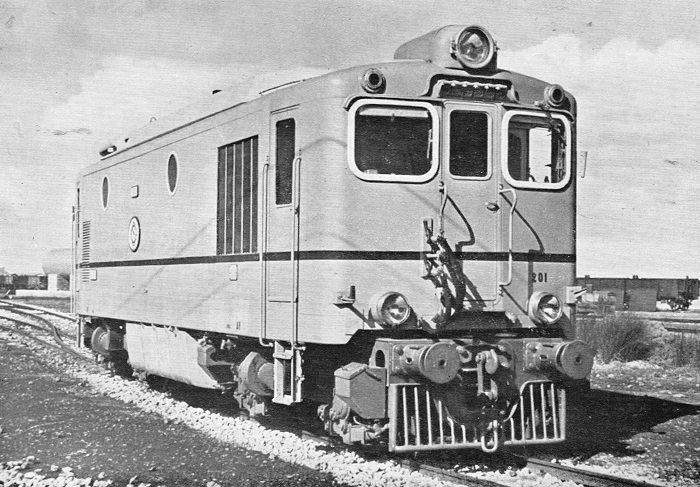
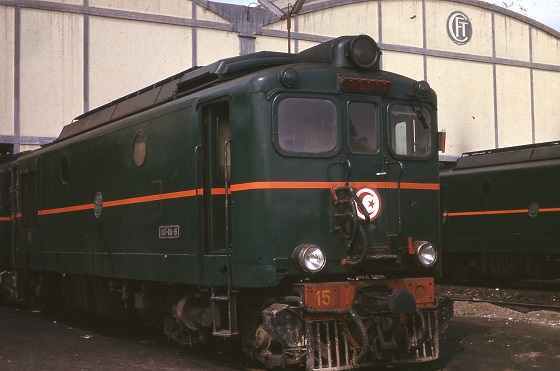
The metre gauge 270 mile Sfax - Gafsa Railway ordered seventeen Sulzer powered Alsthom built Bo-Bo diesel electric locomotives after World War II, with delivery beginning during 1950. The locomotives were numbered 201 - 217.
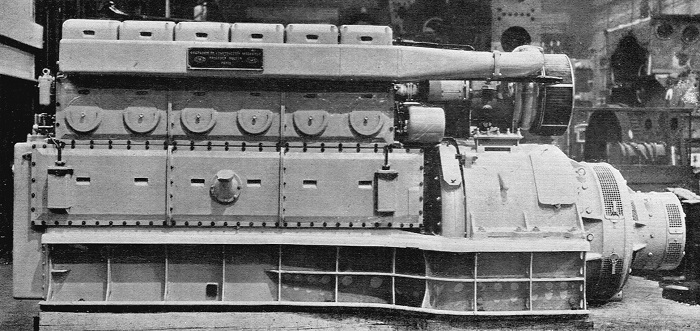
An exhaust gas turbo pressure charger equipped Sulzer 6LDA25 powers the locomotive, the high temperatures, altitude and indifferent working conditions saw the engine set for 610hp at 800rpm. Cylinder size was 250mm by 320mm (9.85in by 12.6in). Construction was of the usual welded crankcase & bedplate which also incorporated the main generator bedplate. All of this was supported by a substantial locomotive underframe. The power units were constructed at the CCM-Sulzer works at St Denis. The engine water & lubricating oil is cooled through two side mounted radiators. The fan has two motors, operating in parallel when the temperature is above 104F (40C). At lower temperatures the motors are in series. In light of the extremely sandy conditions including sandstorms much attention was paid to the filtering of the air in the engine room. A large Tecalemit centrifugal filter along with cell type filters at engine room roof level clean all air entering, additionally the entire engine compartment is slightly pressurised.
Construction took place at the Belfort workshops of Alsthom. The length over buffers beam is 37ft 5in, width is 9ft 3in, height is 13ft. The bogies have a relatively short wheelbase of 7ft 3in, the distance between pivots is 23ft 8in. Starting tractive effort is 30,000lb, the Alsthom-Royer control enables full engine output to be delivered and absorbed at all track speeds from 6.5mph to 43.5mph, the continuous rating being about 16,500lb at 8.7mph. Fuel capacity is 510 gallons. The axleboxes have no guides of the usual pattern, but short thrust arms fitted wirth Silentbloc bushings, an arrangement which does away with possible wear on steel frictional services liable to the ingress of sand. Full weight in working order was 52 tons.
The triple wound main generator was provided by Alsthom, as was the 60kW overhung auxiliary generator, an exciter and four nose suspended force ventilated traction motors. Interestingly the two blower groups were carried outside on the bogie frames, however their air was drawn from the filtered supply in the engine room. Because of dust/sand problems the motors were completely enclosed, whilst air discharged from the blowers was ducted upwards. To enable the Sulzer engine to be shut down whilst running down long grades one of the traction motors could act as a generator to supply current for battery charging and for supplying the auxiliaries.
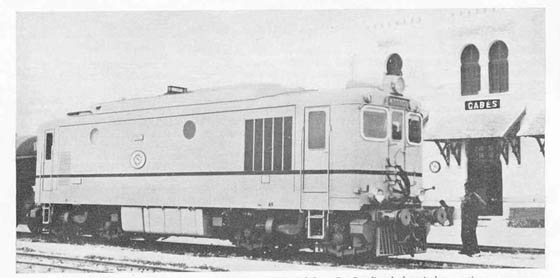
Shortly after their introduction in 1950 monthly mileages of 3,730 miles were being obtained. They were capable of being used in pairs and required to haul 1,485 ton phosphate & mineral over grades of 1 in 104 (0.96%). During 1955 the Sfax - Gafsa line handled about three million ton of freight and three hundred thousand passengers. Ruling grades were 1 in 66, the line summit reached 1,890ft, inland temperatures could reach 120F, whilst humidity at the coast could reach 100% at temperatures of 97F.
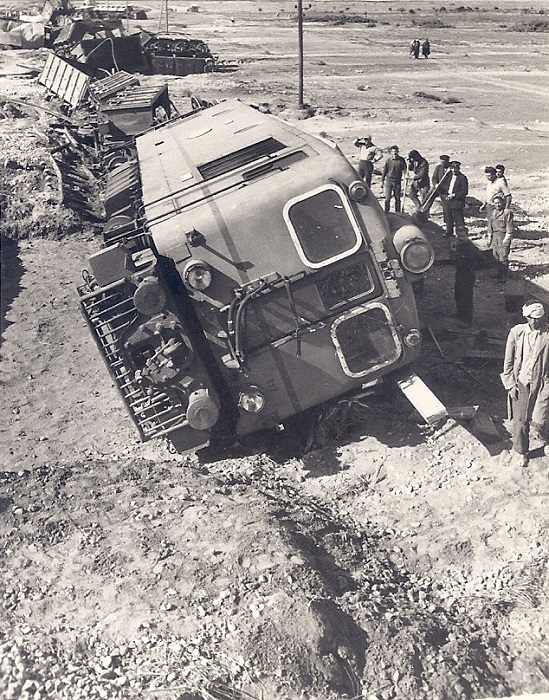
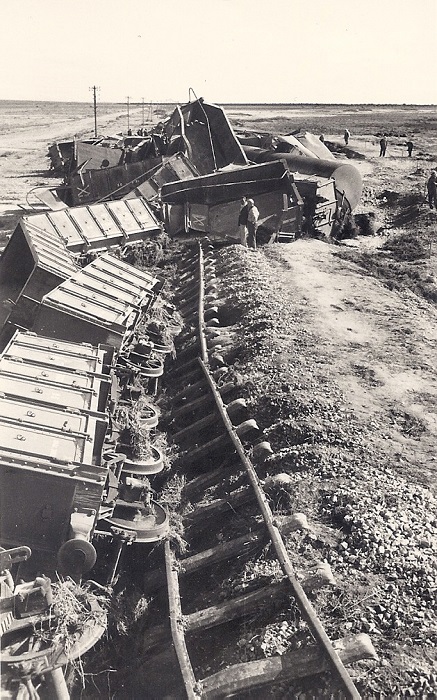
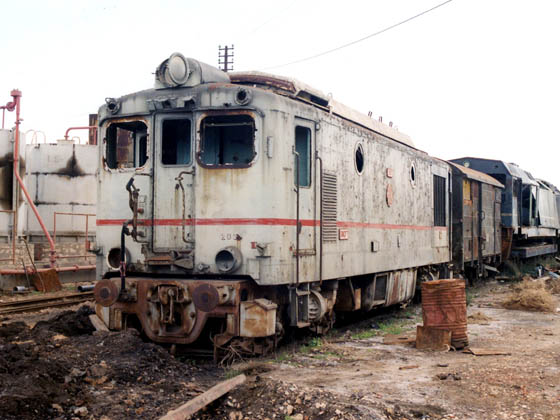

Chemin de fer Tunisiens (CFT).
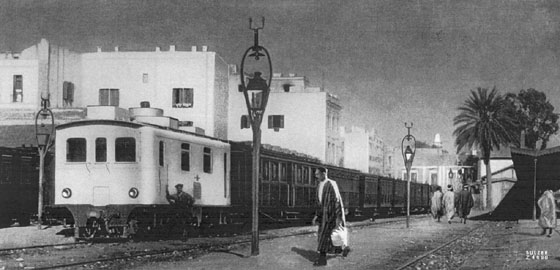
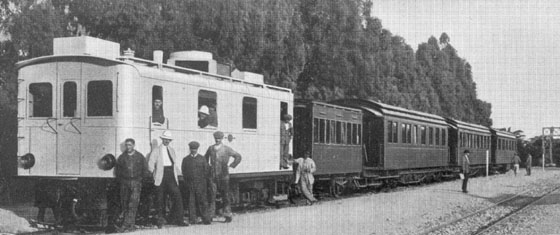
1925 Sulzer 250hp Bo-Bo
After the failure of the Thermolocomotive Sulzer's interested in rail traction focused on smaller diesel engines for use in railcars. The first use of one of these Sulzer engines in a diesel locomotive took place in the locomotive described here.
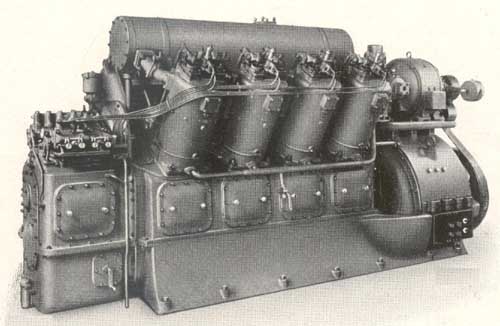
In 1925 the CFT took delivery of a metre gauge locomotive from Compagnie de Construction Mecanique Procedes Sulzer, Paris powered by a Sulzer eight cylinder four stroke airless injection V engine of 250hp at 550rpm installed in a 30ft 9in, 39 ton Bo-Bo locomotive with a top speed of 40mph. The underframe was made of rolled steel sections, the body comprised a steel frame covered in sheet aluminium. The locomotive was fitted with two cabs, as well as all the normal driving controls the cabs also each included a fuel tank which fed a third tank mounted in the engine room roof. The engine drove a direct current dynamo with an output of 145kW with a maximum voltage of 800 volts. A charging dynamo with an output of 25kW maintained the accumulators and powered the roof mounted cooling fan. Four traction motors provided power to the wheels through spur gearing. In starting the locomotive the batteries powered the dynamo which then acted as a motor to turn the engine over. A Clayton vacuum brake controlled brakes on all wheels. Vacuum was obtained using an electric motor taking power from the accumulators.
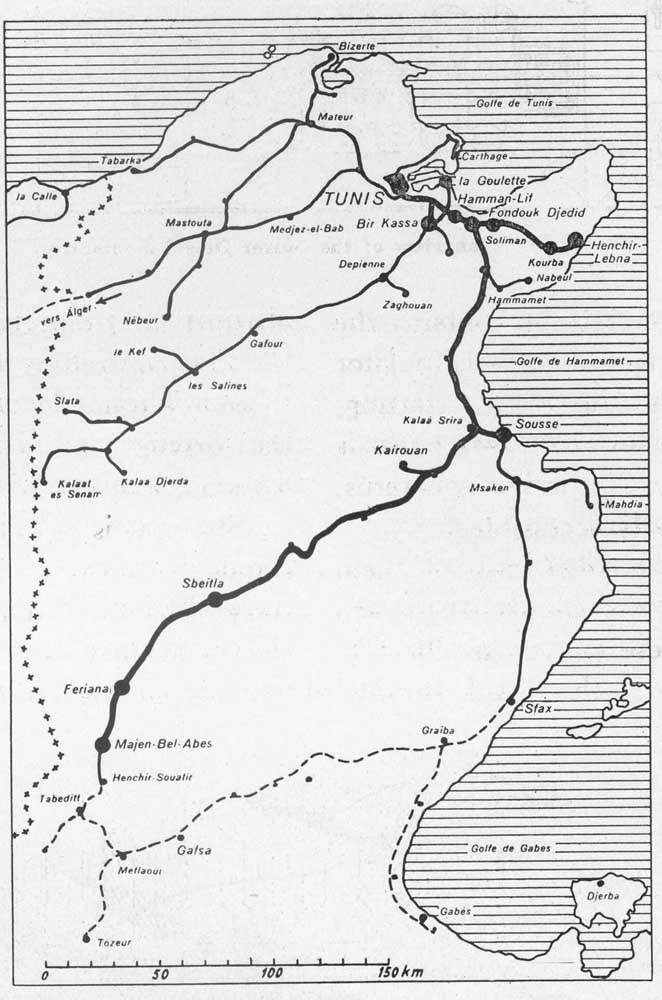
With a load of 80 tons the specifications called for a speed of 37.5mph on the level, 23mph on a gradient of 1 in 100 and 12mph on a gradient of 1 in 70. On the latter gradient it was also required to continuously pull a load of 124 tons but with no speed specified. Initial trials were made at the Sidi-Fath-Allah railway workshops using the 80 ton load. Trials then moved to the mostly level mile Tunis - Hamman-Lif route where four runs were made totalling about 85 miles. In the first test the train weighed only 73.1 tons, this was made up to 80 tons for the remaining three runs. The air temperature this day was 77F, in the cab it reached 86F and in the roof area of the engine room it was 124F. Following this the train made a lengthier run, to Sousse on the coast, then inland 165 miles through the hill country to Majen-Bel-Abes. Gradients on this route included some as steep as 1 in 100. Total journey time was twelve hours. Testing also took place on the Fondouk-Djedid to Henchir-Lebna line east of Tunis. This line included gradients of 1 in 65 & 1 in 55, the latter gradient was used for testing the brakes on the downhill run. From a speed of 28.5 mph using the emergency brake the train was brought to a stand in 189 yards. Using only the automatic safety device the train was brought to a stand in 400 yards. In all cases the locomotive met its required pulling requirements on the gradients.
Speed trials were completed on a different date between Bir-Kassa & La Goulette, the first tests were not successful due to a donkey on the line at one location and missing rails elsewhere (the line was under repair!). The next day the tests went smoother though a strong wind affected the results, though when averaged between the east & west runs the locomotive fulfilled its requirements.
Further tests on the Tunis - Hamman-Lif route required the working of the regular diagrams for one month handling six trains each day in both directions, giving a daily mileage of 125 miles.
The locomotive ran on all lines of the CFT and also occasionally on the Sfax - Gafsa line. However it would see most service in suburban passenger traffic between Tunis & Hamman-Lif, a distance of 10.5 miles. It also operated on pick up freights and shunting in the Tunis area. By 1950 it had run about 245,000 miles, a number of problems were experienced with its electrical system. By 1955 this locomotive was held in reserve.

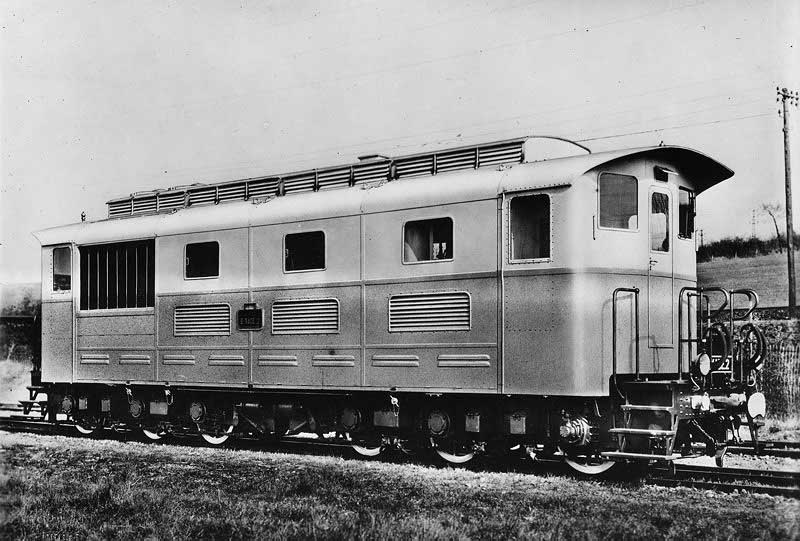
1938 Sulzer 735hp Co-Co 'Phosphates'
The CFT obtained in September 1945 & March 1946 two 1938 built locomotives which were initially acquired by the Algerian company Cie des Phosphates de Constantine. In Algeria these two locomotives had worked on the lines of the Cie. des Phosphates around Tebessa, hauling 500 ton trains up 1.25 miles of 1.5% grade and 150 tons of empties up lengthy 3% grades. The locomotives were taken over by the Algerian Railways during the early part of World War Two.
After sale to the CFT, Tunisia they were used on freight trains in the Tunis area, running up mileages of about 35,000 miles per year. Their low top speed of 31mph (37mph?), traffic availability & railway rehabilitation kept their mileages low.
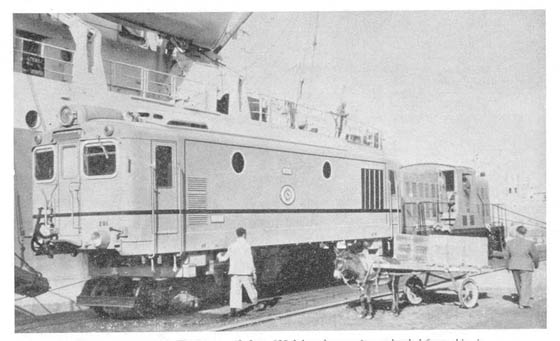
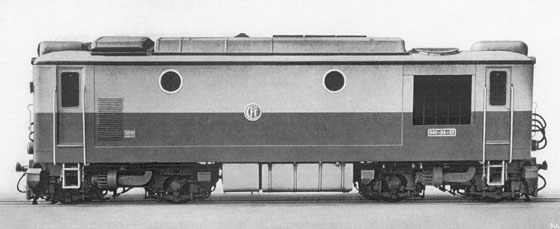
Alsthom built 'outre-mer' standard design
The Chemin de fer Tunisiens had taken delivery of thirty three of the Alsthom built, Sulzer powered 'outre-mer' standard design, as described in the section above. The locomotives were numbered SNCFT 040DA1 - 33. These locomotives had a slightly smaller fuel tank - 498 gallons - than the Sfax locomotives.
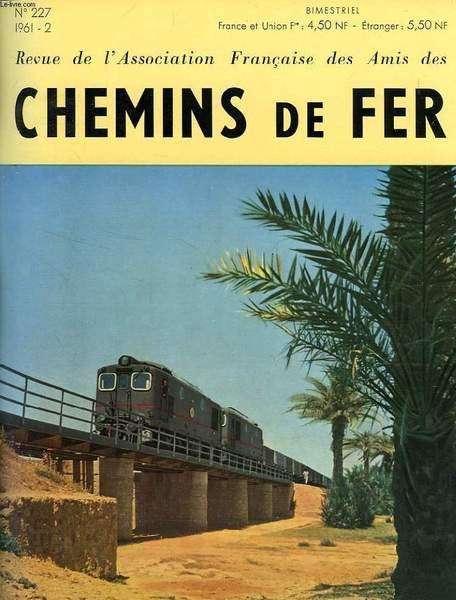
The information below comes from Eljas Pölhö as submitted to the World Diesel Locomotive newsgroup. It provides an insight into the early diesel locomotives in Tunisia.
CFT Compagnie Fermière des Chemins de Fer Tunisiens (1922-1956)
SNCFT Société Nationale des Chemins de Fer Tunisiens (1957-)
1.435m gauge:
040 DA 301-304 Baldwin 73216-219 11.1946 (A1A-A1A de) re # 040 DA 34-37 in 1952
040 DA 34-37 (see above), to CFM Morocco (sold in 1958, delivered 2 in 1958, 2 in 1959)
1.000m gauge:
2.2-DE-1 Bo-Bo de DEVA 21 1923 (trials in Sweden on 0.891m gauge; withdrawn in 1945)
2.2-DE-2 Bo-Bo de CEM - 1926 (withdrawn in 1962)
060 DB 1, 2 Co-Co de FAMH - 1938 (1949 ex-SNCFA 6XADE1, 2; already hired in 1946-49)
060 DB 201, 202 (same as above, renumbered in 1952?)
1.000/1.435m gauge, altered in workshops as required:
040 DD 1-33 Bo-Bo de Alsthom 1950-1952, re # 040DA1-33
040 DA 1-33 (same as above, re # in 1952) (of these 1-4 = 1950, 5-26 = 1951, 27-33 = 1952)
040 DD 101-116 Bo-Bo de Alsthom 1958
4039 Bo-Bo de BLH/Whitcomb 61269 1954 (1968 ex- US Army, Model RS4TC)
There were no 060DC331-333 (delivered to Morocco)
AFAIK -DE- was only used after 1966, when some of the Gafsa 400s became -DE- and some -GE-
040-DG-41 to 49 Bo-Bo de, Traction Export Group 1966-67 (probably Alsthom)
040-DL 231-240 Ganz-Mavag Model DHM-11 # 1834-1843/1980 (1.000m gauge)
040-DO 281-285 Ganz-Mavag Model DHM-13 # 2022-2026/1984 (1.435m gauge)
040-DO 321-335 Ganz-Mavag Model DHM-14 # 2027-2041/1984 (1.000m gauge)
Compagnie des Phosphates et du Chemin de Fer de Gafsa (1.000m gauge)
201-217 Bo-Bo de Alsthom - 1950 (1966 to SNCFT 040 DF 201-217)
301-303 Bo-Bo de Whitcomb 61067-069 8.49 (sold to industry or cannibalized by 1966)
304-309 Bo-Bo de Whitcomb 61070-075 12.49 (sold to industry or cannibalized by 1966)
310-314 Bo-Bo de Whitcomb 61076-080 1.1950 (sold to industry or cannibalized by 1966)
351-354 B dh Decauville 1955 (1966 to SNCFT 352-354; 351 w. by then)
401-404 Bo-Bo de GE 34574-577 6.62 (1966 to SNCFT 040 DE/GE 401-404)
405-408 Bo-Bo de GE 35687-690 7.65 (1966 to SNCFT 040 DE/GE 405-408) some seen as -DE-, some as -GE-
501, 502 Co-Co de EMD 28354-355 3.64 (1966 to SNCFT 060 GR12-501, 502)
503, 504 Co-Co de EMD 30326-327 7.65 (1966 to SNCFT 060 GR12-503, 504)
505, 506 Co-Co de EMD 31867-868 9.66 (1966 to SNCFT 060 GR12-505, 506)
Based on articles in Diesel Railway Traction, November 1950, November 1951 & September 1955.
Sulzer Technical Revue #4 1927
Page added December 9th 2002
Last updated March 8th 2025.
Return to Sulzer page
Return to site menu