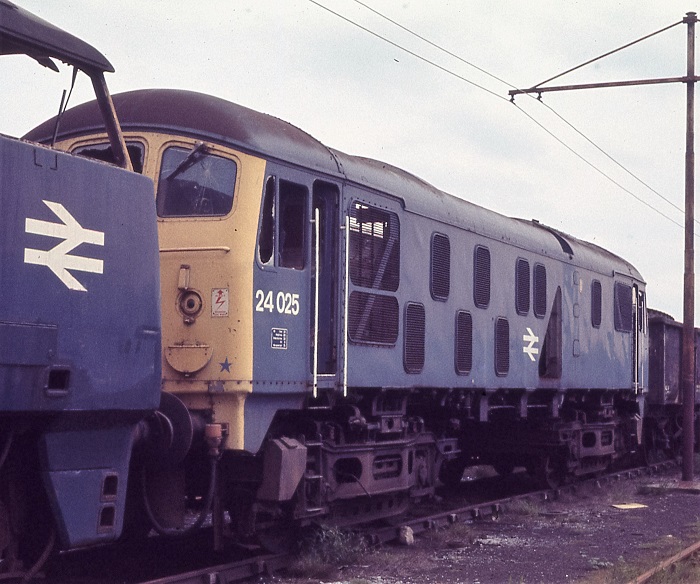
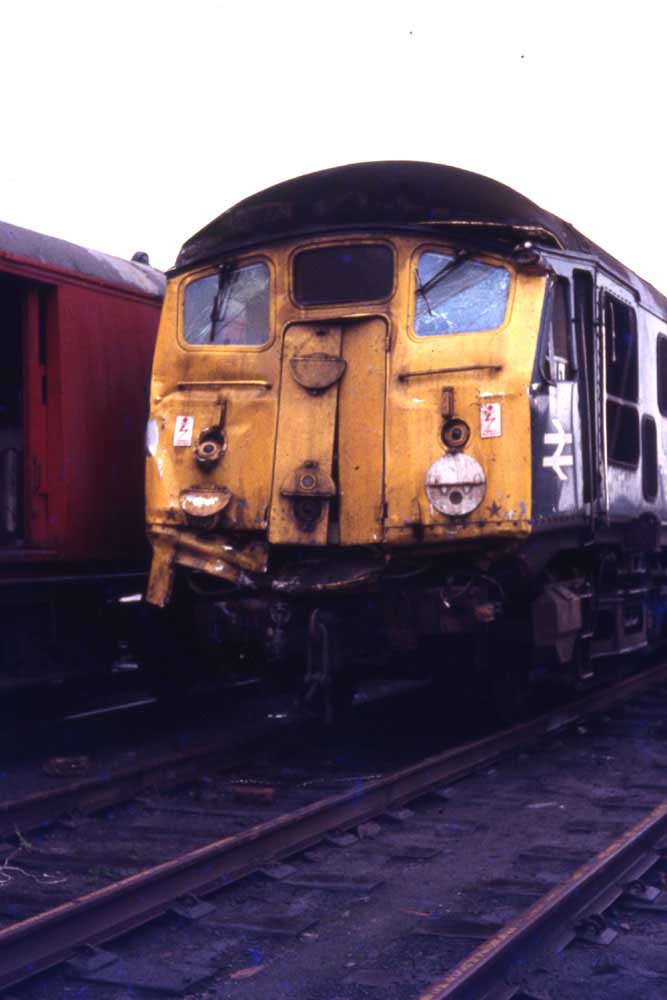
A snapshot of 24025 at Swindon Works on June 12th 1977, a month later the remains would be broken up. This view clearly shows the five grills on the top row, the split level frost screen and the headboard/disc brackets on the No.1 cabfront. Does this suggest that a switch of bodies was made between 24025 and one of the early series Class 24s? Who knows - see below.
The sixteen year three month career of D5025/24025 saw allocations to Eastern Region and London Midland Region depots.
Built Derby Locomotive Works.
1959 - 1969: Four upper and four lower air filters on non-BIS side, three upper and four lower on BIS side.
1969 - 1976: Five upper and four lower air filters on non-BIS side, four upper and lower on BIS side.
Full size fuel & water tanks (shortened water tank added later).
Circular gauge added to fuel tank (1969).
Gangway doors never removed.
Withdrawn with neither cab roof having ventilators.
Roof modification (above generator/brake cubicle): original style retained until withdrawn (raised panels).
Time between last Classified repair and withdrawal: 31 months.
Time between withdrawal & scrapping: 18 months.
Allocations
The frames for D5025 were laid down during the early summer of 1959 at Derby Works. D5025 was new to Ipswich (32B) on October 16th 1959. Further transfers were:
July 1961 to Willesden (1A)
December 1965 to Bletchley (1E)
April 1966 to London Division (D01)
July 1966 to Birmingham Division (D02)
August 1967 to Stoke Division (D05)
May 1973 to Crewe
May 1973 to Longsight
May 1975 to Crewe
July 6th 1975 stored serviceable
January 31st 1976 - withdrawn.
Renumbered May 1974.
24025 was stored at Reddish from July 1975 until January 1976, when it was moved to Crewe and stored there until January 10th 1977 when it was forwarded to Swindon and broken up there by the end of July 1977.
Movement: 24025/29/33/34 06.45 Crewe - Swindon Works January 10th/11th 1977 hauled by 25269.
Works Visits
Works visits (records incomplete).
Noted Stratford Works January 1960.
Noted Derby Works August 1961.
Noted Derby Works January, February (collision damage) & August 1963.
Noted Derby Works October 1970.
Noted Derby Works December 1971.
Noted Derby Works April - June 1973 (collision damage).
Highlights
1959
D5025 was new from Derby Works during October as part of the second Derby order D5020 - D5029. D5025 officially entered service on October 16th being allocated to Ipswich (32B).
1960
Noted Stratford Works January 1960.
On August 6th D5025 was noted at Colchester with a seven coach service, possibly the 13.40 Clacton - Liverpool Street.
1961
D5025 was transferred to Willesden (1A) during July 1961, and was noted at Derby Works during August.
1962
On August 12th there were 46 locomotives stabled at Northampton including ED4, 12046 & D5020, D5025 & D5029.
On the afternoon of November 3rd D5004, D5010, D5025, D5035, D5076, D5134, D5143, & D5146 were all noted at Euston, D5025 would later work a Euston - Northampton service.
On December 9th D5025 was noted at an unknown depot with considerable damage to the No.2 cab, after reportedly running into coaching stock in fog.
1963
D5025 was noted at Derby Locomotive Works during January & February with collision damage to the No.2 cab, which is believed to have occurred early in December 1962 after the locomotive collided with some carriages in fog.
On the morning of June 26th D5025 was noted at Willesden.
1964
On the afternoon of May 2nd D5025 was light engine at Rugby.
On June 20th D5025 worked the 17.27 Birmingham New Street - Rugby.
On July 1st D5025 was at Rugby with the 4S68 14.18 Camden - Sighthill freight.
On November 1st Longsight was host to 48 locomotives, 17 steam locomotives (three withdrawn) and 31 diesels & electrics including D5025, D5034, D5136, D5139, D5142 & D5146.
1965
D5025 was noted on Crewe North shed on February 14th.
On April 16th a very ex-works D5025 (could be D5026?) was noted at Carlisle Kingmoor: small yellow ends, curved upper corners, frame level stripe did not extend around cab front.
D5025 visited Littlehampton with an excursion from Hemel Hempstead on May 22nd.
On July 7th D5025 worked the 21.01 Euston - Bletchley.
Late in the year, during December D5025 was transferred to Bletchley (1E).
1966
During April D5025 became part of the London Division (D01) allocation, then moved northwards in July to the Birmingham Division (D02).
1967
D5025 made the move north to the Stoke Division (D05) in August as part of the big transfer of the Class 24s to the Crewe/Stoke/North Wales area.
Noted at Stoke on Trent on the afternoon of November 13th were D5005 (light engine), D5025 (up parcels), D5035 (down freight) with 75046, 75047 & 75052 lying condemned at Stoke shed.
1970
On the afternoon of April 11th 5025 was at Crewe with a down freight.
5025 was noted Derby Works during October.
On December 30th 5025 & 5142 were noted at Cheadle Hulme on the Stoke line.
1971
Noted Derby Works during December.
1973
Noted Derby Works April - June for collision repairs, from damage recieved in the Birkenhead area early in February 1973, whilst in Works it was transferred to Crewe and then Longsight in May with 24026/27/29.
5025 was the Manchester Victoria banker (T42) on July 27th & 30th.
5025 was the Manchester Victoria banker (T42) on August 2nd & 3rd.
On September 1st 5025 was noted at Stockport with passenger stock.
5025 was the Manchester Victoria banker (T42) on September 19th, 20th, 22nd, 25th & 26th.
5025 was the Manchester Victoria banker (T42) on October 15th, 16th & 17th.
At about 5pm (?) on November 13th 5025 was noted at Liverpool Lime Street with a down van train. 5025 was the Manchester Victoria banker (T42) on November 22nd & 23rd.
5025 was the Manchester Victoria banker (T42) on December 2nd & 13th.
1974
5025 was the Manchester Victoria banker (T42) on January 2nd, 9th, 10th & 11th.
5025 was the Manchester Victoria banker (T42) on April 23rd & 24th.
Noted at Manchester Victoria on August 5th were 24020, 24024, 24025, 24027 & 24035.
On September 6th 24025 was noted shunting at Stockport.
On September 10th 24025 was noted at Manchester Victoria with a down freight.
On September 20th 24025 was on banking duty at Manchester Victoria.
At about 6pm on December 17th 24025 was noted at Manchester Victoria with an up freight. On December 19th 24025 was noted at Manchester Victoria with the 6J05. Class 24/25s stabled at Newton Heath depot at 3.30pm on December 20th incuded 24022/25/52 and 25042/54, 25112, 25291/298.
1975
24025 was noted at Manchester Victoria on January 17th (Class 24s noted at Manchester Victoria on this day included 24021, 24023, 24025, 24026, 24027, 24033 & 24048). 24025 was noted at Manchester Victoria on January 18th & 19th. On January 22nd 24025 worked a tool van from Halliwell to Newton Heath.
On February 5th 24025 was noted at Agecroft. On February 6th & 7th 24025 was noted at Manchester Victoria. On February 12th & 13th 24025 was noted at Manchester Victoria. 24025 was the Manchester Victoria banker (T42) on February 14th. 24025 was noted at Manchester Victoria on February 15th.
On March 5th & 9th 24025 was noted at Manchester Victoria.
24025 was the Manchester Victoria banker (T42) on March 20th.
24025's last transfer was to Crewe in May, by July it was one of many taken out of service and placed in store.
1976
24025 was noted at Crewe depot(?) on January 24th.
24025 remained in store until finally withdrawn at the end of January, continuing to be stored at Crewe.
1977
On January 10/11th 24025/29/33/34 formed the 06.45 Crewe - Swindon Works hauled by 25269. By July the scrappers at Swindon had finished their work on 24025.

That a machine is simply the sum total of its parts is clearly evident in the construction of a steam, diesel or electric locomotive. Many interchangeable components make up a locomotive, and at the times of a Works visit these worn parts are removed and replaced by similar new or repaired items. At these times the identity of a locomotive can become fragmented, in particular with steam locomotives, whose main components - the boiler and the frames don't carry an easily visible number which might be used as a method of identification for the whole locomotive.
For BR's diesels and electrics the body is usually the largest and most visible 'component' and the most obvious one to stick a number on which will follow it through its career. Of course from time to time identities may get mixed up, usually when locomotives are in for a heavy repair, especially at the stage when the repaired locomotives are receiving a fresh coat of paint and are having their numbers added.
D5025/24025 seems to have been one of those locomotives that underwent a most severe identity crisis.
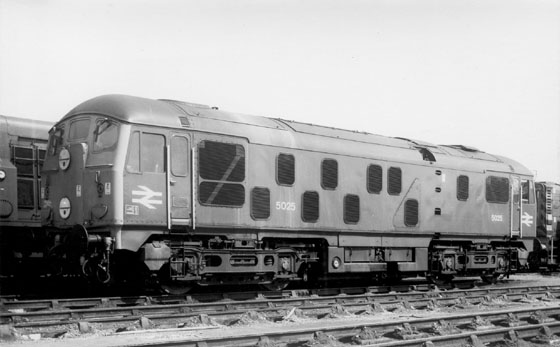
From the collection of Real Photographs Co Ltd (their ref R8253) comes this view of the problematic 5025 with the body style that is more typical of one of the earlier Derby built machines. This view is at Crewe sometime in 1969. If one of the early machines was at Derby alongside D5025 a numerical switch could have taken place. The numbering on the above view and the reasonable condition of the paintwork suggests 5025 must have been at Derby Works sometime during 1968 or very early 1969. There is no suggestion in the photograph that the 'D' prefix has been painted over as happened so frequently in the post-steam era.
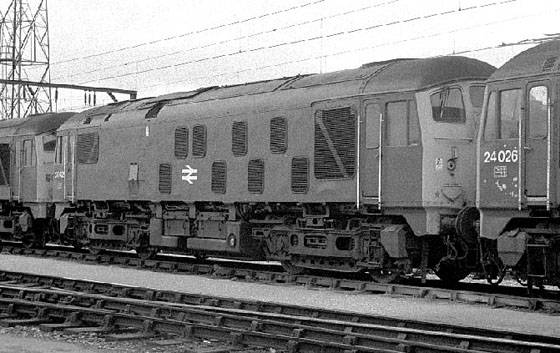
D5025 was part of the second Derby built batch D5020 - D5029 and so carried with it some significant changes that clearly made it stand out from the first twenty built at Derby. As built the early members of the batch carried on one side five grills on the upper body panel and four grills on the upper body panel of the opposite side. Unfortunately in those first twenty locomotives this was not a uniform standard, some carried one grill less on each side and this was carried through to D5020 - D5029!
As a young spotter in the early 1970's these fine detail nuances would have been completely lost on yours truly when we came across 5025! However a visit to Swindon Works during June 1977 found 24025 parked in an uncluttered spot leading to the typical photograph being taken. Which like most was filed away for a rainy day viewing. And eventually a close examination of the slide showed that 24025 was not all that it should be.
Unlike its sisters in the D5020 - D5029 series, 5025/24025 in later photographs carried the extra ventilator grills found on each side, normally associated with the D5000 - D5019 series. It also carried on one side only one of the split frost screens originally fitted to D5000 - D5006. And perhaps the strangest of all is that both cabs carried the headboard brackets that were fitted to D5000 - D5014 & D5017 when they operated on the Southern Region. And thrown into the mix was a photograph from the Real Photograph Co. showing all these unusual features in a photograph taken back in 1969!
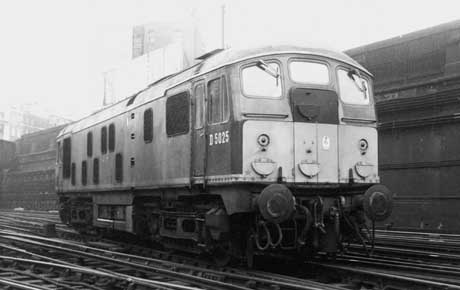 | A view which supports the identity change for 5025/24025 is this early 1960's view of D5025 at Euston. The features are typical of the D5021 - D5029 locomotives, D5025 even has the two-rung steps on the bogie. As expected there is no evidence of the Southern Region headcode brackets. (A similar view of D5025 at Willesden taken during July 1964 from the C Bush collection showing the same side agrees with the view here). Photograph courtesy R Simpson, collection of Graham Wareham. |
Since the complete photographic option is not yet currently available to me its down to a little bit of sleuthing to see if the mystery with D5025/24025 can be clarified. At this point a detailed survey was originally contained within this webpage of the detail differences of D5000 - D5019 and how these changes may have affected D5025/24025. However a photograph at Derby Works taken during 1969 of a locomotive purportedly numbered as 'D5025'came to light and answered the question with a great deal of certainty.
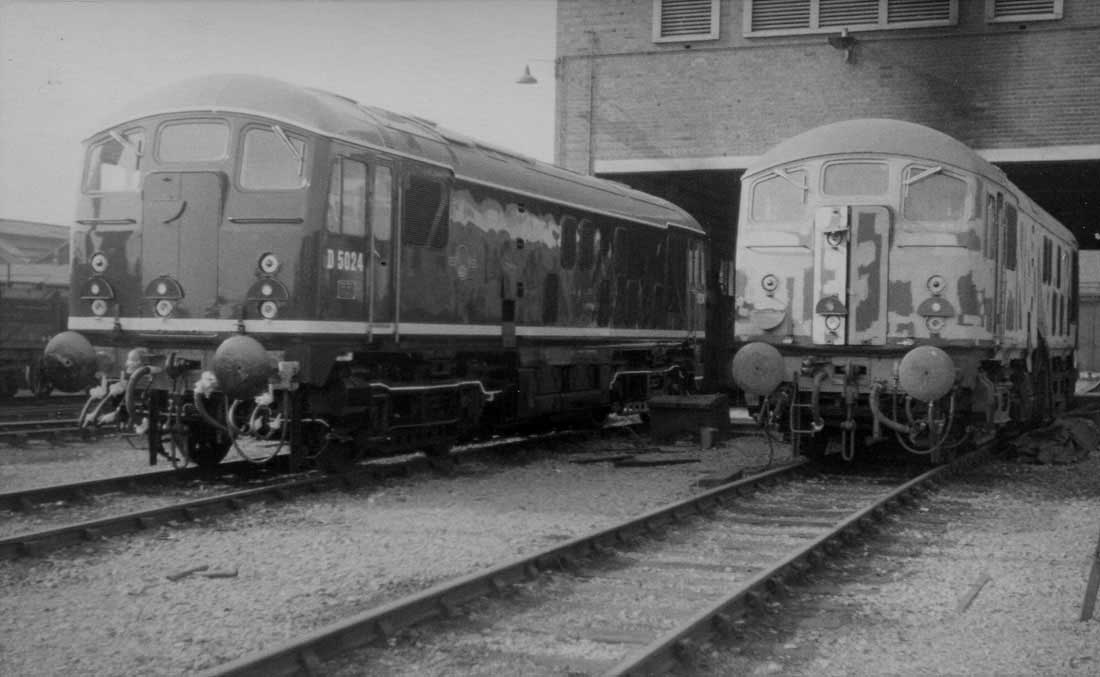
The supposition that maybe D5005 and D5025 swapped identities whilst they were both at Derby Works during 1969 now appears to be what actually happened. The photograph below is taken at Derby during 1969 and show a Class 24 numbered as D5025, but the livery is that of the two-tone green style which was only carried by a few members of the Class and D5025 was not one of them. And since the livery was carried by D5005 and the photograph show a locomotive with the characteristics of the D5000 - D5019 batch it therefore draws the conclusion that essentially the view below is of D5005.
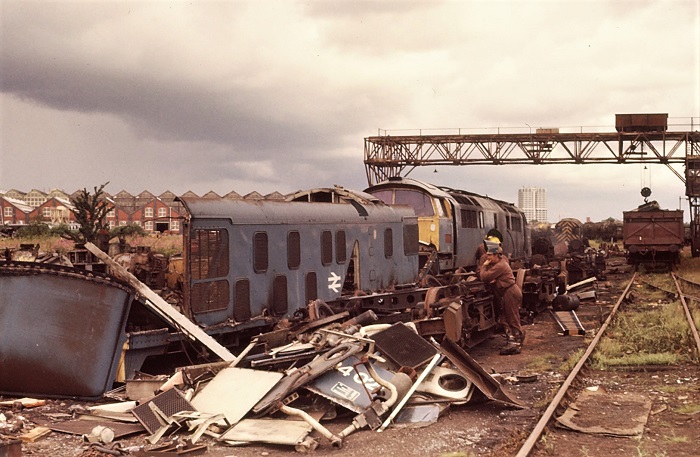
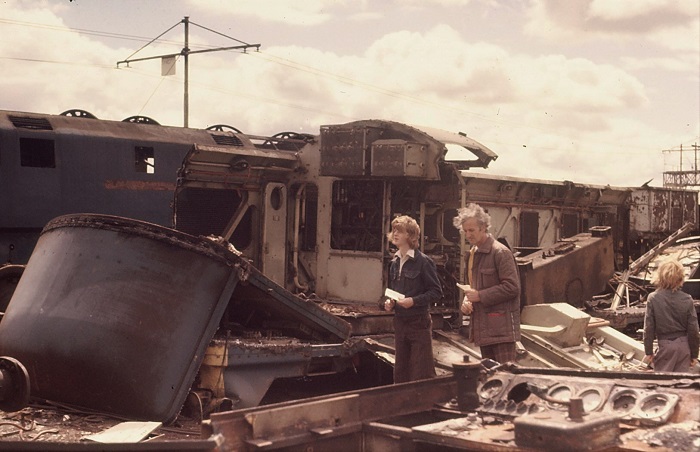
Of course it would be interesting to see photographs of the locomotive that was broken up at Derby represented by D5005 - now made possible by the view at the bottom of this page. Presumably this was 'D5025', possibly with accident or fire damage or general poor condition. At this time there were already a number of Class 24s in store, with the first batch built (D5000 - D5019) being hitlisted, so it was of no surprise to find D5005 withdrawn at this time.

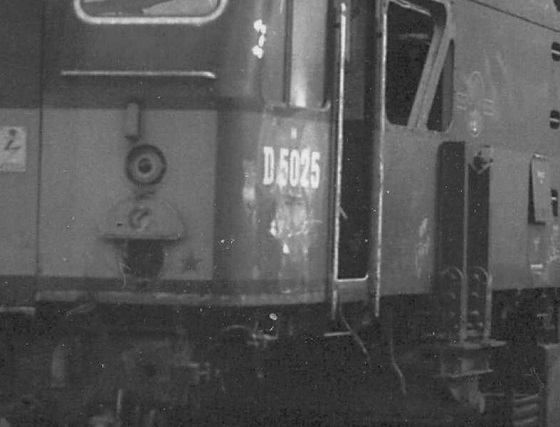
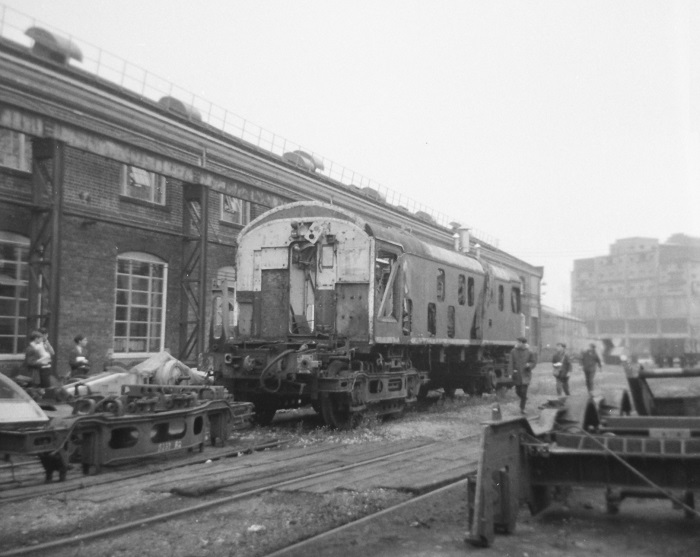
Additionally the Railway Observer notations for Derby Works during 1969 make reference to 'D5005':
March 29th 1969 - Klondyke Sidings: 5005 shell on bogies, neither of which carried this number (sic)
June 15th 1969 - in the yards were the cabless remains of a Class 24, probably 5005 were noted
September 29th 1969 - Outside new paint shop remains of 5005
November 2nd 1969 - Outside new paint shop 5005 (withdrawn).
Resources: additional research provided by Mark Sutton and Ian Osborne.
flk 0626
Page added September 15th 2007.
Last updated September 5th 2026.
Back to 24024
Forward to 24026