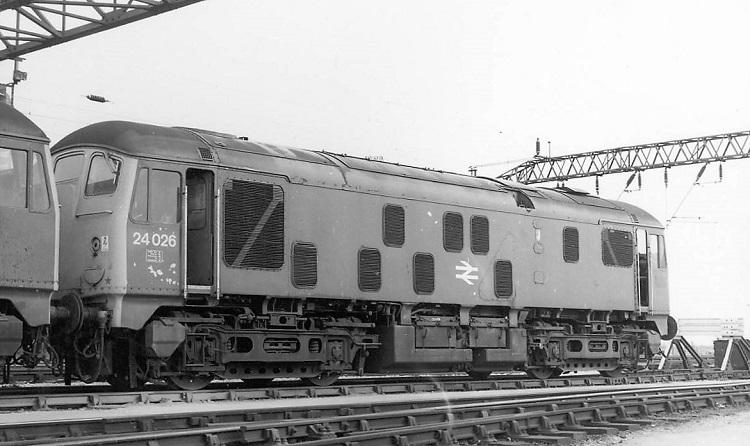
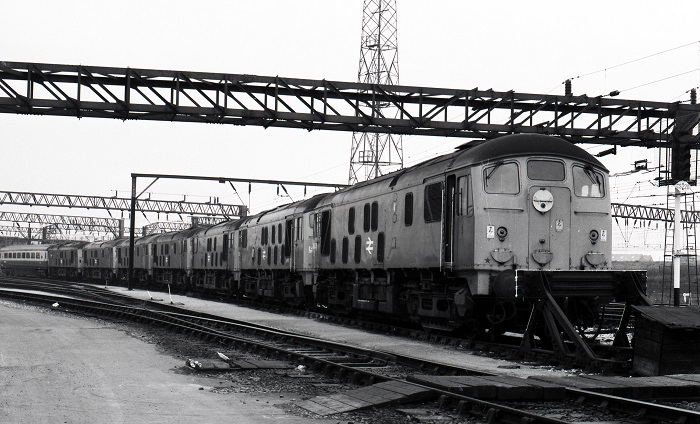
The fifteen year ten month career of D5026/24026 saw allocations to Eastern Region and London Midland Region depots.
Built Derby Locomotive Works.
Full size fuel & water tanks (shortened water tank added later).
Four upper and four lower air filters on non-BIS side, three upper and four lower on BIS side.
Gangway doors not removed (No.2 end only).
Time between last Classified repair and withdrawal: ?? months.
Time between withdrawal & scrapping: 17 months.
Allocations
The frames for D5026 were laid down during the summer of 1959 at Derby Works. D5026 was new to Ipswich (32B) on October 22nd 1959. Further transfers were:
September 1960 to Stratford (30A).
November 1960 to Camden (1A) on loan, made permanent December 1960.
December 1965 to Bescot (2F).
April 1966 to Birmingham Division (D02).
August 1967 to Stoke Division (D05).
May 1973 to Crewe.
May 1973 to Longsight.
March 1974 to Crewe.
January 1975 to Longsight.
May 1975 to Crewe.
July 6th 1975 stored serviceable.
August 10th 1975 - withdrawn.
Renumbered March 18th 1974.
24026 was stored at Reddish from July 1975 until August 1975, it was then moved down to Crewe, remaining here until October 20th 1976 when it was forwarded to Swindon and broken up there during the first week of January 1977.
Movement: 24026/31/44/76 Crewe - Swindon October 20th 1976 by 25245.
Works Visits
Works visits (records incomplete).
Noted Derby Works February 1961.
Noted Derby Works February & March 1962.
Noted Derby Works April 1963.
Noted Derby Works August - October 1964.
Noted Derby Works September 1966.
Noted Derby Works February 1971 (ex-works, blue/yellow livery).
Noted Derby Works August 1973.
Noted Derby Works August - October 1974 (continuous?).
Highlights
1959
D5026 was delivered from Derby Works during late October.
Condition original: green livery with frame level stripe, full size fuel & water tanks, ridge sided sandboxes, two-rung bogie mounted footsteps.
1960
After almost a year at Ipswich D5026 moved to Stratford (30A) during September. Two months later D5026 had been transferred to Camden, remaining there for the next five years.
1961
On July 8th D5026 worked the 20.01 Euston - Tring.
1962
D5026 was noted at Derby Works during February & March and recieved a repaint before outshopping.
D5026 worked the 16.52 Bletchley - Euston on July 28th.
On the afternoon of Sunday November 11th D5026 & D5034 along with D2909 & 2911 and thirty active main line steam locomotives (no steam shunters) were stabled at Rugby shed.
1963
On the morning of June 26th D5026 was noted at Euston.
On the evening of September 1st D5143 & D5026 worked a Euston - Bletchley empty coaching stock.
1964
On January 12th D5026 was stabled at Stockport Edgeley.
On April 25th D5026 worked the 3K07 11.27 Euston - Crewe parcels.
On May 6th D5026 worked the 10.11 Birmingham New Street - Euston.
Noted at Camden on the morning of July 14th were D5026, D5028, D5035, D5073 & D5076.
D5026 was noted at Derby Works from August to October.
1965
With the WCML electrification well under way a gradual move northward of the Class 24s took place with D5026 moving to Bescot (2F) in December.
1967
After twenty months allocated to Bescot/Birmingham Division D5026 moved to the Stoke Division during August.
Condition August: blue livery, small yellow warning panel, squared upper corners, full size fuel tank, shortened water tank, ridge sided sandboxes, two rung bogie mounted footsteps, hand/footholds present, valencing fitted; non-BIS side BR double arrow on driver's cabside, number located on bodyside and 2nd man's cabside.
1969
On the evening of May 2nd 5145 & 5026 were light engines at Stoke on Trent.
1970
On the morning of June 6th 5026 was at Crewe with a down freight.
At noon on Sunday September 20th 5026, 5029, 5042, 5049, 5077 & 5142 were stabled at Crewe Diesel depot.
1971
Noted at Derby Works during February was 5026.
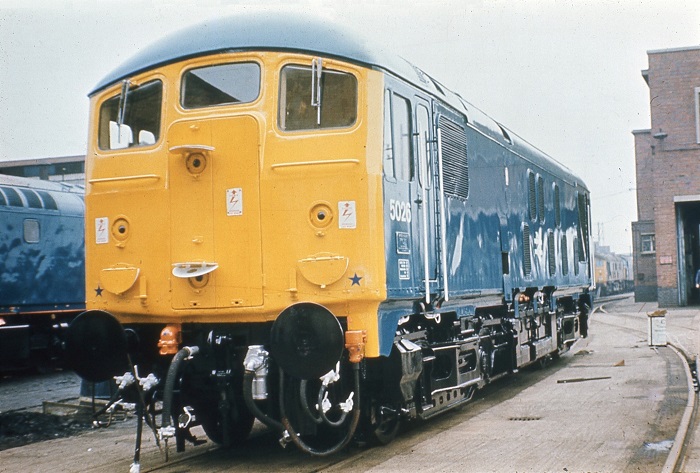
Condition February: blue/yellow livery, gangway doors present, full size water tank, shortened fuel tank, no blanking plates, hand/footholds plated over, two-rung bogie mounted footsteps, ridge sided sandboxes.
On the morning of March 15th 5026 was noted at Stoke-on-Trent with two brakevans.
1972
On the afternoon of April 12th 5026 passed Basford Hall with an up freight of tippler wagons.
1973
During May 24026 moved to Longsight and was noted at Derby Works during August.
The 08.45 Holyhead - Euston was normally a Class 40 working, on May 26th it was worked by 5026 to Crewe, with the return working, the 10.20 Euston - Llandudno worked forward from Crewe by 5044 & 51xx.
At about 6pm on June 5th 5026 was noted passing Park (Manchester) with a down freight.
5026 was the Manchester Victoria banker (T42) on August 30th.
At about 6pm on September 19th 5026 was noted passing Manchester Victoria with an up freight, the banker this day was 5025.
5026 was the Manchester Victoria banker (T42) on October 9th, 10th, 12th & 19th. At about 7am on October 24th 5026 was noted passing Manchester Victoria with a down freight.
At about 7am on November 6th 5026 was noted passing Ordsall Lane with an up van train. 5026 was the Manchester Victoria banker (T42) on November 6th, 8th & 9th.
1974
At about 7.45am on January 11th 5026 was noted at Liverpool Lime Street on a down van train.
After ten months at Longsight 24026 was transferred to Crewe in March and then spent August, September & October at Derby Works.
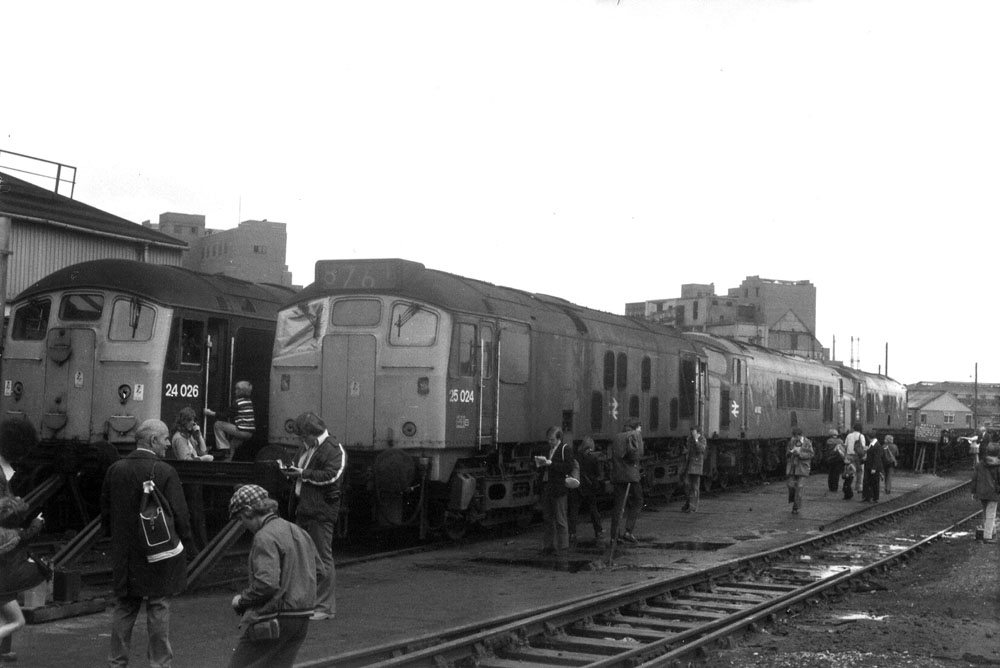
Whilst under repair at Derby Works the No.1 cab front gangway doors of 24026 were sheeted over. One wonders about the expense incurred in such repairs when within twelve months the locomotive would be taken out of service and withdrawn. It may have been difficult to anticipate future traffic patterns but certainly the completion of the WCML eletrification was drawing near and the introduction of the HST passenger trains was also not far off. Both would lead to the cascading of locomotives and the withdrawal of surplus machines. And recent history had certainly shown that the Class 24s were expendable.
1975
24026 returned to Longsight during January.
24026 was noted at Manchester Victoria on January 17th (Class 24s noted at Manchester Victoria on this day included 24021, 24023, 24025, 24026, 24027, 24033 & 24048). On January 21st, 27th, 28th & 30th 24026 was noted at Manchester Victoria.
At about 7am on February 6th 24026 was noted passing Manchester Victoria with an up van train. On February 13th 24026 was noted at Manchester Victoria. On Sunday February 16th three pairs of Type 2s as light engines were noted pasing through Manchester Victoria: 25318 + 25147, 24021 + 24027 and 24020 + 24026, all presumed to/from permanent way duties.
On May 12th 24026 was noted at Manchester Victoria with the 8X64.
24026 was transferred back to Crewe during May. The summer of 1975 brought the massive withdrawals to the Class 24 fleet with 24026 stored in early July followed by final withdrawal in August.
Condition final: blue/yellow livery, gangway doors sheeted over No.1 cab, gangway doors present No.2 cab, full sized water tank, shortened fuel tank, ridge sided sandboxes, two-rung bogie mounted footsteps, no blanking plates, hand/footholds plated over.
flk 0721 (1)
Page added February 25th 2000.
Last updated September 5th 2022.
Back to 24025
Forward to 24027