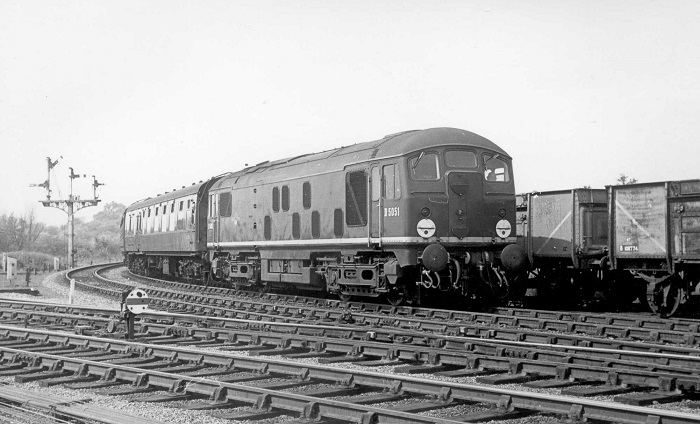
The eight year career of D5051 saw allocations to Eastern Region & Scottish Region depots.
Built Crewe Locomotive Works.
Shortened fuel tank & full size water tank (retained until withdrawn).
Four upper and four lower air filters on non-BIS side, three upper and four lower on BIS side.
Cab roof ventilators sheeted over (Eastern Region modification).
Tripcock fitted (Eastern Region modification).
Gangway doors never removed.
Time between last Classified repair and withdrawal: ?? months.
Time between withdrawal and scrapping: 10 months.
Allocations
The frames for D5051 were laid down at Crewe Works during the late summer of 1959, D5051 was new to March (31B) on December 5th 1959. Further transfers were:
January 1961 to Finsbury Park (34G).
October 1966 to Eastfield (65A) on loan, made permanent December 1966.
December 2nd 1967 - withdrawn.
After withdrawal D5051 was moved to Inverurie Works (noted there during April 1968), by the middle of August 1968 it had been heavily stripped, with the remains scrapped there by October 1968.
Works Visits
Works visits (records incomplete).
Noted Stratford Works June 1962.
Noted Doncaster Works November 1963.
Noted Doncaster Works April & May 1965.
Noted Darlington Works September 1965.
Highlights
1959
D5051 was delivered from Crewe during December to March (31B). This was one of a large batch of Type 2's (D5045 - D5082) initially delivered to March for dieselisation of the East Anglian services. However due to the continuing influx of the Brush Type 2's and English Elictric Type 3's many of these Class 24's were quickly transferred away.
1960
Condition date uncertain (but allocated to March): green livery with frame level stripe, shortened fuel tank, full size water tank, cantrail water filler cover present, ridge sided sandboxes, three-rung bogie mounted footsteps, steam style shedplate on cabfront.
1961
D5051 stayed for about a year at Ipswich before moving to Finsbury Park (34G) in January.
1962
On January 15th D5051 worked the 17.24 Broad Street - Hertford North.
A visit to Stratford Works was made during May.
Condition June: green livery with small yellow warning panels (all paintwork looks very fresh), curved upper corners, frame level stripe is not covered and there is a small gap between the stripe and the bottom of the yellow warning panel.
1963
Late in the year, during November a visit was made to Doncaster Works.
On December 18th D5051 worked the 17.35 Broad Street - Hertford North.
1965
Another visit was made to Doncaster, this time during April - May. During September D5051 was noted in Darlington Works yard.
D5051 worked the 08.39 Gordon Hill - Moorgate on November 2nd.
1966
On October 2nd seven locomotives departed Finsbury Park on transfer to Eastfield, the locomotives heading northbound light engines: D5051 & D5052, D5050 & D5055 and D5053, D5056 & D7600.
D5051 worked the 17.08 Ayr - Kilmarnock on November 1st.
1967
Double headed Gateshead Type 2s worked the Saturday's only Newcastle - Ayr - Stranraer passenger in both directions. So noted on July 15th was D7611 & D5051, the ScR machines no doubt deputising for failures, especially on the eastbound runs.
Condition August: green livery with small yellow warning panels, curved upper corners, frame level stripe covered bottom of yellow warning panel; full size water tank, shortened fuel tank, blanking plates fitted, hand/footholds present, all valencing present, No.1 cab roof driver's side - ventilator above cab door covered over.
Visits to the Ayrshire coalfield were frequent, and it was on a Waterside coal working on September 11th that D5051 caught fire, sustaining considerable damage, necessitating a visit to the workshops at Inverurie, being noted at the Works at least by April 1968.
Repairs to this machine were not approved, thus leading to D5051 achieving two 'firsts', it would be the first BR/Sulzer Type 2 to be withdrawn and it would be the first and only BR/Sulzer Type 2 to be broken up at Inverurie Works (during September/October 1968). The final Type 2, D7677 had been delivered in April 1967, thus the entire fleet of 478 locomotives remained intact for only about seven months!
Condition final: green livery with small yellow warning panels, blanking plates fitted, hand/footholds present, three-rung bogie mounted footsteps.
flk 0222
Page updated September 26th 2003
Last updated February 15th 2022.
Back to 24050
Forward to 24052