In researching the widespread application of Sulzer powered rail vehicles over a period of approximately five decades the name of Armstrong Whitworth features prominently in the vehicles delivered between 1929 & 1937. This page is clearly very much a work in progress and any contributions, updates & corrections are most welcome.
Armstrong Whitworth utilised a number of suppliers in the construction of their rail vehicles, the engines fitted included those built under licence from Sulzer and for the smaller vehicles Saurer engines were frequently used. Electric transmission equipment suppliers included GEC, Laurence Scott & Electromotors, English Electric and Crompton Parkinson.
All photographs are borrowed from publications of the period, unless otherwise recorded, I trust this will not offend anyone in the compilation of this record. From the presentation of the subject matter it is presumed the majority of the views are from the manufacturer's files or their publicity department.
The record is laid out chronologically, providing an interesting insight into how Armstrong Whitworth's designs and sales evolved.
There was a certain negative sentiment prevailing in the 1920's that choose to avoid the term 'diesel engine' because of its links to Rudolf Diesel, a native of Germany. The term 'oil engine' was used by a number of entities to avoid references to anything German, presumably in light of the Great War of 1914 - 1918 and Germany's political & expansionist ideas. I suppose political correctness has been around for many generations. That Rudolf Diesel died under mysterious circumstances (possibly taking his own life) whilst aboard a cross channel ferry only adds to the intrigue.
Generally this page is an overview of Armstrong Whitworth's diesel production, more information can be found on the pages detailing the Sulzer powered vehicles listed by country.
The first three diesel powered railway vehicles were given Works Order Numbers using the existing steam locomotive numbering system.

1929
Order 935 & 936
AW No. D4, D5, D6
Argentina: Buenos Aires Great Southern Railway, two 1,200hp mobile power houses, numbered UE 1 & 2, used to haul five coaches, three 1st & two 2nd class. Traction motors under the coaches were powered by the MPH's. One was loaned to the FC Buenos Aires Pacifico. The CME of BAGSR, P C Saccaggio, was reluctant to initiate full electrification of the lines around Buenos Aires due to its cost, but believed in the idea of powered coaching stock, in this case drawing power from a diesel electric generator set installed in a 'mobile power house'. These units were semi-permanently coupled to five coach sets, the end coach being equipped with driving compartments, avoiding reversals at the busy Buenos Aires terminals. These two locomotives were ordered just after an order to Beardmore, the first diesel locomotives to work anywhere in South America.
Delivered in late 1930, each was powered by two Sulzer 8LV28 cylinder engines developing 600hp at 700rpm, powering an Oerlikon main generator & two 136hp Metropolitan Vickers traction motors - each of the five coaches carried two 125hp motors. The rigid locomotive frame supported four fixed axles, the outer ones of which were powered, with a pony truck at each end (1-A-2-A-1 arrangement). The components were all received separately in Argentina, being shipped to the BAGS workshops, where the locomotives were put together. Because they were semi-permanently coupled to the coaching stock the MPH's carried only one driving cab. Locomotive weight was described variously as from 85 tons to 92 tons, total train weight was 314 tons.
They were most regularly operated out of the Plaza Constitucion terminal to Quilmes, their acceleration was superior to the regular steam fleet, but the MPU powered trains generally ran under the steam timings. Occasionally the two sets were combined. In the early years it was the practice to stop the engines at each station stop, leading to the engines going through the stop/start cycle over two hundred times a day! They remained in service at least until 1954, when they were used to build another mobile powerhouse (UE6) equipped with two 827hp Paxman engines. This hybrid locomotive was withdrawn in April 1963.
1930
Order 937
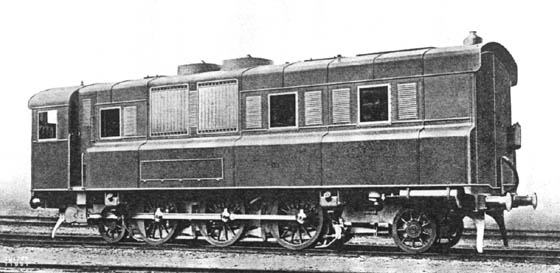
Argentina: Buenos Aires Great Southern - (Talleres Remedios de Escalada) - one locomotive for the railway's repair shops outside of Buenos Aires, wheel arrangement 1-C-1, Sulzer 8LV28 592hp engine (the same as the two 1929 built powerhouses), a Vickers swash-plate hydrostatic hydraulic transmission - designed for driving sugar mill machinery, numbered DH501, maximum speed 45km/h, used for shunting duties. This locomotive was not successful due to serious problems with the transmission (leakages and high oil temperatures), having a very short working life, it was withdrawn in October 1940 and scrapped during May 1943.
1931 - Opening of Diesel Traction Department of Sir W G Armstrong Whitworth & Co Ltd.
1931
Order DT1
AW No. D1, D2, D3
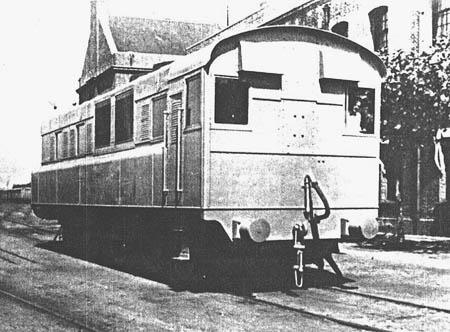
United Kingdom: Three single car railcars, 250hp six cylinder Sulzer engine, electric transmission. One trialled on the LMSR & LNER under the guise of the 'Armstrong-Shell Express'- later named 'Northumbrian', the others were named 'Tyneside Venturer' & 'Lady Hamilton'. All were purchased by the LNER and remained in service until World War Two.
1932
Order DT11
AW No. D10
United Kingdom: AW fifteen ton 0-4-0 diesel electric demonstrator shunting locomotive, Works No.D10. Powered by an Armstroung Saurer 6BXD six cylinder engine producing 95hp at 2,000rpm and coupled to a Laurence, Scott and Electromotors generator. It trialled at many locations but spent most of its career in use at Armstrong Whitworth's Scotswood Works. It was taken out of service in 1953 and scrapped the following year. Only one locomotive of this type was built.
1933
Order DT8
AW No. D9
United Kingdom: AW demonstrator 'universal locomotive' 800hp 1-C-1
Order DT12
AW No. D11 - D14
India: GBSR (Gaekwar's Baroda State Railway) - four 2ft 6in gauge railcars with a 95hp Saurer engine (normally used in lorries), numbered 103 - 106, could run with at least three trailers. The mechanical parts and frame were constructed by Armstong Whitworth, the wooden bodies were built locally in India. The weight of the engine was carried by a bogie with a carden shaft and worm gearing providing the drive to the axle.
Before the mechanical portions were shipped to India, one of the vehicles was tested on the Leek & Manifold Railway during July 1932. Official reports state they were placed into service from February 15th 1933. In service they were designed to pull two third class carriages, to a maximum of 30 tons up 1 in 100 grades at 20mph. Maximum speed was 30mph, mostly because of the track condition.
Annual mileages recorded are (year end was July):
1932 - 1933: 58,573
1933 - 1934: 113,732
1934 - 1935: 86,919
1935 - 1936: 80,584
1936 - 1937: 70,849
Two remained in service until 1943/44, the other two until 1945/46, after which they were converted to first class saloons.

Order DT3
AW No. D4, D5, D6
Argentina: Buenos Aires Great Southern three 1,700hp mobile power houses, 2 x 850hp 8LV34 550rpm, cylinder dimensions 340mm x 400mm, with 8 x 134 hp traction motors, tractive effort 38,000lb, weight in working order 148.50tons. Numbered UE 3,4 &5 they were used to haul eight coaches, five 1st & three 2nd class. They had an increased top speed of 70mph but had the same traction motors and reduction gearing as the first two power houses. The newer machines were also lighter, 132 tons compared to 145 tons. The cost of the two engine-generator sets and ancilliary equipment was GBP16,400.
These three MPU's were direct descendants of the 1930 built UE 1 & 2. Improvements included the use of two four axle trucks rather than the earlier rigid wheelbase, with a wheel arrangement of Bo-2+2-Bo. Each 'locomotive' was comprised of two half units, each containing an engine generator set, though only one unit had a driving compartment (an A-B unit in American diesel nomenclature). A third innovation was the use of Messrs J Stone & Co's 'Skefco' roller bearings on all axles, a welcome fitting in the dry dusty conditions of Argentina.
The Sulzer engines were coupled to Brown Boveri main generators and two English Electric traction motors on the outer bogie of each half unit. The weight of each double unit was 133 tons, with eight coaches in tow the total train weight was 470 tons. Each coach carried two traction motors and as with UE 1 & 2 the performance of these three trainsets was impressive, particularly in light of their quick turnround times at the termini, however for most of their lives they slotted in to steam diagrams.
These trainsets entered service in June & July 1933, working between Buenos Aires & San Vocente. The MPU's remained in service at least until 1959, although one power-house was re-engined with two Paxman 1,500rpm engines and Metropolitan Vickers generators.
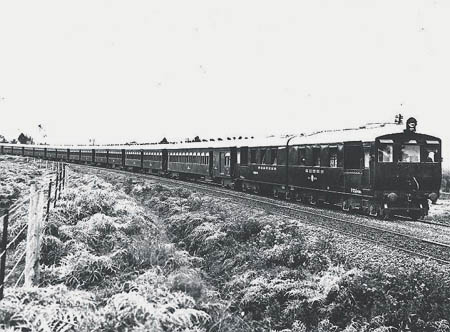
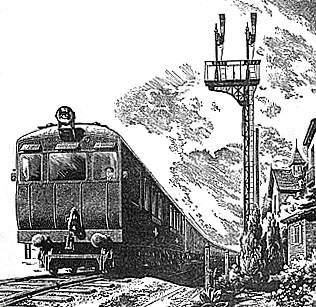
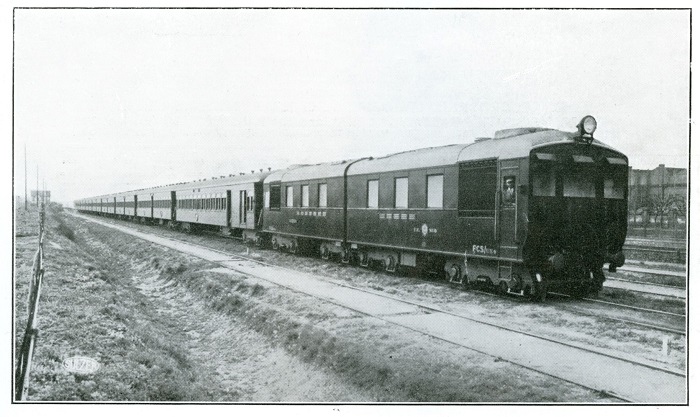
"....experiments with diesel engines were started by us some five years ago. Trials have convinced us that this form of traction for branch lines and similar light service has outstanding potentialities. We sent out two mobile power houses, each of 1,200bhp. Encouraged by the results obtained from these original power houses the company acquired three more powerful units, each of 1,700bhp. These were put into service in June this year and up to the present have run some 45,000 miles. Each of these 1,700bhp power houses operates an eight coach train, weight of which is 526 tons. Seating capacity is provided for 916 passengers. In addition to these units a diesel-electric locomotive of 1,700hp was sent out. Trials of this locomotive were satisfactory. These pioneer developments in diesel traction are being watched with great interest in railway circles, and each step we have taken so far has been attended with complete success....."
Order DT4
AW No. D7
Argentina: Buenos Aires Great Southern one 1700hp 'twin unit' locomotive, #CM210. After the success of the five MPH's one locomotive was ordered as a mainline version of UE3-5. The engines and main generators were the same, but carried six 230hp English Electric traction motors. Each half unit had a driving compartment. When delivered the unit came with three different sized sets of driving wheels, axles & gears. After testing the 'mixed traffic' set was permanently fitted to the locomotive.
In service the locomotive worked 700 - 900 ton overnight passenger trains between Buenos Aires & Bahia Blanca, a round trip of eight hundred miles. CM210 continued on this service after nationalisation in 1948, and was not retired until about 1960.
Order DT7
AW No. D8
United Kingdom: One diesel electric 0-6-0 shunter, 250hp sold to Preston Corporation - tested briefly on LNER & SR. Scrapped about 1969.
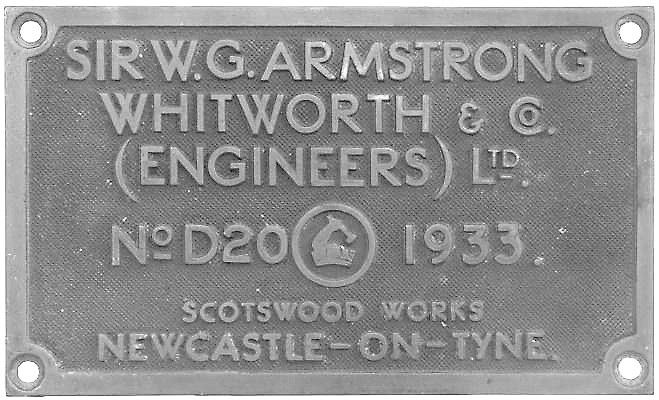
Order DT20
AW No. D20
United Kingdom: One diesel electric 0-6-0 shunter, 250hp LMS7408/7058 Sulzer 6LV22
Order DT16
AW No. D15
United Kingdom: One twin bogie diesel electric railcar, powered by an Armstrong-Saurer 6BLD 140 hp engine and Laurence Scott and Electromotors electrical equipment. The body was designed by Armstrong Whitworth but was fabricated by Park Royal Coachworks Ltd, London and delivered to Scotswood for fitting.
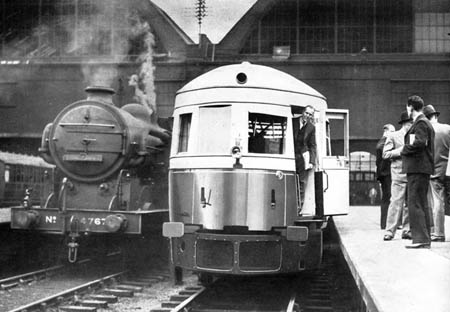
The caption from a period publicity brochure describes this as the Armstrong Whitworth Streamlined Light Weight Oil Engined Railbus. It is powered by either a 110 or 140hp Armstrong-Saurer engine and can hold 57 passengers and their luggage. If no luggage compartment was fitted then the seating capacity was for 71 passengers. The railbus is seen here at Kings Cross. (Source AW)
The railbus trialled on the LNER in the Tyneside area during the summer of 1933. The passenger compartment suffered from excessive engine noise, a wooden box structure and soundproofing material were added to address the problem, but the soundproofing material caught fire on a Newcastle - Carlisle working. On July 30th 1933 the railbus ran from Newcastle to Kings Cross, it spent several days working between London & Hertford before returning to Newcastle. In both directions 35 gallons of fuel were used, fuel consumption was 7.65mpg.
From September 25th 1933 the railbus worked in the Newcastle area on the western branches. It later included trips to Blackhill, Hexham and Morpeth. The LNER acquired the railbus on June 28th 1934 for GBP2,500 and renumbered to No.294. Other routes would include Scarborough and Hull - York - Selby - Pontefract service. The railbus was scrapped at Darlington during 1939.
This railcar was the basis for similar machines sent to the Kalka-Simla & Great Indian Peninsula Railways.
Order DT22
AW No. D21 - D26
United Kingdom: Six diesel electric 0-4-0 shunter demonstrators, 85hp Armstrong-Saurer 6cyl 6BLD, 1700rpm, Laurence, Scott and Electromotors main generator and traction motor. Weight 15tons, length 19'4", height 10'10".
These locomotives were built as demonstrators with many of them being tested at several locations prior to immediate sale or being returned to Scotswood to await a buyer. The brief details below show the main purchaser of these locomotive, their working lifespan and their ultimate fate.
D21: North Eastern Supply Company, Dunston Generating Station. 1934 - 1975, re-engined with Gardner engine. Preserved.
D22: A Reyrolle Co Ltd, Hebburn. 1937 - 1975, re-engined with Gardner engine. Preserved.
D23: Admiralty, Chatham. 1934 - 1966. Scrapped 1966.
D24: Thames Board Mills Ltd, Warrington. 1936 - 1957. Re-engined 1944. Sold for scrap 1957.
D25: North Sunderland Railway, (Chathill - Seahouses passenger service). 1934 - 1947? Scrapped W H Arnott Young Co 1949?
D26: Magneseum Elektron Ltd, Manchester. 1937 - 1962. Disposed of during 1962?
Today little remains of the products of the Diesel Dept of Armstrong Whitworth, fortunately in the United Kingdom the preservation of D21 & D22 keep some of those memories alive.
Order DT34
AW No. D39
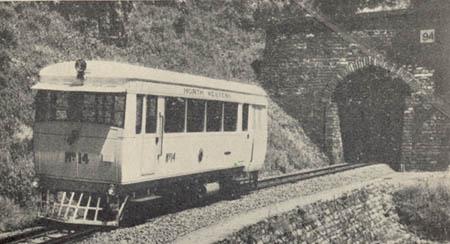
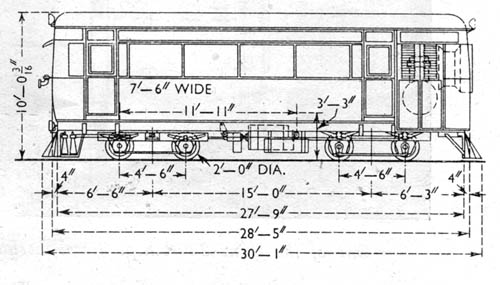
India: North West Railway 2'6" gauge Kalka - Simla route railcar 95hp Armstrong-Saurer 6BXD six cylinder engine, diesel electric - became #14, preserved at NRM New Delhi. The body was built by Gloucester Railway Carriage & Wagon Co Ltd and fitted at Scotswood. This was the second venture in to the use of diesel powered vehicles on the NWR. The first had been two Beardmore branch line diesel electric locomotives, delivered about 1930. These in general were not a success due to generator and motor troubles, both were scrapped in 1940.
The railcar cost Rs 44,513 (GBP3,338) and was delivered in July 1934. It ran a total of 163,992 miles up to September 30th 1943 - this low mileage was due to it only being required to run between April and October, the speed limit on the twisting and heavily graded route would only allow one round trip of 120 miles per day. Operating cost comparisons over this route were difficult due to steam being used for other purposes, however comparisons against petrol engined railcars doing similar work were favourable.
Initially the Armstrong-Saurer BXD type engine was installed with a nominal output of 135hp at 1,500rpm, this was reduced by the manufacturer to 120hp at 1,400rpm due to the operating conditions. Even this proved excessive when the railcar entered service, from 1936 the rating was lowered to 95hp at 1,400rpm, the resistance in the generator field circuit was increased to reduce the generator voltage. After the initial teething trouble had been ironed out the faults sustained by the railcar were few. In June 1942 the railcar was attacked by Dacoits who killed the driver. The engine was left running at high rpm causing two pistons to seize. Cylinder liner wear had been excessive, thought to be caused by the use of Persian light diesel oil which had a high content of asphalt and other foreign matter. The substitution of the engine speed control from an electrical to a mechanical system was made which eliminated the incessant variant of engine speed caused by the line's characteristics. This seriously reduced the liner wear and led to improved fuel consumption, from 7.4mpg to 8.1mpg.
The line connected Kalka (with its broad gauge connections) to the summer retreat of Simla, some sixty route miles away with an altitude gain of 2,143 feet (the elevation of Simla is 6,840 feet). Fuel consumption for a round trip was eighteen gallons. Maximum speed on the twisting line is 18mph, the railcar covered one round trip per day.
1934
Order DT30
AW No. D35, D36
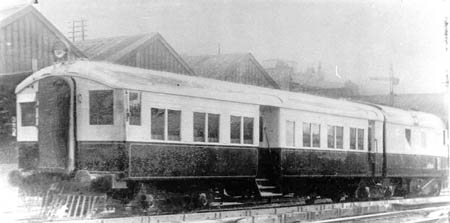
Argentina: Buenos Ayres Western Railway (Ferrocarril Oeste) DE1 450hp Sulzer 8LV25 diesel electric railmotor for branchline service, seating for 50, maximum speed 120km/h. Vestibule connections were provided to allow a trailer to be added at either end. Total weight was 67 tons, the total length was just under 90 feet, unusually electric heating was fitted. The railcar proved reliable, from October 1934 to October 1940 it covered over 621,000 miles, it was out of service for unscheduled reasons for 208 days, five of which were caused by engine problems, fifty seven due to the traction motors the remainder undisclosed. The design was not repeated, Armstrong Whitworth were leaving the railway traction business and the Argentina authorities were now purchasing light weight railcars with small quick running engines. The railcar survived into the 1960's.
Order DT31
AW No. D37
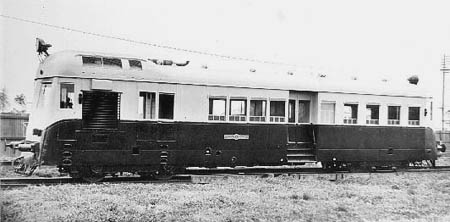
Argentina: Buenos Aires Western Railway, one diesel electric railbus, powered by an Armstrong-Saurer 6BXD 122hp engine, with electrical equipment supplied by Laurence Scott & Electromotors (main generator) and Crompton Parkinson (traction motors). The two traction motors were axle-hung, nose suspended, unlike the more normal frame mounted type used by Armstrong Whitworth. The body was built by Park Royal Vehicles Ltd, London and delivered to Scotswood for fitting. It had a cab at each and accommodated 48 passengers (16 1st, 32 2nd).
Order DT19
AW No. D16 - D19
Brazil: Sao Paulo Railway, 450hp diesel electric train.
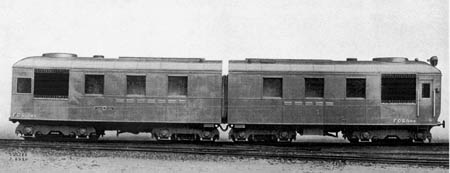
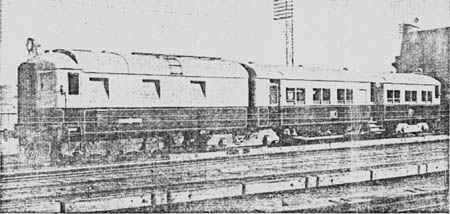
One 5ft 3in gauge rail motor articulated with three coaches powered by a 6LD25 450hp engine, electrical equipment by Laurence, Scott & Electromotors Ltd, later named 'Cometa'.
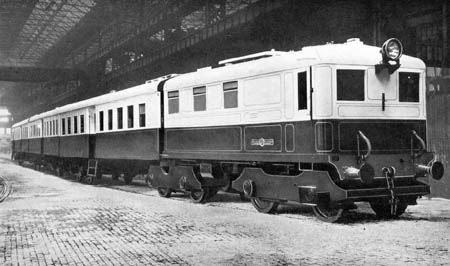
From a period publicity brochure this is described as a 500hp Armstrong Whitworth Light Weight Motor Train, articulated on the Gresley system in two groups. Designed for a maximum speed of 65mph, it can accomodate 168 first & second class passengers at the low tare weight of 1,230 lbs per seat. (Source AW)
Order DT44
AW No. D43
Ceylon: Ceylon Government Railway, one diesel electric 0-4-0 shunter, Armstrong-Saurer 6BXD engine 122hp at 1,400rpm, Laurence, Scott and Electromotors electrical equipment, jackshaft drive from frame mounted traction motor. Numbered CGR No.500, entered service during October 1934 at their Ratmalana works. Re-engined 1959 with a Rolls Royce C6 SFL 127C engine and BTH traction equipment. Believed still in existance, maintained by the Works apprentices.
Order DT36
AW No. D40
West Indies St Kitts Basse Terre Sugar Factory: one diesel electric 0-4-0 shunter, Armstrong-Saurer 6BLD engine 78hp at 1,700rpm, Laurence, Scott and Electromotors electrical equipment, cardan shaft/worm drive from frame mounted traction motor. 2ft 6in gauge. Delivered May 1934, re-engined about 1950 with a Cummins HB1 engine. The sugar plant closed in 2005 and the locomotive is still extant, as a possible exhibit in a museum dedicated to the St Kitts sugar industry.
Order DT23
AW No. D27, D28
Ceylon/Argentina: Two 5ft 6in gauge mixed traffic Universal type locomotives built for an anticipated North Western Railway, India order. Powered by Armstrong Sulzer 8LD28 engines of 800hp at 700rpm, Laurence, Scott and Electromotors main generator, three Crompton Parkinson traction motors, wheel arrangement 1-C-1. The Indian order came through but for two 1,200hp locomotives so when completed these two 800hp locomotives were in need of a buyer. Arrangements were completed with the Ceylon Government Railways for a six month trial of the two locomotives, numbered 800/801. During trials a traction motor fault on D27 required a visit to the Workshops, here, whilst being lifted a chain broke resulting in some visible damage. Less obvious was damage which later led to a broken crankshaft. D28 later suffered a cracked cylinder block.
The locomotives were returned to Newcastle, repaired and eventually purchased by BAGSR, Argentina in 1937.
Order DT41
AW No. D41
India Great Indian Peninsula Railway 2ft 6in gauge diesel electric chassis. Powered by an Armstrong-Saurer 6BXD six cylinder engine and a Laurence, Scott and Electromotors Ltd main generator & traction motor. The output from the engine ranged between 140bhp & 95bhp. The body for this vehicle was built by the GIPR's Mutunga workshops and could seat 58 3rd class passengers.
The railcar worked solely on the 22 mile long Pulgaon - Avri branch, frequently working with one coach as a trailer vehicle, with a maximum speed of 40mph. Total costs per mile for the railcar were 7.26d (3p) as compared to steam working of 29.78d (14p). The railcar was delivered with a spare engine which allowed for ease of exchange, particularly as the engine/generator set were mounted transversely across the chassis on a subframe which was mounted on rollers to allow it to be rolled clear of the body for easy access. The railcar remained in service until January 1969 when engine repairs were deemed uneconomic. After this it continued in service as a non-powered luggage and guard's vehicle.
Order DT43
AW No. D46 - D51
India: Madras & Southern Mahratta Railway 5ft 6in, six 180hp diesel electric chassis equipped with Armstrong-Saurer 6BXD engines and Laurence, Scott & Electromotors electrical equipment. The railcar bodies were supplied by the M&SMR's workshops, and provided seating for 110 passengers.
Delivery of all six vehicles took place between February & August 1935, initially to Madras, but eventually all vehicles operated out of Cocanada. Average daily mileage for all six vehicles varied between 830 & 860 miles with one railcar held in reserve. They could operate in multiple with themselves but were not used with trailer vehicles.
1935
Order DT63
AW No. D54 - D63
United Kingdom: Ten diesel electric shunters 0-6-0, 350hp Sulzer 6LTD22, LMS 7059 - 7068. (delivered May 1935 - November 1936)
Order DT61
AW No. D53
United Kingdom: Penmaenmawr & Welsh Granite Co Ltd: one 3ft gauge diesel electric 0-4-0 shunter named 'Alice', Armstrong-Saurer 4BOD engine 60hp at 1,700rpm, Laurence, Scott and Electromotors electrical equipment, cardan shaft/worm drive from frame mounted traction motor. Placed into service during July 1935, to haul granite over tracks at the Penmaenmawr quarry. At some point it acquired an AEC diesel engine. The quarry rail system was abandoned in 1967 and the locomotive was scrapped during 1969. This was the only narrow gauge diesel locomotive built by Armstrong Whitworth for use in the United Kingdom.
Order DT51
AW No. D44, D45
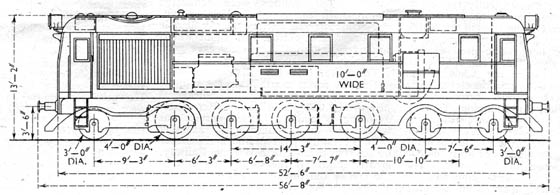
India: North West Railway broad gauge, two diesel electric locomotives 1,200hp, 8LD34 Sulzer engines 1A-C-2 wheel arrangement, cost Rs 3,30,789 (GBP24,809) each. They were delivered to Karachi in September 1935, numbered 332 & 333. They were intended for express passenger service over the Karachi - Lahore route, particularly the 600ton mail train at a top speed of 60mph.
Unfortunately whilst one of the locomotives was being hauled dead vibration caused the reverser drum of the traction motors to close, allowing the motors to generate causing serious damage to two and considerable damage to the others. It was sent to Lahore for the extensive electrical repairs to take place. The remaining locomotive was used for testing, totalling about 1,000 miles hauling no more than 350tons. Flashovers of the electrical equipment were frequent particularly over 50mph. The main generator was required to attain a voltage of at least 1,200 according to the manufacturer's specifications, but the tests revealed the voltage became unstable above 850. The bench tests carried out by the manufacturer did not represent the field conditions that the locomotives were to operate under, hence never revealed the weaknesses discovered by the NWR. Engines, generators and motors were removed in 1936 and returned to England for reconditioning or replacement. Armstrong Whitworth had by this time decided to concentrate on the supply of munitions to the English government and so asked to be relieved of the contract. This was accepted by the NWR and the mechanical portions remaining in India were scrapped.
Order DT67
Argentina Central Argentine Railway single & double railcars, powered by Armstrong-Sulzer 6LF19 engines of 275hp at 1,150rpm. These integrally welded all steel vehicles were built by BRCW Smethwick being equipped with mechanical transmission, two with a Vulcan-Sinclair fluid coupling and Wilson five speed gearbox & two equipped with a five speed SLM oil operated gearbox. The engine, transmission and radiator were mounted on a subframe carried by one of the 12ft wheelbase bogies, the single cars weighed 38tons and were 76.5ft long and seated 75 passengers. The articulated sets weighed 66tons with a top speed of 68mph.
Order DT60
AW No. D52
Malaysia (formerly Straits Settlements) Penang Harbour Board: one diesel electric 0-4-0 shunter, Armstrong-Saurer 6BLD engine 92hp at 1,700rpm, Laurence, Scott and Electromotors electrical equipment, cardan shaft/worm drive from frame mounted traction motor. Metre gauge (3ft 3.3in). Delivered August 1935 and operated until 1959 when the Malayan Railways took over the harbour shunting work. Resold to the Associated Pan Malaysian Cement Co. at Rawang, Selangor. Taken out of service during 1973 due to a gearbox failure and broken up there during July 1973.
1936
Order DT68
AW No. D64
India: Bombay, Baroda & Central India Railway (BBCIR), diesel electric shunter 0-6-0, 350hp Sulzer 6LTD22, lasted into 1950's, number 800.
1937
Armstrong Whitworth's Diesel Traction Department ceases taking new orders - it remains open only to complete existing orders.
Order DT71
AW No. D65 - D70
Australia: Six twin bogie railcars for the 3ft 6in gauge Western Australia Government Railways (WAGR). These were delivered in 1937, one railcar was delivered ready to run, the other five were delivered as chassis with the body in kit form.
Powered by an Armstrong-Saurer 6BXD engine producing 140hp at 1,500rpm, Laurence, Scott & Electromotors provided the main generator and traction motor. The engine/generator set was mounted transversely across the body in a compartment behind the driver's cab. Driving positions were provided at each end. They were equipped to haul trailer coaches if necessary.
Known as the 'Governor' class they were initially pased at Perth, Bunbury & Geraldton. Over time they would work from Perth to Narrogin, Denmark, Pigerup & Miling and from Geraldton to Mullewa. In 1951 new railcars sent the 'Governor' class to remoter routes: Kalgoorie to Laverton & Esperance. With lifetime mileages exceeding one million miles they were retired in April 1962, though some remained extant at least until 1974 at the Midland Workshops.
1937/38
Order DT73
AW No. D71, D72
Brazil: Sao Paulo Railway (Estrada de Ferro Santos a Jundial), two 600hp trains, powered by AW/Sulzer 6LDA25 600hp engines, the trailer coaches were built by BRCW Smethwick 1939/5ft 3in English Electric Co Ltd 2 'Planeta' & 'Estrella'
| Order & Works No. | Type of Vehicle | Principal Owner | Country | Year Built | Retired/Scrapped |
| 935 | Mobile Powerhouse UE1 | BAGSR | Argentina | 1929 | ?? |
| 936 | Mobile Powerhouse UE2 | BAGSR | Argentina | 1929 | ?? |
| 937 | Shunting locomotive (600hp) | BAGSR | Argentina | 1929 | 1940/1943 |
| DT1/D1 | Bogie Railcar | LNER | United Kingdom | 1931 | ?? |
| DT1/D2 | Bogie Railcar | LNER | United Kingdom | 1932 | ?? |
| DT1/D3 | Bogie Railcar | LNER | United Kingdom | 1932 | ?? |
| DT3/D4 | Mobile Powerhouse UE3 | BAGSR | Argentina | 1933 | ?? |
| DT3/D5 | Mobile Powerhouse UE4 | BAGSR | Argentina | 1933 | ?? |
| DT3/D6 | Mobile Powerhouse UE5 | BAGSR | Argentina | 1933 | ?? |
| DT4/D7 | Twin Unit Diesel Locomotive CM210 | BAGSR | Argentina | 1933 | ?? |
| DT7/D8 | Shunter (250hp) | Ribble Navigation | United Kingdom | 1932 | ??/1969 |
| DT8/D9 | Universal Locomotive 880hp | Armstrong Whitworth | United Kingdom | 1933 | ??/1937 |
| DT11/D10 | Shunter (95hp) | Armstrong Whitworth | United Kingdom | 1932 | 1953/1954 |
| DT12/D11 | Locomotive Tractor (100hp) | Baroda State Railways 101 | India | 1932 | ?? |
| DT12/D12 | Railcar chassis | Gaekworks, Baroda State Railways 102 | India | 1932 | ?? |
| DT12/D13 | Railcar chassis | Gaekworks, Baroda State Railways 103 | India | 1932 | ?? |
| DT12/D14 | Railcar chassis | Gaekworks, Baroda State Railways 104 | India | 1932 | ?? |
| DT16/D15 | Bogie Railbus (95hp) | LNER | United Kingdom | 1933 | ?? |
| DT19/D16 | Articulated railcar set (450hp) | Sao Paulo Railway | Brazil | 1933 | ?? |
| DT19/D17 | Articulated railcar set (450hp) | Sao Paulo Railway | Brazil | 1933 | ?? |
| DT19/D18 | Articulated railcar set (450hp) | Sao Paulo Railway | Brazil | 1933 | ?? |
| DT19/D19 | Articulated railcar set (450hp) | Sao Paulo Railway | Brazil | 1933 | ?? |
| DT20/D20 | Shunter (250hp) | LMSR 7408/7058 | United Kingdom | 1933 | ?? |
| DT22/D21 | Shunter (95hp) | Dunston Power Station | United Kingdom | 1933 | ?? |
| DT22/D22 | Shunter (95hp) | A Reyrolle & Co, Hebburn | United Kingdom | 1933 | ?? |
| DT22/D23 | Shunter (95hp) | Admiralty, Chatham Dockyard | United Kingdom | 1933 | ?? |
| DT22/D24 | Shunter (95hp) | Thames Board Mills, Ltd | United Kingdom | 1933 | ?? |
| DT22/D25 | Shunter (95hp) | North Sunderland Railway | United Kingdom | 1933 | ?? |
| DT22/D26 | Shunter (95hp) | Magnesium Elektron Co Ltd | United Kingdom | 1933 | ?? |
| DT23/D27 | Mixed traffic locomotive (880hp) | BAGSR CM204 (trialled in Ceylon) | Argentina | 1934 | ?? |
| DT23/D28 | Mixed traffic locomotive (880hp) | BAGSR CM205 (trialled in Ceylon) | Argentina | 1934 | ?? |
| D29 | Not used - cancelled order | ? | ? | ? | ?? |
| D30 | Not used - cancelled order | ? | ? | ? | ?? |
| D31 | Not used - cancelled order | ? | ? | ? | ?? |
| D32 | Not used - cancelled order | ? | ? | ? | ?? |
| D33 | Not used - cancelled order | ? | ? | ? | ?? |
| D34 | Not used - cancelled order | ? | ? | ? | ?? |
| DT30/D35 | Twin unit articulated railcar (450hp) | Buenos Aires Western Railway | Argentina | 1934 | ?? |
| DT30/D36 | Twin unit articulated railcar (450hp) | Buenos Aires Western Railway | Argentina | 1934 | ?? |
| DT31/D37 | Twin bogie railcar | Buenos Aires Western Railway | Argentina | 1934 | ?? |
| D38 | Not used - cancelled order | ? | ? | ? | ?? |
| DT34/D39 | Twin bogie railcar (122hp) | North Western Railway of India | India | 1934 | ?? |
| DT36/D40 | Shunting locomotive (85hp) | St Kitts Basse Terre Sugar Factory | St Kitts, West Indies | 1934 | ?? |
| DT41/D41 | Twin bogie railcar chassis (122hp) | Great Indian Peninsula Railway | India | 1934 | ?? |
| D42 | Not used - cancelled order | ? | ? | ? | ?? |
| DT44/D43 | Shunting locomotive (122hp) | Ceylon Government Railway | Ceylon | 1933 | ?? |
| DT51/D44 | Mixed traffic locomotive | North Western Railway of India | India | 1935 | ?? |
| DT51/D45 | Mixed traffic locomotive | North Western Railway of India | India | 1935 | ?? |
| DT43/D46 | Twin bogie railcar chassis (140hp) | Madras & Southern Mahratta Railway | India | 1934 | ?? |
| DT43/D47 | Twin bogie railcar chassis (140hp) | Madras & Southern Mahratta Railway | India | 1934 | ?? |
| DT43/D48 | Twin bogie railcar chassis (140hp) | Madras & Southern Mahratta Railway | India | 1934 | ?? |
| DT43/D49 | Twin bogie railcar chassis (140hp) | Madras & Southern Mahratta Railway | India | 1934 | ?? |
| DT43/D50 | Twin bogie railcar chassis (140hp) | Madras & Southern Mahratta Railway | India | 1934 | ?? |
| DT43/D51 | Twin bogie railcar chassis (140hp) | Madras & Southern Mahratta Railway | India | 1934 | ?? |
| DT60/D52 | Shunter (100hp) | Penang Harbour Board | Straits Settlements | 1935 | ?? |
| DT61/D53 | Shunter (60hp) | Penmaenmawr & Welsh Granite Co | United Kingdom | 1935 | ?? |
| DT63/D54 | Shunter (400hp) | LMSR 7059 | United Kingdom | 1935 | ?? |
| DT63/D55 | Shunter (400hp) | LMSR 7060 | United Kingdom | 1935 | ?? |
| DT63/D56 | Shunter (400hp) | LMSR 7061 | United Kingdom | 1935 | ?? |
| DT63/D57 | Shunter (400hp) | LMSR 7062 | United Kingdom | 1935 | ?? |
| DT63/D58 | Shunter (400hp) | LMSR 7063 | United Kingdom | 1935 | ?? |
| DT63/D59 | Shunter (400hp) | LMSR 7064 | United Kingdom | 1935 | ?? |
| DT63/D60 | Shunter (400hp) | LMSR 7065 | United Kingdom | 1935 | ?? |
| DT63/D61 | Shunter (400hp) | LMSR 7066 | United Kingdom | 1935 | ?? |
| DT63/D62 | Shunter (400hp) | LMSR 7067 | United Kingdom | 1936 | ?? |
| DT63/D63 | Shunter (400hp) | LMSR 7068 | United Kingdom | 1936 | ?? |
| DT68/D64 | Shunting locomotive (400hp) | Bombay, Baroda & Central India Railway | India | 1936 | ?? |
| DT71/D65 | Twin bogie railcar chassis (140hp) | Western Australian Govt Railways | Australia | 1936 | ?? |
| DT71/D66 | Twin bogie railcar chassis (140hp) | Western Australian Govt Railways | Australia | 1936 | ?? |
| DT71/D67 | Twin bogie railcar chassis (140hp) | Western Australian Govt Railways | Australia | 1936 | ?? |
| DT71/D68 | Twin bogie railcar chassis (140hp) | Western Australian Govt Railways | Australia | 1936 | ?? |
| DT71/D69 | Twin bogie railcar chassis (140hp) | Western Australian Govt Railways | Australia | 1936 | ?? |
| DT71/D70 | Twin bogie railcar chassis (140hp) | Western Australian Govt Railways | Australia | 1936 | ?? |
| DT73/D71 | Twin bogie powercars (600hp) | Sao Paulo Railway | Brazil | 1937/38 | ?? |
| DT73/D72 | Twin bogie powercars (600hp) | Sao Paulo Railway | Brazil | 1937/38 | ?? |
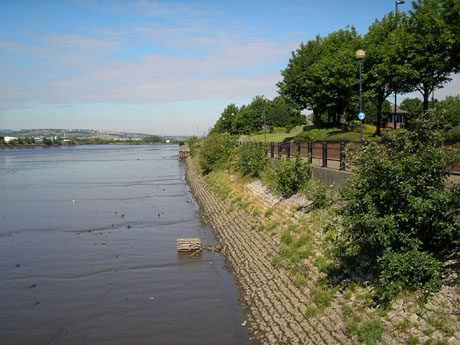
The vast majority of the diesel powered rail vehicles produced by Armstrong Whitworth have long since gone to the wall, although if one looks carefully one or two of these vehicles still exist, either in preservation or lingering forgotten in railway sidings many, many miles from Tyneside. Of course they can no longer go home to the place which built them. The huge riverside facilities that produced many of Armstrong Whitworth's products have long since been torn down, with the land now the home of newer industrial facilities, or, as in the view above turned into riverside parks.
In this view from June 2009, close by the Newcastle Business Park, the tide is out as the Tyne drifts lazily past the site of the former Elswick Works (to the right) and the town of Dunstan (on the left). And although the mention of Elswick and Scotswood no longer conjure up the the might of industrial Britain, nearby street names still remember these pioneers such as William Armstrong Drive
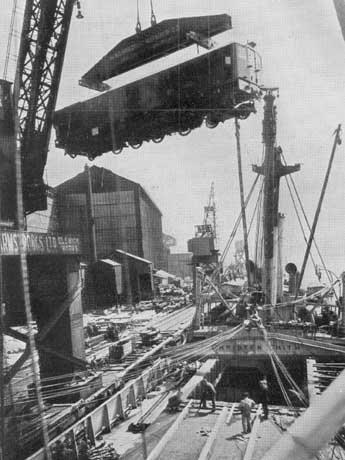 |
In contrast to the somewhat serene view above, the view to the left shows the river alongside the Elswick Works in 1935. This busy scene shows one of the two NWR diesel electric locomotives being loaded onto one of the purpose built Belships vessels. Some of the Belships fleet were built by Armstrong Whitworth and were powered by Sulzer engines. They proved to be longer lived than the locomotive shown in this photograph. The two NWR locomotives proved to be a failure. The engine-generator sets were returned to Scotswood for repair. The closure of AW's Diesel Traction Division saw the generators returned to their maker. Armstrong Whitworth photograph. |
For views of Armstrong Whitworth's Ceylon & India locomotives click here.
For views of Armstrong Whitworth's United Kingdom locomotives click here.
Sources
AAT: Asociacion Amigos del Tranvia
AW: Armstrong Whitworth
DDT: Development of Diesel Traction
DLR: Diesel Locomotives & Railcars
FMF: Fundacion Museo Feroviario
MFN: Museo Ferroviario Nacional
British Steam on the Pampas, Douglas Stewart Purdom
The British Internal Combustion Locomotive 1894 - 1940, Brian Webb
Diesel Railway Traction, October 6th 1933, supplement to the Railway Gazette
Diesel Railway Traction, August 9th 1935, supplement to the Railway Gazette
Diesel Railway Traction, July 1959.
Armstrong Whitworth: A Pioneer of World Diesel Traction, Brian Webb (2010)
India - GBSR - Indian Railway Study Group newsletter from 1991 & Ray Ellis
Last updated May 8th 2011.
Return to Sulzer Global Listing page
Return to Picture menu