
Change is in the air - Birkenhead to Liberia
Part one of this story features Mal's adventures on British Railways between 1960 and 1980. Previously covered are a variety of steam memories, then the steam/diesel transition followed by events in the corporate blue/yellow era of British Rail. As part one drew to a close the story ended with memories from the electrified lines in the Wirral & Liverpool area.
It is perhaps ironic that Mal's last diesel worked on British Rail was Sulzer powered, that of 25106 on March 6th 1980. The final job worked was an electric multiple on March 15th 1980, with my last official day being March 22nd 1980.
Webmaster's note: When Mal offered up his railway memories for inclusion in this website I had no clue that Mal would make the dramatic and challenging move from driving trains in Liverpool to driving trains in Liberia! In the course of Mal's email exchanges about his time in Liberia it became obvious that the full story of this fascinating time needed telling, not just the railway segments of it. So I hope the readers don't mind the inclusion of the additional, sometimes personal material. Especially since this way of life disappeared almost in an instant as Liberia quickly became embroiled in a long, bitter, destructive civil war.
The Day Arrives - off to Liberia!
The next week was hectic, with everything sorted I left home early Friday morning March 28th 1980 for Manchester airport. My first flight was by British Airways BAC111 for Brussels, departing at 10.05am. I sat next to a business man, when we reached our flying altitude he asked if this was my first flight? I replied does it show that much, he smiled and ordered me a whiskey, one of three in fact! Maybe because of this I didn't remember the landing!
Previously whilst in London I'd been told there were three enginemen starting together, one was from Preston. On arrival at Brussels we were booked on a Brussels - Monrovia flight with a Sabena Boeing 707. Glancing up and down the check-in queue I tried to locate the Preston man - we had never met. I spotted an older guy wearing a raincoat, after a brief introduction he confirmed he was going to work for LAMCO. We booked on the flight together and chatted in the departure lounge, his name was Pete Fletcher. I felt happier now, travelling with someone in the same boat as me!
On the aircraft we had three seats, one being next to the window, this was already occupied by a young French girl. Pete takes the middle seat, he has a broad Lancashire accent, he tells me he was a diesel instructor at Preston, but otherwise doesn't say too much. I have a vague recollection of him from the messroom.
When ordering drinks the attendants stick a coloured pin in the back of the seat for each drink you have. Whilst crossing the Sahara Pete wants the window seat so as to take some photographs of the Atlas mountains. Unfortunately any conversation with the French girl is challenging since she spoke very little English, I felt a bit embarrassed.
We eventually arrive at Robertsfield airport, Monrovia, the plane would continue on to Abidjan. We disembark from the plane and step on to African soil, first of all the humidity hits you, we walk towards the terminal and go to the washroom to freshen up, the water from the tap is brown! We carry on to passport control and customs. First comes the passport check, there's a guy in a uniform in a box, this is where my trouble starts! I suppose being brought up in Liverpool makes you a little streetwise but I'm proud of that. The passport guy took Pete's passport, and while hovering the stamp over the passport he asked for five dollars, Pete paid. I handed mine over, same again, I said what's the five dollars for? He said for me! I said he was not getting five dollars from me, he was staring at me with a stern face. He said I will keep your passport. I said please yourself and walked away.
Next came customs, they had us empty our suitcases, I had a big short wave radio and amplifier, the customs guy wanted money for them but we had been told that on your first entry into Liberia you were allowed to bring these items in. We were supposed to be met at the airport by the LAMCO company agent but he was nowhere to be found. Anyhow with the sweat dripping off our brows the customs guy relented. Then he asked me for a carton of cigarettes, I opened the box and give him two packs, he started laughing at me and told me to go.
We were through, a big sigh of relief, we walked to the LAMCO office which was situated by the door of the terminal and finally met the agent, Pete was shaking. At this time I did not know Monrovia airport was second to Lagos as worst for hassles in the world. From the LAMCO office we were directed to a minibus to load our suitcases. The minibus is surrounded by young kids with outstretched hands, the driver shows up and off we go south to Buchanan, which is named after an American president. By now its dark so we don't see much of our journey.
Pete had by this time packed his Mack away, don't think he ever used it again. The minibus air conditioner was on, it was still very humid. At Buchanan we pass through a checkpoint to enter the LAMCO concession area. They have their own security force, 'PPF' Plant Force Protection. We stop outside a guest house which looks like a motel. Here we meet the yardmaster who briefs us before we settle down for the night, two rooms have been booked for us. We get showered and go for a meal and meet up again with the yardmaster in the bar. He explains the railbus does not leave till tea time, this was a regular move for the enginemen and any of their family members, if permission is given by the railroad superintendent. Later that night we are invited back to the brake testers house for a drink and chat. He is one of the guys we would work with later, we had a good chat and met his family. He drove us back to the guest house. I slept like a log despite the air conditioner banging away all night.
Next morning after breakfast a twincab takes us to an ore train bound for Nimba. We load our cases on the second locomotive and meet up with driver Vic Nile, an ex London driver, he offers us the opportunity to ride in the front locomotive, which we take. The first thing you notice is the height of the cab. His brake test had already been completed, so off we went. The usual time for the empties back to Nimba was five hours. The time went fast, talking etc, we gave Vic our newspapers. We arrived Nimba around 2pm. We are dropped off outside the tower and met by two training school instructors, Peter Paine & Gunner Lungren. The training school is next to the tower, here we meet another new employee, Norman Hartley.
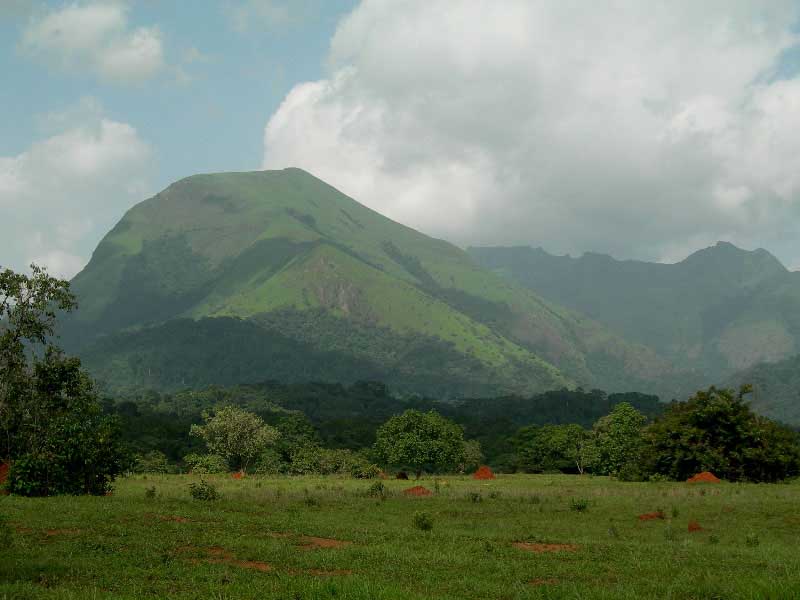
After the introductions Peter said the first thing to do was to get our passports turned in to the main office. Pete handed his over, when asked where was mine, I said I don't have one! To this day I can still see the expression on his face, but after retelling the airport story, he said leave it with him. Then it was off to the mess hall, alongside this was the guest house where we booked in. We were told to stay off Sunday, Norman had arrived three days earlier, so he could show us around. We sat in the mess hall on the veranda, looking down onto the community, and up to the mountains, the scenery was spectacular. Norman told us to order what food we wanted, sign the book and the company would pay. He said the sleeping accommodation was very good. After our meal we went to the pool bar, next to tennis courts and Olympic size swimming pool, it was more like a holiday camp. In the pool bar we spent all night being introduced to a variety of local workers; school teachers, mine workers, railroad, transport mechanics, admin people, you name it, this was a big community.
Having taken the Sunday off, we were picked up on Monday morning at 7am and taken to the training school. The school was well laid out on the Swedish style, having a model railway with 3 locomotives and 90 cars. We were given book after book, rule books, books on all the traction, yard books, so many! Then followed a flask, spanners and flashlights, all to be kept in an engineman's bag which was now somewhat heavy. Also collected from the railroad stores were two important items, a cool box and cool seat, a real necessity. We chatted for most of the first day, meeting the other drivers as they dropped in to see us. We soon began to settle in.
April 7th, our second week, we are put on the local switching job with a driver. Switcher 1, 11, 111, the ore bins trips switch 1V local shunt. I had left my short wave radio in school!
Revolution is in the air
We were in school on Saturday April 12th when our world was suddenly turned upside down. Master sergeant Samuel Kanyon Doe had taken over the country by force. How unlucky can you be! We were listening to the radio, things were getting worse, members of the government were being shot on the beach. Expatriate women were being sent over the border to the Ivory Coast for safety. Peter told the three of us to go to the mess hall and stay there. Thinking back nobody cared what happened to us. So from 1847 to 1980 the country had been ruled by Americo Liberians, then the week we arrive the indigenous people take it back, that's what you call bad timing! The Americo Liberians were slaves who had returned to Africa from the United States and the West Indies, on ships supplied by the U S government.
We learned William Tolbert Jnr was dead along with other members of the ousted government. The only phones working were those internal lines that were tied into the messhall. This part is a bit vague. I think Norman & myself were outside on the patio having a drink, Norman was very jovial, so we got on well together, I can't remember where Pete was. All of a sudden rebel forces came running in, I was sitting facing the doorway. These men had no uniforms. One came over to us with a machete, he said this is our country now, the real soldiers are following. He had his machete in his hand close to Norman's head. He then said, you buy me a drink, I said you buy us a drink, and we will buy you one, stupid thing to say I know, Norman is sweating somewhat. He then said, don't worry we have been told not to harm LAMCO people. I told him to go and have a drink at the bar. I think we needed another drink too, especially Norman!
When we looked outside, the Americo Liberian bank manager was lying face down. A man with a gun was hovering over him, despite the apparent danger the bank manager was not harmed. We decided to go to our rooms until things got a bit quieter. Later on the real soldiers arrived, they told us we were safe and not to worry. Then they raided the bar and took some bottles of booze. Guards were posted outside the messhall to ensure our safety.
Throughout the day we were joined by others fleeing Monrovia for the presumed safety of the mountains. These included two CIA agents Bob and a guy from Rio; two female American school teachers, one from Boise, Idaho, the other from California; one British guy from a bank and a couple from Venezuela, with their daughter, they were United Nations workers. They were to be our friends for the next four days and stayed in the guest house. There was now a curfew. Peter had phoned to make sure we were all right and told us to sit tight. The CIA guys were a good laugh, of an evening the guy in charge of the messhall, I think he was Swiss, would leave big tubs of ice, Gin, Vodka, Martini, Whiskey and mixers out for us. We sat on the patio playing charades, Norman and I enjoyed this. Also of vital importance was the club beer, brewed by a Swiss consortium in Monrovia. It was a very good brew and along with the malaria tablets no doubt stopped me from getting malaria! Every day around 10am Bob and his partner would go off somewhere, I asked him that night where had they been going, they said to the diamond mine, who knows?
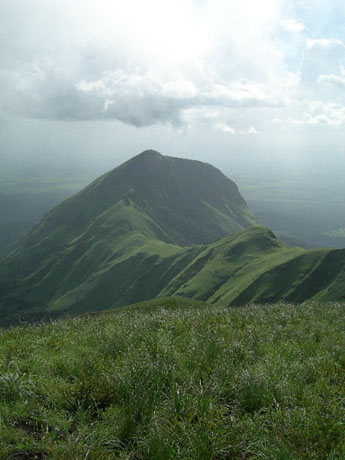
Despite everything it was beginning to feel like we were on holiday. My diary indicates we went back to school on Thursday April 17th.
Back on Merseyside the alarming news coming out of Liberia was of course of very great concern to my family. I had been able to phone my wife, who had also been contacted by a company rep who had told her everything was OK, she said to me how can it be OK when the prime time news had shown members of the government tied to poles on the beach and being shot. I said quite right it had been very stressful, but everything was now alright.
Before leaving the UK we had received all the necessary injections, yellow fever, cholera, tetanus and also started taking malaria tablets, two a week. So while in the training school we visited the hospital to obtain a supply of malaria tablets. Then it was off to the main office for ID cards and other needed documents etc. We were told we would be assigned a house when the family arrived.
 |
A company map showing the route of the railway. The west end of the line was at Buchanan on the Atlantic coast, whilst Nimba was at the very eastern edge of Liberia, bordering the Ivory Coast and Guinea. The line was virtually a straight shot from the coast to the iron ore facilities, running along a NE/SW axis. The route roughly paralleled the St John River for much of its length. Image courtesy collection of Mal. |
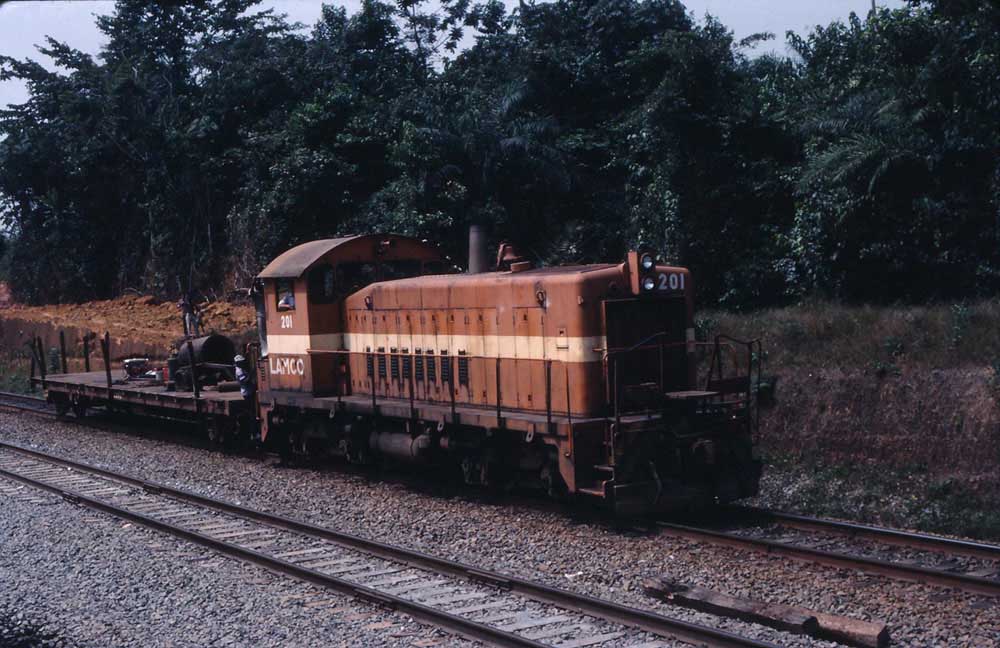
Later that week we passed our rules and regulations. From Buchanan to the ore bins at Nimba it was a distance of 266 km. There were nine stations on the line, each with passing tracks. The operation of the line was controlled from Nimba by microwave radio relay, computerized signaling system. At each station cabin there were two stationary diesel engines. One was always working, the other was a back up - these provided power to supply the needs of each station, the points, signals etc. Terminology on the railroad was truly American. There were loaded iron ore and log trains down to Buchanan. Empty cars returned to Nimba. We also had box cars, sand and stone gondolas, bogie cars, oil tankers. All for supplies, and of course the railbus, down and back once a day. Additionally on a daily basis the trollies would go out to inspect and maintain the track and signals. Nearly all of the track had wooden ties, closer together than in the UK, and the running rails were heavier, because of the weight of the trains, the weight of three locomotives combined was over 500 tons.
As for driving we were each allocated to a driver on the line, to instruct us. We had a graph of the line marked off in different colours, for dynamic braking, coasting, power, full power, dynamic and air braking. Marked at different Km posts. I found the American terminology easy to understand, you had ground relay instead of earth fault, transition in place of weak fields, and so on. I had decided to split the line into sections. Drive without the graph as I progressed, I felt comfortable with the train, drove it like a loose coupled. You would soon know if you were driving wrong, by the snatches you would get. When my instructor saw I was doing well, this plonker of a driver would come over to my side of the locomotive and try to distract me. I would ask questions about engines and he would fob me off with changing conversations, he talked incessantly. We lodged in the old town in Buchanan, which was a bit of a dump, if your room's air conditioning was not working properly you got very little sleep. That is assuming the humidity, traffic noise or people talking outside weren't already keeping you awake.
By now I was getting to know the trainmen, they seemed a happy bunch of boys from all over the country, from different tribes. After a month the railroad superintendent wanted to see us to find out how we were doing, at this time my instructor had not released me to go down the line alone. I could not understand this so I said to the chief, put me with Bobby Grant, an ex-Haymarket man for one trip. After this one trip with Bob, he said to me no problems you are very good. I was on my own now, I'll say no more about my line instructor, other than I knew more than him about railway working. Pete and Norman passed out not long after me, so we were all on our own now. At that time there were three Swedish drivers still left, Ake Johansson, Karley Nilsson and Tulah Anaved, one had been there almost twenty years. The chief dispatcher was Rolf Neilsson.
One day after arriving in Buchanan, this would have been in the early years, I asked the trainman would he like to go for a meal with me at the country club? Yes, he said he would love to. After getting showered off we went, we sat at the bar in the club and ordered two peppered chickens and a large beer. We're chatting away and the meal arrives, soon getting stuck in enjoying the meal. I had just finished but my trainman was chewing the bones, It was a whole chicken they served, I'm looking around, some other expats are looking my trainman - he had eaten everything, not a bone in sight, just a mound of sand like remnants on his plate. What to do!
The time was approaching when our wives and families were coming out. Before settling in to our first house, a local school teacher took six weeks holiday and asked if I wanted to stay in her house for that time. So I left the guest house for a three bedroomed bungalow, I met the house boy, they had no dog.
The big day arrived, I went to Buchanan to meet the wife and kids, everything was fine. They had changed planes in Abidjan, whilst sitting in the departure lounge a boy was catching flies with his tongue, which the kids found very amusing. I remember standing outside the front door of the house where we were staying, fiddling with the key. Nearby was a red ants nest, the wife's feet were being bitten, she was jumping around saying what kind of place have you brought us to! With the family now in town I was given a day off to show them around. The schoolteacher's house was near the town center and close to all the shops.
We had a couple of unexpected visitors, unfortunately sustaining two break-ins by 'rogues' (the local term for burglars). The first occurrence, during the visit of the 'gold man' saw some trinkets stolen, the second one involved the eating of my sandwiches from the fridge, this was a little disconcerting as I was going down the line the next night and the family would be alone. The story of the events made the rounds and a driver who's wife and family had recently gone home offered us his dog, Frisky. He said there was no longer anything of importance in his house. Frisky was the perfect dog, on the outside he was growling, barking, frightening; on the inside he was one big soft loveable dog. We took Frisky home and the next night whilst I was out on the line the rogues struck again, but this time they were unprepared for Frisky and they ran off, never to bother us again. All the houses had metal bars on the windows, however the rogues would put the thinnest kid through bars, he would then hand stuff off to those outside. The 'gold man' came from the Ivory Coast, visiting the community about once a month, selling gold items. They were good but the gold had some impurities in it.
A type of normality descended, the children settled into the International school and the wife made friends with the other 'railroad' wives, everything was going fine. One night we're having a drink down at the center, around 8pm, when up drives the new general manager John Pavola, big American guy, being shown around by the second in command Rune Osterlund. They sat down by us and ordered a drink, this was the American open door policy, talk to the workers! Later on as we got up to leave they offered us a lift to our house, which we accepted, but were concerned that we would then have to invite them in for a drink. There was a small amount of liquor in the house including some Drambuie whiskey. They took two drinks said goodnight and left. In the conversations I told them I had not long arrived. By the next day everyone in the community knew we had 'entertained' the new boss!
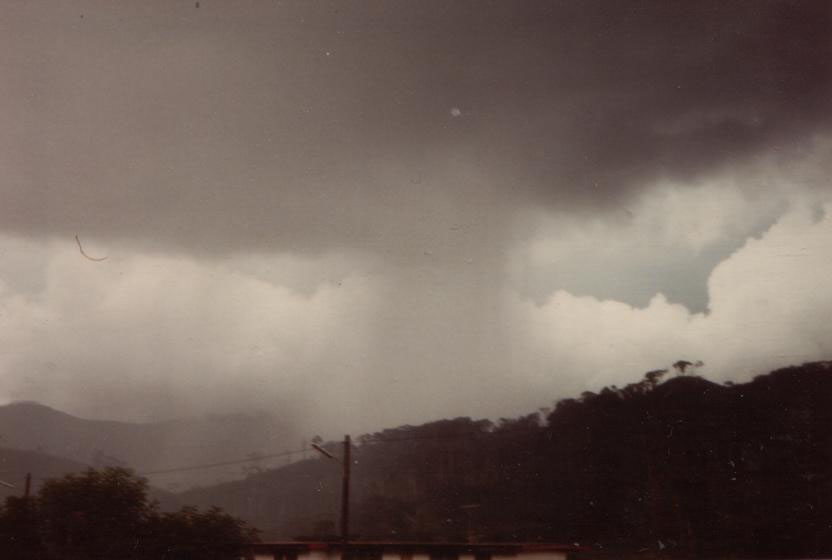
Our time at the borrowed schoolteacher's home ended suddenly when we were offered an older two bedroom house in another area, which we accepted. Now with the family permanently settled and things falling into place I could enjoy my work a little more. Some of the children's school books allowed me to identify the great variety of wildlife that was new to me as I worked the trains up & down the line. The first big birds you noticed were the Allied hornbills, then the civet cats in the dark, and a whole collection of reptiles, butterflies, insects and animals, frequently whilst waiting for a train to pass I had something to study.
Uncertainties created by the civil unrest, such as workers choosing not to renew contracts were addressed one day when all employees were told to meet in the messhall. All the chiefs were there including the general manager John Pavola. He stood up and announced that since the troubles the company were going to put US$200 a month into American Life Insurance Company (ALICO) for as long as you stayed in the company. Additionally when you got your pay raise that could be taken or put into ALICO. Everybody clapped, Norman said we arrived at the right time, I wasn't so sure. I asked another enginman about the pay raises. He said when your contract ended and you haven't caused any trouble they would renew. You negotiated the pay raise within certain boundaries, apparently they liked to give everybody different amounts!
March brought the rainy season, but it didn't matter, I was enjoying the jobs on the line. For instance train 15 down departed at 08.30, we stopped at Tropoi to pick logs up, usually 10 bogies, the logs were hard wood and very heavy, the switcher locomotive would shunt them on to the rear of train, which would put this train over length. We'd arrive at Buchanan at 15.45, take a rest break and then work back with train 20, departing 00.30 and arriving Nimba at 07.30.
With train 11, we'd depart at 00.20 down and arrive at 07.25, then a rest break and work back with train 52 railbus, departing 16.30 and arriving Nimba at 21.30, just an example. On the line you were paid expenses for breakfast, lunch, dinner etc, all tax free. There were seven trains down and seven trains back, round the clock. On Sunday there were work extras, maintenance trains and a fuel train once a month for the stations.
There was a switcher at the workshops daily 07.00 to 16.00, every day one locomotive had to go in for full maintenance. The workshops could handle every kind of job on the locomotives including engine changes and were able to keep the fleet running. Sadly the 350hp shunters shipped out from the United Kingdom were not up to the job, they were very rarely used. I did have one shunting one day but they were too light, half way through the shift I changed to one of the SW9 switchers. The yardmen and trainmen hated them. One of my mates in the workshop was Dave Lewis, ex Landore man, he used to tell me about the locomotives. On the BR engines you had to wait for parts for the locomotives, the GM/EMD engines however had parts that were interchangeable. Much better engines and more reliable.
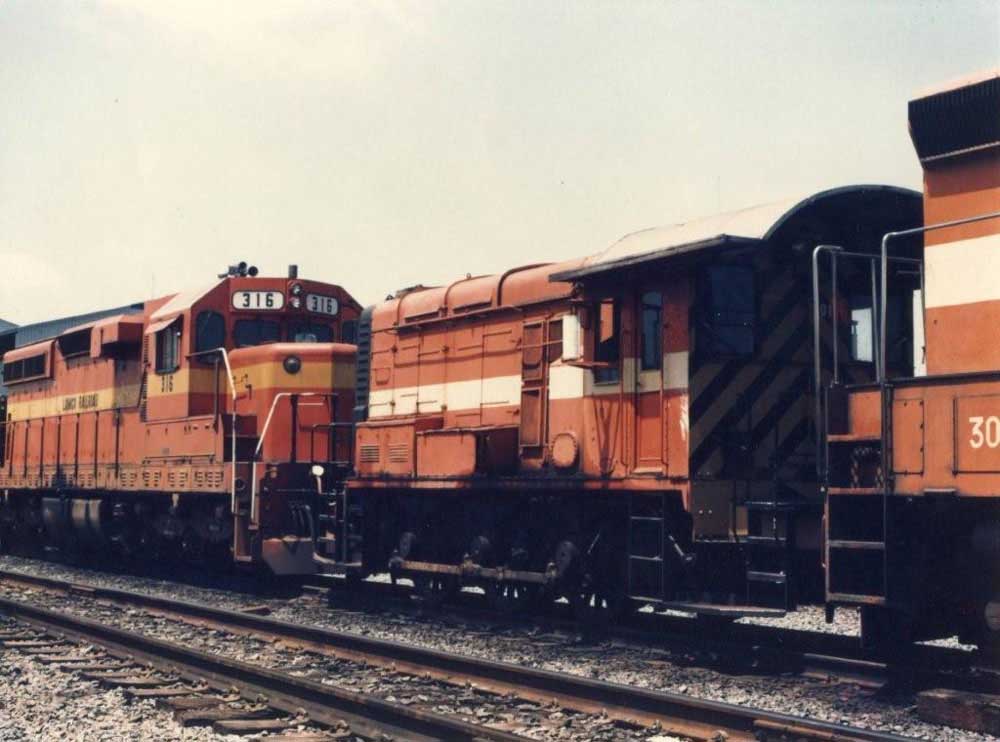
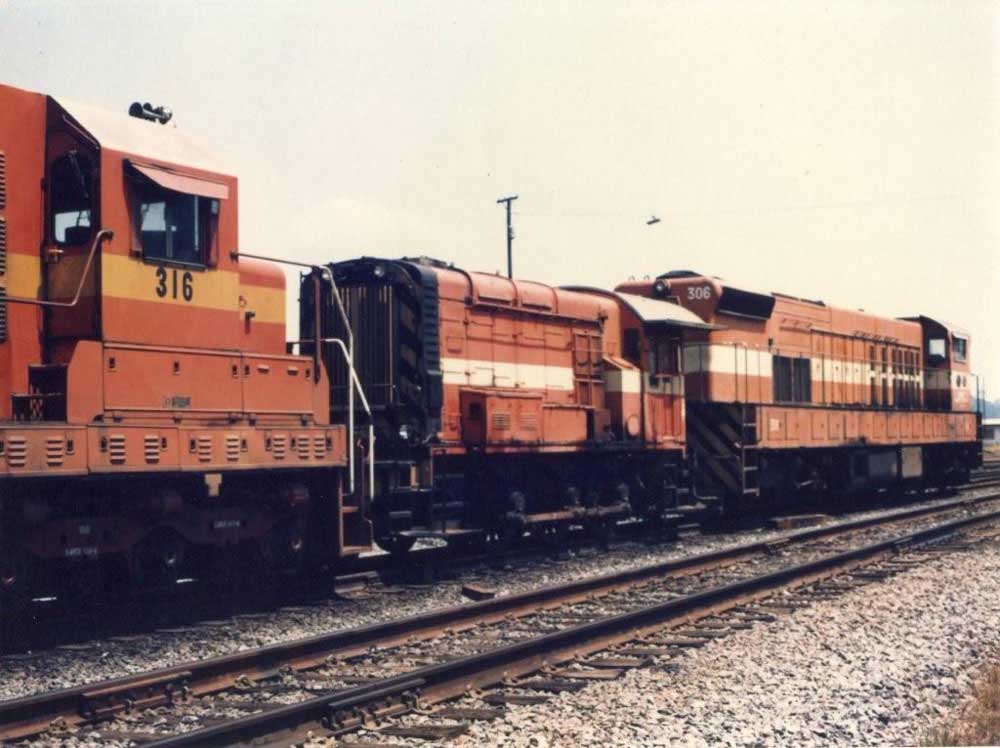
The modifications to the Class 08 shunters destined for Liberia included:
Buckeye couplers fitted.
Vacuum brake removed, air brakes fitted.
Air pipes for the train brakes.
Four headlights fitted (front & back).
Air horn (replacing the whistle).
Cab controls revised to accommodate the air brakes.
Two-way radio installed.
Fuel transfer pump handle removed from inside the cab and placed next to the pump below the cab.
Side mirrors fitted to each cabside.
Substantial roof extension to provide extra shade to the cab.
Extended front and rear platforms, with footsteps, at each end of the locomotive.
The ore bin trips were worked by Enginemen 2 whilst Enginemen 3 were for yard work only, these positions were held by Liberians. Some times you would get switch 4, its first job was to pick up supplies, food container first, to the quay for our food for the cold store. All business run by Lebanese, they would be waiting for the food container, I would always ask if there were special or different food inside, so I could ring wife and tell her what would be in store later! Some foods were in short supply, sometimes potatoes. I did ask one of the Lebanese how they got the food to us, he told me they brought it down over the Sahara, who knows. The second job was sand for brickyard, dynamite up to the ore bins, box cars for warehouse, tank cars for fuel dump and so on. This was a busy job and also included ore cars for repairs which were swapped for repaired cars. At Buchanan they had a switcher for shunting loaded cars, 30 cars at a time. A switcher on the dock estate for working round the port.
Some jobs ran with two big six axle units and a smaller switcher. My first trip with this type of combination led to a slower journey of course, but the job still got done. Some of the drivers who had been there a long time did not use the series/parallel switch on the leading locomotive which had to be one of the big ones. When speed dropped below 15kph the switcher could not make transition, so you had to put the switch to series, the switcher would then burst into life and you'd then have all three locomotives pulling.

Having just got nicely settled the school authorities intervened, saying it was not right to have a boy and girl in same room, the youngest boy was seven at that time. So we were moved into a fairly new three bedroom house. It was a lovely spacious bungalow, even the house boy had his own shower. But we were now further away from the town center, so I needed a car! Swedish driver Karley Nilsson volunteered one, it had been in his garden for over a year. We went over to look at it, taking a workshop fitter with me. The car was a 1959 VW Beetle with flat tires, paint worn off, looking a sorry sight. But it did have a spare tire and tools. The fitter looked it over, got some fuel and started her up, it spluttered a bit and then settled down. The paperwork was signed over, money exchanged ($500) and the car gave no trouble. I gave some spare parts to the fitter for his time.
Later that year we moved from the camp in Buchanan town, to a better much quieter lodging near the railroad. During 1980 three drivers leave, as three new ones arrive, from Sheffield, Gatwick (ex-Blackpool), and our first from Toton. The first two were out alone, Pete Fisher, from Toton was bringing his family out. We invited him for dinner, told him as much as we knew, this had happened to Norman and myself not long after arriving, when John Smith an instructor had invited us for dinner, helps you settle in.
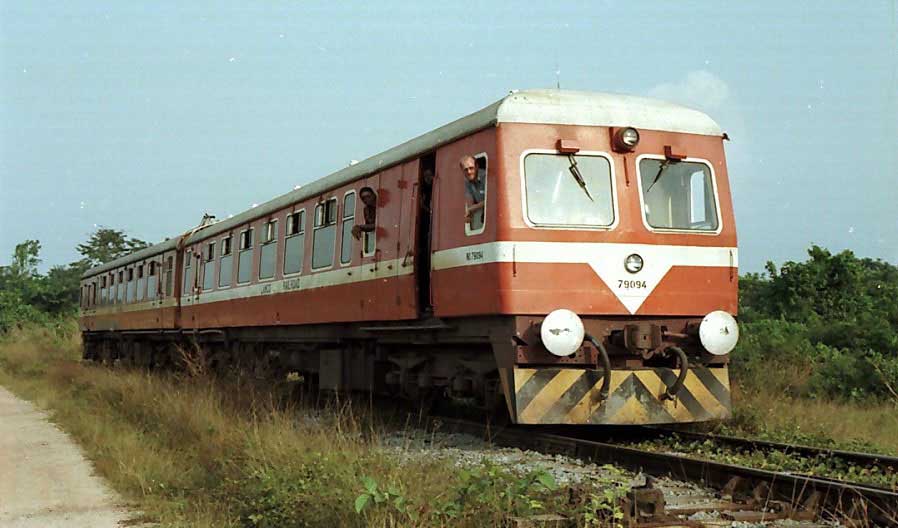
Back to the railbus, the leading coach was kept for employees, the rear coach was for paying passengers. The Guinea women would take vegetables down to Buchanan and bring fish back, so the rear coach smelled a bit. In the rainy season sometimes the road could be washed out, so the railbus was the only link. When you arrived at Buchanan you would reverse around the Y track. You always had people coming up to the cab asking if you could take something or other and somebody will collect at a particular station. One evening some guy said you have to give this big elephant's tusk to one of the bosses! There was a big container in the guards van full of ice for selling beer and soft drinks. I enjoyed the experience of being on the railbus, the maximum speed was 100kmh. You were lucky to get back to Nimba with all four engines still running!
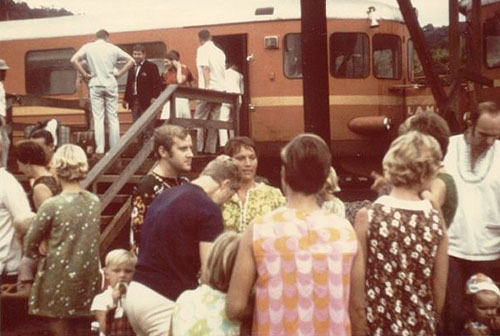
The family were all settled now, the wife had made new friends, they would be down at the bakery in the morning, up at pool during the afternoon. Pete Fisher's family had arrived, his son a similar age to mine. I had found out you could take your vacation between eight months of arriving and sixteen months. Not knowing how things were going to pan out, I said to wife we should go on vacation early. We went to see the KLM agent, he visited LAMCO to offer excursions. I had a big travel entitlement with five in the family including open tickets home. The KLM agent would offer excursion tickets at much lower prices than my entitlement, but you had to be back within six weeks or the ticket was void. After booking all the flights through the KLM agent we were left with about $2,000 in miscellaneous credit orders (MCO's). These could be used for future flights, car hire, hotels etc.
The agent asked where did we want to go, some people had already been to the recently opened Disney World, so we started planning. The trip took place in December 1980, just reaching our destination was a challenge! A KLM DC8 took us from Monrovia to Casablanca where we overnighted in a hotel. Next day a Royal Air Marocco B747 took us to New York, changing here to an Eastern Airlines flight to Orlando. We stayed one week here and saw all the sights; Disney, Sea World, Busch Gardens, Daytona Beach. Then it was off on a Delta Tri-Star to Los Angeles for another week's adventures, doing all the tourist stuff including the Queen Mary and a trip across the border to Tijuana, Mexico, its probably a good thing the rental car company didn't know about this bit. Then it was back to Merseyside with a British Airways B747 to Heathrow, with a connecting flight to Liverpool on a British Midland Viscount. After one month at home it was back to LAMCO, a KLM DC9 from Manchester to Amsterdam and then on to Monrovia with another KLM DC9.
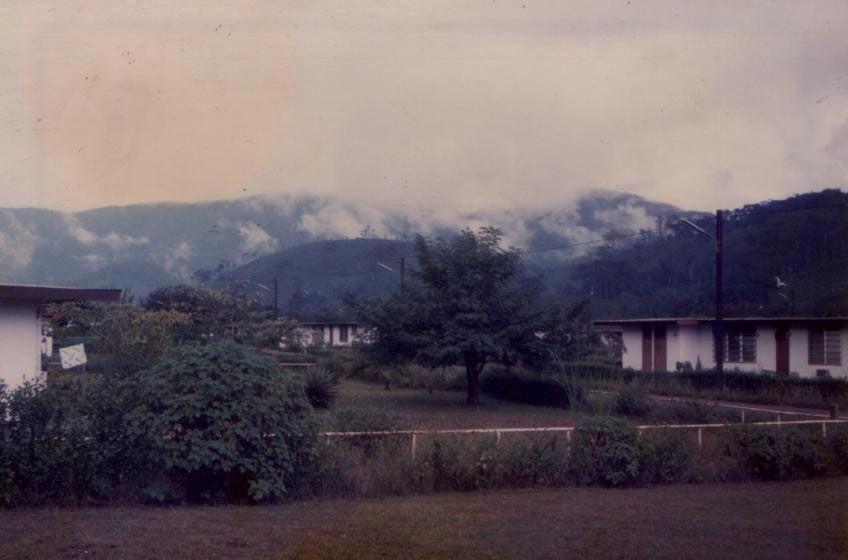
1981
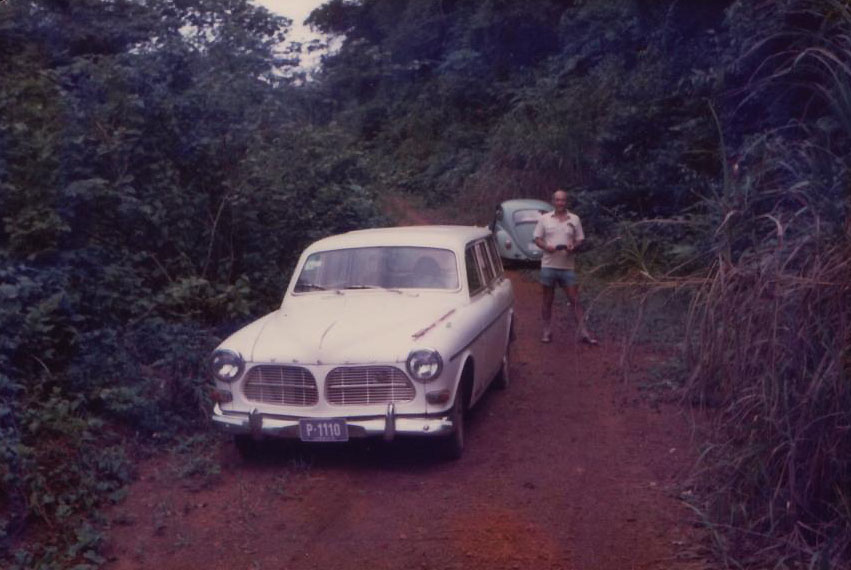
Now into 1981 we were back at work and grateful for the extra space in the three bedroom bungalow. Pete Fisher had obtained a 1960 Volvo Estate, so on our days off together we would go out into the bush and have adventures as only two Englishman could. The dog would go with us and we wandered around so much that more than likely we entered Guinea without realising it! And any resemblance that the Liberian countryside might have had to England fell apart when you met up with the local wildlife!
Whilst out on the line a driver offered me a baby mongoose which we took home as a pet for our daughter. It was very fast, it would nip the ears of any visitors who sat down and was well known for its speed in removing food from the frying pan - it was fast and agile. It was a good pet, but after two years it disappeared and believed to have been turned into a meal by a neighbouring Liberian family. A few weeks later the boys walked in with a pangolin, this thing started climbing the wall! But then things got far worse - they started collecting snakes! At first it was the water snakes, then frog eating snakes, and later a file snake. Next came a spitting cobra, a tree viper, then a rhinoceros viper, deadly poisonous. The locals were selling the snakes for a few pennies each at a location near the golf course. My son kept them in Perspex boxes on the patio, one night the tree viper got in with the night adders, next morning the latter were dead. After that they started collecting scorpions! Where we were living was home to many snakes, including the Gaboon viper and the pythons, which were also a delicacy for the Liberians. Given the chance the locals would eat all animals and reptiles.
Whilst shunting at Tokadeh, Daniel Bubu my trainman walks up with a basket made out of grass, 'What's in the basket? I ask. Oh, just a Cassava snake, Gaboon viper and a short fat snake. He said it only bites if you tread on it, dead of course, with the head chopped off! From my note book the following wildlife sightings from the train were recorded:
March 1st 1981, train 13, large deer at km 218 04.30am very misty, termites out 06.15am, kingfishers everywhere and the egrets still here.
March 12th 1981, raining more frequent now, small green & yellow bird at Tokadeh, black lines on face, not identified yet, egrets still around.
March 13th 1981, 05.05am at km 113 we ran over a pangolin walking in rain on rail, plenty of civet cats - spotted at least six, first sighting of genet cat long neck, in tree.
March 20th 1981, red deer at km 56, 04.15am, when passing km 15.5 at 05.25am three hunters were noted carrying a small red deer, they laid the deer on the ground so we could see their night's work.
April 11th 1981, train 11, km 66, ran over a civet cat, trainman Bubu begged me to stop, after bringing the train to a stand we pushed back to find the animal, Daniel found the mangled cat, he climbed back on the locomotive with blood all over him and squashed the cat into his cool box and sat down smiling.
Another English driver arrived, Roy Wort from Redhill. One night driver Gunner Ljunggren had his home burgled, a fight had occurred with Gunner grabbing a sword off the wall to defend himself, unfortunately he ended up with his hands slashed by the very same sword. The rogues got away apparently with some alcohol. That night I was on the night train to Nimba, the dispatcher told me to stop at Saniquelle, westbound train 13 had a failed locomotive and they needed to take one of mine. So from Saniquelle onwards I was running long hood forward. We reached Nimba safely and then went home. However the next morning the first trolley down line found two bodies on a crossing, apparently drunk with alcohol taken from Gunners, close investigation found they also had other items belonging to him. Justice had been done. It is presumed that my eastbound train had run over the two people, my first fatalities, though running long hood forward, at night, with such heavy locomotives would provide no clue that you had hit anyone.
Two more drivers arrive from the UK whilst two Swedes leave. With the expats the railroad was now nearly all Brits, whilst the whole company was a 50/50 split between the Swedish and the British.
The start of the of the rainy season brought an amazing sight as termites (the Buga Bugs as the Liberians called them) took to the air. They would come out of the termite mounds all together, we had three mounds in our garden about four to five feet high. It was like watching clouds of dust erupting from the mounds, an untold number of them. They each had four wings which would fall off when they landed, so now you had millions of termite wings all over the place, which then attracted the birds! The railway was not immune to this event. They would be heaped up on the walkway behind the door of the locomotives. The Liberians would put a lamp in a bowl and attract them, very soon the bowl would be full. They'd start the process over until they had enough to fry them in oil, put them in jars and save for later! As for the termite mounds in our garden a digger came to knock the mounds down. At the bottom of the mound was a delicacy, the termite queen. Unfortunately for the digger our houseboy jumped on to the remnants of one of the mounds and made off with the delicacy.
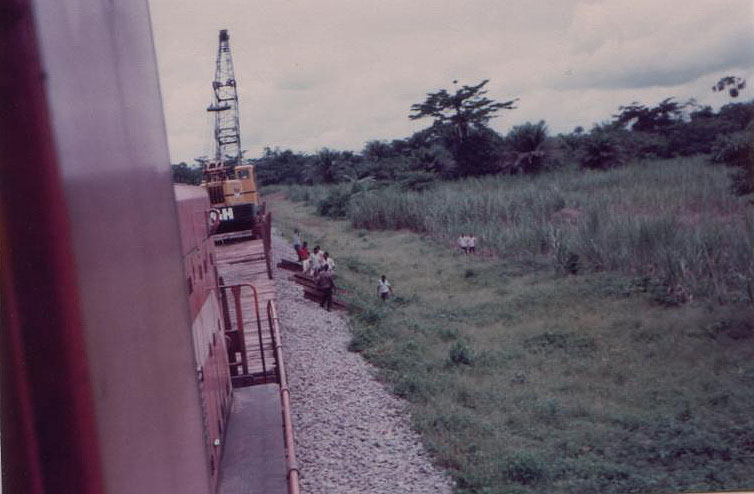
In October 1981 a second Toton driver, Dennis Hawksworth comes out. Friends are soon made and we learn his girlfriend will be coming out, they will end up getting married in Liberia.
Our second Christmas in Liberia saw my mum and dad out come out for the holiday. The previously unusued MCOs from our trip to the USA would pay for their trip, my dad had been to Liberia before as a seaman. Many others made the trip to Liberia for Christmas, enough to charter a flight. Bad weather in the UK delayed the DAN Air 737 (?) which required refuelling in the Canary Isles. The idyllic Christmas card scenes of England were no match for the fair weather and warm temperatures of a Liberian Christmas holiday. On some weekends we'd go down to Buchanan, I would borrow the brake testers pick up and off we'd go to the beach, with its rows of palm trees, warm seas, golden sands and a meal at the Nautical Club. At the end of the day we'd take the railbus back.
There were more celebrations with the big Valentines Day wedding of recently arrived ex-Toton driver Dennis and his bride Kay. The priest came to the house to perform the ceremony. Pete was the best man, there was a big party, a good time was had by all.
Another new driver arrives, Alex Cowie from Glasgow. It seems the personnel changes were now becoming more frequent.
We join the Caledonian Society, Alex Maclean, the head of the locomotive workshops is on the committee, he is also the British Caledonian Rep and additionally works with the British Consulate in sorting people's passport problems. The society provides a means of keeping expatriate Scotsmen in touch with their traditions. This included celebrating the likes of St Andrews Day (November 30th) and Burn's supper (January 25th). These are social evenings to look forward to with Scottish dancing, sit down dinners, including haggis being piped in with a piper specially flown in by British Caledonian Air.
Christmas 1981 finds us invited to trainman Wilson Johnson's house for the seasons festivities and the exchange of gifts. Wilson was a good friend, he was from Sinoe county, Kru tribe. Because of our good friendship Wilson invited my wife and I to a Kru meeting, we accepted not sure what to expect. It took place at a mission hall in area P where most of the workers lived. We ended up seated on a long table next to the stage, the chiefs were seated on the stage. We were the only white people there, all the Kru people were in their traditional dress. Wilson told us we were the guests of honour and just to sit back and enjoy the evening.
All along the table were dishes that contained ground cola nuts mixed with pepper. The dancing started with the dancers reaching around the room in a big group, eventually we were invited to join the dancers. Wilson told us we had to eat the cola nuts, so we and everybody were chewing these, swilled down with soft drinks, after a while they began to taste OK. Part of the evening involved donations to the tribal chiefs, speeches in both English & their tribal tongue. Even Radio LAMCO was present, as the guests of honour we said a few words. Despite being desperate for a club beer Wilson advised it was time for more dancing. As the evening wore on so did the effect of the cola nuts! There were different types of nuts, some would suppress your appetite, others were stimulants to avoid drowsiness, whilst the ones at the meeting were aphrodisiacs!
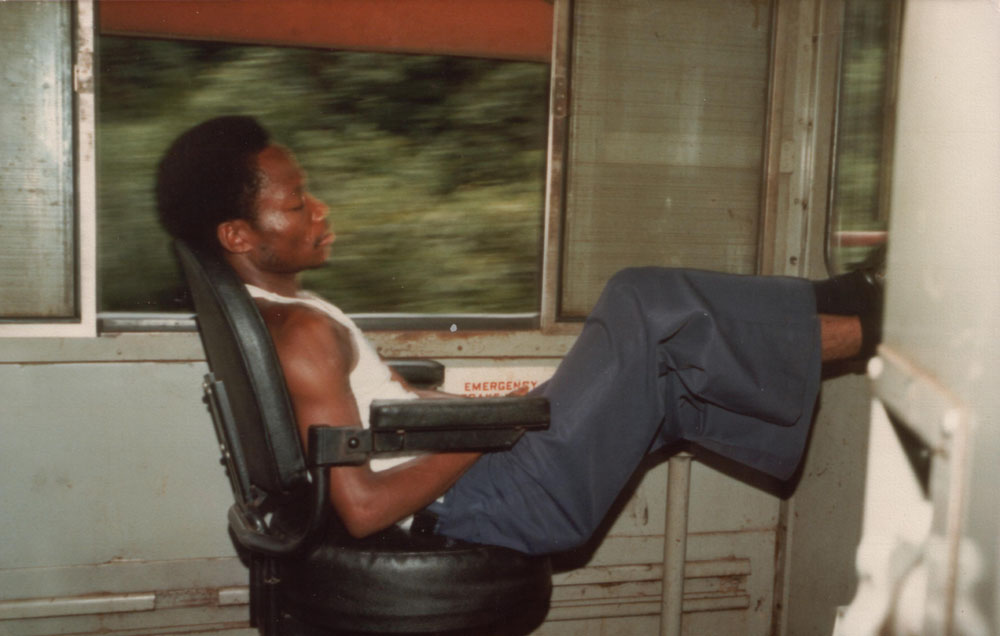
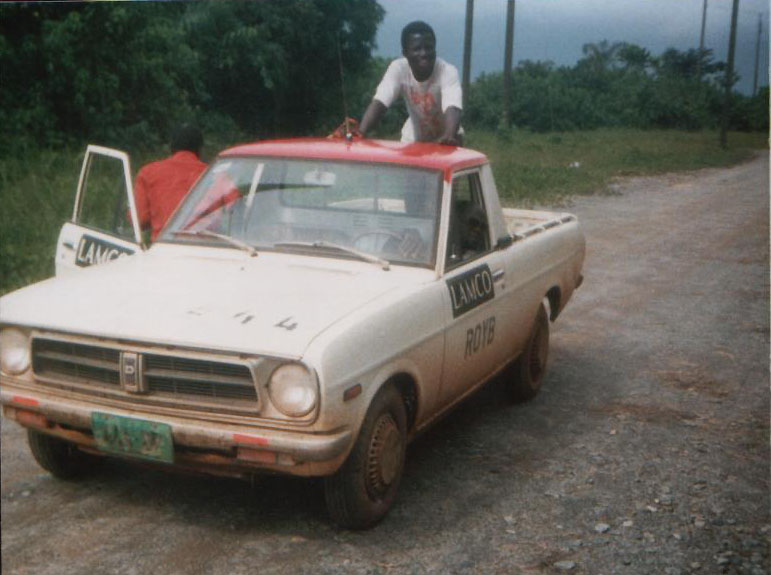
1982
Our next holiday came in March. We go to Alex to see what's on offer, and decide on a trip to the US Virgin Islands and Miami, although our daughter stayed home. As before we start out by travelling to Monrovia, where we pick up a Pan Am 747 to New York, then to St Croix on a B737, and finally to San Juan on a Hawker Siddley Prinair. We also make a round trip between San Juan & Miami on a Tri Star. Then its from San Juan to London Gatwick on a DC10.
We enjoyed St Croix and hired a car, the first thing the guy said, was will you be OK driving on left side of road? No problem there! The roads were narrow and driving on the left seemed to minimise any injuries in the collisions - well that's what the barman said at the place we stayed at! We were staying at a beachfront place called Cathy's Fancy just outside Christianstad, the barman's name was Gill, he said you don't get many Brits coming here, he made us welcome. He took us to other side of island were tourists didn't normally visit. I remember at the beach bar one day Gill said you drink twice as much beer as the Americans, when you want another, fill you own glass free! The beer was Schlitz.
In Miami we noticed the frequency in which Spanish was spoken, this gave us problems when hiring the car. The kids wanted to go back to Disney World, so we did, passing through the Everglades, enjoyed the drive, plenty of alligators to be seen. All in all it was a good vacation. Coming back from the UK we had a British Caledonian DC10.
Now back at work I remember one of the Swedish drivers saying he had coasted from Blezi station at km 77 to the coast at Buchanan! I thought I would love to try this. I don't remember the specific train but it was a 90 car train. The dispatcher was Dave Ridley and I told him what I was going to do, so he could alter the graph, there were no tapes in the locomotives. The original speedometers had been isolated and replaced by those made by Hassler. When working properly these had tapes that recorded the speed. But they kept failing and I never liked going down the line with the speedometer not working. Anyhow this day I tried it and we coasted all the way. I was amazed, although at some points we were down to 10 kmh, the highest speed was 70kmh. I was able to repeat this feat again at a later date.
Trainmen were employed to ride the locomotives to keep a check on them and report any irregularities as they occurred. They were Liberians and most of them were a happy bunch of guys. Some felt they should have been driving so were not too happy about us being there. Joe Dugbo was one of the unhappy ones, he would go off checking the locomotives and that's the last you would see of him on the trip. You could try to reach him on radio, but to no avail. I told the dispatcher one day I was stopping the train because I couldn't locate the trainman. Joe heard this on radio and as we were slowing down he suddenly appeared.
I had a talk to him about this and he opened up with all his grievances. He was upset about having been on the line for years but had not yet been picked for driving. I explained to him that going missing en route on a regular basis was not going to help his cause. He said he could drive an ore train to Buchanan, no problem. 'Is that so?' I said. At that time we were passing Tropoi station and I asked him, 'Joe if I say to you takeover the train at any point, you will be able to do it?' He said yes. Taking a risk I waited until we reached a reasonably level section just beyond Yila station, at which point Joe took over the controls. It was a case of balancing the speed with the power settings in conjuction with the feel of the train and the track gradients. In trying to regain speed too much power was applied, then he shut power off and slowed down too much. He looked over at me but I let him get on with it until on a down grade, he lost control, panicked, and told me to takeover. This I did and brought the train back under control.
After that incident he was best of mates with me, he represented the trainmen through some kind of union organisation. I was invited to his house for dinner.
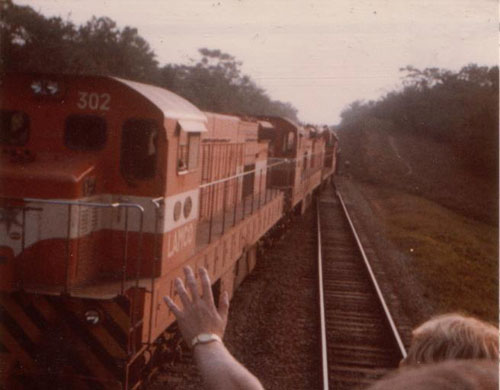
I remember going to the fuel point at Buchanan, crossing over a small stream, I looked down and a head was bobbing in the water, I told the trainman - he just said he's dead, forget it. We received new sleeping quarters at Buchanan, much better than the old accomodations, the place was called Yellow Camp, the enginemen have one side, trainmen the other. Nearby was the dumper which ran day and night, but seemed to go down more frequently at night, meaning we didn't have to get up until it was fixed. It never seemed to breakdown during the day! For dinner in Buchanan, I would go to the country club for peppered chicken, believe me, the Liberian peppers were hot. The humidity for some people was too much here, you needed an air conditioner in every room. One night whilst shunting a train in Buchanan yard I happened to look out of the trainmans side and witnessed a guy siphoning diesel fuel from the locomotive while we were on the move. This was just one of a number of incidents like this leading to the fitting of locking fuel caps.
The summer of 1982 proved to be a tragic one for the railroad when a collision claimed the life of a trainmaster. This is believed to have happened during July when the railbus was on its regular working to Nimba. On this day I was on train 15, a day turn, just before reaching Buchanan the railbus would pass you, in my case this occurred at Gaye Peter Town, from here I followed the railbus into Buchanan. After detaching the train I put the locomotives away, went to Yellow Camp for a shower and then off to the country club for a meal. By this time the railbus would have begun its return journey to Nimba. Whilst sitting down with an S & T man and his family, a report was received about a crash on the line, I'm not sure of the exact time but the first reports were sketchy, later we learn the railbus is involved.
The accident took place at km 58 on a log crossing, the railbus had hit the articulated part of the truck, knocking the truck's cab off to the side and causing the logs to tear through the other side of railcar. The railcar's roof had folded over, the very front part came to rest on the driver's cab hand brake which actually saved Stuart the driver. Regrettably trackmaster Ken Taylor, who was in charge of the track maintenance and was travelling in the cab with Stuart was killed. The news had travelled quickly up and down the line, a phone call to my wife confirmed the sad news had reached Nimba. Driver Stuart who had sustained major head injuries was found by his trainman Franklin Smith, who tied a scarf around the head wound to stop the bleeding.
The railbus had derailed but was still upright. Nobody else was seriously injured in the train but many were in shock. The line came to a standstill. With the line closed I was told to stay in Yellow Camp for the night but instead went to see Stuart at the hospital. The doctor said Stuart would survive, but would spend most of the night in surgery getting shards of glass out of the wound, then stitching the side of his face back together.
Ken had not long been out in Liberia, he was a great guy, very clever, always happy - we were all in a state of shock. I went to the hospital the next day and was able to see Stuart, but he was sedated having been worked on for most of the night. The rest is a bit vague. Not too sure when I went back to Nimba, but I did see Stuart again maybe that night, he was covered in bandages, he tried to sit up but said his back was killing him. Later they found he had a cracked bone in his back.

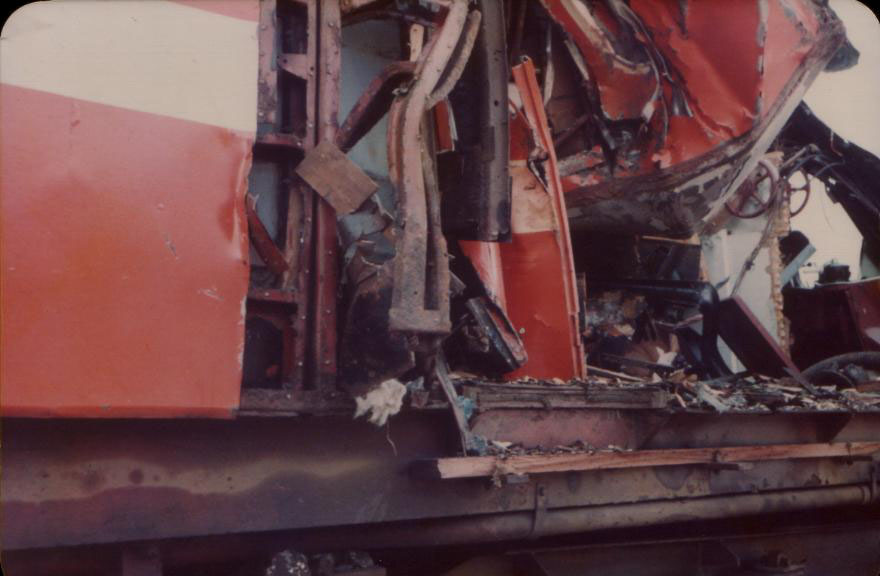
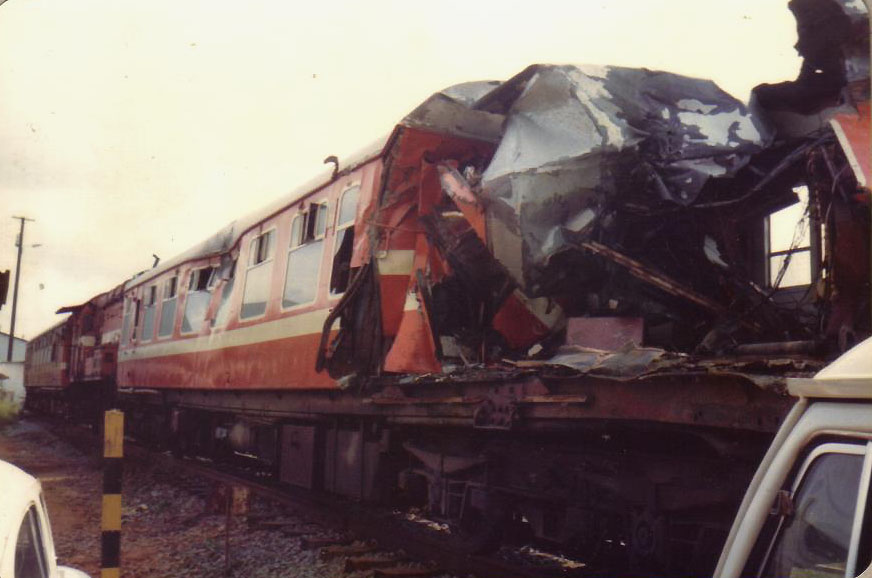
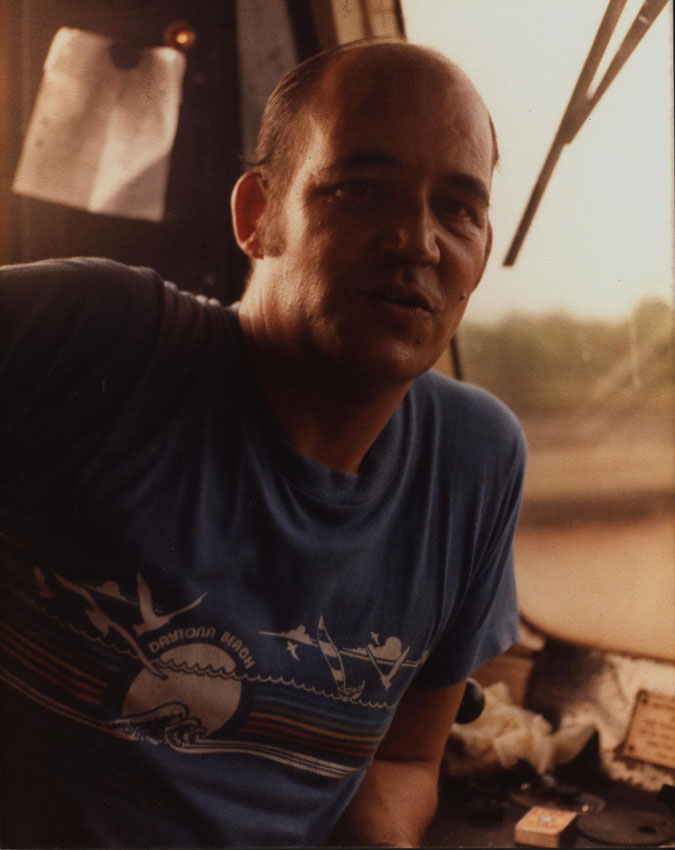
During the latter part of 1982 Stuart would be transferred from the Buchanan hospital to London, I think Guys Hospital, for major surgery. We had all been to see him and had wished him luck. During 1984 or 85 Stuart made a trip out to see everybody, apart from facial scars he had made a good recovery. He died in the late nineties, not sure of cause.
There was some good news at this time, during July Dave Lewis's wife Geraldine gave birth to a baby at the hospital in Nimba, no complications, a healthy baby girl to be named Helena. Dave's eldest son was about the same age as my youngest, so they made good friends. During 2008 their son was married in a fine ceremony in Marbella, to which we were invited and had a great time.
During the middle of 1982 Mick Boyd, another ex Toton driver arrived. One great character on the railway was big Ron Heritage, everybody's friend. He was born in Stratford upon Avon, just round the corner from the Bard's house. Ron lived with a Sierra Leone girl, had a German shepherd called Sheba, he was always there to help anybody, I remember with my dog, Ron said to me let's get the ticks off the dog, I said what ticks? He said them black lumps, when you touched them they were like little warts, he got a cigarette and burned them off. Amazing these things could not walk, full of blood.
He was very kind to the trainmen, they all loved him. I remember when socializing there would be quite a crowd of enginemen and families. We were beginning to be called the railway children! Another great Christmas and New Year were soon upon us. My wife was now in the Scottish dancing group. Pete had joined the golf club (as most of us eventually would), he had quite a good handicap, the nine hole course was right alongside the Guinea border. If you sliced your shot it would end up in Guinea. Our sons also played and won quite a few prizes, which were supplied by the sponsors such as Bridgestone, Caterpillar, British Caledonian. Every day the Guinea women, with babies on their backs & baskets on their heads would walk down from the border to the center to sell there crops & vegetables, some of which grew at the higher altitudes. Beyond Guinea the savannah started. One Sunday afternoon we were just about to have dinner when hunters walked past the house carrying two dead baboons tied to poles, hanging lifeless, even my wife was not shocked anymore, the family had seen the bush meat in area P hanging up on stalls. Also seen were the second hand clothes sent from the USA and sold to the people in area P.
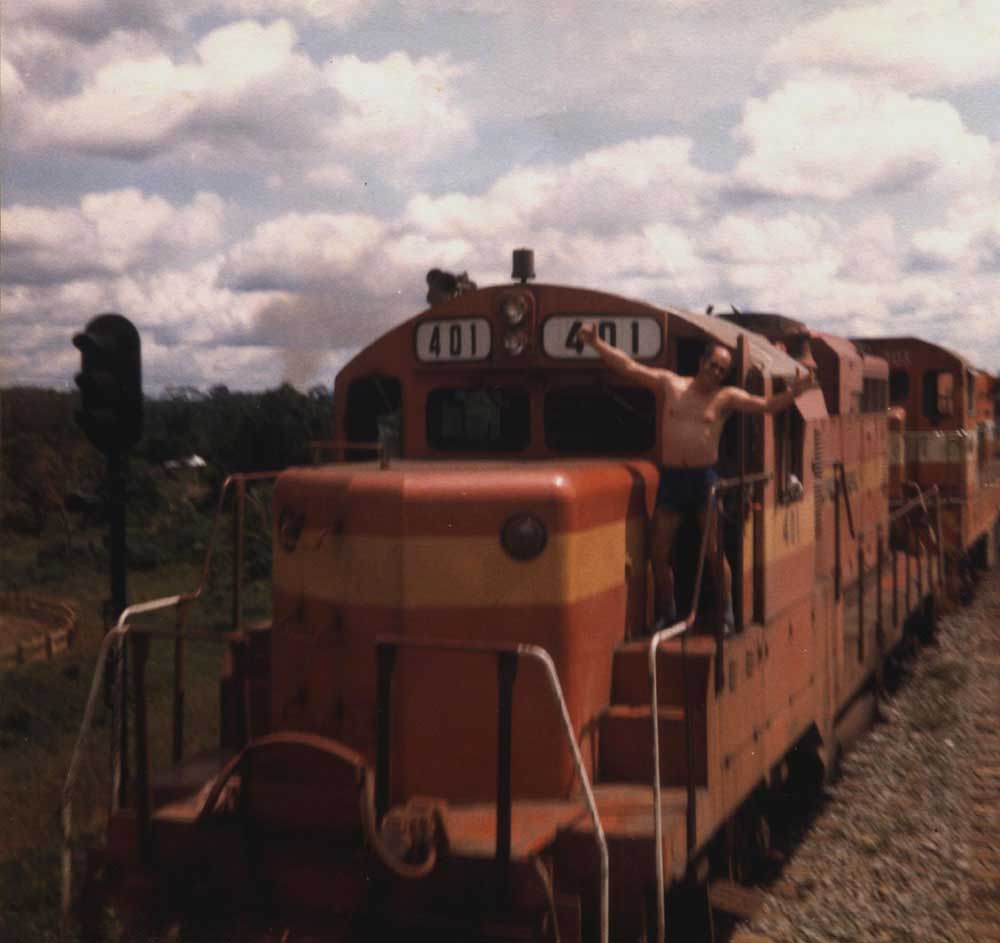
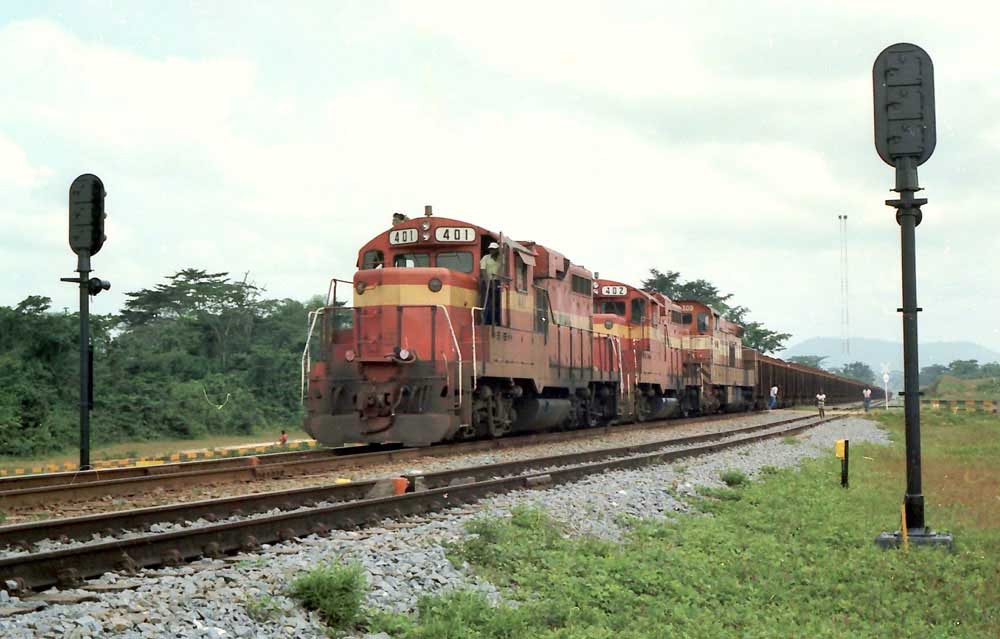
Sometime between 1982 and 1984 (can't remember the exact date), we had new neighbours just across from us. Tom and his young daughter were American, working at LAMCO on a short contract. He was some kind of engineer. I was scheduled to work train 11 down this particular night, when collecting my radio and temporary speed restriction notices from the tower, I was instructed to allow Tom to ride down to Buchanan, on special business. The train has a Henschel leading with ex-American units 401 and 402 at rear. Tom was riding in the cab with me and on the way down asks if he can walk around and check the locomotives. 'Carry on!' I say, so off he goes. About ten minutes later he returns and asks to let him know the next time we are in dynamic braking. I say what's wrong, he says he wants to check something out.
On the next down grade the dynamic brakes are used and Tom goes off to inspect the locomotives. I'm curious by now, he comes back and advises the cooling fan on 401 is not working when your braking, this causes the dynamic brake on 401 to loose 50% of its efficiency. Very good I say, and record the defect in the repair book. Apart from this its a normal trip down, Tom goes about his business. Next time I'm in the workshop Alex says thanks for reporting this defect, he didn't know how long the dynamic brake had been like that, made me feel good, although the credit was due to Tom.
1983
During April we were off again on a week's holiday. We started out with a Pan Am B747 from Monrovia to Dakar, hotel for the night here (used by the Pan Am crews on their layovers - more later about this hotel), then an Iberia Air B727 to Las Palmas, this flight must rank as one of the craziest boarding experiences we have encountered. At the departure gate you were told when you board the plane that smoking is on the right, non smoking to the left and there were no booked seats. When the door opened everybody made a charge for the plane! After everyone had obtained a seat the doors shut and we're off, upon reaching the flying altitude the steward came round throwing food packs to everybody - an apple and sandwich, whether you wanted it or not. Its a nice week in Las Palmas to unwind, hired a car and went round the island twice. Then its a B737 to Madrid followed by a brand new A300 Airbus to London. We can't wait to get home, but after two weeks you want to get back. The return is from London Gatwick to Monrovia by an A310 Airbus. On this trip I brought a video player with me, arranged with the agent before leaving, a payment of $20 ensures we'll have no problems with Customs.
Now safely back in Nimba its time to mention another aspect of the Liberian wildlife - the insects! Some of these were quite harmful, first on the list would be the mango fly. This one got me at least three times, usually on the line, for the first encounter my arm felt itchy then chased the fly away. The trainman jumped up shouting mango fly, we have to kill it. The mango fly is bigger than a house fly, it would rest on your shirt and stick its probe into your arm and start sucking your blood. We chased it everywhere round the cab, behind your cool box, under your seat, under the driver's desk where it would hide until you forgot about it. However the trainman wasn't so easily placated and would not rest until he found & killed it. My arm swelled up and really itched for about three days.
Next were the gas ants, if you put your foot near to them they would let off a foul odor. These were quite big ants. Then there was the Nairobi fly, this one never got me, but I come across some people who had come in contact with it. It was not in fact a fly but a small orange beetle that contained a toxin which when released would leave a big burn on your skin. If you squashed one and then touched yourself somewhere else the burn would transfer itself to this new area, miserable! I well remember a schoolteacher who had squashed one on her face whilst in bed and then touched her arm, the red welts lasted for a few weeks. I could put up with the mosquitoes, the itch only lasted a few hours.
The rhino beetle was the biggest in world, how these things could fly amazes me, if one hit you on the head you would feel it. I was told they only fly once. On the line they would bounce of the cab windows like a stone. People collected them, inject with formaldehyde and varnish them. The most unusual one to me was the scarab beetle, very heavy for its size, the emerald green one was the most sought after, they would like to put them in jewelry. I did catch one and put it in a matchbox, of course it chewed its way out!
My daughter became friendly with the head surgeon's daughter, so he knew our family quite well. While getting our malaria tablets from the hospital one day, Dr Dubon asked my wife if she wanted a small lump removing from her face, it had been there for years. We did not know that the doctor was a skilled cosmetic surgeon who had fled Nicaragua because of the unrest there. Within thirty minutes he had done his work, so well in fact that there was no trace of the procedure, micro stitches being used to finish the job.
Peter Fletcher had his first big derailment, whilst turning two locomotives around the 'Y' track one of them went through buffer stop and down the embankment with the other locomotive still attached. Also at this time Norman's contract was not renewed.
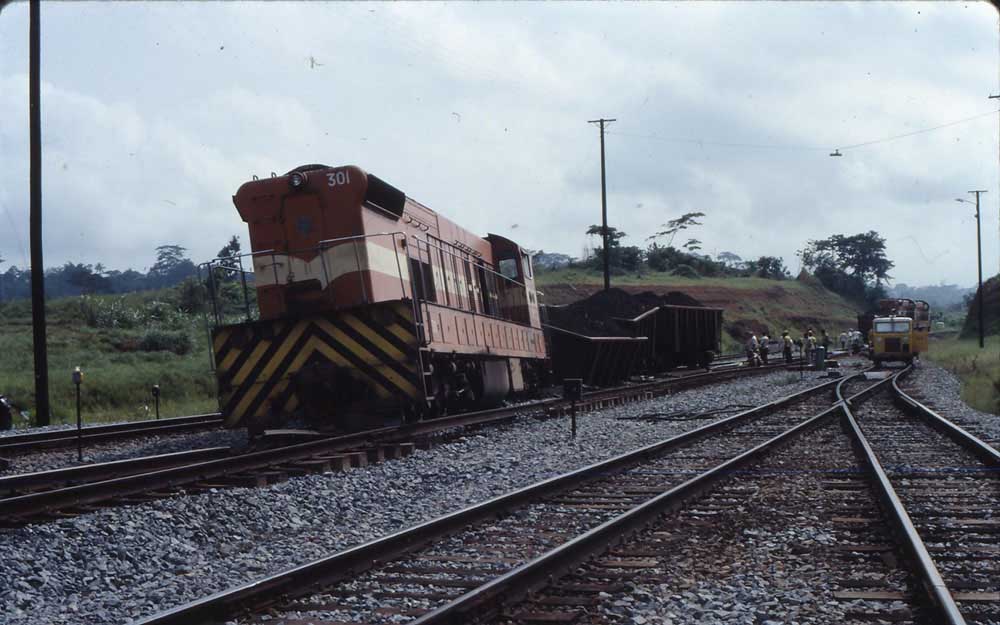
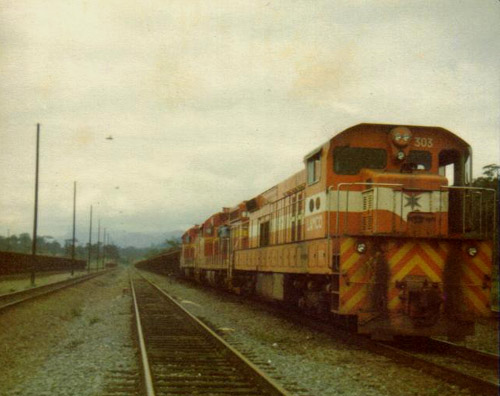
One day I was talking to Mick Boyd alongside the tower as he was taking a few pictures of three locomotives over on the main track. I noticed he had a good camera, much more elaborate than mine. In retrospect thank goodness Mick decided to bring that camera, the evidence of his fine handiwork is found across this page and in a number of other websites featuring LAMCO's locomotives.
The year ended with excellent Christmas and New Year celebrations. The Christmas season was also the time of the Hamatan winds which blew down from the Sahara for about five weeks. You knew when the winds arrived because there was red dust everywhere with these winds affecting much of West Africa.
1984
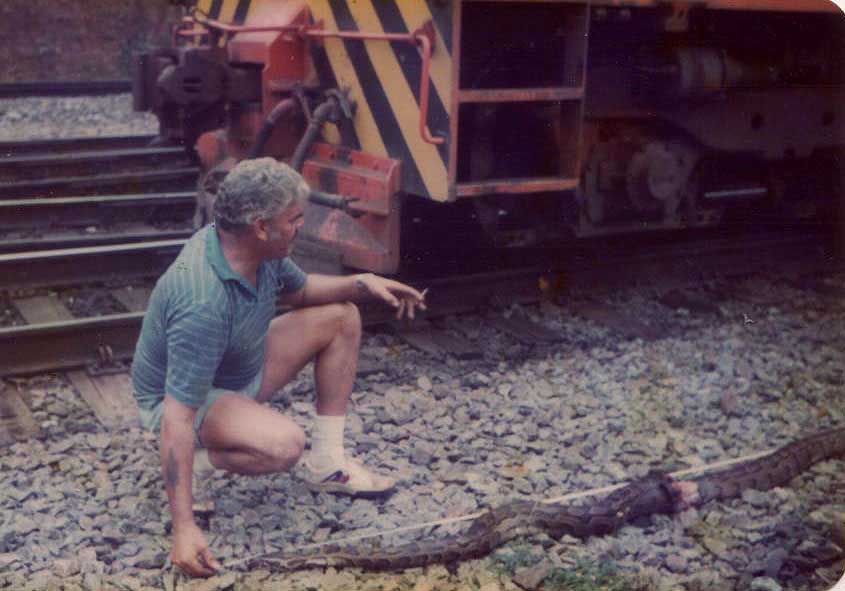
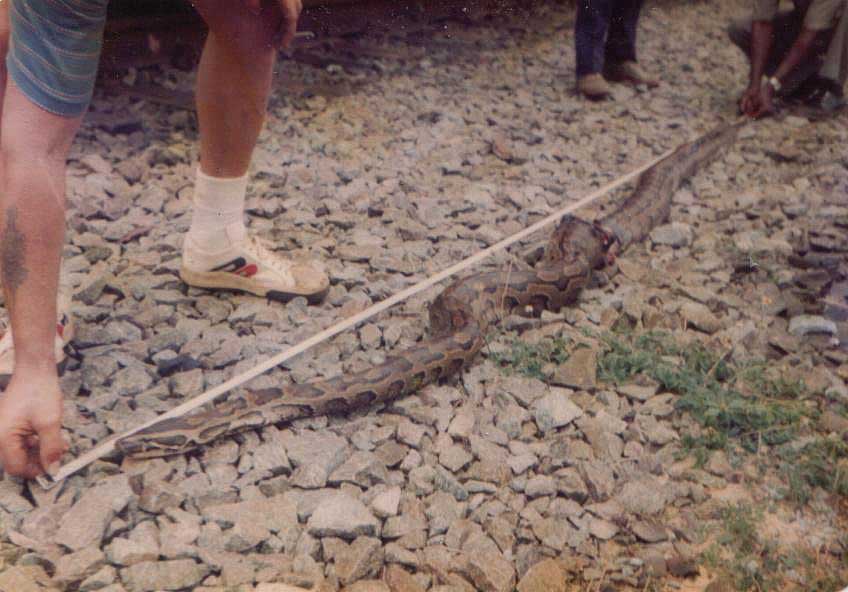

(Center) Its 10ft 9in long.
(Bottom) The trainmen take home the halved python.
The above views were taken during February. I had worked train 21 down the night before and was getting up, ready to work train 12 back, Dennis had come down with train 11 and told me he'd run over a snake at km26, asking me to keep a look out for it. So we headed back east with Train 12, Ron and his trainman were to idle back on. As requested we slowed down at km26 and spotted the snake in two pieces about ten feet apart. We stopped the train and I walked up to the part with the head, I went to pick it up and it tried to bite me, but instead bit itself on its neck. The trainman grabbed a stone and hit it on the head, picked up both pieces and dumped them on the front of the locomotive. At the first station we stopped at I phoned the wife asking her to bring the camera down to the tower. After the pictures were taken both trainmen wanted the rear part, more meat, what to do? Ron and myself decided to toss a coin, which we did, one trainman was very happy, the other one was very upset. The back half of the snake would have provided a week's meat, being cut up into steaks, I was told by an expat that python meat was delicious. Another python story - in Buchanan yard the foreman's dog was swallowed by a python, they found the python digesting the dog and shot it.
In addition to the occasional wildlife that went for a ride on the trains we also picked up stowaways, what a pain. The two night trains down - train 21 and train 11 were the ones most used by the stowaways, sometimes I think the yardmen were involved, putting them on board. If they were going to Buchanan you did not mind. There was a village just south of Grebo where you could expect to be stopped. They would go between the cars and gently shut the brake valve bringing the train to a stand, you called the dispatcher and waited. In most cases your brake pipe pressure would soon begin to rise, once the brakes released off you would go, and let the dispatcher know you were on the move.
Usually when the stowaway left the train they would reopen the brake valve. If they did not your trainman would then have to walk all the way back and reset, this could take awhile, especially in the dark. On the line in daylight you could spot the stowaways on the loaded trains when you were on the passing track waiting, the dust would be whirling around them, they used to dig holes in the iron ore and cover themselves up. Crazy! During my time on the line I only ever had one burst air pipe. Every time the trainman had to walk back, he had his hand radio, so he was always in contact with you, I always gave them the spanner for changing pipes in case, on my one occasion I told him to take the pipe off the rear car, and replace the burst one. I can honestly say I never broke a knuckle whilst working on the line.
One day I was going down the line on train 17, normal trip was 90 cars, approaching Grebo we get checked and start to slow down the train. The dispatcher comes on the radio and says train 15 with 60 cars is on the main track, he had been delayed by something or other. Our instructions are now to attach to him and go forward as one train. To accomplish this we are permitted to pass the signal at stop and enter the main track and attach to train 15. My brain starts working overtime. Who is on train 15? To be quite honest there were some drivers I would never attempt to do this move with, so I get on the radio to talk to train 15, then Pete Fisher responds. Well I can relax now, Pete was a good driver, I come against his train, and attach. I thought to myself this must be a first, the dispatcher did not understand the danger in what he was asking us to do. Anyhow off we went with 150 cars and five locomotives, estimate 15,000 tonnes, the locomotives alone were the weight of a good sized freight train in the UK!
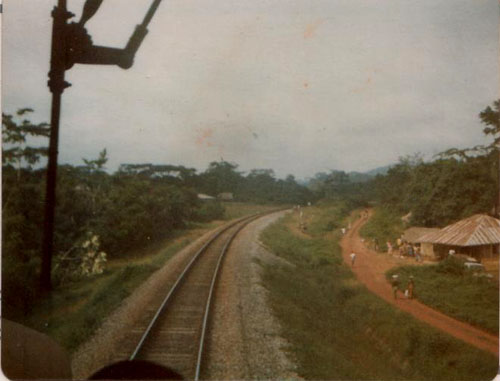
The cars were always slightly overloaded so Pete and I have to completely change our way of driving this train to get safely to Buchanan. He would be powering much further over the hills, so would I to keep the momentum going. Well I must say that all the way to Buchanan we did not get one snatch. One thing that did cross our minds was the possibility of a burst pipe or stowaways, both trains were piped separately, only joined by the coupling, one brake application on either train would have been a disaster. On approach to the yard he started dynamic braking and we detached, slowing down he went down one road, the switches were reset and I went down the road next to him, job well done.
March 1984, another trip down to Buchanan, Mick was working train 11 down, normal train 90 cars, Going down Kitoma steepest grade on line, Mick's trainman said he saw somebody on track, the line hereabouts is going round curves so your headlight is not always shining straight in front of you. Mick sounds the horn and notices somebody out of the corner of his eye, he thinks he's ran over them. He immediately informs the dispatcher. The regulations at this time for this type of occurrence were to inform the dispatcher and keep going, which Mick had done, the train carries on to Buchanan. I am working train 18 back empty cars and supplies. My wife is with me on the locomotive, she had been down to Buchanan for a scan, to detect a stomach ulcer. The dispatcher told us to check for a body on the line in the vicinity of Kitoma, can't remember the actual km? As we climb the grade at Kitoma its almost dawn I see a man sitting by track with his back to line, my trainman Jessie Dahn approaches and says that the man is wounded, he has severe leg injuries.
I radio the dispatcher to report what Jessie had told me. My train is put on the passing track at Saniquelle. I am told a trolley is on the way down. The trolley eventually passes me and returns eastbound having picked up the injured man, I then follow the trolley to Nimba. On reaching Nimba and having detached from train in the yard, we set back to the workshops and pass the trolley, the man was being put into an ambulance. After this incident Mick and the dispatcher did not have their contracts renewed. Nobody could understand why. Not long after this incident Alex Cowie had some trouble with the railbus, yet again his contract was not renewed, sad episode.
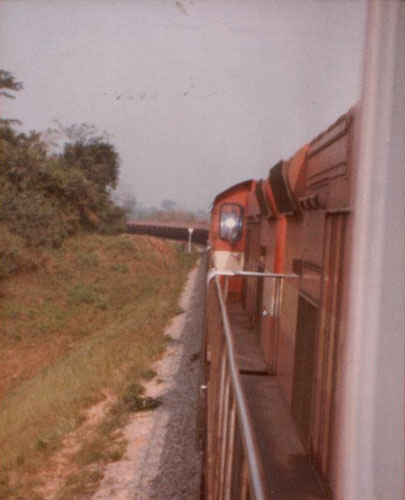
The railbus was now getting harder to keep running, the fitter doing his best to keep it going, very rare to arrive back in Nimba with all the engines ticking over.
March 1984, I ended up working the last scheduled railbus from Buchanan to Nimba, well almost! We leave Buchanan on time but already we only have three of the four engines working. (The two railcars working the train are each equipped with two engines, 150hp 6cyl horizontal B.U.T. (A.E.C.) models, the transmission is mechanical and the total empty weight of the train is about 78 tons.) I did not see the engineman who had brought it down so I'm not able to find out how well the railbus had run on its trip from Nimba. So off we go running alright on the three engines. On passing Gaye Peter Town we lose another engine leading to a big reduction in speed, but we keep plodding on. At Blezi we wait in the passing track for a train to pass, I try and start the bad engine but no luck. Off we go again averaging about 40km hour, by now we've past Yila and losing a great deal of time. Now the priority is just to get the railbus back to Nimba. Approaching Tropoi another engine goes out, now there is no chance of going forward. We stop in Tropoi and try to start the engine, the one good engine can at least provide lights etc.
Since Gaye Peter Town the dispatcher has been continually updated on our faltering progress. He advises that train 14 was not so far behind me, his plan was to have this train come against me on the main track and push the railbus to Nimba. I heard train 14 approaching Tropoi, Bobby Grant, my old instructor is in charge. He must have got a shock when the dispatcher told him to pass the signal at stop and enter the main track to come up behind the railbus to attach. All went well with the planned manouevre and off we go, he pushes us to Nimba and spots the train in the railbus station. The railbus is then detached and his train is pushed back onto an empty road, then the locomotives go off to the depot.
We meet a short while later in the tower. He said that's one job I thought I would never have to do, meanwhile I make my report out and both crews go home. Most of us loved the railbus, and of course the link it provided to Buchanan for the local people to sell their goods etc. With the railbus service now discontinued the number of stowaways increased from that date forward. However we still maintained a set for special workings.
We return to the United Kingdom during June, an A310 to Gatwick - my wife was scheduled for an operation to deal with a stomach ulcer. My return south is on a British Caledonian A310.
During June & July two new drivers arrive: Colin Kasher ex-Worksop and Ken Stephenson ex-Toton. They soon settle in as the other Toton men look after them making it easier for them to get to know everybody.
Later that year going down the line with train 11, somewhere around Blezi a fruit bat landed on the nose of the locomotive, you would always see the bats darting through the headlight beam catching moths and bugs. This one was hanging on, to this day it rates as one of the most beautiful sights I ever saw. It was golden brown, quite big, the eyes were blinking in the light, it must have been only two foot away from me. The trainman wanted to go and get it, I told him no, leave it. We must have gone 2 or 3 km before it began to slide off, I watched it go, and it flew off into the night just before hitting ground.
Towards the end of year we have the first two Liberians taking up the position of engineman - George Duwana and Emanuel Topka, both good lads. George came from Loffa county a long distance away. The Tropoi job for years had been worked by a Spanish foreman who had never been a locomotive driver. He had been with the company for over twenty years and under the Swedes had been allowed to do this job. I was sent with George Duwana to work this job, you would attach to the ten or twelve log cars, take them down to Tropoi, arriving on the passing track. Here we take local operation meaning the dispatcher would give you control, and you could work the switches in that station manually. There were black boxes by each switch, you would open the box with your key, and push buttons in the box to move the switches.
Having arrived on the passing track you would push back into the sidings, two roads to spot cars. On this occasion Pedro was acting foreman, over the last few years he'd been taken off the driving part of job, I did not know why, but I found out later that day. Logs were on the ground, including some really big ones, a mechanical loader would pick logs up and place on the cars. The foreman would be checking what company brought the logs in and which cars they were loaded on. We would be standing around watching the log trucks coming and going, some were rough looking vehicles.
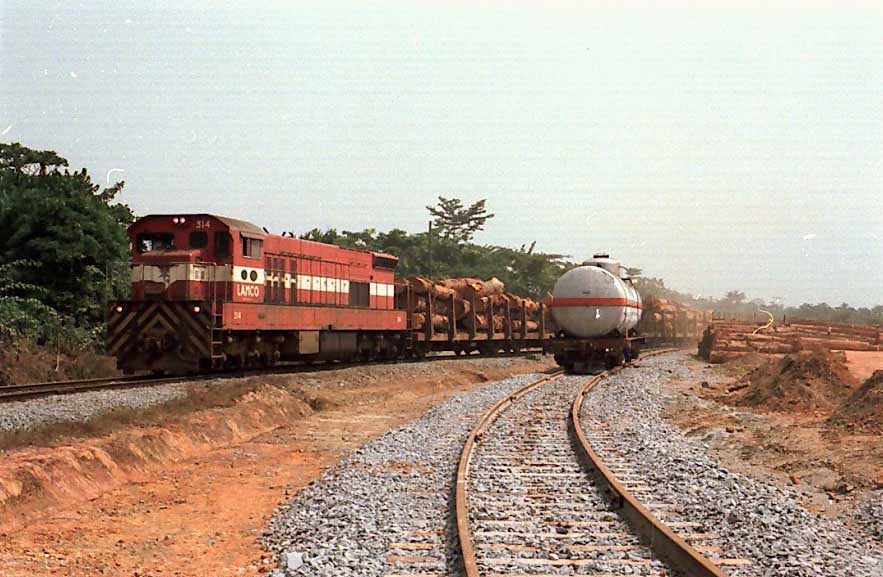
If the loading went well the dispatcher would allow you to return to Kitoma and put the logs behind train 15 there, or if not wait at Tropoi and attach there. On this particular day we had finished our loading and switching, so we set off for Kitoma. George was driving, Pedro was on the locomotive, I was keeping an eye on George, then I noticed Pedro touching the locomotive controls while George was driving. I told Pedro to leave the controls alone, George is the driver. We were approaching a work gang with a 20km speed restriction. George was using the train brake as I had instructed, then Pedro told him to use locomotive brake only. Pedro said to George its easier. I stood up and went over to Pedro, who was an intimidating character, and advised that any more interference with the operation of the train would result in him leaving the cab! I now realised that when Pedro had operated the Tropoi switching job he had never used the train brake, seriously shortening the life of the brake blocks on the switcher. I tried to explain to him the cost involved in replacing locomotive brakes, while the log car brakes were not being used, plus the overheating of blocks on the locomotive was also a fire hazard.
He never said a word. I honestly think he could not work the train with the train brake. Which with the 90 car trains some drivers had problems with the train brake, one pipe for 90 cars. Too much brake and the train would come to a stand. The running brake pressure was set at 5.2 bar, not many drivers would use the overcharge, I found the Knorr brake system inferior to the American one. On the GM locomotives the overcharge valve had a plate fitted over it, I would unscrew the plate and use the valve to release the brakes quicker, as long as after using this you brought your brake pipe pressure down to running pressure there would be no problems.
By this time the wife had returned from her post-operative recuperation, some of the women were friendly with John Pavolas' wife, she had a young daughter at International School. She invited them to her house to see their leopard, which had been found on a mountain, she also has a potto, a nocturnal small bush baby like animal, all the kids loved seeing the leopard playing around in the garden, the potto also bit her finger. Talking about bites, one of the managers was bitten by a rabid dog, they killed the dog, cut its head off, then the manager and the dog's head were flown to Sweden, where he was treated.
One driver I have not mentioned so far was Malcolm Jones, ex Kenya EAR man, he was in his fifties and seemed to be of Anglo Indian extraction. He was always puffing a pipe, when you opened the door at Yellow Camp, before entering you knew Malcolm was there. He would be sitting at a table, puffing away and drinking a bottle of Barton and Guestier wine, he spoke very eloquently. He did look like your traditional colonist. He had a plane at Buchanan, one day he took me to see it, a small light aircraft and I was praying he would not ask me to go up in it, thank goodness he did not!
One more driver arrives, F Holt ex-Worksop, then we are up to Christmas and the New Year.
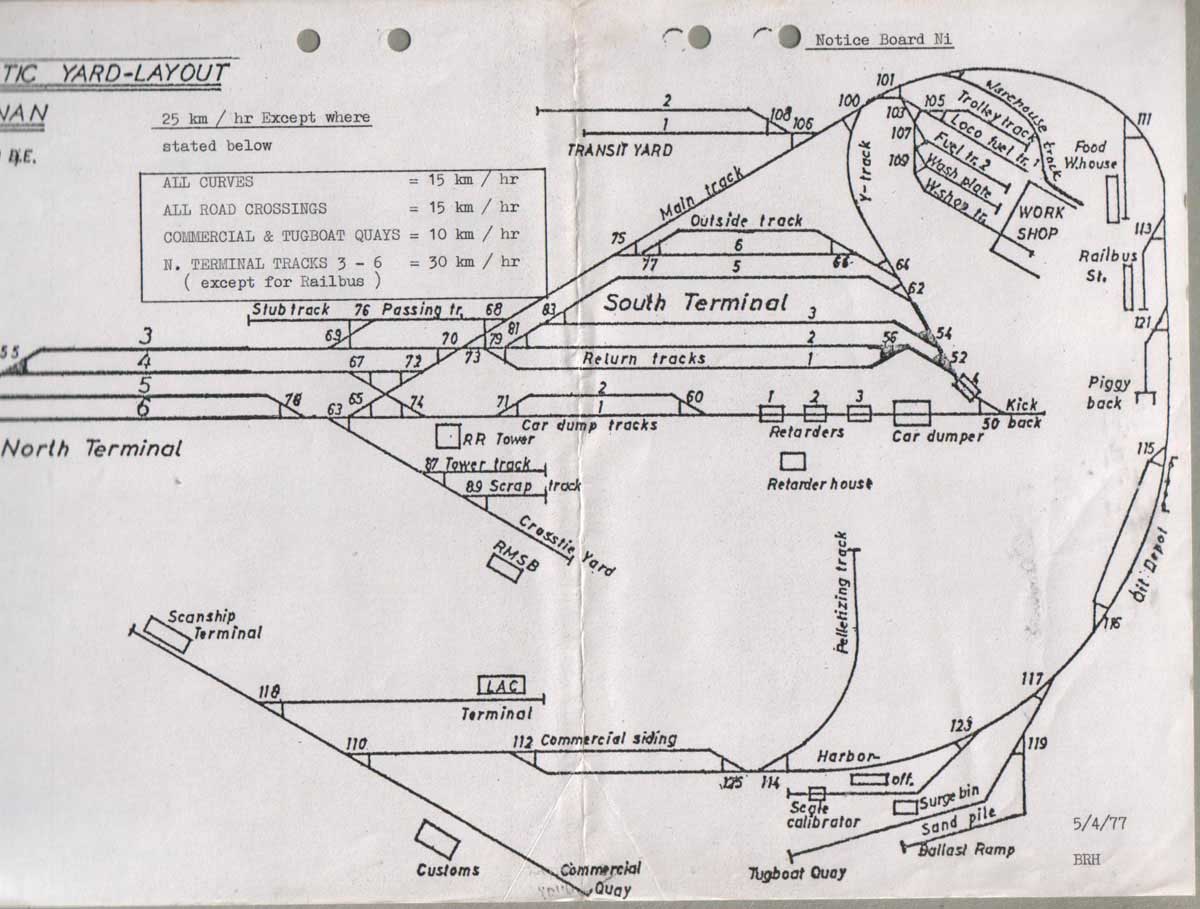 |
A map of the facilities at Buchanan. Centralised Traffic Control (CTC) operated from Nimba (260km post) to the Buchanan reception sidings (4km post). The Buchanan Yard and Harbour branch featured hand-operated points, except for the departure end of the reception sidings. |
1985
At some point Roy Wort leaves. Other activities available to us include the go kart club and the skeet shooting club. Go Karting happens once a month, a good day out with plenty of excitement. At Buchanan a yard man asked if I want to go out fishing, he tells me they catch all kinds of strange fish, I turn that one down. Dave Lewis the locomotive fitter is sent down to Buchanan to assist with an engine overhaul on one of the tugs, he says the heat in the engine room is unbearable.
Early in the year I have my second fatality, approaching Tropi, train 21, a guy asleep on track, I sound the horn and make a brake application and inform the dispatcher. By the time I come to a stand I reckon I'm ten cars past him, the dispatcher says the trainman must go back to check the body. I knew he was dead, he had not moved. The trainman gets the radio and flashlight, off he goes reluctantly. He's back in two minutes and confirms the guy is dead. I sit him down, the reality of what has happened sinks in, he's frightened, he agrees. So I told the dispatcher I was leaving the locomotive, and return to the location of the body, which is not a pretty sight having suffered severe trauma. Back on the locomotive I report to the dispatcher who tells me to proceed with the train. There was a work gang camping near by, they were given the unpleasant of removing the body.
I always followed the instructions for taking the anti-malaria tablets - avloclor, two a week, even when I was away from Liberia I never missed. And I never got malaria. My wife was prescribed a different tablet, the avloclor gave her double vision, unfortunately she also got malaria. Ron and Pete both had bad bouts of malaria, along with plenty of other ex-pats. Thank goodness it was not the recurring type.
Unlike the locomotives working on British Railways, those working for LAMCO had solid wheels, no tyres so flat spots were a big problem. If a locomotive was found to have severe flat spots the workshop would fit special heavy duty brake blocks. Alex the head of the workshops would take the locomotive into the yard and find an empty track. Then he would run the locomotive up and down the yard with frequent braking to wear down the wheels until the flat spots had gone. The moment I discovered flat spots on any consist, I would log it in the locomotive repair book and notify the dispatcher, the problem seemed more prevalent on the HG locomotives.
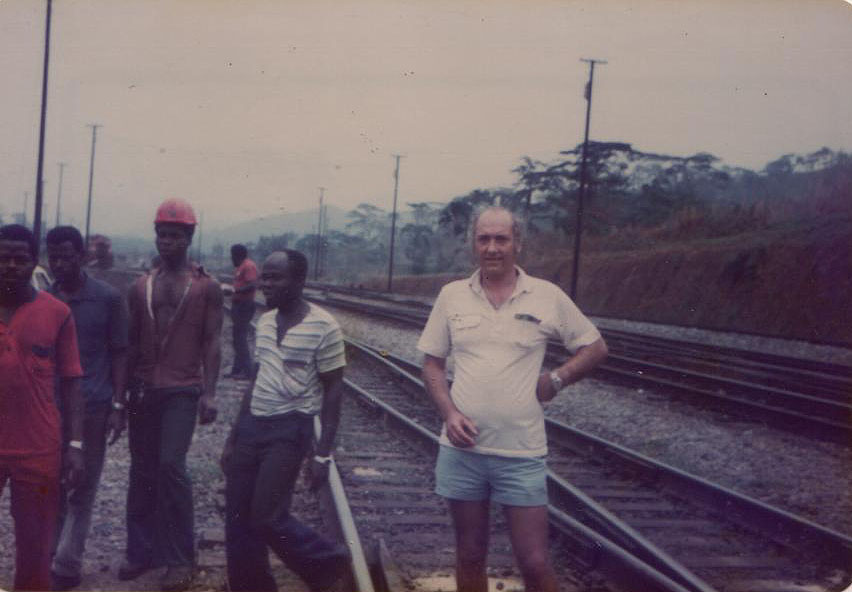
1985 saw quite a few redundancies, mainly of the warehouse people, vehicle workshops and administration, to be quite honest some of them were lucky to have kept their jobs for as long as they had. This resulted in housing changes. Ron now lived by me, I had moved across the road to a two bedroom bungalow, same style. Late one night the phone rang, it was a very distraught Ron, apparently he thought his German Shephard 'Sheba' had been bitten by a snake and was dying. I hurried over, Sheba, who had been with Ron for seven years, was frothing at the mouth, and died shortly thereafter. The incident should have been reported to the authorities. But Ron said no way, he wanted to bury her in the garden. By now its 2am and we set about digging a hole, we had a shovel and a pick. We wrapped her up in plastic bags, and took her to the spot he had chosen. Immediately there was a problem, the high iron content of the ground made the digging not only extremely tough going, but also very noisy. Very soon Malcolm Jones pops his head over the bushes, and asked the obvious question of what were we doing at this unearthly hour! He gave us a fright. We explained what was going on, he offered his condolences to Ron and then we got back to the digging, which took about two hours to complete, at sometime around 4am.
On a trip down to Buchanan Lanyama Williams was my trainman, he was the next to be selected for driving. It was an afternoon job and we'd just passed Yila when there was a bang from his side of loco, with black smoke streaming out from the engine. Before I could do anything he had pulled the fire extinguisher switch, but nothing had happened, the fire bottles had not activated. I shut down the leading locomotive, started coasting and then went back to check the problem. An engine inspection cover had blown off, it was a simple matter to retrieve it and screw it back into place. Then it was back to Lanyama to remind him not to panic when the unexpected happens, let the engineman make the decisions. I told him if the fire extinguisher had activated then the locomotive would require a visit to the workshops for a few days. At the same time I was thinking if there had been a real fire we would have had a problem. Next time we stopped I phoned Alex in the workshop and told him personally.
Another night trip down to Buchanan found us almost at the end of the run when I saw what I thought was a man along side the line, getting closer we realised it was a giant porcupine. Unfortunately we hit the animal and notified the dispatcher of the location, I knew Emanual Topka was on train behind me. Waking up the next morning, the driver who had come to pick me up said the boys are cooking bush meat, I went across to to their kitchen, there was a big pot on the stove with a porcupine in the pot. I noticed what big teeth it had, the quills were all over the place, I picked some up and I still have them to this day.
During 1985 a group of Liberians made an unsuccessful attempt to oust Doe and his group. A curfew was put in place during this episode, gunshots could be heard one night in our area. We were given protection by soldiers. On the way to work the next morning there were bodies on the ground outside the police station with soldiers standing around. Since the export of iron ore provided the Liberian government with 50% of its export earnings it should come as no surprise that government forces would be used to protect this industry. It was also at this time that a new Liberian $5 coin was minted and these were to be used to meet the company's payroll. Small American coins were still in use, but no US dollar notes.
During the time of this attempted uprising one day I was waiting to depart Buchanan and was told to wait for the soldiers. Two big trucks pulled up alongside the locomotives, the soldiers jumped from the trucks and the yard foreman drove up in the brake testers pick up. I was told the payroll would be carried in the locomotive cabs and accompanied by four armed soldiers all the way to Nimba. The five dollar coins were in really heavy big bags, I was busy counting the bags along side the train. With three locomotives there was enough seats for the train crew and soldiers. Firstly the rear locomotive cab was filled up, then onto the middle locomotive, then to the lead locomotive, this cab was almost full but with some room to move around cab. Then the soldiers board, they all have automatic weapons, one joins me in the lead cab, it seems a comical episode, I would love to have known how much cash we were carrying.
Off we go, our train has been given priority on the line. The soldier in my cab did not say much, his gun was resting within arms reach of me. By the time we passed the first station on the line, Mokra town, my soldier was fast asleep. Throughout the journey my trainman would pop his head into the cab, he said all the other soldiers were asleep too. Further up the line I picked the gun up, I'd never held one before, it was lighter than I expected, I was pretending to shoot things from the locomotive. Then I was thinking I could throw a bag of money off the train into the bush and collect it later. How the mind wanders when given the chance! The trip went well, I was glad to get home earlier with a non stop run.
My Volkswagen beetle was still going strong after five years of my ownership. A guy from Guinea would go around the community repairing peoples cars. He seems a good mechanic, if your car needed a part he would make it. Without him many of the cars would have long ago been abandoned.
Around this time our railroad superintendent and trackmaster were two youngish guys from Leeds, Brian Forster and Wayne Peacock. One of the first jobs they took on was finishing the departure road at Tokadeh. Originally after loading here, the train with 60 cars had to be pushed back out to the main track. They added the new track from beyond the ore bins to lead straight out onto the main track, eliminating the need to push out. Now you could run straight into Tokadeh, load the train and depart straight out, saving a great deal of time with switching etc.
We did run some trains from Tokadeh which was 18km from Nimba, 60 car trains were run from here, the mine produced a different grade ore from Mount Tokadeh, like brown earth. You had to load your own train there.
They also ordered rail/road vehicles, so they could take the vehicle off track when a train approached, causing less delay than the normal trollies. So money was being put into the railroad at this time. The French Canadian consortium were in talks with the Guinea government to extend the LAMCO line a further 8 km across the border into Guinea, and transport their iron ore out to Buchanan. Whilst there was a chance of this coming to fruition, the Guinea authorities were looking for their people to have a far greater role in all of the mine/railroad activities. Possibly this may have been a stumbling block for this plan?
The first driver arrives from Knottingley.
Our June 1985 vacation was perhaps not as strenuous as previous ones. From Monrovia to Gatwick we had a British Caledonian A310, followed by an Air Europe B737 from Gatwick to Faro, with one week in Portugal touring the sights including Lisbon, Lagos, Portamaio & Alberfura. Then its back to Gatwick on another Air Europe B737. A car is hired for five weeks, paid for with MCOS. When its over an A310 takes us back to Monrovia.
Late in 1984 there was trouble at home, our house boy had became complacent, things were going missing and some days he didn't turn up, I had warned him. He came to me around this time asking for money for hospital bills to cover his wife's confinement. I went to the hospital with him, paid the money and then drove him home with the new baby. They lived in a hut in Camp 4 which was just outside the concession area, the camp being left over from the days of the railroad builders. It was dark when I dropped them off, they stepped out of the car with the baby and I followed them into the hut, I could barely see anything it was so dark. So I gave him another chance. But by 1985 the trouble started again, stealing etc, time for him to go. It wasn't easy in sacking the house boy, paid him off with 100 dollars, he signed for that sum at the community center. How much he would have got is anyone's guess. A new boy is recommended, Cooper, who turned out to very good. It was however not quite the end of the other boy yet. He came by our house one day with another boy who walked half way up to the front door, only to get bitten by Frisky the dog! The small bite mark on the leg broke the skin. Then I'm sued and had to visit the Area P courthouse taking my new house boy as a witness. By this time the boy's leg has a big gash, he'd been picking the wound to make it appear worse. The fine was 10 dollars, I was quite happy with this decision, some expats had paid up to 500 dollar fines for similar issues.
The biggest derailment LAMCO had seen happened about this time, some of these dates and the time of the derailment are a little fuzzy in my memory. Peter Fletcher was working down to Buchanan, I think train 17 with 90 cars. I spoke to his trainman at a later date, and he said the brakes went on and the train came to a stand, Peter told his trainman, Jesse Dahn to go back and check the train. He does this and radio's back to Peter to advise some of the train is missing. Peter notifies the dispatcher he is going back to check. When he gets to the rear Jesse advises the rest of the train is derailed around the curve, they walk back a bit further and find the devastation. Cars are strewn all over the place, heaps of iron ore line the sides of the track, the line is completely blocked, no further progress can be made. I don't know exactly how many cars derailed, maybe 30 or more, I think the location was south of Bakohn. There were no trains for at least a week, regretably Peter is finished after this incident. I remember the crane going down to assist in clearing the wreckage, the railbus was taking crews down, with hoards of men shoveling. Possibly I was back in the UK when this happened and returned to Nimba prior to the line reopening?
More wildlife is seen from the train, my first sighting of a Giant Ant Eater, whilst waiting to depart Buchanan it walked across the track at the top of the yard, it was just getting dark, quite a big animal. We also see what looked like a Monitor Lizard north of Tropoi, bounding along the track, then straight off into the bush. However I was getting a little weary of running over the goats, maybe one or two a week.
More time is now spent at the golf club, the social weekends are brilliant, I start to change my turns of duty to attend these social events. One afternoon whilst playing golf with Ron we see some young kids playing with an African grey parrot, its flying around tied to a wire, like a toy. We give them a dollar and they let the bird go.
At Green Hill quarry, just beyond Yila we take empty stone cars, run round and then back them up to the loading ramp, and start loading the stone. One Swedish guy stays there regular, he's in charge of blasting in the quarry, its a lonely job. The company also make there own ties just outside of Nimba, quays for loading ties, ovens for heating ties, and creosote for soaking, all self sufficient.
About this time (late 1985), a Dutch company are given the job of rewiring the locomotives, four Dutch guys are sent over to start the work which is expected to take a year at least. We were getting more ground relays, leading up to this time.
Christmas 1985 and the New Year came around, visitors this year include the sister in law who came out with our daughter, big parties, her sister said she had never seen so much booze. One night there was a party next door to us, but the wife's sister said she was having an early night, we said OK please yourself. When asked where she was, in bed we said, so about six of the lads went round to our place and carried the bed, with wife's sister still in it out on to the veranda. Fortunately all was taken in good fun and she joined party.
1985 or maybe 1986 not sure, ALICO was not performing well with our investments, it stayed at 10% to long. So the company changed to AETNA, This is what they told us, we had no say in matter anyway.
Part One - The Steam Years 1960 - 1968
Part Two - The Diesel/Electric Years 1968 - 1980 & 1989 - ?
Page added December 6th 2008
Last updated December 10th 2017